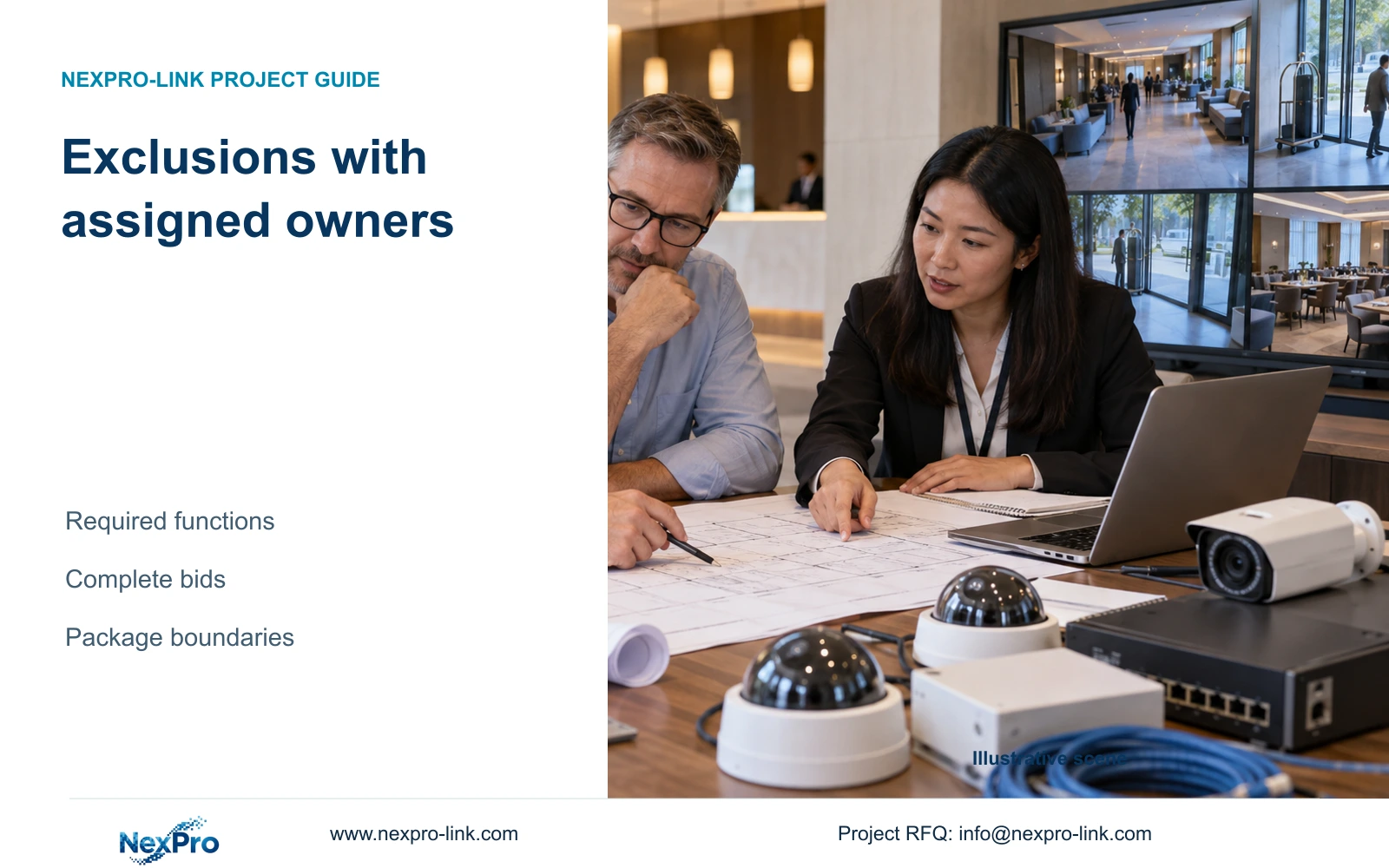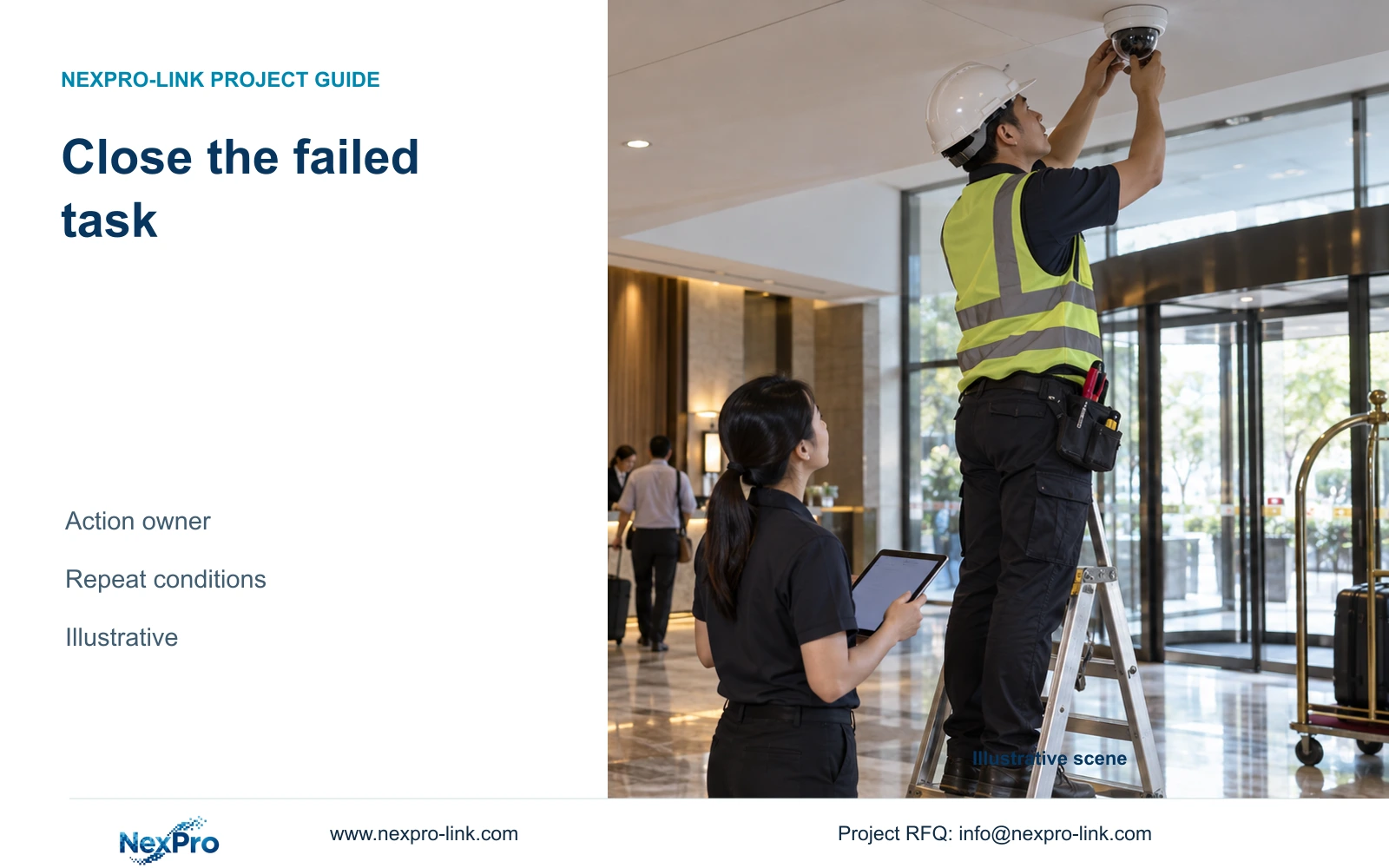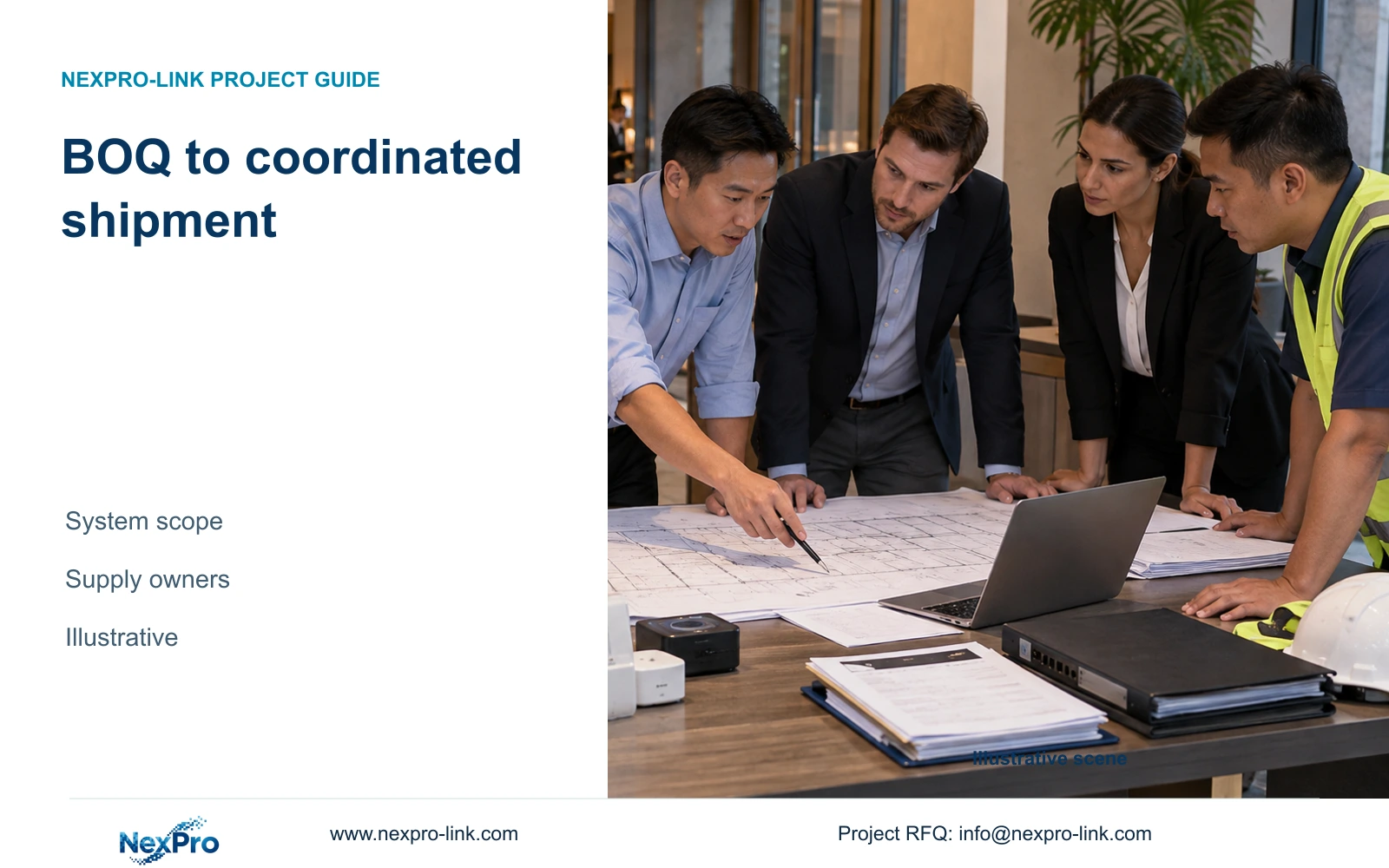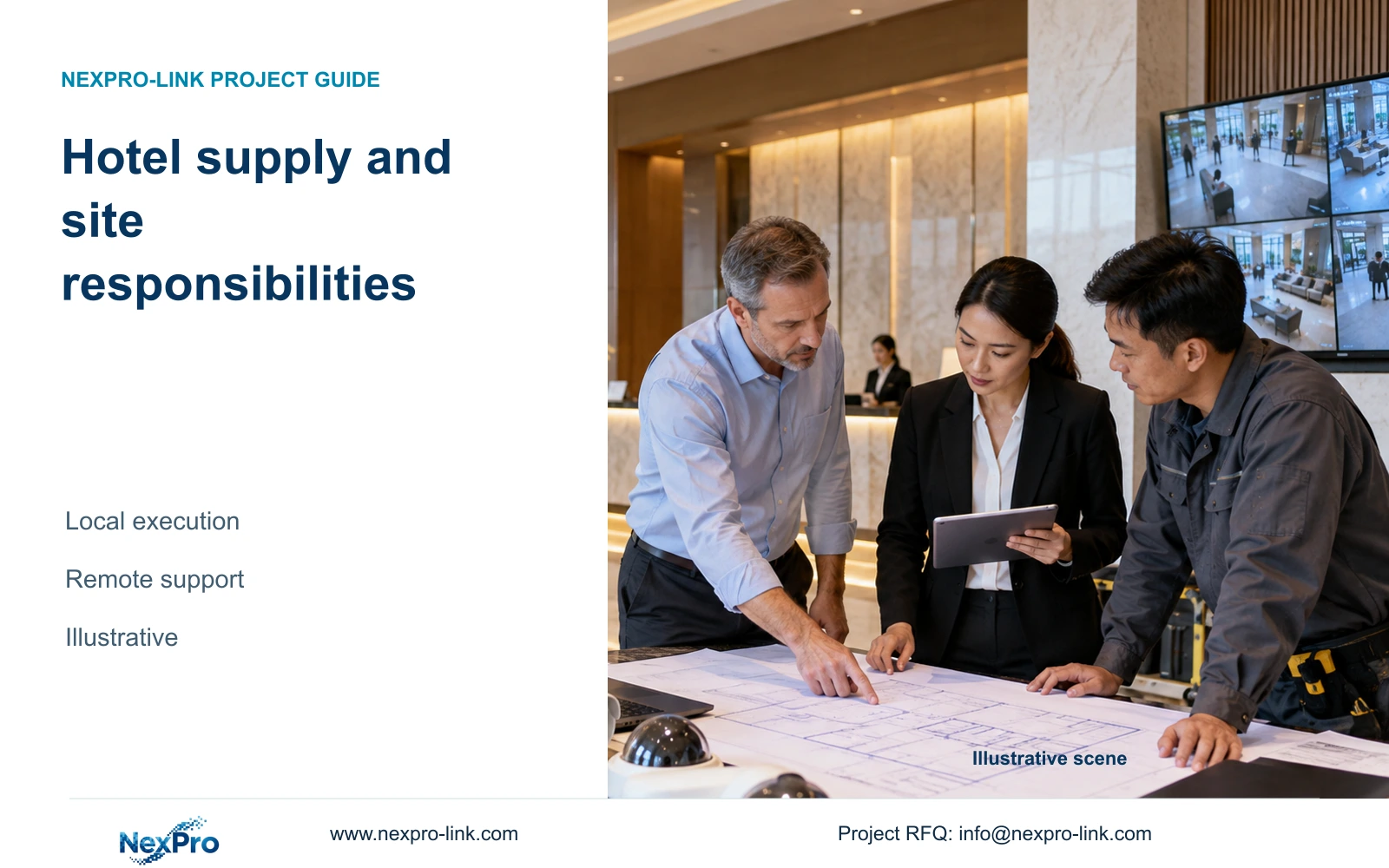
Assign overseas equipment support and local site work before ordering. A clear responsibility schedule keeps recording, commissioning and fault response covered.
Section 01
Assign every opening-critical delivery task
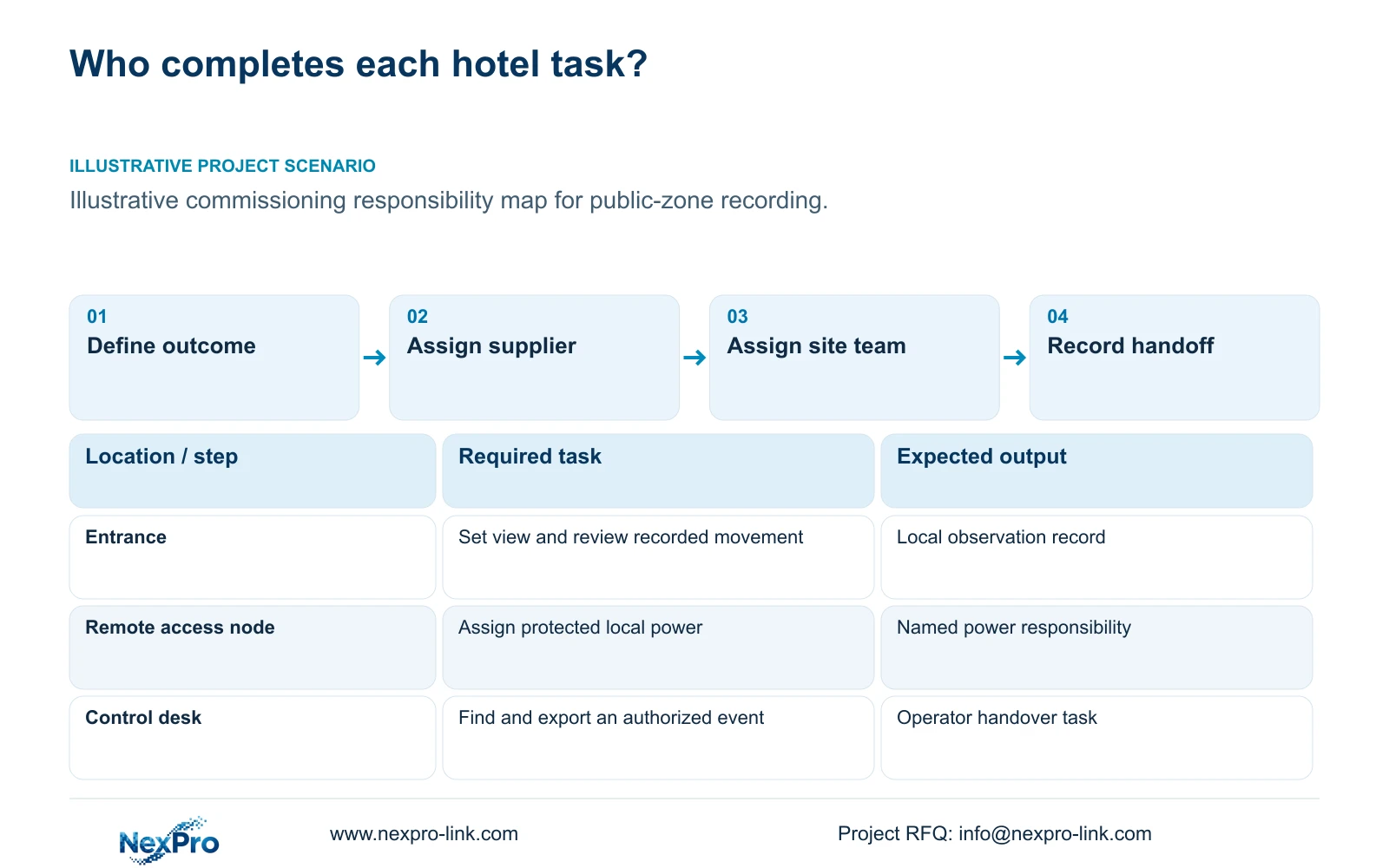
Choose an overseas equipment package only when a named local party can install, commission and respond to the required system. Assign remote model matching, configuration guidance and technical documents to the supplier, and site construction and physical testing to the local contractor. If either side leaves a recording dependency unassigned, close that gap before ordering.
Work backwards from the hotel functions required at opening. Entrance recording, incident retrieval and the agreed outage state each depend on several completed tasks. Equipment arrival does not establish that cameras have usable views, disks are configured or authorized staff can export footage. Record those outcomes separately from shipment milestones.
Technical approval and packing artwork may proceed together when they use stable inputs. Preparation follows the necessary approvals; installation also depends on accessible ceilings, ready cabinets and available site power. Use the controlling dependency when coordinating these activities. An indicative programme should identify who supplies each input without presenting assumed durations as a delivery commitment.
| Required task | Given information | Decision still needed |
|---|---|---|
| Record public entrances | Camera schedule and retention target | Who sets views and verifies recorded detail |
| Continue recording during outage | Requested backup state | Who protects and tests every active node |
| Retrieve an incident | Operator access requirement | Who configures roles and demonstrates export |
Section 02
Separate equipment preparation from local execution
Give the overseas supplier the approved camera schedule and request a matching BOM, stated assumptions and equipment interface information. NexPro-Link can discuss CCTV model matching, coordinated supporting equipment and BOQ documentation. Its CCTV manufacturing core and coordination of other categories should remain distinguishable in the proposal.
The local installer should confirm mounting arrangements, installed cable routes, cabinet access and site connections within its contracted competence. Hotel IT should control network addressing and authorized access. Electrical installation and applicable safety arrangements belong with the appropriate local professionals. Naming these roles prevents remote guidance from being interpreted as responsibility for physical work.
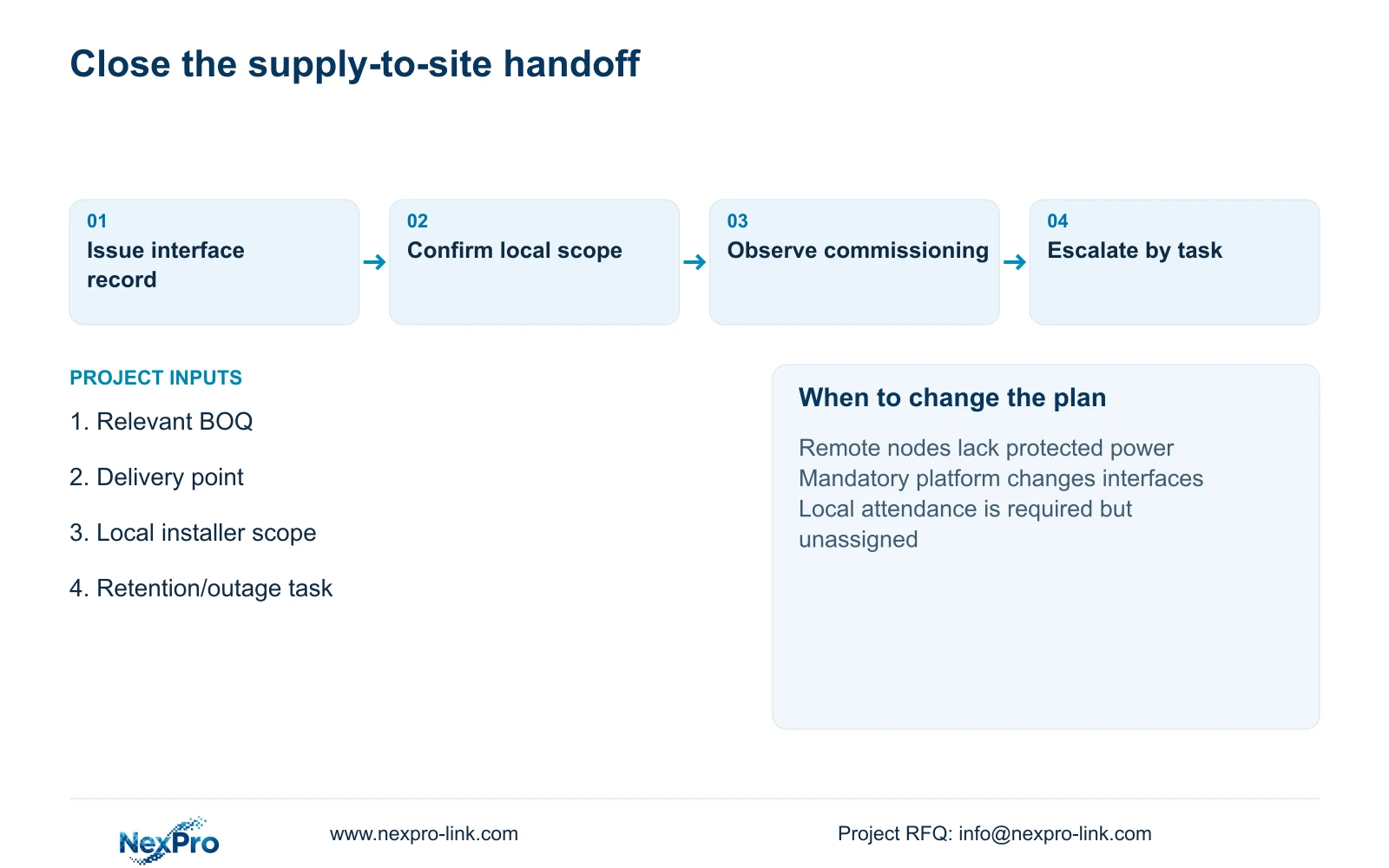
Use one interface record across the teams. A proposed recorder needs compatible recording modes and disks; an access switch needs a supported port type and sufficient output budget. The supplier provides the selected equipment information, while the site team confirms the installed conditions. Changes to camera groups must reach both parties because they affect storage, networking and protected power.
| Interface | Supplier input to confirm | Local/approving party to name |
|---|---|---|
| Equipment identity | Exact supported models, accessories and scope deviations | Who approves substitutions and reconciles delivered items? |
| Site installation | Documentation and bounded technical assistance | Installer owns authorized mounting, routes and site observations |
| Network and access | Configuration needs and supported workflow | Hotel IT authorizes network permissions and access |
| Power and protection | Actual configuration and required load inputs | Qualified local professional verifies electrical conditions |
| Acceptance | Supported task, version and evidence needed | Authorized party observes/retests the installed task |
| Issue escalation | Warranty/RMA and support scope under controlling terms | Who preserves records, performs local work and signs closure? |
Section 03
Map the recording and power interfaces
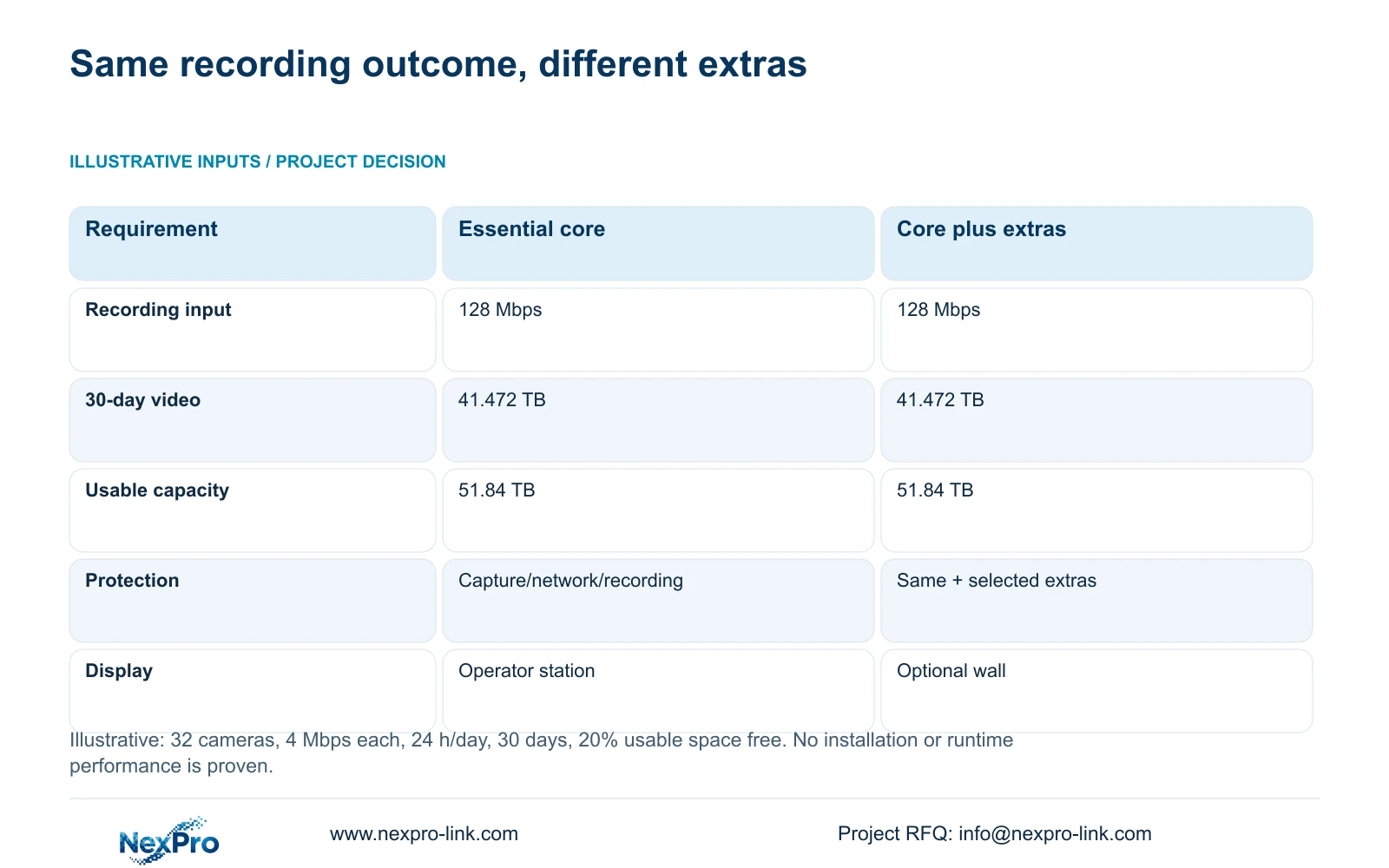
For an illustrative 32-camera scope, assume an average recording bitrate of 4 Mbps per camera, continuous recording and 30 days of retention. These are planning inputs, not camera specifications or a legal retention rule. Aggregate input is 32 × 4 = 128 Mbps. Video volume in decimal TB is 0.0108 × 32 × 4 × 30 = 41.472 TB.
Retaining 20% of usable space free requires 41.472 ÷ 0.80 = 51.84 TB of usable capacity. The supplier must identify a supported disk arrangement; the installer must establish the actual formatted capacity and recording configuration. Raw disk capacity cannot be substituted for usable capacity in the acceptance record.
Draw data and protected-power paths separately. Cameras feed the access network and recorder; a viewing client branches from that path. The display is not a recording dependency. A remote switch connected by fiber still requires local power and, where continued recording is required, appropriate backup. Calculate each switch group and each protection zone independently.
| Metric or condition | Essential recording-first package | Same core plus display/recovery scope |
|---|---|---|
| Recording input | 128 Mbps | 128 Mbps |
| 30-day video data | 41.472 TB | 41.472 TB |
| Required usable capacity | 51.84 TB | 51.84 TB |
| Protected path | Cameras + network + recording | Same plus explicitly selected extras |
| Operator display | Task-sized monitor/workstation | Optional wall; independent recording |
| Cost comparison | Complete scope quotation required | Documented incremental scope only |
Section 04
Compare support against the retained operating outcome
Both equipment options retain the same recording requirement. Buying a display upgrade does not reduce the 51.84 TB usable-capacity target. Compare supply-only and supported service offers against that unchanged outcome, then price configuration assistance, documentation and operator handover separately. The equipment comparison and the service comparison are different decisions.
NexPro-NVR4449-4K is a candidate with published 49-channel, 320 Mbps input and four-SATA fields, including an 18 TB per-disk field. Its summary lists 49 × 5MP and 9 × 4K modes; channel count does not establish arbitrary 8MP recording or a particular RAID level. Ask the supplier to state the exact selected mode and disk arrangement.
NexPro SW-POE1618G remains an inquiry candidate because its source has inconsistent access-port speed descriptions and no numerical total PoE budget. Support should expose that unresolved selection condition. Likewise, an optional NX-VP-5535 installation concerns a 55-inch Full HD LCD panel, not direct-view LED. Actual decoding, mounting and power requirements need their own scope.
Section 05
Set the commissioning escalation path
When a commissioning task fails, the local team should record the affected camera or device, selected configuration and observed symptom. Separate a missing network path from a recording-mode problem before requesting remote assistance. Use approved support access and avoid putting passwords or guest footage into general project correspondence.
Agree who can change settings, who can authorize replacement and who repeats the affected test. A restored live image does not close an incident-retrieval failure until the relevant footage can be replayed and exported. The hotel should receive operating instructions for its actual software version and authorized roles.
Buy additional handover or refresh training when staff changes or revised equipment alter the workflow. Where the hotel already has competent operators and unchanged configurations, a focused update may be sufficient. No assumed training benefit should be presented as measured time savings.
| Retained outcome | Extra scope | Worth buying when | Counter-condition |
|---|---|---|---|
| Usable incident export | Operator rehearsal | Staff cannot complete the approved task | Existing operators demonstrate it successfully |
| Recording fault resolution | Agreed remote session | Equipment configuration needs assistance | Physical cable or power fault needs local repair |
Section 06
Present one coordinated service boundary
Recommend the essential recording-first package with written supplier and local responsibilities when one operator station meets the hotel's needs. Add display or recovery scope only for a defined operating task. Revise the arrangement if a mandatory platform, remote building or local response requirement introduces responsibilities that the original parties cannot cover.
Keep warranty handling separate from installation and attendance. The supplied policy record states a 24-month limited hardware baseline for applicable main equipment from receipt, subject to controlling written order terms. Batteries, disks, cable and OEM scope require their own treatment. Continuing technical support does not mean unlimited free repairs or local attendance.
Send info@nexpro-link.com the relevant BOQ, destination and delivery point, together with the local installer's proposed scope and the unresolved handoff. State the required retention and outage function if these affect equipment selection. Hotel project equipment support and BOQ and tender support provide existing routes for a scoped proposal.
Section 07
Buyer questions
Can remote commissioning proceed without hotel internet access? Separate local recording acceptance from remote assistance. Identify which checks the local team can perform offline and which support tasks require an approved connection. Confirm the selected device and client workflow before including remote commissioning in the programme.
Does one coordinated quotation include local installation? Only if the quotation explicitly includes that work and names the responsible party. Equipment coordination can simplify purchasing while local cabling, electrical work, mounting and response remain under separate contracts.
What should an unresolved fault report contain? Provide device identity, configuration version, affected task and observed symptom. State what the local installer has checked and what assistance is requested. Share sensitive logs or footage only through a hotel-approved route.
Engineering references
These sources support the general planning principles. Always use the selected product's current datasheet and applicable project standards for final design.