A kitchen entrance camera and a camera exposed to washdown have different selection requirements. Set the environmental boundary before comparing image specifications.
Section 01
Separate protected entrances from exposed positions
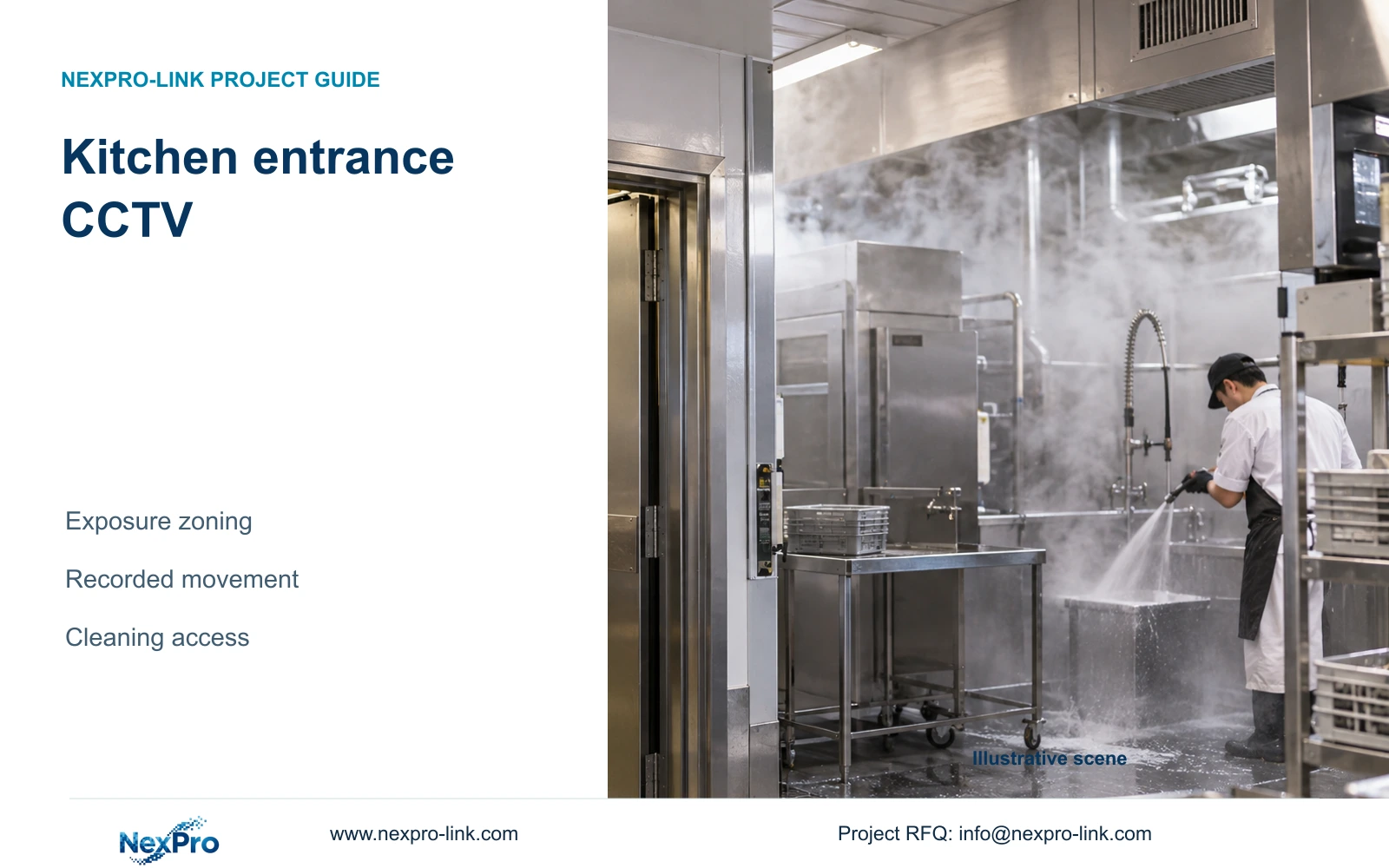
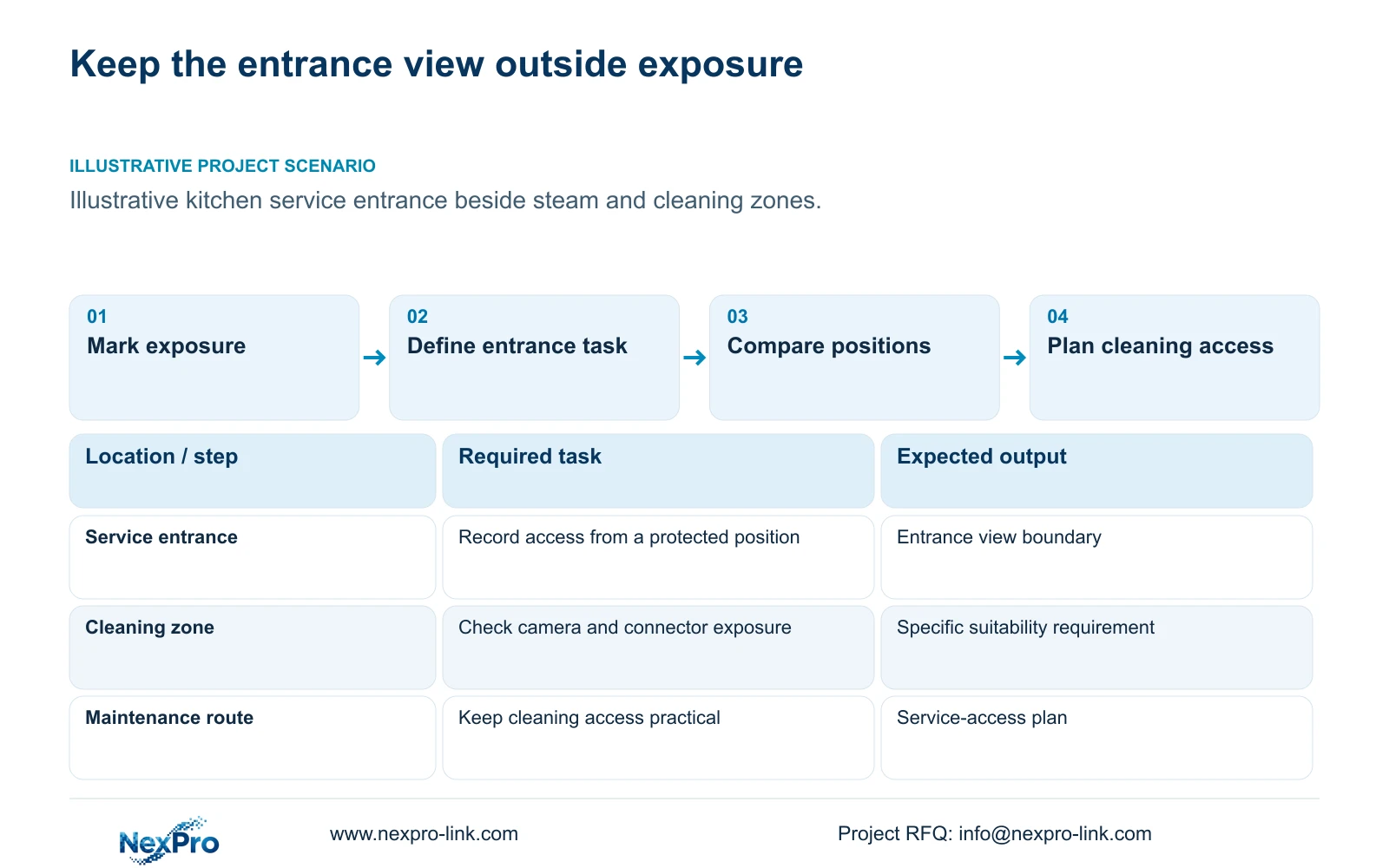
Choose a protected kitchen entrance or service-route position when it can record the required movement without direct steam, grease or cleaning exposure. Use an exposed position only when the exact equipment and installation conditions support that environment. An IP66 field does not establish suitability for every cleaning chemical or washdown procedure.
Mark cooking equipment, steam outlets and cleaning areas on the proposed layout. Include the camera mounting point and its connector location, since placing the body outside the direct cleaning zone does not automatically protect the termination. Record the actual cleaning method and materials as selection inputs, without substituting a general description such as 'commercial kitchen.'
Map the moving task alongside environmental exposure. Identify the route, direction and action that must remain interpretable, such as goods entering through a service door. Nominal frame rate and exposure blur describe different limits. A 25 fps specification cannot establish that each moving-subject frame will be clear under the entrance lighting.
| Required task | Given information | Decision still needed |
|---|---|---|
| Record entrance movement | Service door and route | Protected position with clear view |
| Cover an exposed transfer point | Cleaning and steam exposure | Documented equipment suitability |
| Maintain the image | Proposed mounting point | Safe cleaning and service access |
Section 02
Define the approved monitoring purpose
Write the purpose as a specific recorded task: review access through the kitchen entrance or establish the context of goods moving from the receiving route. Keep unrelated work areas outside the necessary view. Ordinary CCTV in this scope does not replace machine vision, food-process inspection or an employee performance system.
Define how the authorized operator will use the footage. A permanent overview may help locate an event, while replay at a larger window may be needed to review the transfer. The display layout should support that sequence. A high-resolution recorded stream does not retain full visible detail when reduced to a small overview tile.
Name the role allowed to search and the role allowed to export. If audio is available on a candidate, make its use a separate justified and authorized decision. The hotel's applicable requirements govern view boundaries, access and retention. Neither available storage nor a microphone in the hardware establishes a need to collect more information.
| Item | Entrance task | Broad work-area view | Effect on scope |
|---|---|---|---|
| Purpose | Access and goods movement | Additional activity captured | Additional justification required |
| Viewing | Overview with event replay | More continuous observation | Different operator task |
| Audio | Separate decision | Separate decision | Hardware capability is insufficient |
Section 03
Compare protected and exposed positions
Compare environmental suitability before ranking image quality. A sheltered view that records the entrance may avoid a direct exposure problem, although its angle still needs validation. If the task can only be seen from the washdown zone, request conditions specific to the equipment, mounting and connection arrangement. A clear demonstration image cannot establish chemical resistance.
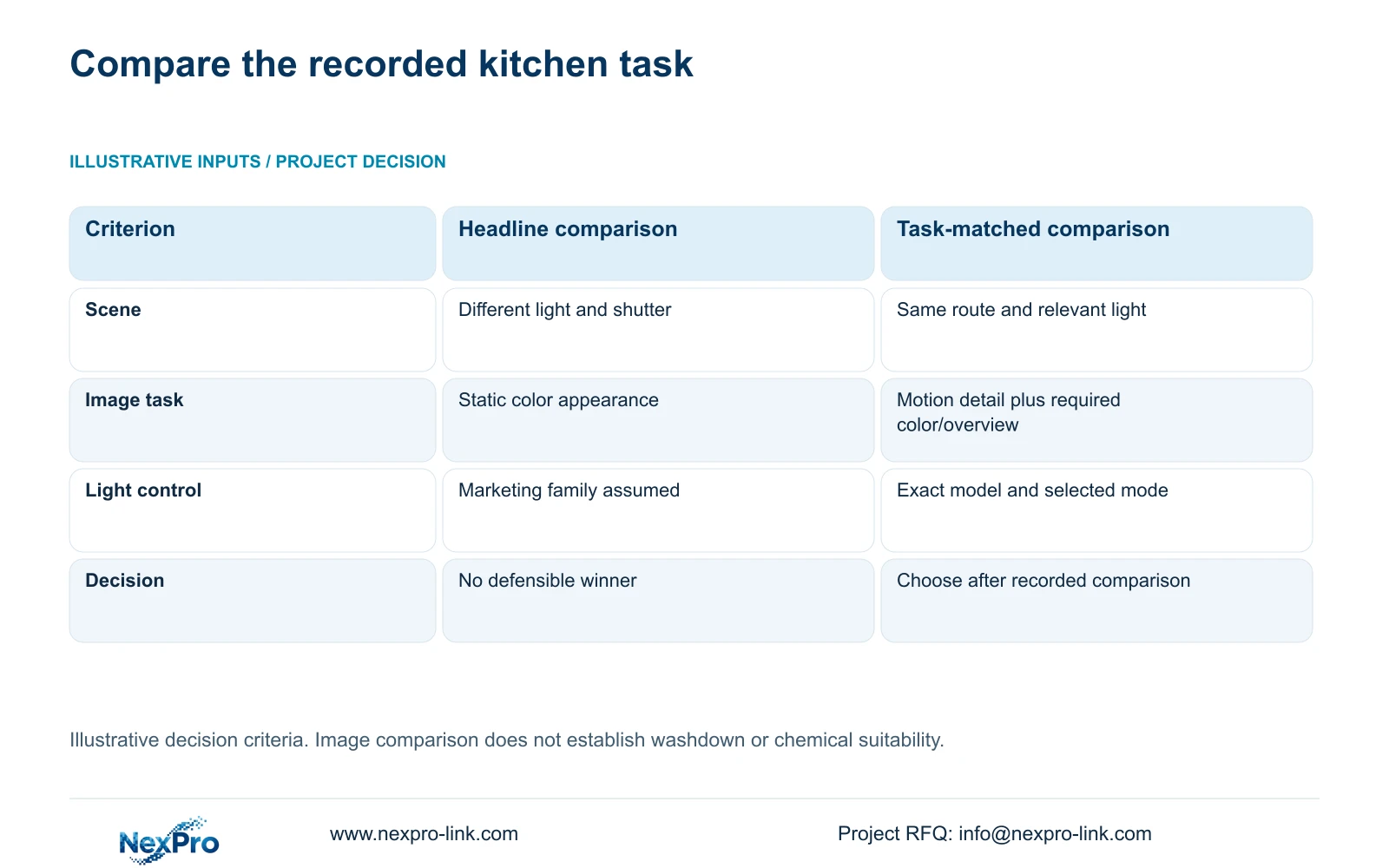
For lighting, use the source's task-matched comparison below. These are illustrative decision inputs, with no performance figures or completed test results. Compare the same target route under the relevant light and shutter conditions. A minimum-lux headline without exposure and gain conditions cannot identify a defensible winner.
Separate outline visibility, necessary color information and moving detail. IR, visible illumination and event-triggered light are different operating choices whose availability depends on the exact model and selected mode. Reflections from glass or finishes and light spill toward accommodation may require a position or illumination change. Preserve the required entrance task when changing either.
| Metric / condition | Single low-lux headline | Task-matched night comparison |
|---|---|---|
| Scene | Different light and shutter conditions | Same target route and relevant light |
| Image task | Static color appearance | Motion detail plus required color/overview |
| Light control | Assumed by marketing family | Exact model and selected mode |
| Decision | No defensible winner | Choose after recorded task comparison |
Section 04
Consider lens cleaning access
Include access for cleaning and replacement in the placement decision. Identify who can reach the camera, the hotel operating window in which access is possible and the approved cleaning method. A position that avoids direct spray but cannot be maintained may leave the required view unavailable when its optical surface needs attention.
The supplied DM2812M PDF lists NexPro-DM2812M55-5MP-DIC-AI with a 2.8 to 12 mm lens range, PoE and IP66. Its listed main output includes 2880×1620 at 25 fps. NexPro-DM2812M88-8MP-DIC-AI lists 3840×2160 at 25 fps, the same lens range, dual light, two-way audio, PoE and IP66. These product fields do not supply washdown or chemical-resistance approval.
Motorized optical adjustment can help resolve framing uncertainty, but it does not clean the optical surface or make the camera a patrol-capable PTZ. Digital enlargement adds no missing source detail. Compare maintenance access and recorded lighting transitions with the lens choice, then repeat the same route comparison after any relocation or framing adjustment.
Section 05
Locate recording outside harsh areas
Place the recorder and ordinary network equipment in a suitable controlled equipment area when the route allows it. The camera needs to observe the kitchen entrance; the recorder does not need to occupy that same environment. Include the cable route, intermediate nodes and protected power in the proposal so relocation preserves the recording path.
A remote active node introduces its own environmental and power requirements. Fiber provides a data path without automatically powering the distant camera or switch. If the revised route needs a local switch, identify its supply and any required outage protection separately. Do not label the system protected solely because the central recorder has a UPS.
Compare the complete cost of protected relocation with an exposed-equipment solution. Cable work, terminations and maintenance responsibility belong in that comparison. Keep optional operator displays separate from necessary recording. CASE01 provides an illustrative whole-hotel system context, but it does not determine this kitchen's camera count, routes or environmental suitability.
| Retained outcome | Extra scope | When justified | Change condition |
|---|---|---|---|
| Entrance recording | Route to controlled equipment area | Route and access are practical | Actual link constraints prevent route |
| Exposed-point recording | Documented specialist arrangement | Protected position loses necessary task | Exposure support is absent |
| Low-light review | Permitted illumination configuration | Recorded movement needs it | Light spill or reflections are unacceptable |
Section 06
Select a maintainable scope
Start with protected entrance coverage and a maintainable connection arrangement. Select a dual-light mode where visible illumination is permitted and the recorded task supports it; use an appropriate IR or other supported approach where visible light would interfere. Ordinary cameras in this proposal do not become thermal cameras or process-monitoring instruments.
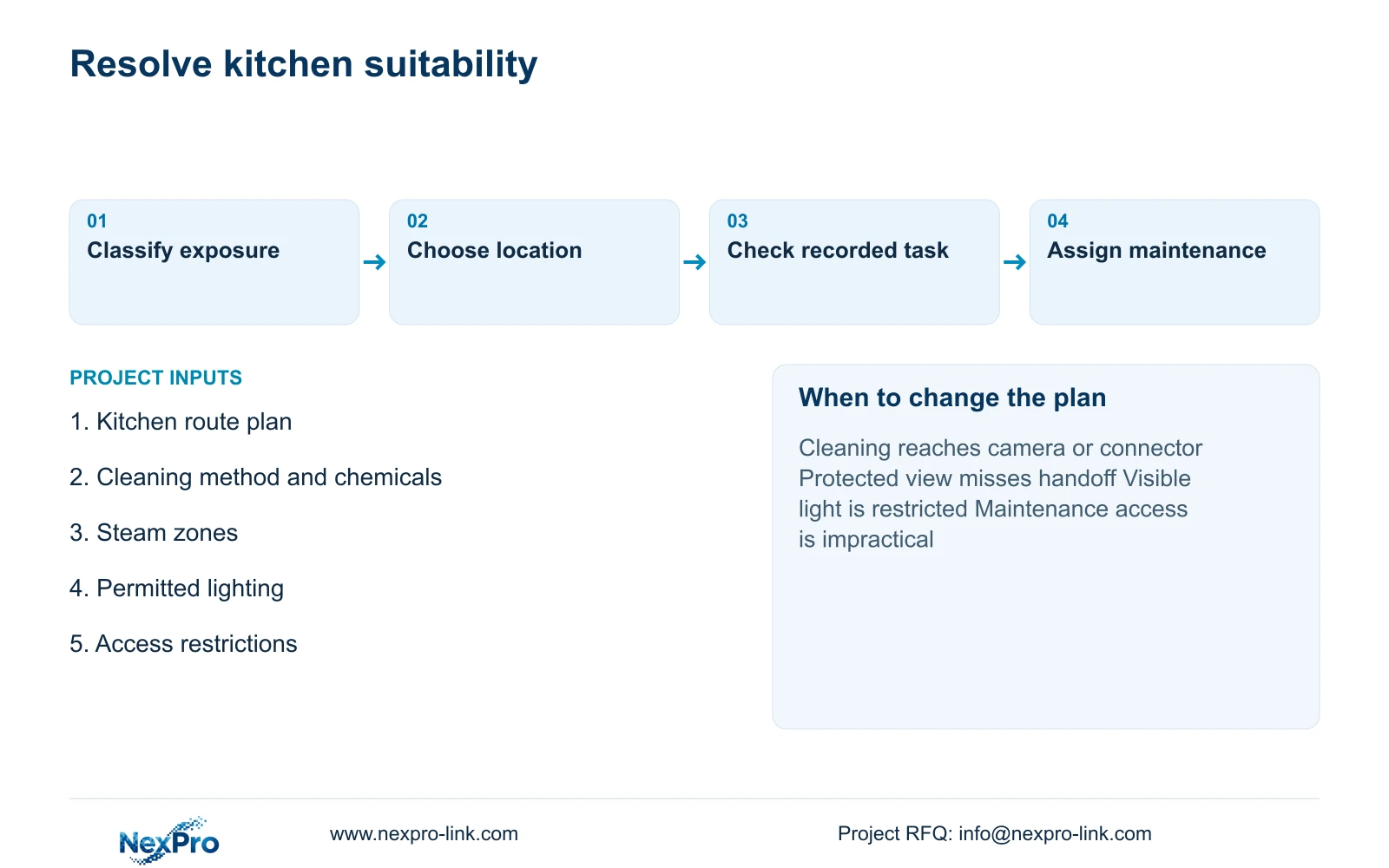
Change the recommendation when the protected position misses the approved action, the cleaning regime reaches the equipment, or a recorded task comparison fails under the actual light. In those cases, revise location or specify an arrangement with documented environmental support. Keep unresolved suitability separate from the model's verified image fields in the equipment schedule.
Send the kitchen/service-route plan, proposed handoff points, cleaning method and chemicals, and maintenance-access restrictions to info@nexpro-link.com, with the destination and relevant operator requirement. NexPro-Link can discuss model matching and BOQ documentation through its hotel project support. Supporting equipment coordination and local installation responsibilities should be stated separately from the CCTV manufacturing scope.
Section 07
Buyer questions
Can an IP66 dome be ordered for a direct washdown position? The supplied IP66 field alone is insufficient. Provide the cleaning method, chemicals and actual exposure, then require support for the complete camera and connection arrangement. Keep the order provisional if those conditions remain unresolved.
Will motorized zoom remove the need to access the camera? No. Optical adjustment can help framing, but cleaning, replacement and connection servicing still need a practical access arrangement. It also does not provide PTZ patrol capability.
What should a first kitchen proposal exclude? Exclude unconfirmed washdown claims, assumed audio recording and unspecified process analytics. Identify those as separate requirements if the hotel needs them, with their environmental, permission and interface conditions.
Engineering references
These sources support the general planning principles. Always use the selected product's current datasheet and applicable project standards for final design.