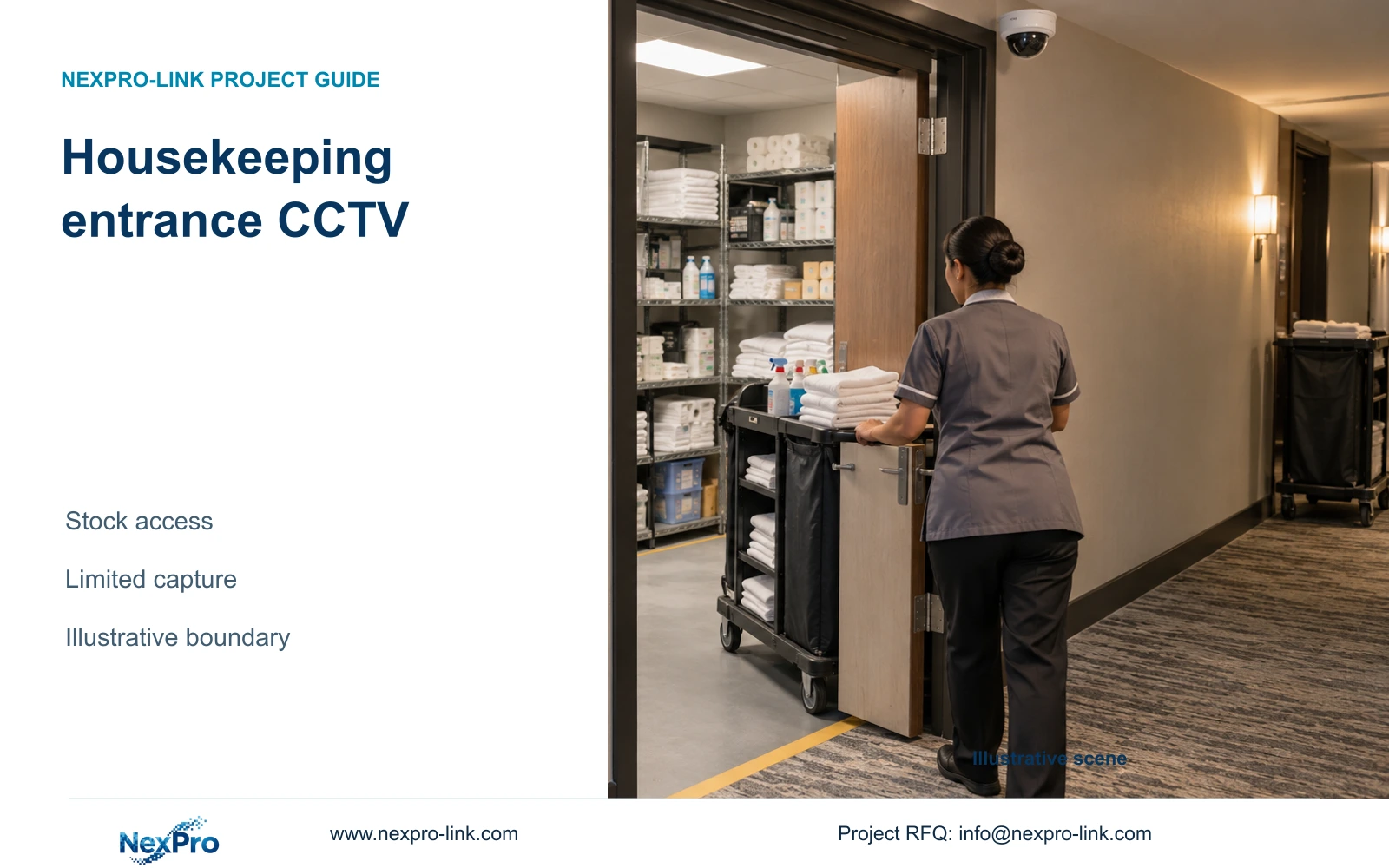
Use an entrance-focused view when it can answer the approved stock-access task. Define the image boundary, authorized users and retention before specifying equipment.
Section 01
Define the stock-access purpose
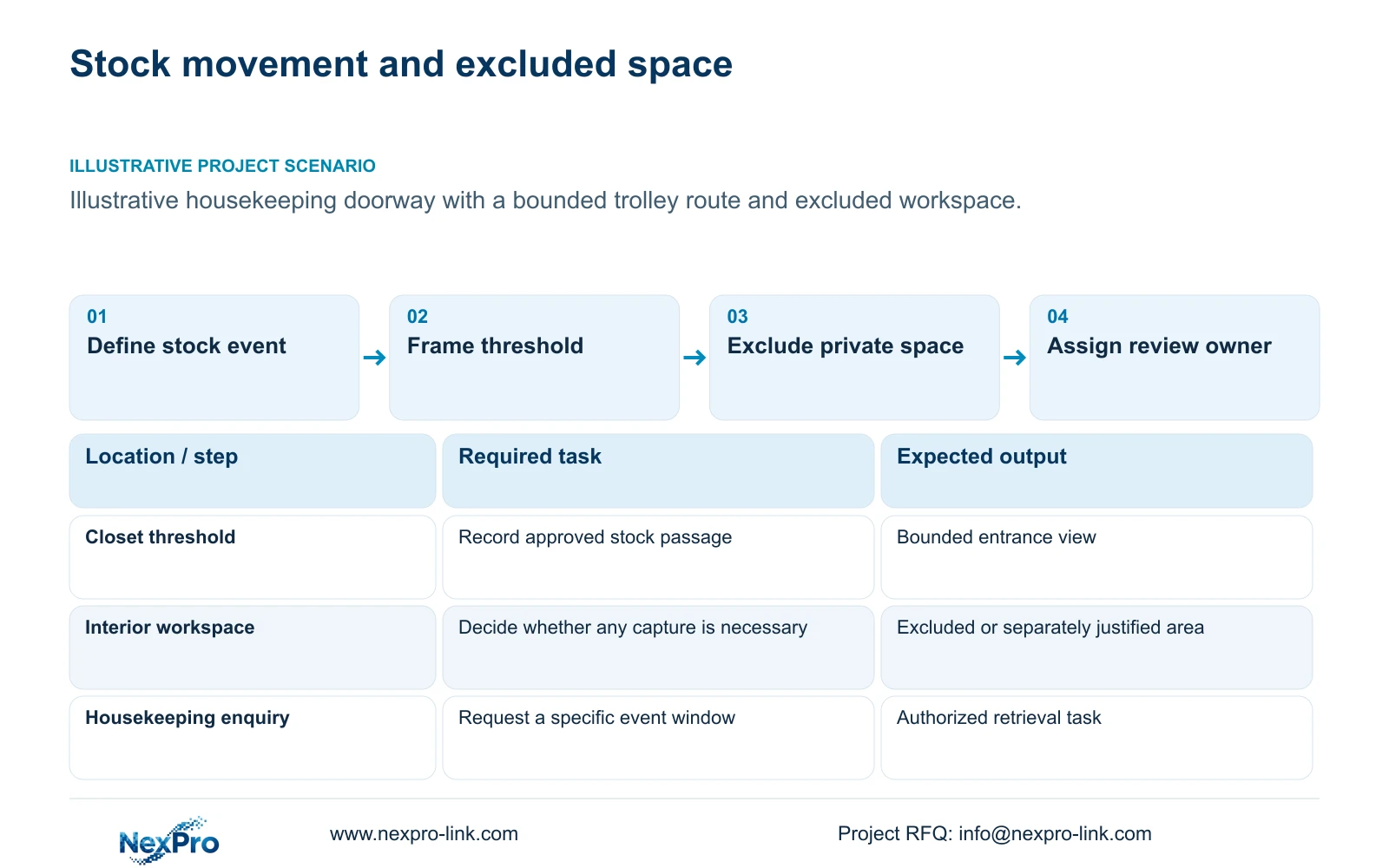
Choose an entrance-focused camera view when it can document the approved movement of stock into or out of a housekeeping closet. Add interior coverage only when a separately defined task requires it and the hotel authorizes the necessary scope. Equipment should follow the agreed image boundary, access ownership and retention purpose.
Describe the stock event in observable terms. Recording a trolley crossing the threshold differs from establishing which individual item was removed from a shelf. An entrance view can support the former task without proving the latter. If the buyer needs item-level information, identify that requirement explicitly before selecting a lens or expanding the monitored area.
Name the hotel role responsible for the purpose and the person who can authorize changes. Keep guest-room interiors, bathrooms and changing spaces outside routine coverage. An open closet door should not silently extend the view into an unrelated private area. The following illustrative task table helps separate useful entry evidence from a request that needs further definition.
| Required task | Given information | Decision still needed |
|---|---|---|
| Review stock movement through doorway | Closet entrance and trolley route | Permitted threshold view and event window |
| Resolve a disputed item movement | Entrance footage may show passage only | Whether item detail needs a separately justified task |
Section 02
Choose the least intrusive useful view
Compare positioning the camera outside the closet with framing from an approved interior position. The outside option may retain the doorway while excluding routine work inside. Its usefulness depends on the door swing, approach direction and whether people or trolleys obscure the stock movement. A broad view can capture more activity without providing the detail the event actually needs.
Try physical position and optical framing before relying on masking. Repositioning changes the observation angle; narrowing the view changes the area captured. A supported mask excludes a configured image area, but its actual behaviour must be checked on the selected equipment and recording path. These measures are not interchangeable.
Review the permitted view with the door open and closed, including adjacent public circulation. Keep the boundary visible in the camera schedule so that a later lens adjustment does not widen capture unnoticed. The supplied ICO guidance supports purpose minimization in its UK context and is marked as under revision. It does not establish a universal legal rule for every hotel.
Section 03
Compare entry detail with an interior overview
Use the same stock-access purpose to compare both layouts. Entry detail concentrates the available image on passage and handover. An interior overview may help a separately approved activity, but it can also include staff work that the original purpose did not require. Do not assume that a camera's wider field is a reason to retain the whole image.
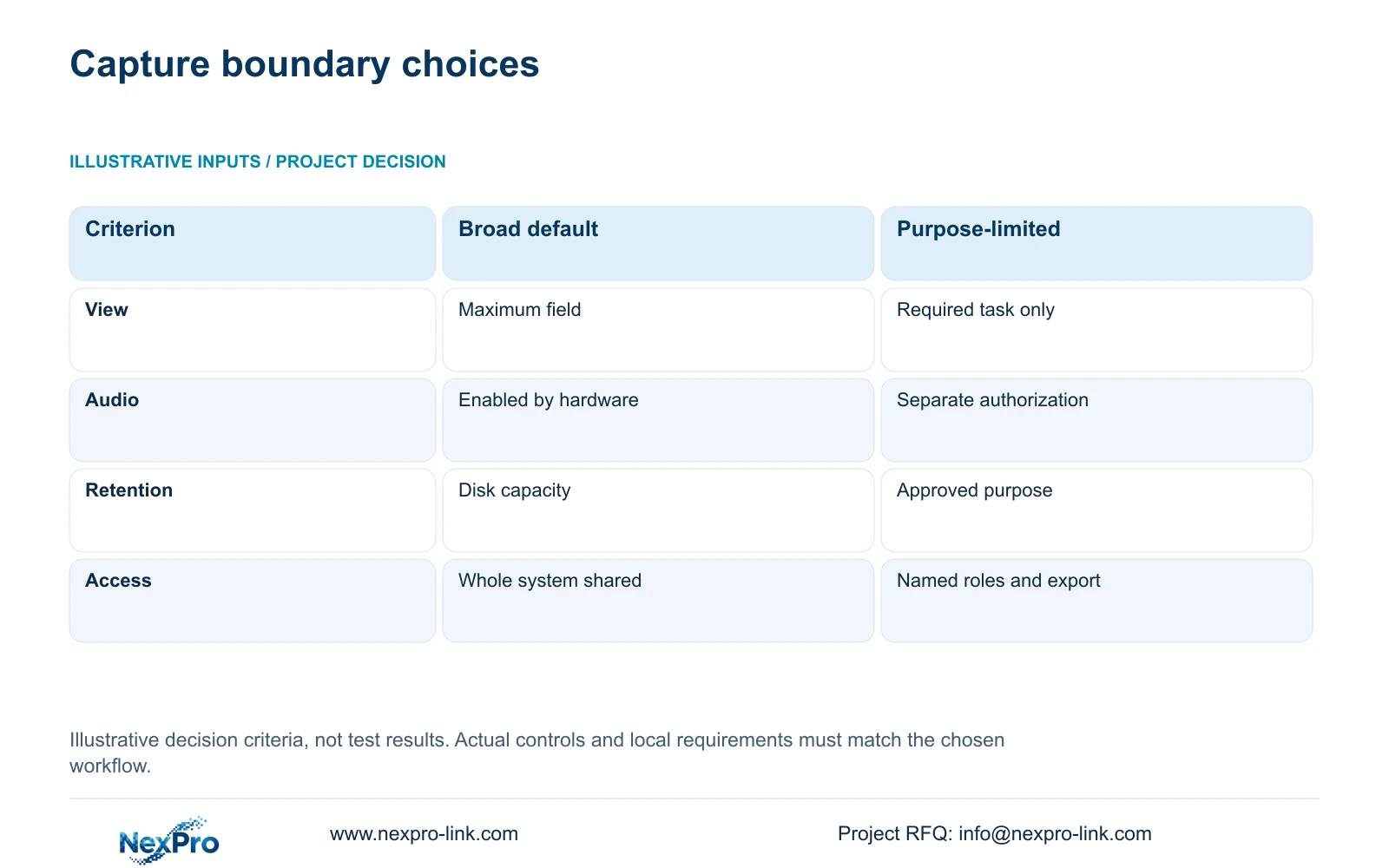
The decision matrix below compares broad capture by default with a purpose-limited design. It contains illustrative criteria, not a quotation or measured performance result. The preferred option defines what must be visible and what must remain excluded, while treating audio as a separate decision.
Set retention from the authorized purpose and applicable project requirements. Disk capacity does not determine permission to retain footage. Likewise, a microphone or two-way audio specification does not authorize continuous recording. If colour, spoken communication or additional interior detail is genuinely required, document its purpose and verify the exact supported function before including it in the proposal.
| Metric / condition | Broad capture by default | Purpose-limited design |
|---|---|---|
| View boundary | Maximum field regardless of purpose | Required public task; excluded private space |
| Audio | Enabled because hardware includes a mic | Separate justified and authorized decision |
| Retention | Longest disk can hold | Approved purpose and applicable requirements |
| Access | Whole system shared | Defined recipients, roles and export scope |
Section 04
Identify authorized operators
Assign permissions by action. A housekeeping supervisor may request review of a stock event without needing unrestricted system access. A security operator may retrieve the relevant footage, while an authorized recipient receives a limited export. These are proposed responsibility distinctions; the selected recorder and client must support the required controls.
Document account ownership separately from the ability to view a camera. Device binding, network access and export permission can sit at different system layers. A shared administrator login obscures those boundaries. Verify the actual workflow for adding a user, limiting the task and removing access when responsibility changes.
Include an exception path for staff absence or unavailable remote connectivity. Identify who can complete an authorized local retrieval and who can approve disclosure. Training should use the delivered equipment and software version, with the same role boundaries expected in operation. Record observed task results without inventing time savings or treating a demonstration as proof that every future event will be retrievable.
Section 05
Specify a bounded event retrieval task
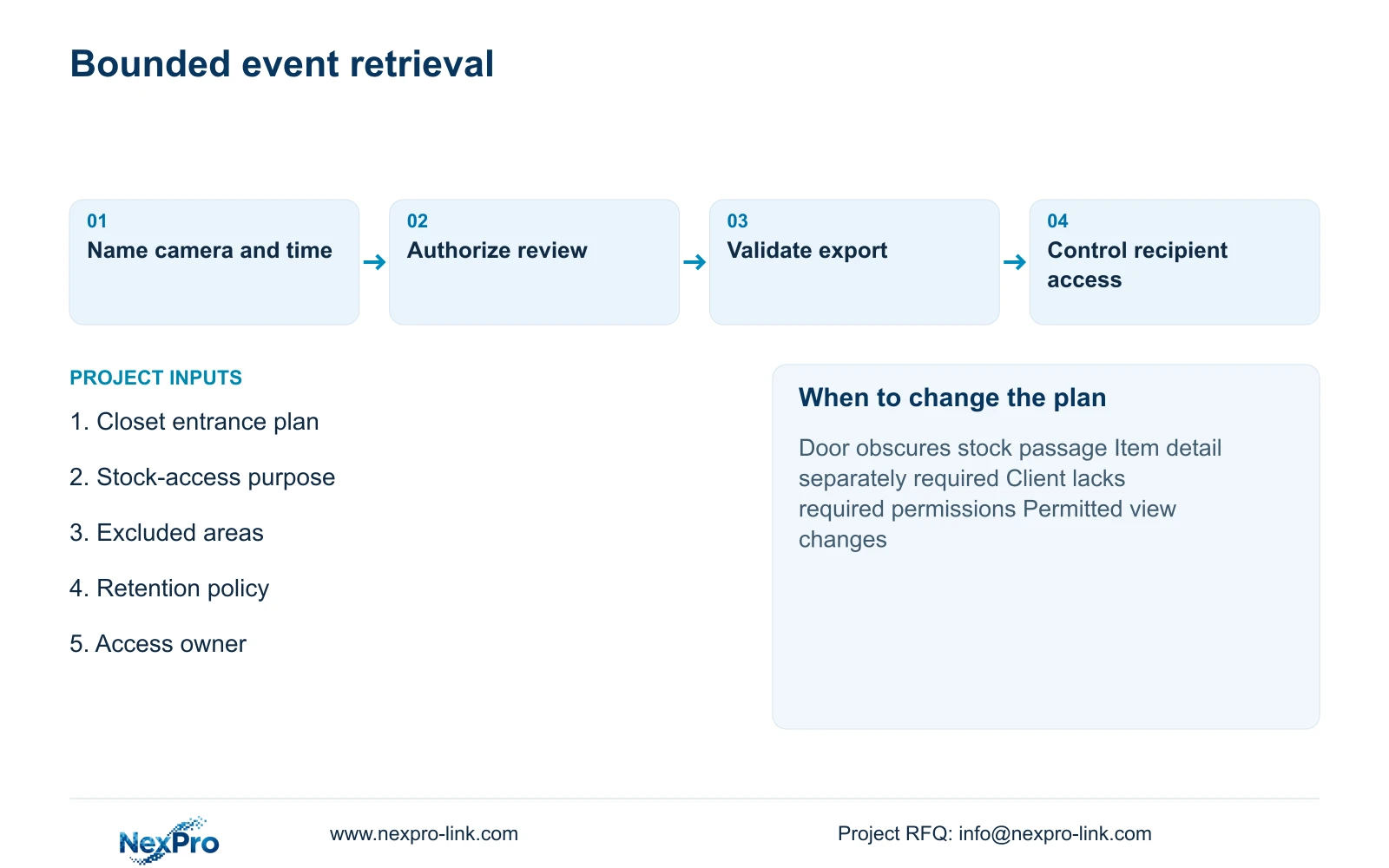
Define a representative retrieval using the closet camera tag, a stated time window and the stock movement of interest. The operator should find the relevant recording, replay it and produce the authorized export. Check that the recipient can play the file with the agreed tool and understands which doorway and time period it represents.
Keep the selected event window narrow enough to answer the approved enquiry. Exporting all cameras or an entire day's footage can disclose unrelated activity and increase handling work. Specify the recipient, transfer path and access duration under hotel policy. Preserve an authorized event separately when needed; routine circular recording and event preservation have different purposes.
An additional interior camera is worth evaluating when the approved event cannot be resolved at the threshold and the wider scope is justified. If passage information is sufficient, retain the entrance view and avoid the extra recording and access burden. ONVIF support alone does not prove retrieval, export or account behaviour across a third-party platform.
| Retained outcome | Extra scope | Change condition |
|---|---|---|
| Review doorway stock passage | Tagged entrance recording and bounded export | Use when passage answers the approved enquiry |
| Review separately authorized interior event | Additional view, storage and access controls | Evaluate only when entrance evidence is insufficient |
Section 06
Tie equipment to the agreed boundary
Specify the required view and retrieval workflow before naming the equipment. The supplied DM2812M PDF can support model matching, but housing appearance does not establish an impact rating, and resolution does not prove useful stock detail. Check actual framing and the recorded event under the lighting and obstruction conditions expected at the closet.
Keep this entrance decision separate from a whole-hotel design. CASE03 is an illustrative 48-camera system with independent recording and power assumptions; it does not prescribe a number of housekeeping cameras or a retention period for this task. Once the approved closet views are known, calculate their actual recording and network demand within the project's equipment schedule.
Recommend purpose-limited entrance coverage when it meets the authorized stock-access task. Reassess the position or equipment when door movement, lighting or a separately approved detail requirement prevents that outcome. Send a closet entrance plan, the stock movement to be reviewed, excluded areas and access owner to info@nexpro-link.com. NexPro-Link can discuss equipment matching and coordinated supply through its hotel project route, while the hotel retains responsibility for local policy and legal assessment.
Section 07
Buyer questions
Can a doorway camera identify every item removed? An entrance view can show passage without resolving individual items. Specify the item-detail task separately and assess whether the permitted geometry and recorded image can support it.
Should audio be included in the initial equipment scope? Include it only when the hotel has a separate justified and authorized task. Distinguish intercom use from continuous recording and verify the exact camera, recorder and client behaviour.
Can unused disk space extend the retention period? Unused capacity is not a retention instruction. Keep the approved period tied to purpose and applicable requirements; review any proposed extension through the hotel's responsible owner.
Engineering references
These sources support the general planning principles. Always use the selected product's current datasheet and applicable project standards for final design.