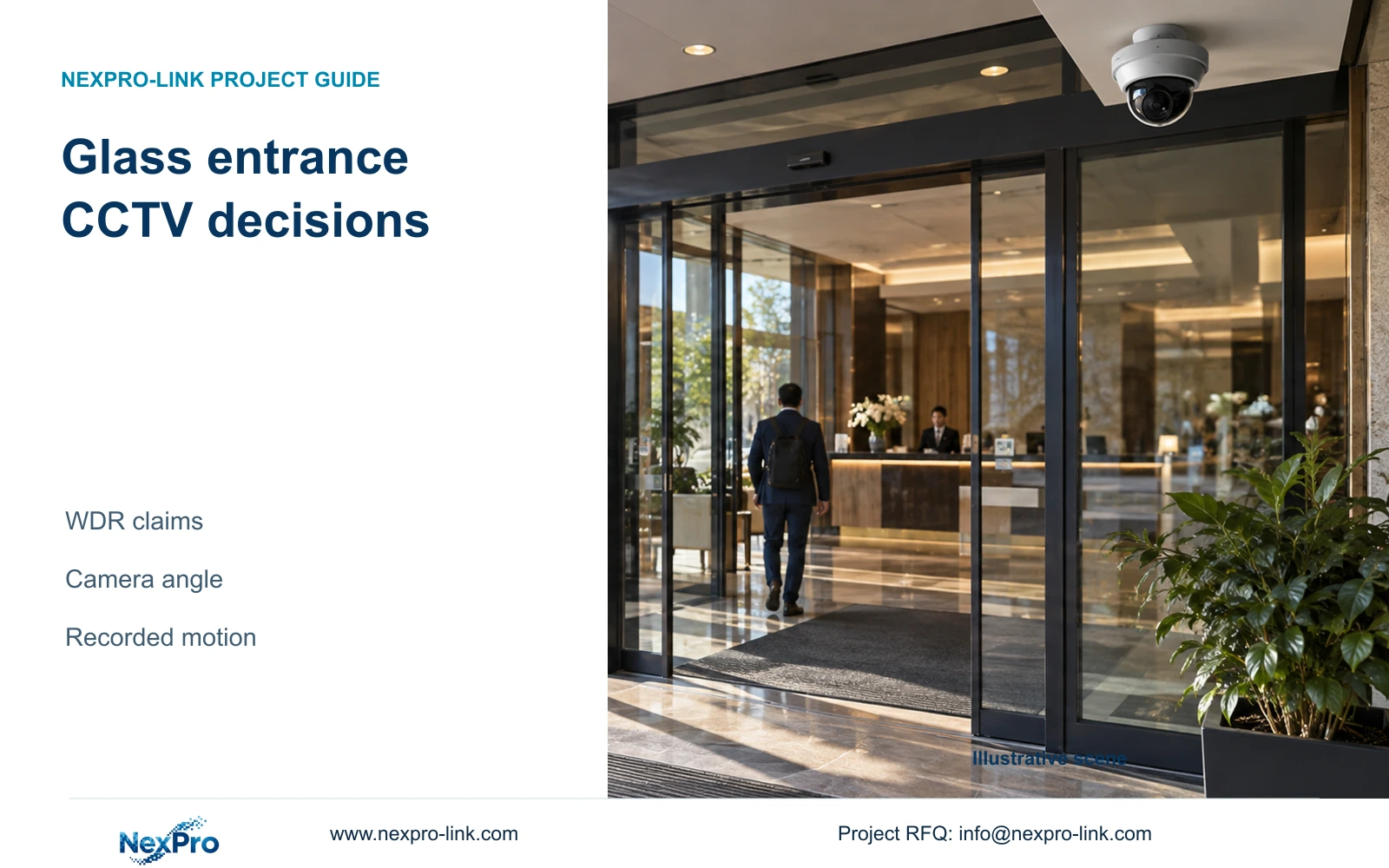
For a glazed hotel entrance, check the required target, camera angle and recorded exposure before replacing equipment. Reserve higher dynamic-range requirements for positions that need them.
Section 01
Choose the doorway detail that must remain visible
Check camera position and recorded exposure before buying a replacement for a backlit glass entrance. Retain a higher dynamic-range requirement where the approved doorway task still fails after a practical position adjustment. Other lobby views should keep their own requirements; a difficult entrance does not justify upgrading every public-area camera.
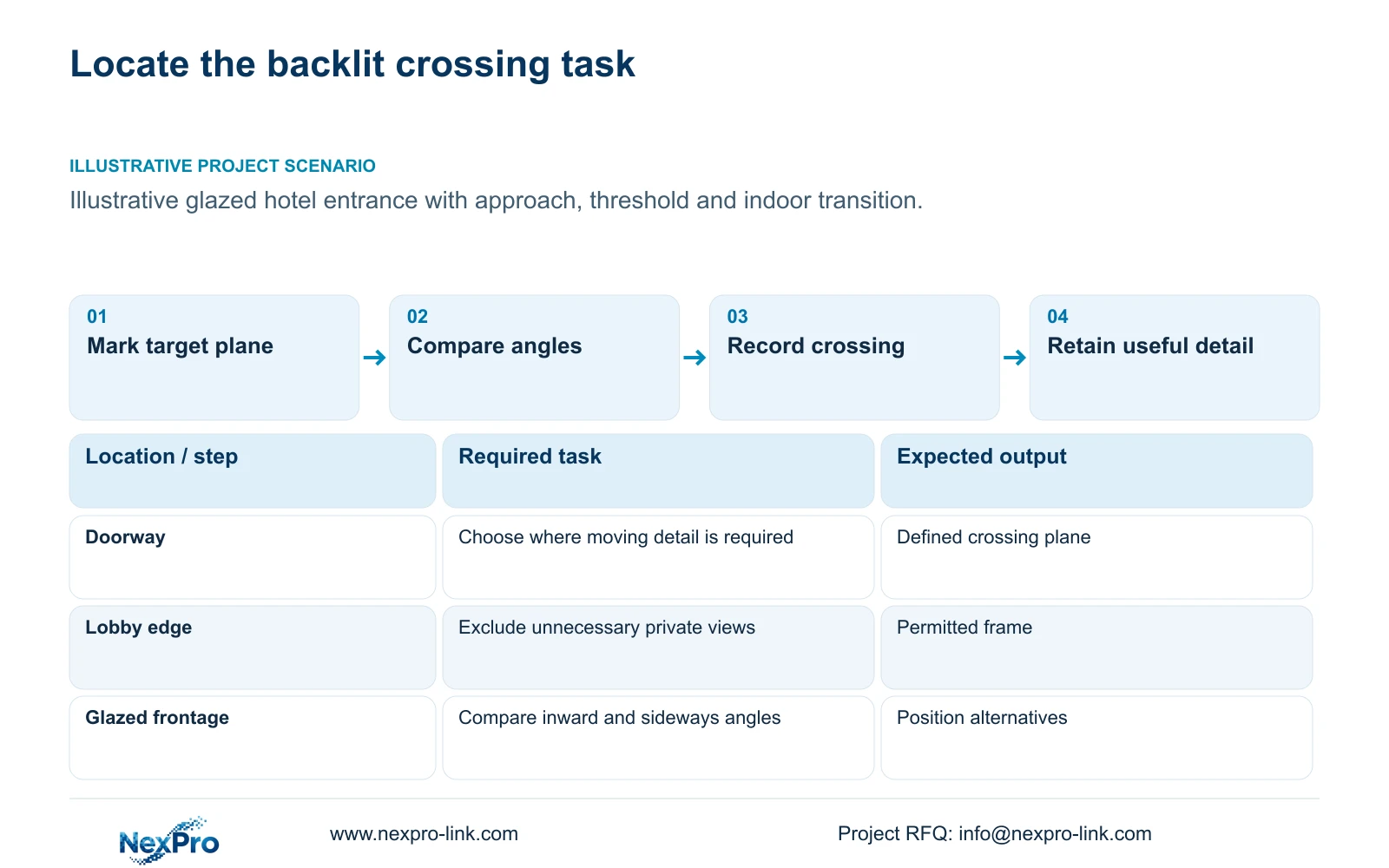
Mark the point where the hotel needs useful detail: outside approach, doorway crossing or the first indoor step. These positions experience different backgrounds. A lobby overview may explain movement while leaving a crossing subject too small or too dark for the required review. Separate that overview from any justified detail task, including reception handovers.
Define daytime and night-time outcomes separately. Seeing a silhouette, retaining clothing colour and preserving moving detail require different evaluation. The drawing should show the target plane, permitted camera positions and excluded areas. A useful entrance view should not extend into private spaces simply because the lens can capture them.
| Required task | Given information | Decision still needed |
|---|---|---|
| Doorway crossing detail | Glazed background and changing light | Target plane and acceptable recorded detail |
| Lobby arrival overview | Approach and queue routes | Whether one view preserves the whole route |
Section 02
Separate digital and multi-exposure claims
Ask the supplier to identify the exact camera mode behind a WDR claim. Digital processing and multi-exposure descriptions should remain separate entries in the comparison. A family name, an attractive still image or a minimum-lux headline does not establish how the selected model records a person crossing a bright doorway.
The Axis WDR paper distinguishes contrast enhancement from combining exposures and describes motion artifacts in the latter. For this entrance, ask whether a moving subject remains usable through the light transition. This is a general imaging consideration, not evidence of a NexPro-Link WDR implementation.
Record the offered resolution, frame rate and exposure conditions alongside the claimed function. Frame rate describes sampling frequency; exposure time affects movement within an image. A nominal 25 fps profile therefore needs a recorded-motion check. If the supplier proposes a different operating mode to improve the doorway image, assess the detail and recording consequences of that mode.
The supplied DM2812M PDF lists NexPro-DM2812M55-5MP-DIC-AI with a 2880×1620 main-stream mode, 25 fps and a 2.8-12 mm lens range. It lists NexPro-DM2812M88-8MP-DIC-AI with 3840×2160 at 25 fps and the same focal-length range. These fields support candidate selection, but the supplied evidence does not establish a particular WDR implementation or measured doorway performance.
| Item | Option A | Option B | Effect on the hotel task |
|---|---|---|---|
| WDR description | Digital processing claim | Multi-exposure claim | Compare recorded crossing detail in the exact mode |
| Evidence | Unmatched static preview | Matched recorded route | Only the latter addresses the moving doorway task |
Section 03
Compare inward and sideways positions
Draw both position options against the same crossing route. An inward-facing approach view and a sideways transition view may expose different backgrounds and obstructions. Compare what each preserves during entry, including luggage movement and queue overlap. Keep maintenance access and the permitted mounting surface in the drawing.
Glass reflections, polished finishes and lighting transitions belong in this comparison. Moving the camera may remove an unwanted reflection or reduce the bright background within the required view. Changing focal length can refine framing, but the published 2.8-12 mm range does not supply an exact field of view at a particular distance. Confirm the actual frame before approving the position.
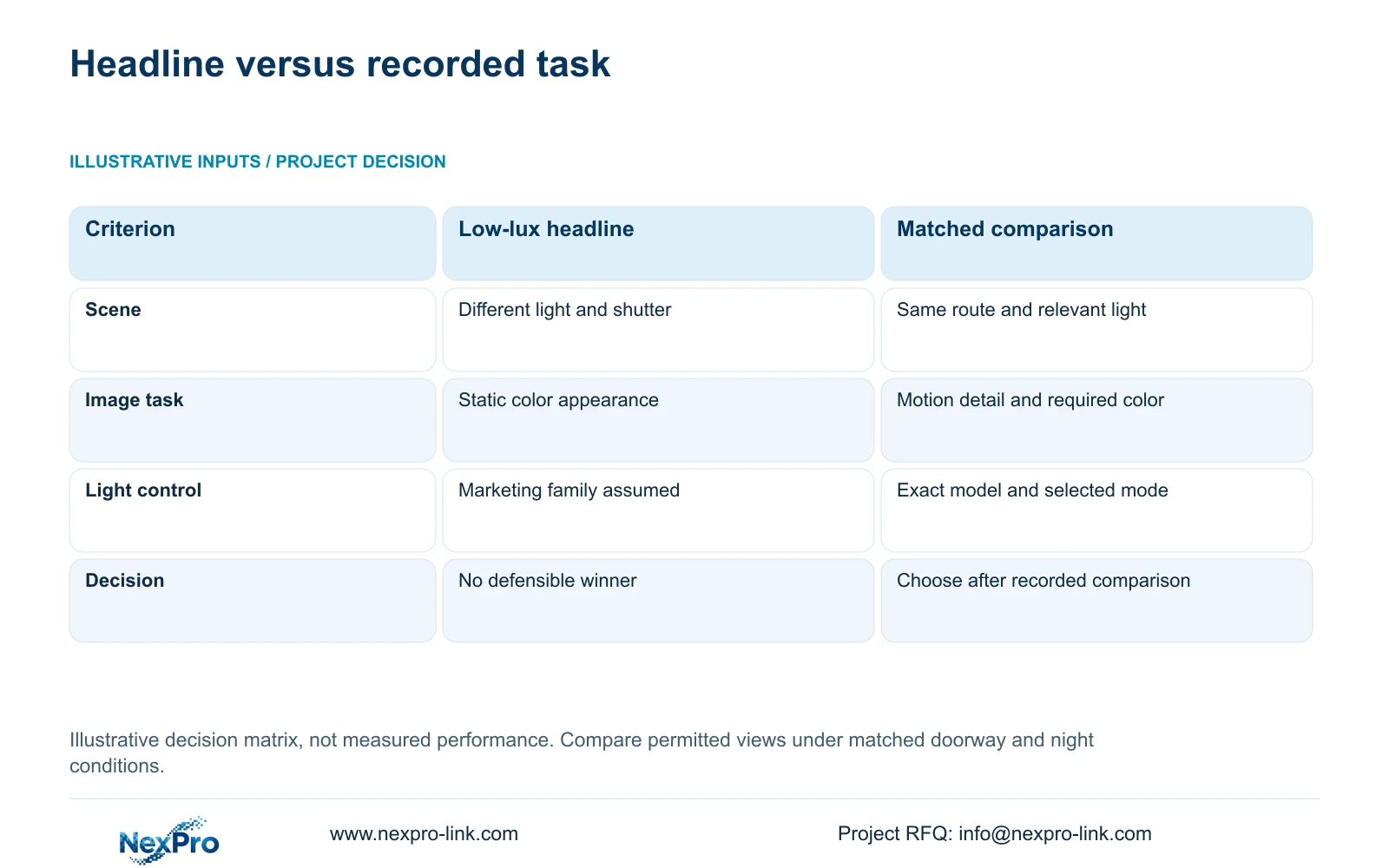
Use the following illustrative matrix for the night comparison after the position options are defined. It contains decision criteria, with no numerical performance score or claimed test result. The same route and relevant light conditions must be retained so that a position change is judged against the required task.
| Metric / condition | Option A | Option B |
|---|---|---|
| Scene | Different light and shutter conditions | Same target route and relevant light |
| Image task | Static color appearance | Motion detail plus required color/overview |
| Light control | Assumed by marketing family | Exact model and selected mode |
| Decision | No defensible winner | Choose after recorded task comparison |
Section 04
Test motion through the doorway
Have an authorized participant follow the defined route while the system records. Review the crossing before, within and after the doorway, rather than selecting the best stationary frame. Repeat the route under the relevant bright-background and night conditions. Record camera identity, firmware, position and selected image settings so that an adjustment can be compared fairly.
The matrix supports choosing after a recorded task comparison. It does not identify a winning camera in advance. Review whether the required action remains interpretable, whether colour is available when needed and whether light-mode transitions interrupt useful detail. Keep each unresolved observation attached to a responsible party and a repeat-test condition.
Factory testing can establish conditions that are reproducible there. The hotel's glazing, lighting and installed viewpoint need site assessment. A successful sample supports the conditions observed; it does not prove every entrance, every season or an entire batch. If position changes solve the defined problem, preserve that configuration in the camera schedule before considering an equipment upgrade.
Section 05
Cost the qualified image options
Price only options that preserve the required entrance outcome. Compare camera replacement with repositioning, lens adjustment and any permitted lighting change. Include mounting work, cable alterations and repeat testing where they arise. The least expensive camera line can become the more expensive installed option if its position cannot deliver the approved view.
Keep initial work and recurring support costs separate. If one option has a higher initial cost but a lower assumed annual cost, the break-even period is the initial difference divided by the annual saving. Use actual scope-matched quotations for those inputs. No supplied prices or service records establish a financial winner for this entrance.
NexPro-Link's BOQ support can help identify model substitutions and scope differences. The proposal should distinguish its CCTV manufacturing core from coordinated supply of other categories and from local installation. Any applicable hardware warranty should follow the controlling order and policy, without treating remote technical support as free site attendance.
| Retained outcome | Extra scope | Worth buying when | Counter-condition |
|---|---|---|---|
| Useful doorway detail | Position and cable adjustment | The revised angle passes the task | Required crossing becomes obscured |
| Detail at the approved position | Qualified camera replacement | Position cannot change and recorded detail fails | Existing equipment already meets the task |
Section 06
Specify the recommendation for each position
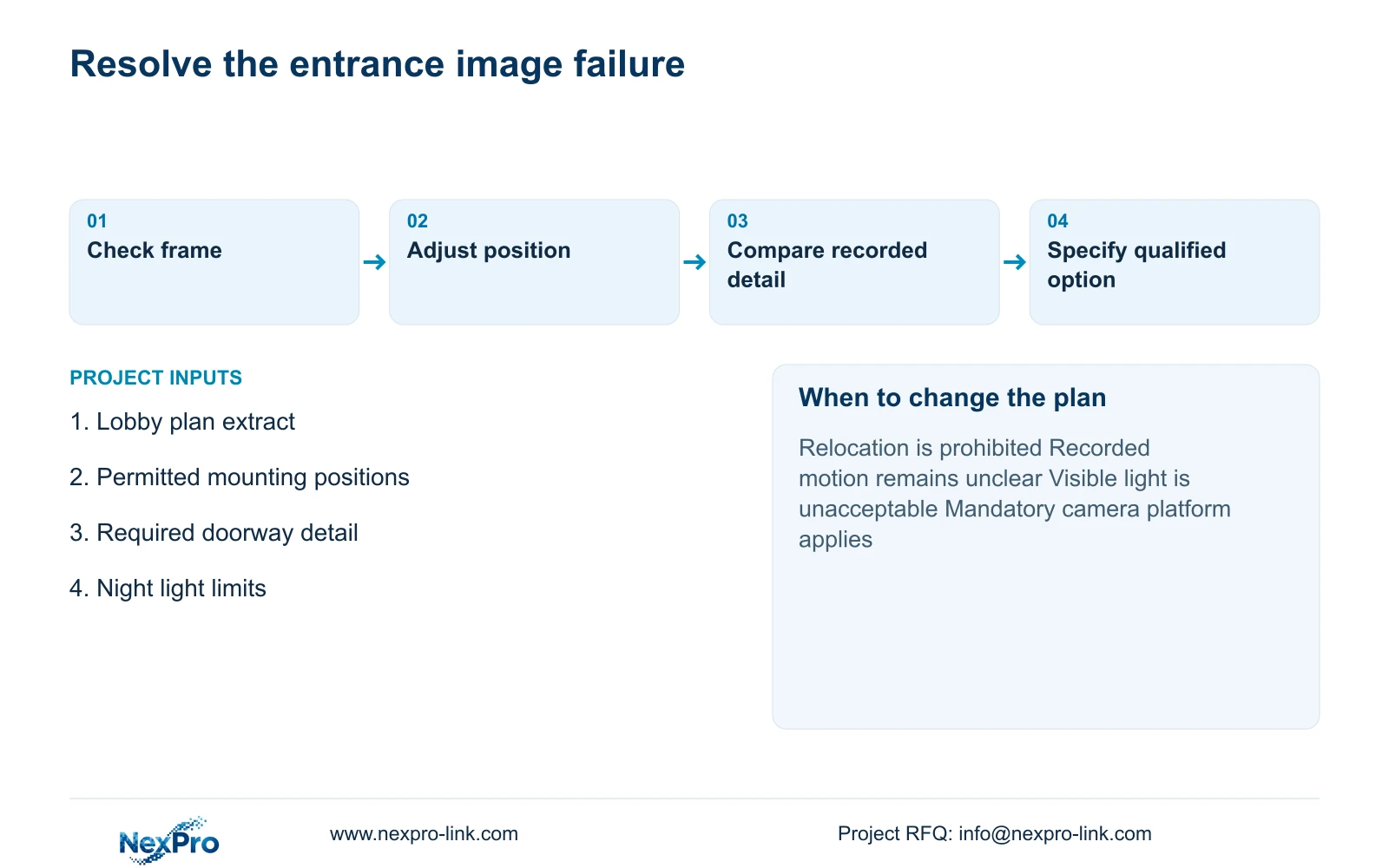
For a position that can be adjusted, begin with the permitted angle and lens setting that preserve the crossing task. Specify a higher dynamic-range requirement when that position still cannot retain the required recorded detail. Change the recommendation if architectural restrictions prevent relocation or the hotel's actual lighting produces a different result.
Choose illumination separately. Dual light is a candidate where visible light is acceptable and its selected mode supports the task. Where light spill affects guest accommodation or finishes, assess an appropriate infrared or other permitted approach. The camera's included audio functions do not authorize recording conversations, and ordinary cameras should not be specified as thermal equipment.
Send info@nexpro-link.com the relevant lobby plan, proposed entrance positions and required recorded doorway detail. Include the permitted night lighting and any mandatory brand or platform requirement. Hotel project equipment support can then address model matching and supply scope, while local teams retain responsibility for installation and applicable privacy decisions.
Section 07
Buyer questions
Can a 5MP camera remain at the entrance? Yes, if its permitted framing and actual recorded crossing detail meet the approved task. The supplied 5MP output is a candidate specification, not a doorway performance guarantee. Replace or reposition it when the defined task remains unmet.
What should a WDR quotation identify? The exact model, claimed implementation, selected recording mode and comparison conditions. A numerical or marketing label without a matched moving-subject recording is insufficient to settle this entrance decision.
Do we need a complete hotel drawing package for the first inquiry? A lobby extract with glass boundaries, allowed mounting positions and the required entry view is enough to begin a scoped discussion. Add project stage and destination; omit guest footage and account credentials.
Engineering references
These sources support the general planning principles. Always use the selected product's current datasheet and applicable project standards for final design.