Connecting an annex to the main hotel can simplify operation, but it also creates dependencies. Compare recording during link loss, local power and complete equipment scope before choosing the boundary.
Section 01
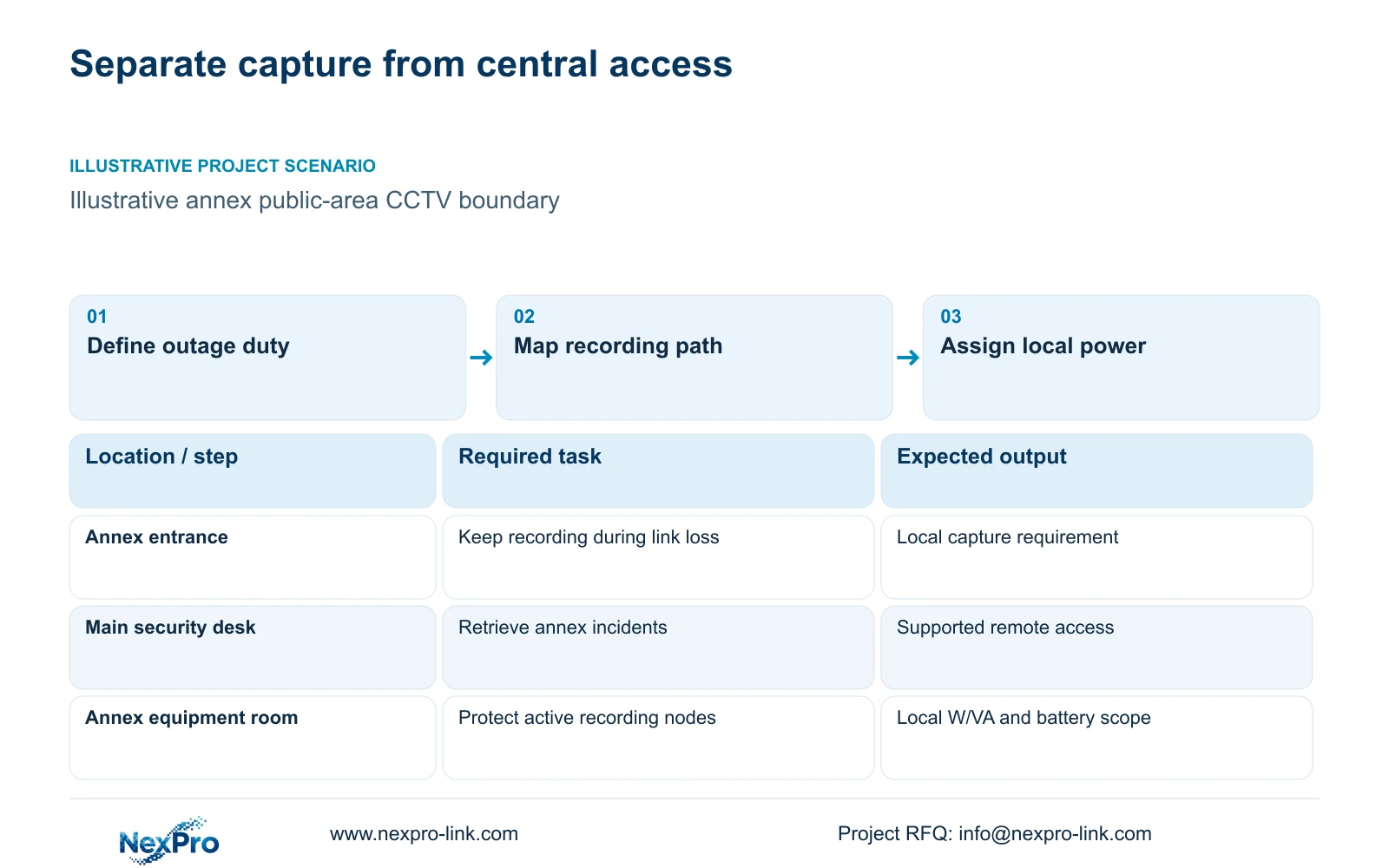
Decide which annex tasks must survive link loss
Use independent annex recording with approved main-property access when recording must continue through an interbuilding link outage. Expand the main recording system when its capacity and the accepted link-loss behavior meet the hotel's requirements. The choice changes if operator rules require a particular platform or local power cannot support the intended annex path.
List annex public-area views and the people who use them. Entrance observation, public-route incidents and service-area retrieval can have different response needs. Define who watches live video, who retrieves footage and who supports the local equipment. Camera quantities should follow those tasks and drawings, not bedroom counts.
Describe normal operation and loss of the main link separately. The hotel may require continuous local capture while accepting temporary loss of central viewing. Another project may require centralized recording and approve the resulting dependency. Those are different operating briefs, even with identical camera quantities.
Create a camera and interface schedule connecting each duty to its recording destination, network path and protected-power zone. Exclude guest-room interiors and unnecessary private views. Optional display or integration functions should remain identifiable so they cannot consume the essential recording allowance.
| Required task | Given information | Decision still needed |
|---|---|---|
| Record annex entrance events | Public-area camera schedule | Must capture survive main-link loss? |
| Review footage from the main hotel | Authorized central operator | Which supported access and search route applies? |
| Maintain annex operation during outage | Separate building power context | Which local nodes need protected power? |
Section 02
Calculate capacity on the actual shared paths
Draw the camera-to-recorder route before adding traffic. With main-property recording, annex recording streams traverse the interbuilding path. With an annex recorder, those streams can remain local while approved viewing or export traffic crosses the link. The camera total alone does not describe either link demand.
Calculate recording, live viewing, playback and export according to their actual simultaneous duties. Add each flow only to the links it uses. Show the project's chosen engineering allowance separately. Available port speed, overall forwarding, recorder input and client decoding are independent limits.
The article's illustrative 32-camera recording profile uses 4 Mbps per camera, giving 32 × 4 = 128 Mbps of aggregate video input. That is a defined scope total, not an assumed annex-only demand and not a measurement of spare capacity on the hotel's existing network.
For any expansion, add the applicable new flows to the existing traffic on the controlling path. NexPro SW-POE1618G remains an inquiry candidate: its source has conflicting access-port speed descriptions and no stated total PoE wattage. Neither its name nor the 128 Mbps calculation establishes that it meets the annex requirement.
| Item | Main-property recording | Annex recording | Operating effect |
|---|---|---|---|
| Recording traffic | Traverses the building link | Uses the local recorder path | Calculate different link flows |
| Link interruption | Interrupts the defined recording route | Local capture may continue if supported and powered | Verify the actual failure state |
| Central retrieval | Uses central recording workflow | Needs supported remote retrieval | Check permissions and client behavior |
Section 03
Compare recording failure domains
A central recorder can simplify the recording destination, but the annex depends on the complete route to it. Local recording changes that dependency: the main link can affect central access while the local camera, switch and recorder path remains responsible for capture. Continued recording still requires that path to be correctly configured and powered.
Separate data and power diagrams. Fiber carries data and does not automatically supply the annex switch or cameras. A display is outside the essential recording route unless another explicitly defined function requires it. Switching off a wall display should not be treated as a recording outage.
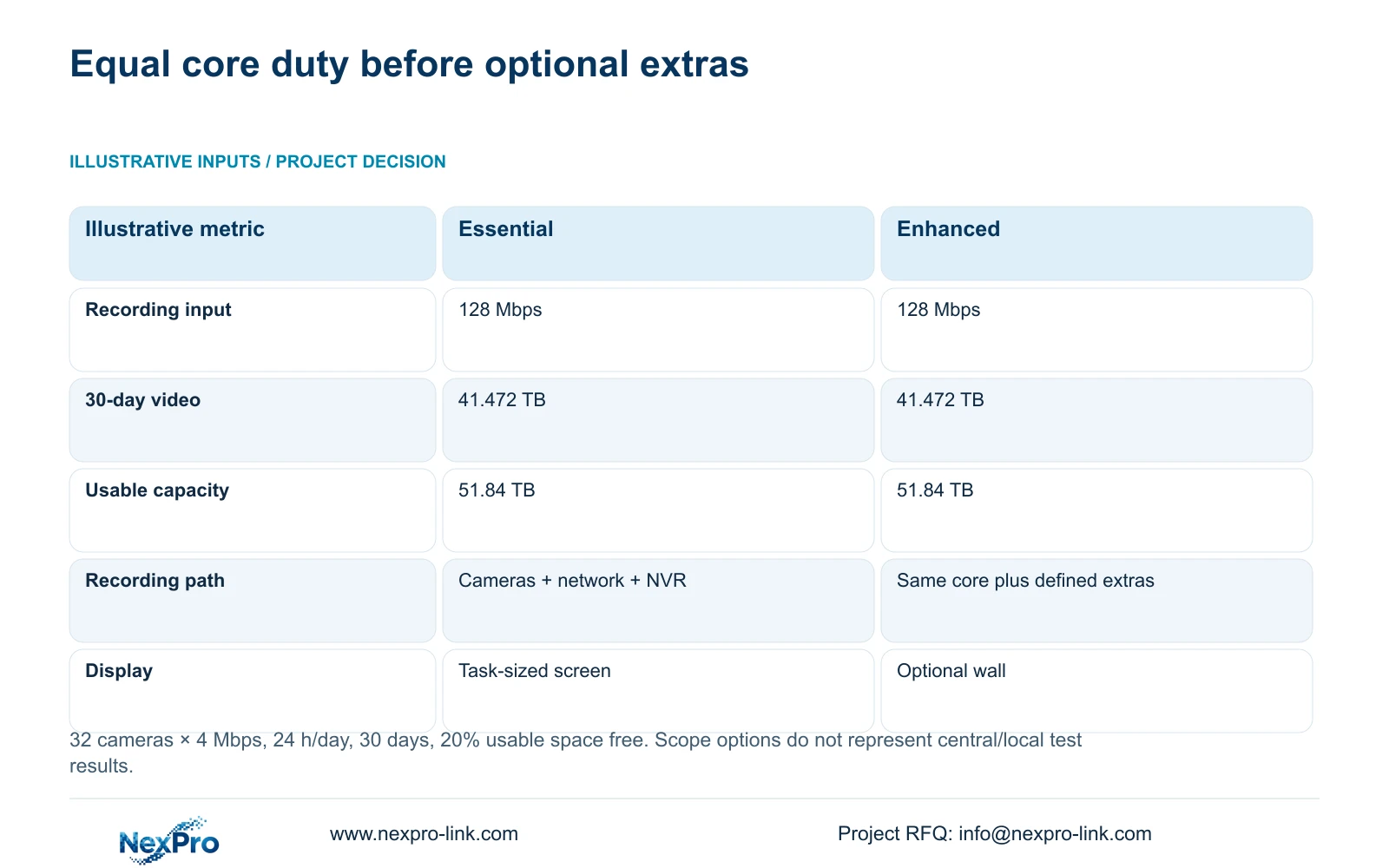
For an equal-scope comparison, use the independent illustrative baseline of 32 cameras averaging 4 Mbps, recording 24 hours daily for 30 days. Video input = n × 4 Mbps. Decimal video TB = 0.0108 × n × 4 × 30. Required usable TB = video TB ÷ 0.8, because the scenario keeps 20% of usable space free.
The resulting 128 Mbps, 41.472 TB and 51.84 TB apply to the defined complete recording scope. Allocate groups to actual recorders after selecting topology. Do not add these totals to CASE07 or silently relabel its 12 proposed cameras as an annex.
Section 04
Size storage and power within each boundary
The table preserves the same recording duty in an essential package and an enhanced package. These A/B options describe scope enhancement, not central versus local recording. Either topology must still meet the assigned recording and usable-capacity requirement.
The storage calculation gives 41.472 TB of video and 51.84 TB of required usable capacity. Keeping 20% free requires division by 0.8, not multiplication by 1.2. Select disks only after accounting for supported arrangements, array losses where applicable and formatted capacity.
NexPro-NVR4449-4K lists 49 channels, 320 Mbps input and four SATA positions with 18 TB per drive. Its summary lists 49×5MP/9×4K, so channel count cannot establish arbitrary 8MP concurrency. RAID levels are unspecified in the supplied record. Check the actual assigned stream and playback modes.
Calculate each annex PoE group from verified device peaks, then size protected AC load in both W and VA. SP2KR(S) is a published 2 kVA/1800 W rack candidate, but no runtime follows from that rating. Use the supported battery configuration and load curve; dispersed power zones require separate allocations.
| Metric / condition | Option A | Option B |
|---|---|---|
| Recording input (Mbps) | 128 | 128 |
| 30-day video data (TB) | 41.472 | 41.472 |
| Required usable capacity (TB) | 51.84 | 51.84 |
| Protected path | Cameras + network + recording | Same plus explicitly selected extras |
| Operator display | Task-sized monitor/workstation | Optional wall; independent recording |
| Cost comparison | Complete scope quotation required | Add only documented incremental scope |
Section 05
Normalize central and local equipment scopes
Compare complete central and local proposals against the same annex tasks and retention. Central expansion may need backbone work, recorder capacity or additional protected infrastructure. Local recording needs its recorder, storage and local power, plus the approved management interface. Include those items before comparing totals.
State who maintains the interbuilding link and who restores annex recording. Match spare equipment by function and supported configuration, not housing appearance. A spare camera or recorder may need renewed compatibility checks after the platform changes.
Keep optional operator displays separate. NX-VP-5535 is a 55-inch Full HD LCD product, not direct-view LED. A wall purchase needs its actual signal and decoding scope; it cannot compensate for missing recorder capacity. Similarly, SP5648 is a Cat6 patch panel, not a cable-reel specification.
Carry service boundaries into the comparison. The supplied policy record gives applicable main equipment a 24-month limited hardware baseline from receipt, with accessories and written-order exceptions scoped separately. Local labor, restoration arrangements and replenishment are distinct from that warranty term.
Section 06
Choose and verify the operational boundary
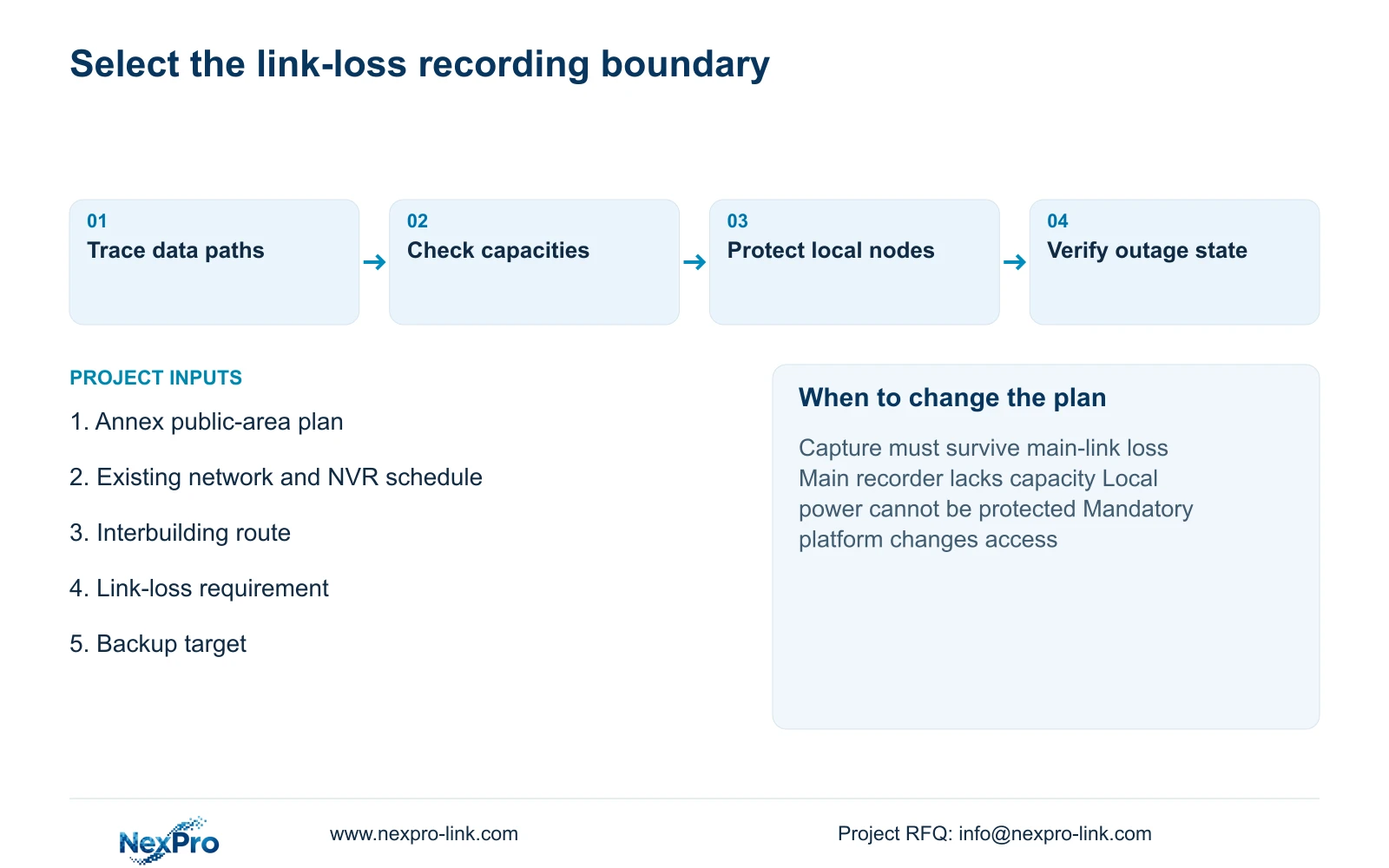
Prefer annex recording with supported central access where link-loss capture is required and local equipment can be protected and maintained. Prefer main-system expansion where available capacity is established, its failure boundary is accepted and the existing operating platform supports the added duties. Document the accepted outage state in either proposal.
Change the arrangement if central retrieval cannot be supported, local power is inadequate or the operator's mandatory platform alters the interfaces. Verify the chosen local and remote states during the agreed cutover process. This remains an engineering decision method, without a promise of zero downtime.
Send an annex public-area plan, existing recorder and network schedule, interbuilding route, required link-loss behavior and backup target to info@nexpro-link.com. NexPro-Link can discuss model matching and coordinated equipment scope through hotel project equipment support and BOQ and tender support. Electrical installation and building-link implementation need their defined local responsibilities.
Section 07
Buyer questions
Can annex recording continue when the main link fails? It can under a supported local-recording arrangement with an operational camera, network, recorder and protected-power path. Central viewing may still be unavailable; verify both states separately.
Does the 128 Mbps example represent our annex traffic? No. It is the aggregate input for the stated 32-camera illustrative scope. Determine the annex groups and add only the flows that traverse each actual link.
Does fiber remove the need for annex backup power? No. Fiber provides a data path. Local active networking, PoE cameras and any annex recorder need an explicit power and backup arrangement.
Engineering references
These sources support the general planning principles. Always use the selected product's current datasheet and applicable project standards for final design.