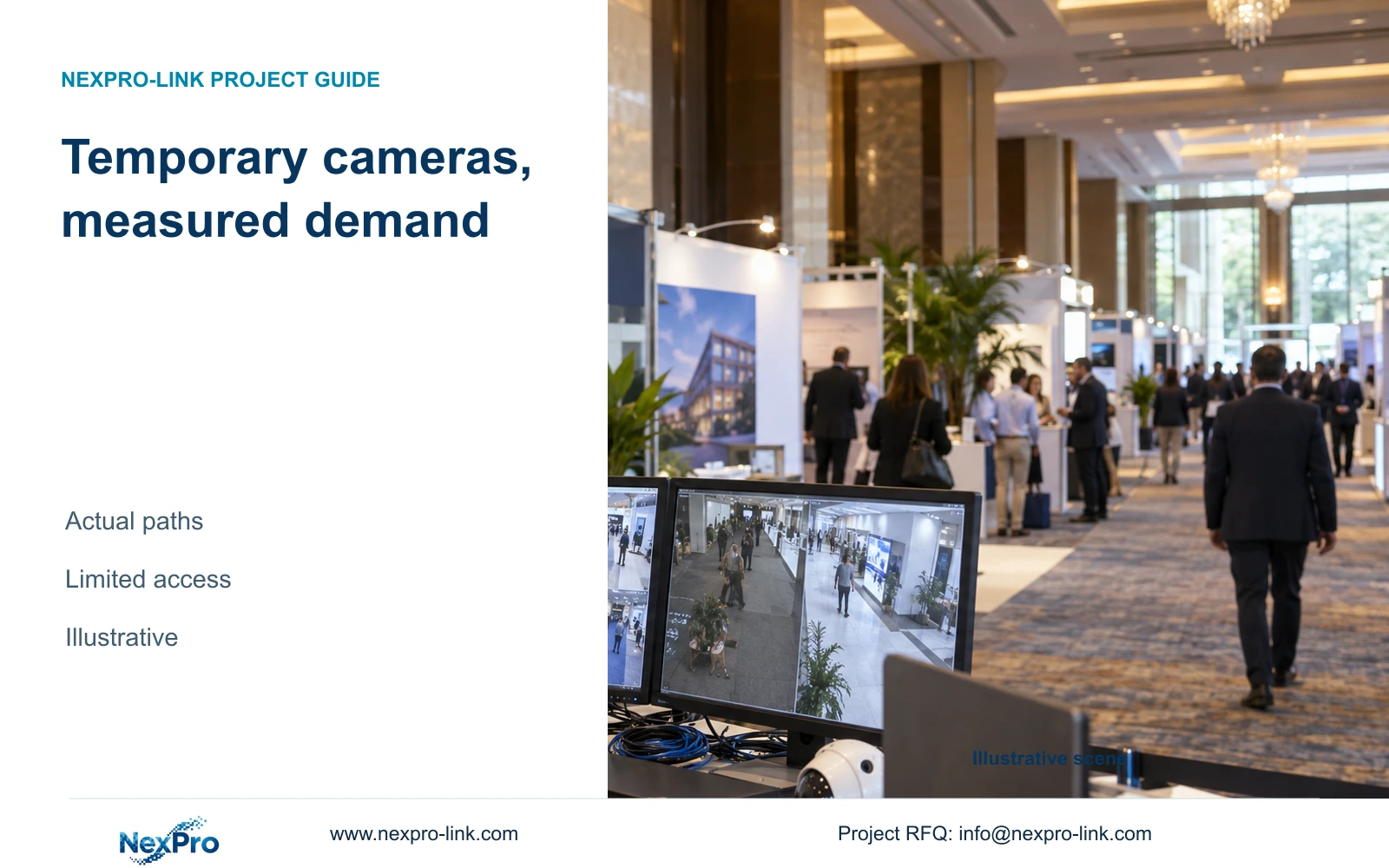
Reuse the hotel network only when the affected links, PoE groups and recording system can carry the event workload alongside existing services. Define removal before connecting temporary cameras.
Section 01
Count the event streams before approving network reuse
Use the existing hotel network only when its affected links, switch power budgets and recording configuration can support the event workload alongside existing services. Start with main-stream recording and substream overview viewing where that view meets the operator's task. Change to dedicated access or a revised uplink when verified capacity, access control or maintenance requirements prevent safe reuse.
List each temporary camera by public task and recording destination. Exhibition entrances, public aisles and service access points can need different views after booths are installed. Camera quantity should follow those tasks rather than exhibition floor area alone. Exclude private spaces and unnecessary views into adjacent accommodation.
Count streams as well as devices. One camera can supply a recorded main stream and a simultaneous viewing stream, while playback and exports create separate activities. Document which tasks coincide during the event and which are occasional. Keep existing hotel traffic as a distinct input so the event request does not conceal the occupied network capacity.
| Required task | Given information | Decision still needed |
|---|---|---|
| Record exhibition public routes | Temporary cameras join an existing network | Main-stream profiles and recorder destination |
| Show an event overview | Operators need concurrent views | Viewer count, stream type and viewing location |
Section 02
Trace each recording and viewing uplink
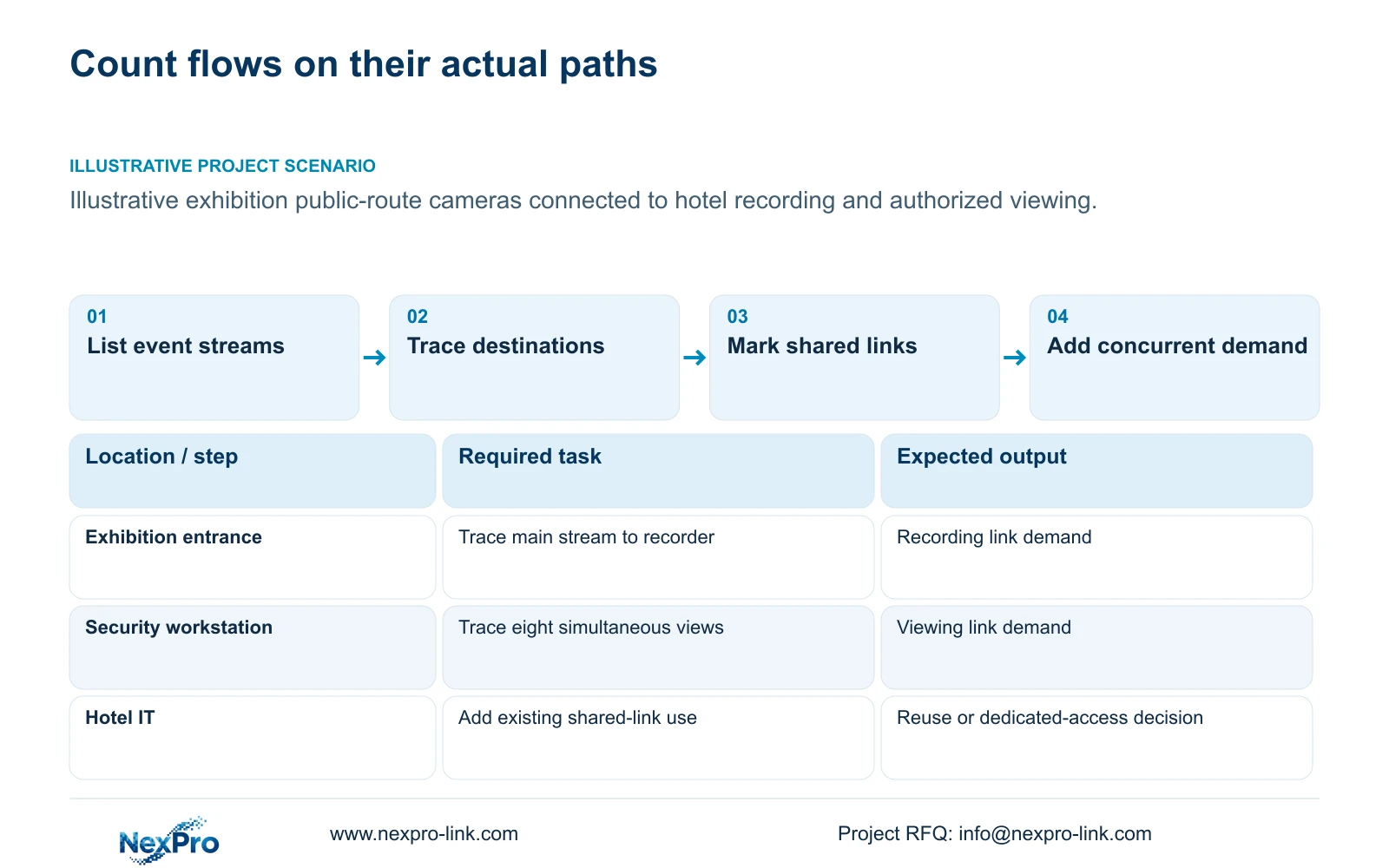
Draw the camera-to-recorder path first, then add paths to authorized viewers. Mark where they share a physical link and where they separate. An access uplink carrying only recording should not inherit traffic from a client path that never traverses it.
The same applies to playback and export. Identify their source, destination and direction before adding rates. For a shared segment, compare demand in the relevant direction with its supported service and existing use. A total camera bitrate copied onto every network line obscures the location of the actual constraint.
Record the access-port speed, uplink speed and switch forwarding requirement separately. NVR ingestion and client decoding have their own limits. A faster uplink cannot establish that the recorder accepts the selected image modes, or that the workstation can decode every main stream in its grid. The topology should identify the configuration decision for each boundary.
| Traffic | Recording-only segment | Shared recording/viewing segment | Effect |
|---|---|---|---|
| Main recording | Count traversing streams | Count traversing streams | Preserve the approved recording profile |
| Client viewing | Exclude if it does not traverse | Add simultaneous traversing views | Choose a supported viewing layout |
Section 03
Calculate the combined simultaneous traffic
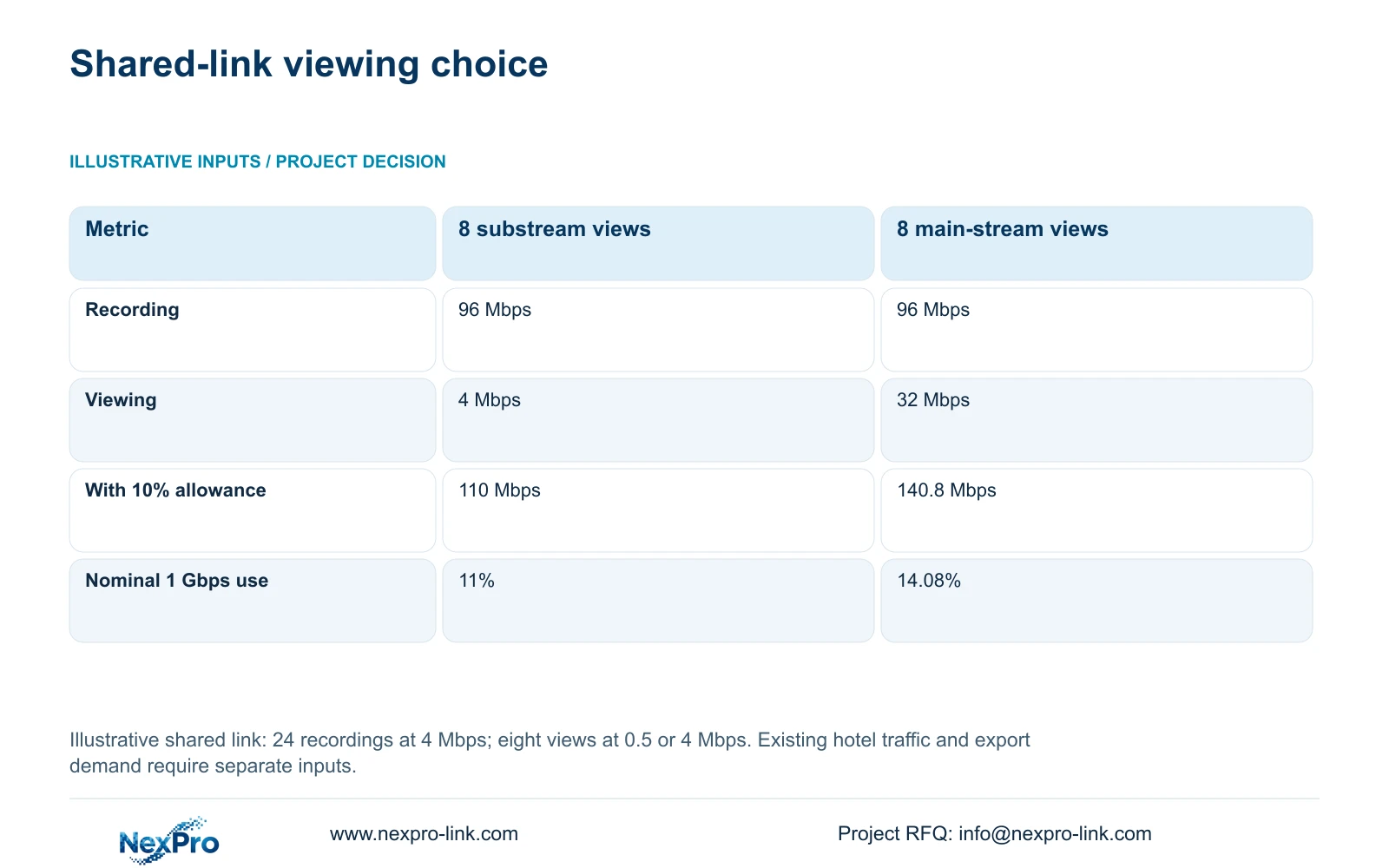
This independent example deliberately puts 24 recording streams and eight viewing streams on one shared link. Recording averages 4 Mbps per camera. Viewing uses either 0.5 Mbps substreams or 4 Mbps main streams, with an illustrative 10% traffic allowance. These assumptions are neither camera specifications nor measured peak rates.
Recording demand is 24 × 4 = 96 Mbps. Eight substream views add 8 × 0.5 = 4 Mbps, giving (96 + 4) × 1.10 = 110 Mbps. Eight main-stream views add 32 Mbps, giving (96 + 32) × 1.10 = 140.8 Mbps. Against a nominal 1 Gbps, those demands are 11% and 14.08%.
Neither percentage establishes spare capacity in a live hotel network. Add the applicable existing traffic and separately address export concurrency and actual stream peaks. The figures support substreams for a suitable overview task; they do not justify lowering main recording quality or automatically upgrading every segment to 10 Gbps.
| Metric / condition | Main recording + 8 substream views | Main recording + 8 main-stream views |
|---|---|---|
| Recording traffic (Mbps) | 96 | 96 |
| Viewing traffic (Mbps) | 4 | 32 |
| Planned link traffic (Mbps) | 110 | 140.8 |
| 1 Gbps nominal utilization | 11% | 14.08% |
| Other links | Calculate their own flows | Do not copy this sum to every segment |
Section 04
Separate temporary access from hotel administration
Give event personnel only the supported access needed for their assigned task. A public-route live view, recording retrieval and export authorization are different responsibilities. Hotel ownership of accounts and device bindings should remain clear when contractors connect temporary equipment.
Specify who creates access, its approved duration and who removes it. Where automatic expiry is unsupported, assign a documented manual removal action. Remote assistance should use a hotel-approved path with limited authorization. Keep credentials out of equipment schedules and initial supplier inquiries.
Verify the actual recorder and client capability before promising role restrictions or event-specific view boundaries. ONVIF Profiles provide a basis for checking relevant device and client functions; a general ONVIF claim does not prove third-party account binding, all event functions or complete search interoperability. If the existing platform cannot implement the required boundary, revise the platform or access arrangement before the event.
Section 05
Compare shared and dedicated access switching
Shared switching is a reasonable starting point when supported ports, PoE output and affected uplinks have adequate capacity and hotel IT can control the event configuration. Dedicated access can provide a clearer setup and removal boundary, although its connection to a shared core still needs traffic accounting.
Calculate each actual camera group's PD peak load, cable delivery allowance and required PSE output. Free ports and spare watts are separate resources. If UPS demand uses the complete switch's AC input, avoid adding its powered cameras again. Temporary equipment must retain the agreed outage behaviour across all active nodes.
NexPro SW-POE1618G remains an inquiry candidate: the source lists 16 PoE ports and two uplinks, but its access-speed fields conflict and total PoE watts are not stated. SP5648 and DT968MX are Cat6 patching components, not evidence that the installed cable system or switch power budget passes. Compare complete equipment and installation scope without assigning invented prices.
| Retained outcome | Extra scope | Worth buying when | Counter-condition |
|---|---|---|---|
| Event recording on existing infrastructure | Approved ports and configuration | Capacity and access boundaries are verified | Existing load or permissions prevent reuse |
| Separate event access boundary | Dedicated switch, power and uplink | Removal or fault responsibility needs separation | The same shared core remains the unresolved bottleneck |
Section 06
Remove event configuration without disturbing normal recording
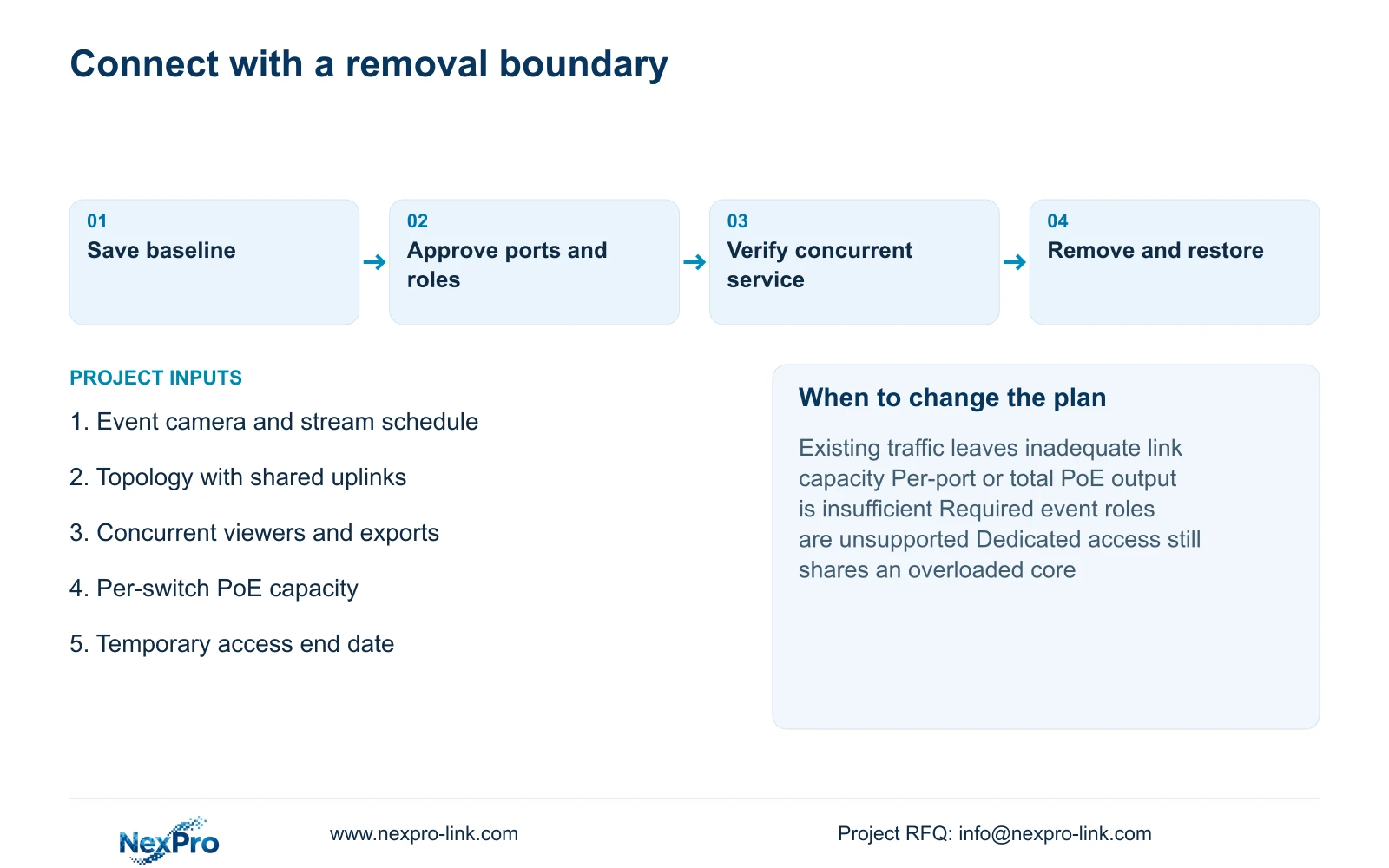
Keep a baseline of the ports, camera identities, recording assignments and authorized access affected by the event. The removal list should distinguish temporary additions from existing hotel dependencies. Disconnecting a shared uplink or deleting the wrong recording assignment can disrupt normal service.
Before removal, resolve any authorized incident export and its approved recipient. Then remove temporary access, release event-specific ports and restore the documented normal configuration. Confirm existing cameras still record and that authorized users can retrieve new footage. Preserve evidence handling separately from network cleanup.
Send the event camera schedule, topology with shared uplinks marked, recording/viewing profiles, concurrent viewer and export requirements, and known PoE capacity to info@nexpro-link.com. NexPro-Link can discuss model matching and a scoped BOQ response, with CCTV manufacturing and supporting equipment coordination identified separately. Choose shared access only after these checks; change the proposal when measured demand or required permissions exceed the existing system.
Section 07
Buyer questions
Does low calculated CCTV utilization prove the business network is safe to reuse? No. The example excludes existing hotel services and does not measure peaks or switch performance. Request the affected-link traffic baseline and event concurrency before deciding whether shared access is acceptable.
Will a dedicated event switch remove every network bottleneck? It separates the access equipment, but traffic can still traverse the same core or recorder link. Trace the resulting path and check recording, viewing and export demand at each shared boundary.
Can temporary cameras be removed immediately after the exhibition? Coordinate removal with the hotel's authorized incident handling and restoration process. Complete required exports, revoke temporary access, remove only identified additions, and verify normal recording after the change.
Engineering references
These sources support the general planning principles. Always use the selected product's current datasheet and applicable project standards for final design.