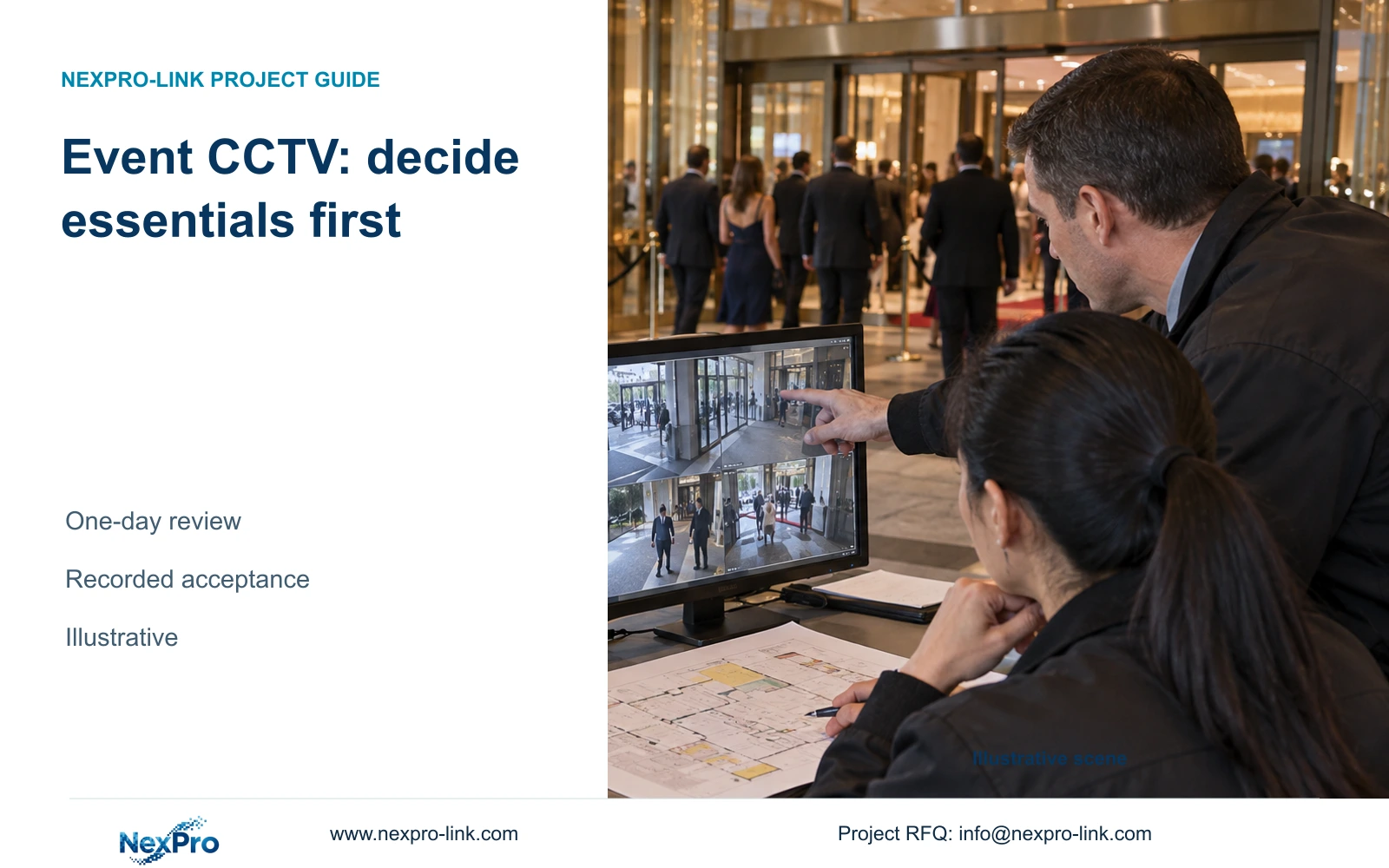
A one-day review should prioritize essential entrance views and a working recording path. Use existing qualified resources first, and distinguish a rapid decision from completed installation.
Section 01
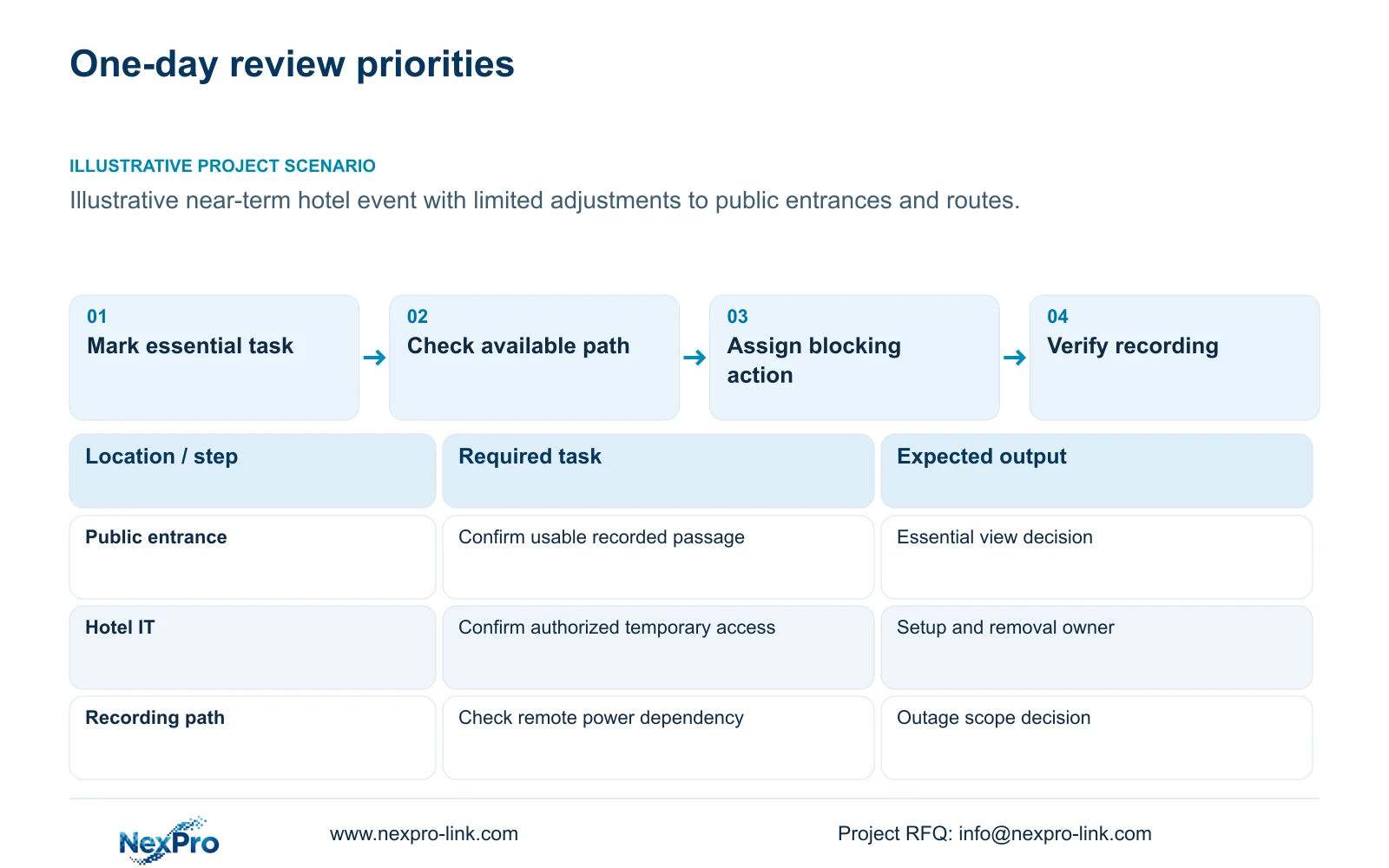
Identify the operating risks that must be resolved first
When an event is close, resolve essential entrance coverage, recording integrity, authorized access and power before adding optional views or displays. Use existing qualified resources where they meet those tasks. A one-day review can establish priorities and responsibilities; it cannot turn untested equipment or an incomplete delivery programme into an accepted installation.
Work backwards from event operation, identifying what must be available when public access begins. A camera shown online is insufficient if the relevant footage cannot be replayed. A powered recorder does not establish that its remote cameras and intervening switches remain operational during the required outage state.
Mark each unresolved item by its consequence and responsible person. Distinguish a blocked essential function from an optional improvement, then record the decision needed to release the next action. Arrival of equipment, permission to connect it and successful recorded acceptance are separate milestones even when the team has little time.
| Required task | Given information | Decision still needed |
|---|---|---|
| Review the public entrance event | A camera is online | Recorded passage and replay remain usable |
| Maintain required recording | The recorder has protected power | Required access nodes also have protection |
Section 02
List equipment and routes that are actually available
Build a short inventory tied to the event plan. Record available camera identities and mounts, actual recorder assignments, usable ports and known PoE capacity. Separate confirmed stock from equipment that still requires sourcing, preparation or transport. A catalogue item does not belong in the available column simply because it can be ordered.
Trace each proposed addition from camera to recording destination, with power on a separate path. Measure installable cable routes including vertical sections and detours. Where a remote node is necessary, include its environment, supply and service access. Fibre and copper solve different route questions, and a data connection cannot establish remote backup power.
Prefer reuse when the equipment and route are qualified for the required view. Buying additional cameras is justified when an essential task remains uncovered and the complete connection can be ready. Avoid rushed changes that consume the final recorder channel or switch power reserve without a documented revised resource check.
| Item | Existing qualified resource | New equipment | Effect on event readiness |
|---|---|---|---|
| Camera endpoint | Verify view and recording | Include mounting and configuration | Choose the branch that can meet the essential task |
| Connection | Check current route and capacity | Include route, power and access | Shipment alone cannot establish readiness |
Section 03
Prioritize essential views against real delivery dependencies
Classify the public routes by the event's observation requirement. Preserve useful arrival and service-access recording before optional wide views. Consider a functional first release when it is genuinely available, keeping later display or branding work separate from the essential recording package.
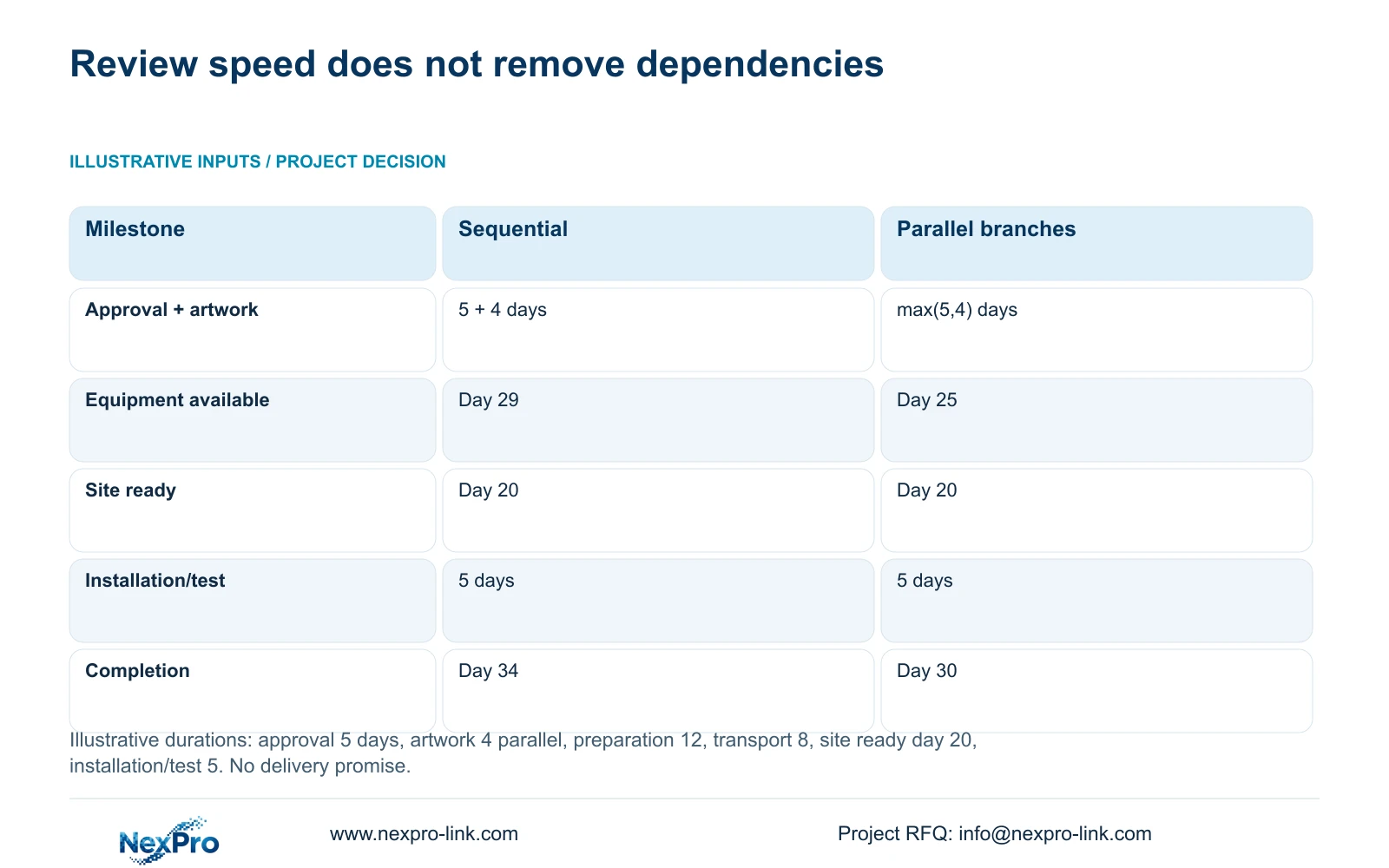
The teaching programme below assumes technical approval takes five days and artwork four days, with those branches able to proceed in parallel. Preparation takes 12 days, transport eight days, site readiness occurs at day 20, and installation/testing takes five days. These durations are illustrative and have no connection to a promised NexPro-Link lead time.
Ready-to-install day equals the later of equipment availability and site readiness. Completion adds installation/testing. Parallel approval and artwork give max(5,4) + 12 + 8 = day 25 equipment availability, followed by completion at day 30. Treating both branches sequentially gives day 29 availability and day 34 completion. Neither branch delivers a next-day new package.
| Metric / condition | All branches treated as sequential | Actual parallel branches |
|---|---|---|
| Approval + artwork treatment | 5 + 4 days | max(5,4) days |
| Equipment available day | 29 | 25 |
| Site ready day | 20 | 20 |
| Illustrative completion day | 34 | 30 |
| Actual commitment | Depends on real sequence and agreed dates | Requires actual project inputs |
Section 04
Calculate changed resources and threshold effects
Keep the existing accepted system as the calculation baseline, then identify the event changes. Recalculate the affected camera groups, recorder inputs, disk requirement and protected load. An unchanged part of the hotel does not need to be presented as a new purchase, although shared resources require a combined capacity check.
Check thresholds before accepting a small quantity increase. An added camera can require another recorder, a larger PoE budget or a different protected power arrangement when the existing limit is reached. Such consequences are not proportional to camera count. Separate reuse and cancellation from genuinely added equipment and site work.
Explain cost changes in a fixed sequence: quantity changes at the baseline rate, specification or rate effects on the revised quantity, and shared-resource additions. Use actual scope-matched quotations for financial decisions. The schedule example establishes dependency treatment only; it supplies neither equipment prices nor permission to compress necessary testing.
Section 05
Assign setup, authorization and removal responsibilities
Assign who decides the essential view, who connects and configures the equipment, and who accepts the observed outcome. Hotel IT should control network and account changes within its responsibility; local installation and electrical work need their appropriate project roles. A purchasing forecast is not order authorization.
Include site access and any transport restrictions on the relevant programme branch. Model freeze and packing information can also affect release. Independent work can proceed in parallel only when it has sufficient approved inputs. Do not describe a late hardware or artwork change as cost-free or schedule-neutral without an agreed response.
Define removal while the temporary setup is still identifiable. Record changed ports, camera positions and user access, along with the person who restores each item. NexPro-Link can discuss equipment matching and coordinated BOQ support, with CCTV manufacturing distinguished from supporting-category supply. That scope does not automatically include local event staffing or unrestricted platform integration.
| Retained outcome | Extra scope | Worth buying when | Counter-condition |
|---|---|---|---|
| Essential public-route recording | Qualified local setup and acceptance | Available resources meet the required event task | An unresolved route, power or recording limit blocks operation |
| Additional observation convenience | Optional views or display | Essential work is ready and concurrency justifies the addition | The addition delays a necessary recording dependency |
Section 06
Use a short recorded test to decide readiness
Define a representative test around an observable event action. Record a controlled passage through the essential entrance under relevant lighting, then have an authorized operator find the time window, replay it and perform the supported export. Capture equipment identity, firmware and settings so a correction can be checked under the same conditions.
Where outage continuity is required, have appropriate personnel verify the selected camera, network and recorder path in the agreed power state. Keep actual observations separate from expected passes. A short sample supports only the tasks and conditions inspected; it does not prove every view, zero defects or long-term reliability.
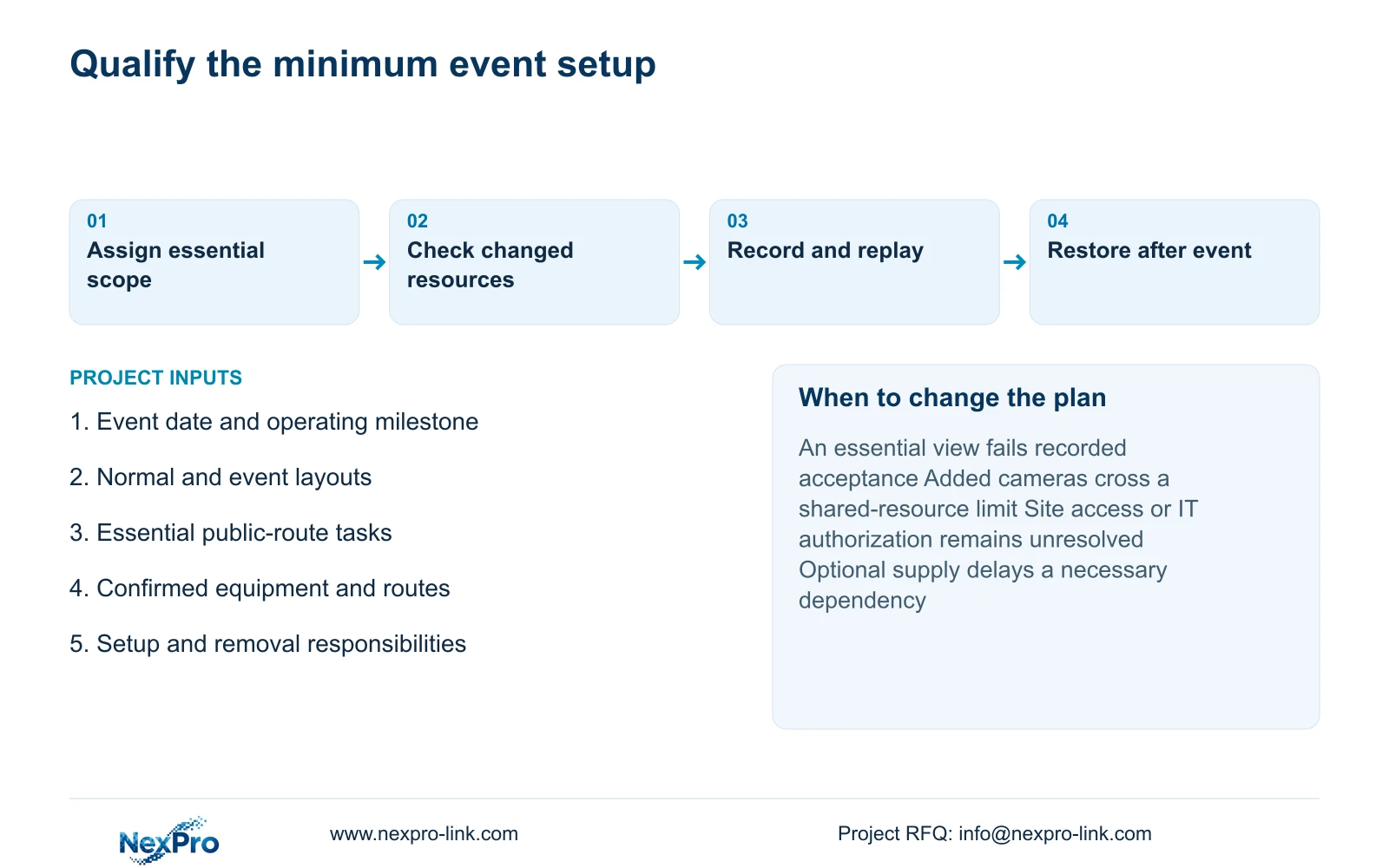
Proceed with the minimum qualified setup when those essential tasks pass and responsibilities are assigned. If a required task fails, revise the affected view or dependency and retest instead of hiding the issue behind an optional screen. Send the event date, normal/event layouts, essential public routes and confirmed equipment list to info@nexpro-link.com for a scoped equipment discussion. Include destination if new supply is being considered.
Section 07
Buyer questions
Does a one-day review mean new equipment can be ready in one day? No. The review can prioritize work and identify release decisions. Availability depends on actual approval, preparation, transport and site inputs. The independent teaching programme completes at day 30 when its stated branches run in parallel.
Should an optional video wall delay the essential event setup? Only if the agreed operating task genuinely depends on that wall. Otherwise keep its release separate and qualify essential recording and a usable authorized viewing position first.
What is the minimum useful supplier inquiry for an urgent event? Provide the event date, essential public-route tasks, marked normal and event layouts, and confirmed available equipment. State the specific unresolved dependency and any mandatory platform requirement; do not send guest footage or credentials.
Engineering references
These sources support the general planning principles. Always use the selected product's current datasheet and applicable project standards for final design.