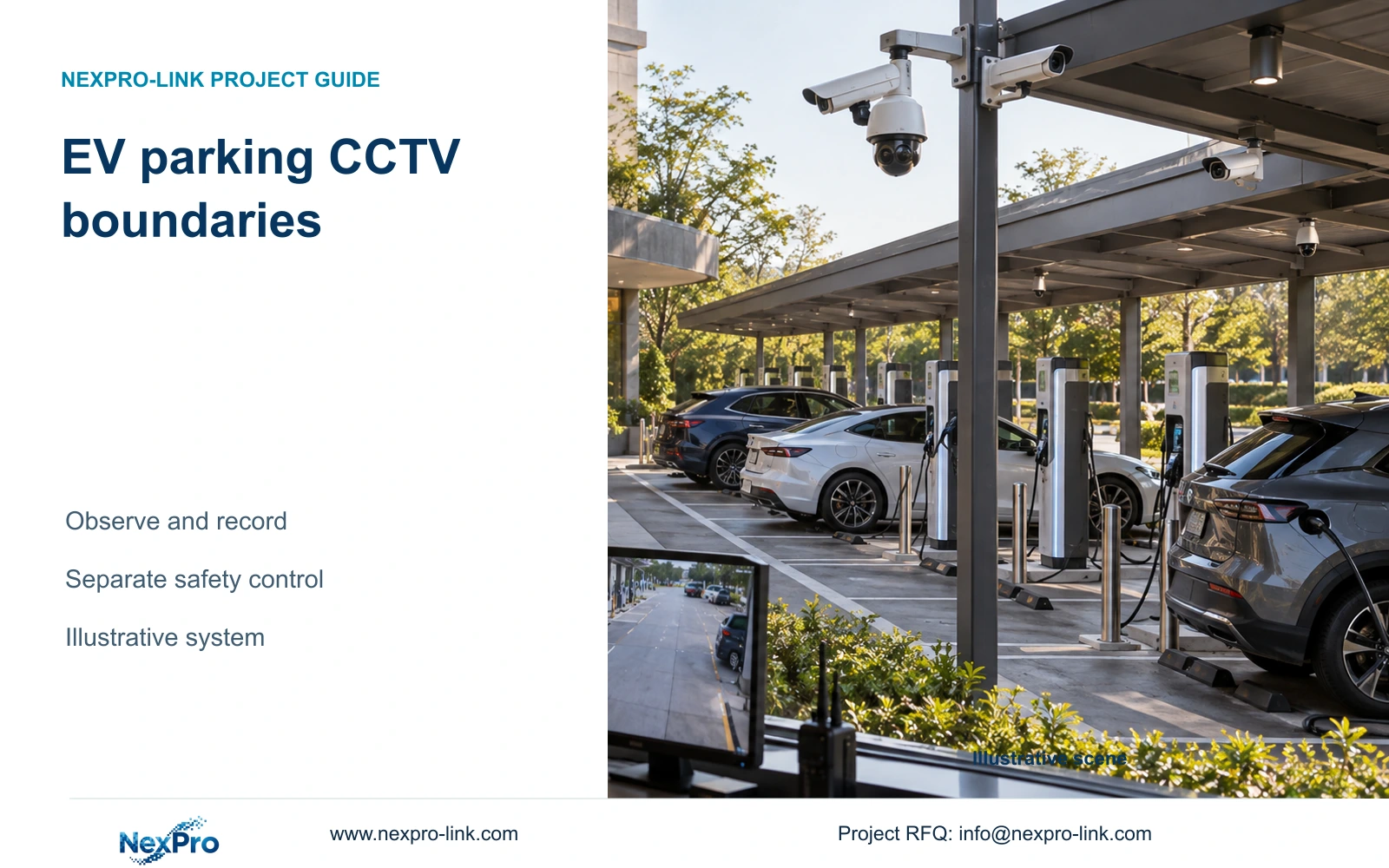
Use ordinary CCTV for approved observation and incident review in EV parking areas. Keep specialist detection and charging control with their responsible systems, and add interfaces only when their functions are supported.
Section 01
Define the parking observation and recording purpose
Choose ordinary CCTV for approved visual observation, recording and incident review around hotel EV parking. Keep specialist hazard detection and charging control in their dedicated scope. Add a display or interface only when the hotel has a defined operating task and the selected equipment supports it; general video capability does not qualify a charger safety function.
Describe the event that staff need to see and retrieve. Relevant tasks may include observing a pedestrian approach, reviewing vehicle movement around charging bays or locating footage around a reported incident. Assign the task to a permitted public view, recording profile and authorized user. Exclude unnecessary private views and decide audio separately.
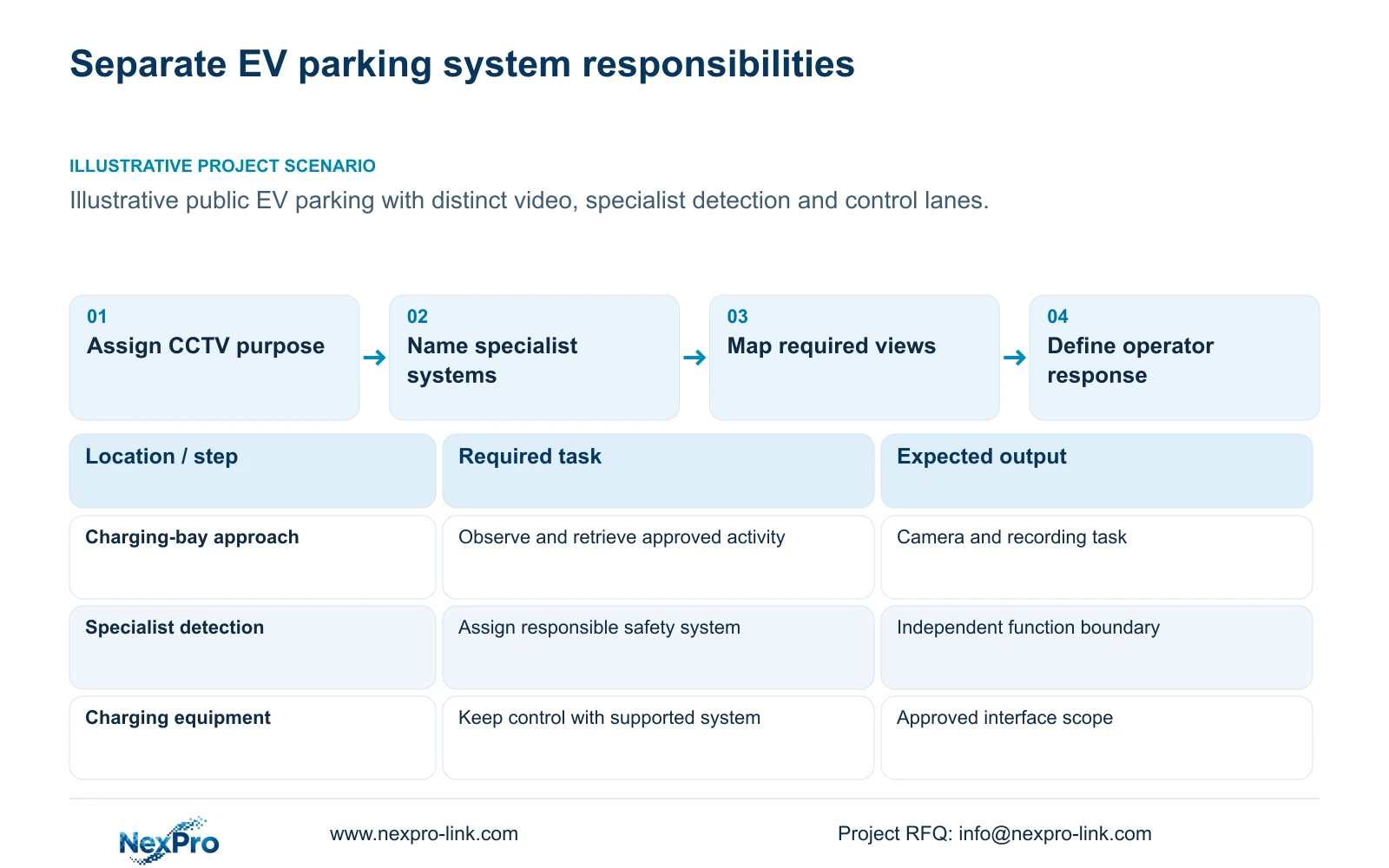
The camera schedule should identify the responsible system for each outcome. Video can provide visual context around an event, while a charging transaction or safety signal has its own source and owner. A single supply quotation can coordinate those categories without establishing automatic integration or transferring specialist design responsibility to the CCTV equipment.
| Required task | Given information | Decision still needed |
|---|---|---|
| Review bay-area activity | Approved public camera views | Recording and retrieval requirements |
| Respond to specialist detection | Separate safety-system scope | Responsible specialist and supported response |
| Control charging equipment | Charger system responsibility | Approved control design and interface |
Section 02
Separate specialist safety and charger functions
Name specialist detection, charging control and operator observation as separate functions in the proposal. Ordinary camera recordings should not replace required detection or control equipment. The relevant local specialists must define the safety design and response under project requirements; this article supplies no universal legal requirement or specialist system qualification.
Person and vehicle detection in a camera specification do not establish fire detection, thermal monitoring or plate recognition. NexPro-BL2812M55-5MP-DIC-AI is a 5MP motorized-lens candidate in the supplied PDF, with dual light, PoE and IP66 fields. Those are camera facts. None is evidence that the model provides a charging safety controller or dedicated hazard detector.
Compare the proposed interface by the actual action it performs. An operator opening a relevant view after receiving an external notification differs from automatic equipment control. If the project requires either function, identify its source, supported receiver and responsible implementation party. Price that scope explicitly instead of treating a general analytics label as proof that every event is handled.
Section 03
Map visible routes and their equipment dependencies
Map pedestrian approaches, ramp movements and the approved bay-area views before fixing quantities. Give each point a target task and identify the recording destination. CASE09 uses 16 illustrative positions across ramps, entrance overviews, pedestrian approaches and circulation. Its quantity is a teaching schedule, not an EV-bay ratio or a delivered hotel design.
Trace the data route from each camera through access networking to the recorder. Where a remote active node is needed, include its enclosure, power and maintenance access. Fiber does not automatically supply power to the remote switch. Adding an extender or another switch also changes the failure boundary and supported throughput.
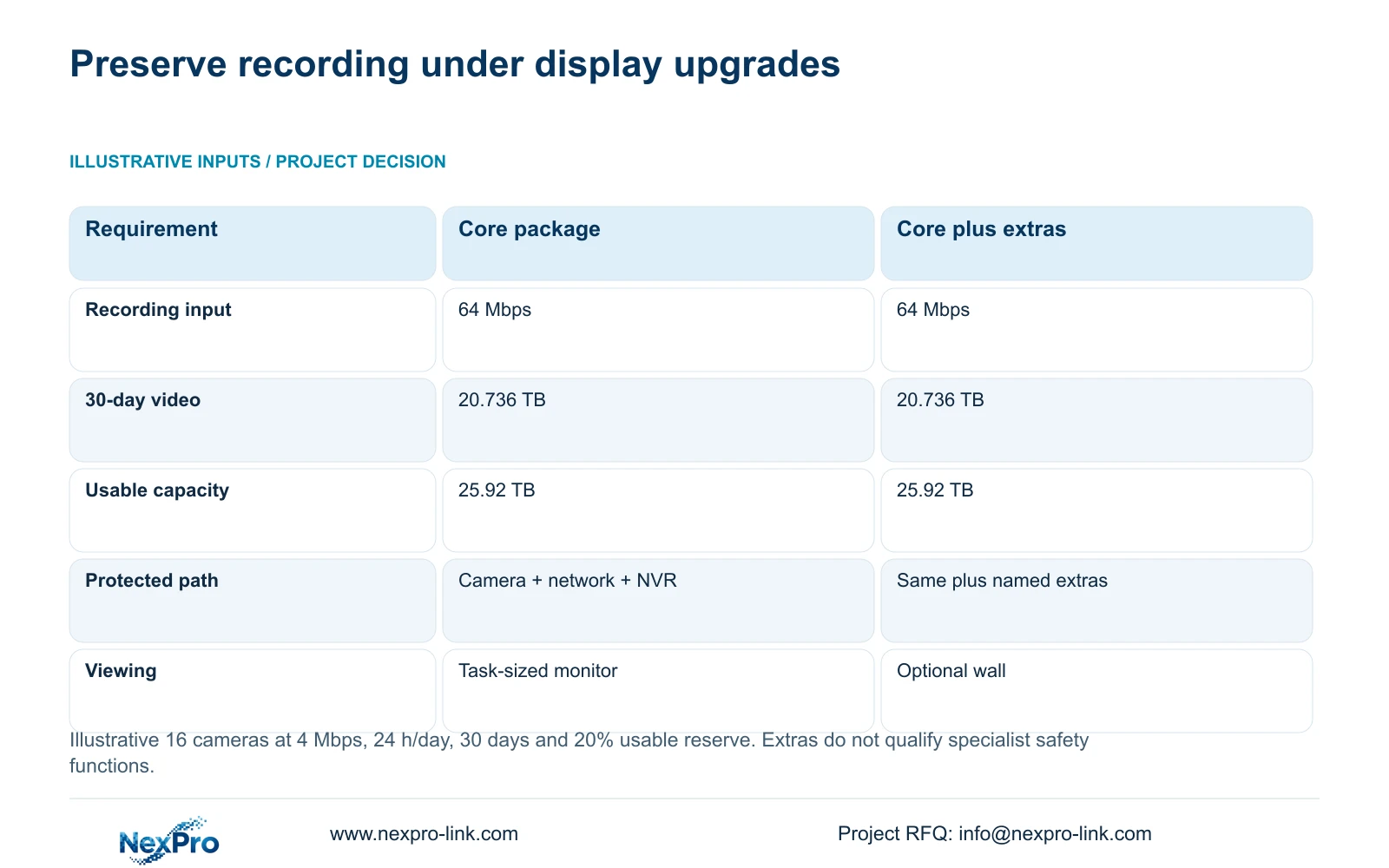
For the independent article calculation, assume 16 cameras at an average 4 Mbps, recording continuously for 30 days. Input is n × 4 Mbps, giving 64 Mbps. Video volume is 0.0108 × n × 4 × 30 decimal TB, giving 20.736 TB. The coefficient applies to 24-hour recording and the stated bit-to-byte conversion. These rates and periods are scenario inputs, not camera specifications or legal retention defaults.
Section 04
Connect recording and displays without changing the core
Reserve 20% of usable storage by dividing the 20.736 TB video volume by 0.80, giving 25.92 TB. Both package options preserve that requirement. A wall display changes the operator's viewing arrangement; it does not reduce the required recording volume or create a safety-detection service.
NexPro-NVR4449-4K lists 320 Mbps input, four SATA positions and 18 TB per disk. Its summary includes 49×5MP/9×4K, so the channel count does not establish arbitrary 8MP concurrency. Check the actual recording modes, usable disk arrangement and retrieval task. CASE09 shares these article storage inputs, but its separate power and cable assumptions must still be identified before reuse.
Start with a task-sized monitor or workstation. Add a wall for an approved continuous-observation requirement, with the signal and decoding scope included. NX-VP-5535 is a 55-inch 1920×1080 LCD with a listed 3.5mm seam, not direct-view LED. NX-VD-4K16 remains a decoder candidate; its name does not prove sixteen simultaneous 4K streams. Recording must remain operational independently of the optional display.
| Metric / condition | Essential recording-first package | Same core plus optional display/recovery scope |
|---|---|---|
| Recording input (Mbps) | 64 | 64 |
| 30-day video data (TB) | 20.736 | 20.736 |
| Required usable capacity (TB) | 25.92 | 25.92 |
| Protected path | Cameras + network + recording | Same plus explicitly selected extras |
| Operator display | Task-sized monitor/workstation | Optional wall; independent recording |
| Cost comparison | Complete scope quotation required | Add only documented incremental scope |
Section 05
Include only supported and approved interfaces
Write an interface schedule with the originating system, receiving system and intended operator action. Identify the exact models and software versions used to support each function. Leave an unsupported automatic link outside the committed scope while retaining a clear manual response path where the hotel approves one.
ONVIF profile matching can help examine relevant video functions, but it does not establish charging-system compatibility, every alarm event or cloud account behavior. Shared procurement, a network connection and common screen access each describe different relationships. Confirm the required function before describing them as an integrated operating system.
Evaluate optional interface costs alongside the retained outcome. An event-linked view may justify platform work if staff need it and the exact configuration supports it. If the responsible safety system must remain independent, preserve that requirement. A sample review is an assessment input; it neither guarantees operator approval nor authorizes an equipment substitution in a mandated system.
Section 06
State the complete supply and protected-power boundary
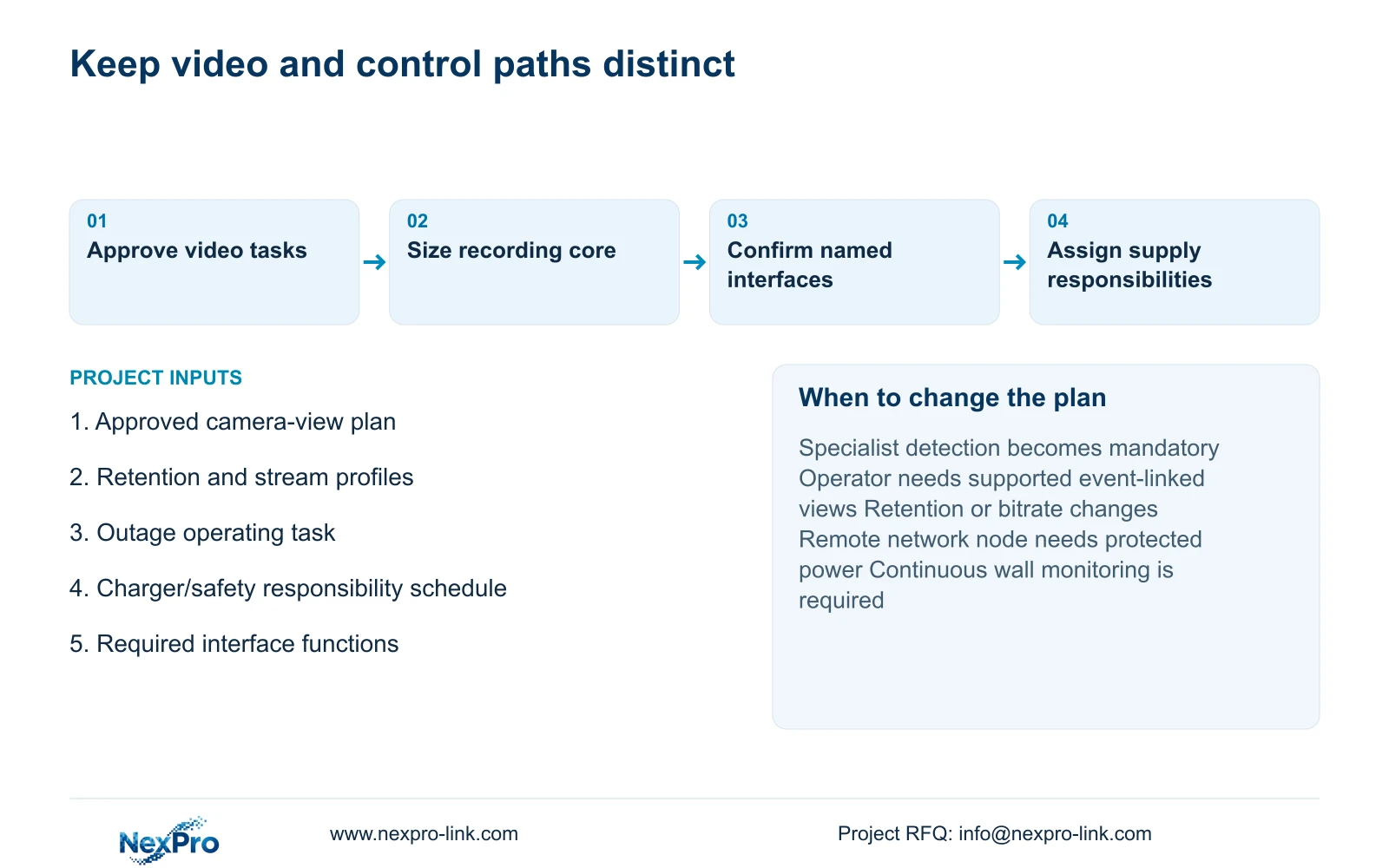
Recommend the recording-first package when approved observation and local retrieval are the CCTV tasks. Add display or recovery scope when the owner specifies a supported need. Change the proposal if mandated specialist detection, charging interfaces or different retention requirements arise, while keeping those functions assigned to their responsible systems.
Show power separately from data. Protect the camera, required network and recording path in each actual electrical zone; a central UPS nameplate does not resolve remote supplies. Calculate per-group PoE output and protected W/VA separately. NexPro SW-POE1618G has conflicting access-speed fields and no stated total PoE watts, so it remains a candidate requiring clarification. UPS capacity also does not establish battery runtime.
Send the approved EV parking views, retention target, outage task and charger/safety responsibility schedule to info@nexpro-link.com, with the destination. NexPro-Link can discuss CCTV manufacture and coordinated equipment supply through hotel project equipment support. The written scope must identify local work and third-party interfaces. The supplied policy records a 24-month limited hardware baseline from receipt for applicable main equipment; batteries, storage, cable and project-specific terms remain separately scoped.
Section 07
Buyer questions
Can the proposed cameras replace dedicated charging safety equipment? No such capability is established by the supplied camera records. Keep specialist detection and charging control with their qualified project scope; use the CCTV package for approved observation and review.
Does the optional wall need to run for recording to continue? The design should keep recording independent of the wall. Define which displays must remain available during an outage and budget their supported signal path and power separately.
What should an EV parking equipment RFQ include? Send the approved camera-view plan, recording requirements and outage task. Add the charger and safety-system responsibility schedule, identifying any required interfaces and mandatory equipment.
Engineering references
These sources support the general planning principles. Always use the selected product's current datasheet and applicable project standards for final design.