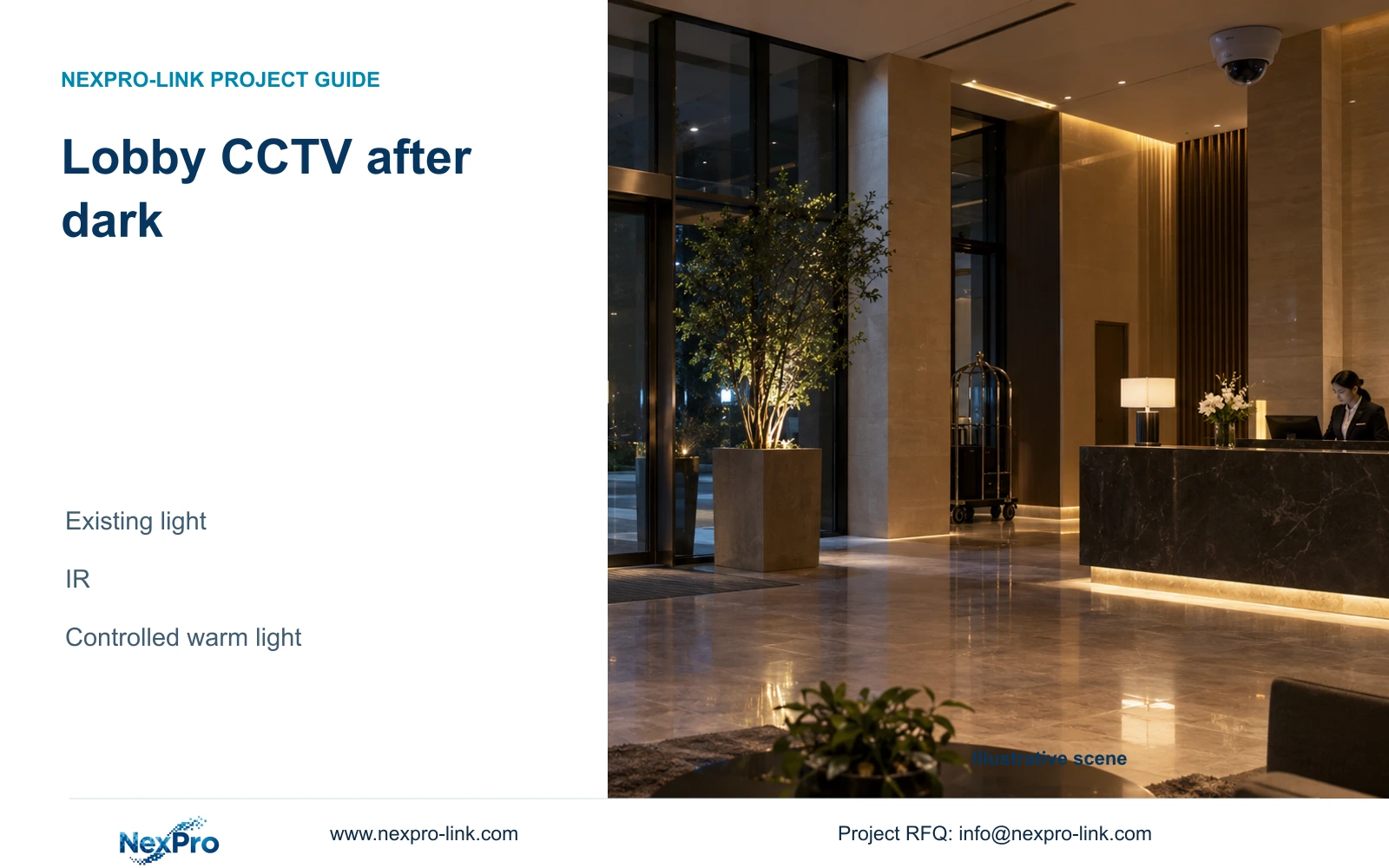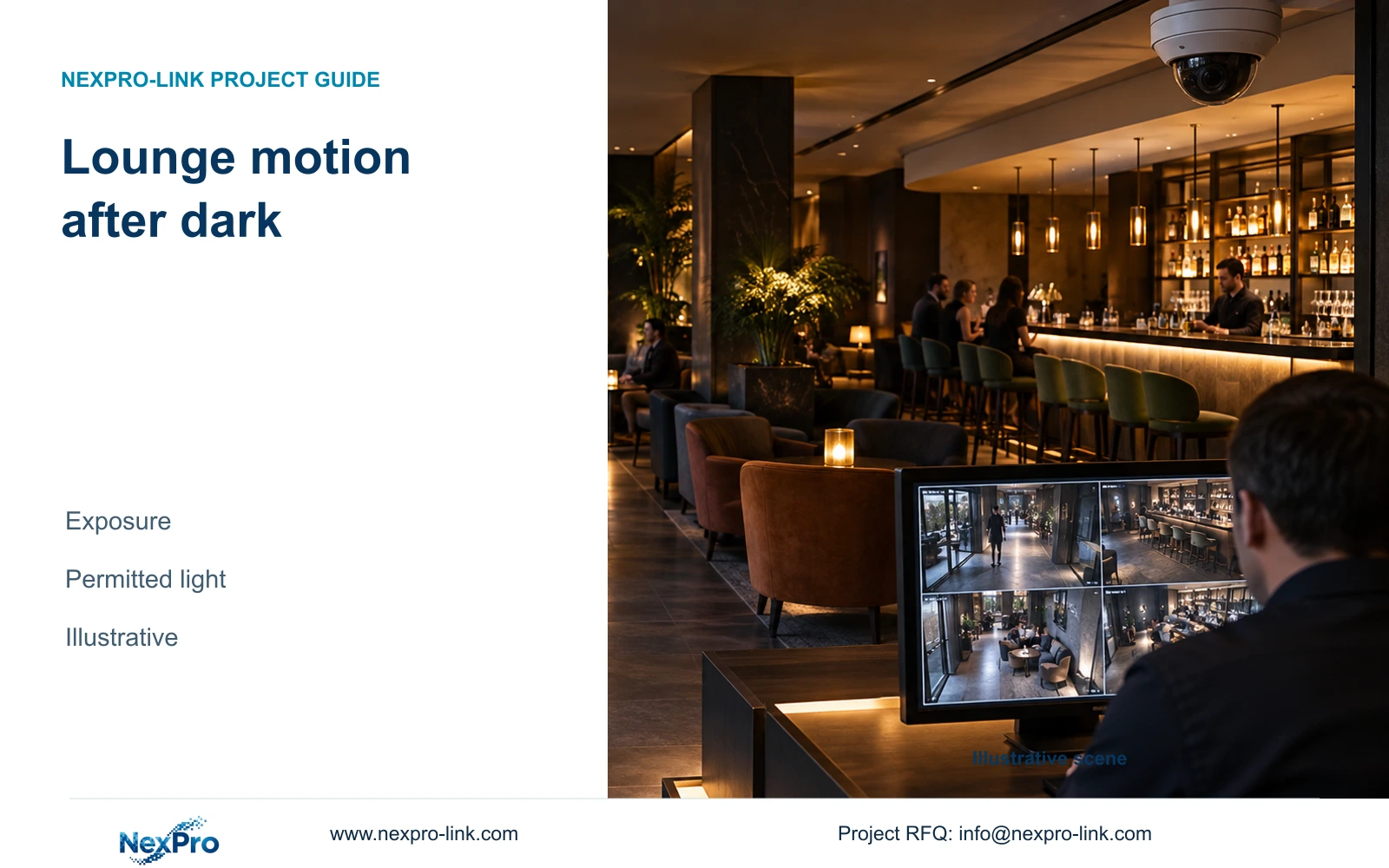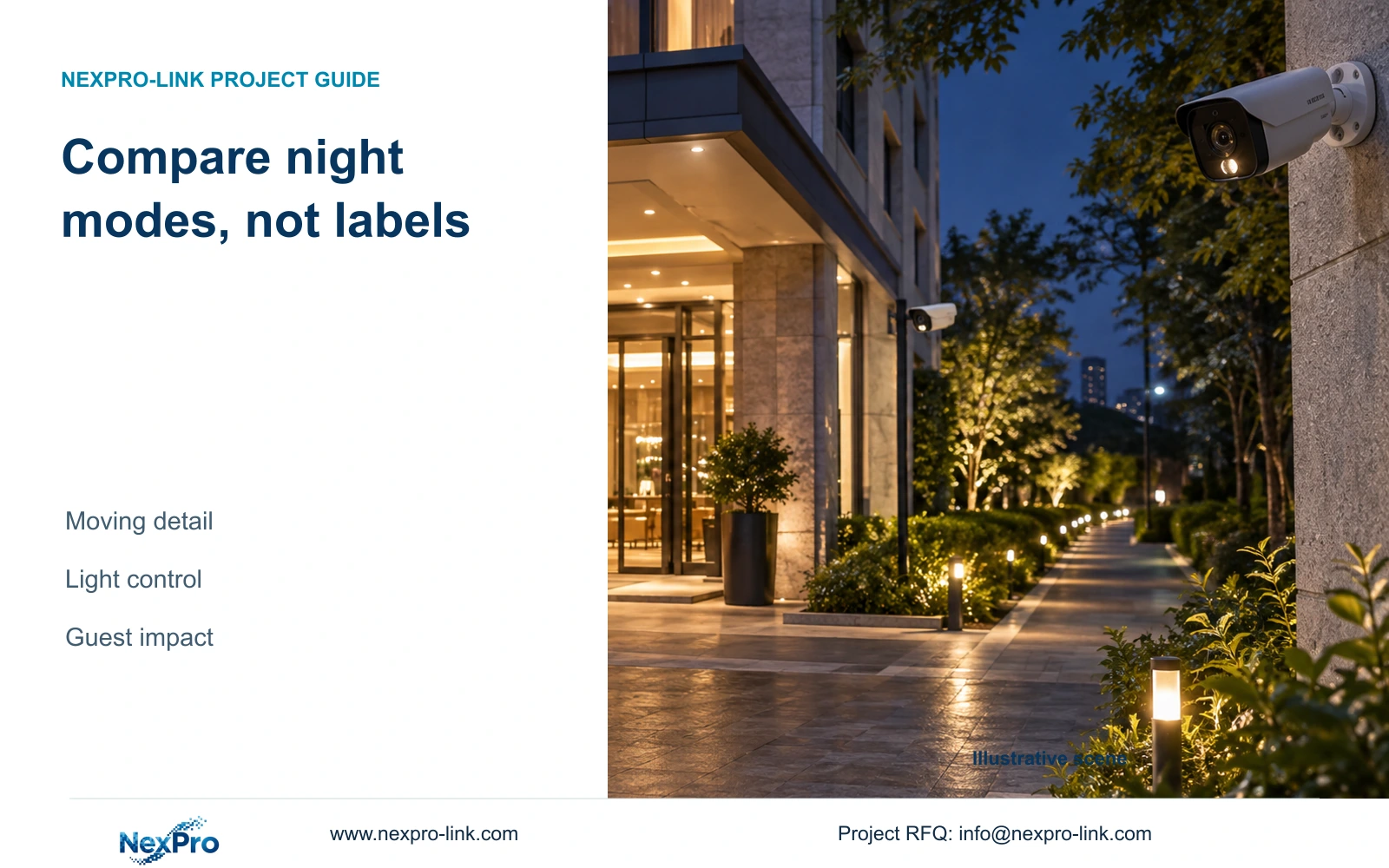
Dual light, ColorVu and Smart Dual Light labels do not establish the same night workflow. Select the actual mode by recorded motion detail and the hotel's permitted illumination.
Section 01
Separate imaging requirements from light control
Choose a camera and operating mode that preserves the required moving detail under the hotel's permitted lighting conditions. Consider dual light where visible illumination is acceptable and the selected mode supports the task. Use an appropriate IR or alternative arrangement where light spill is restricted. ColorVu, Smart Dual Light and a dual-light description cannot establish equivalent operation without exact model evidence.
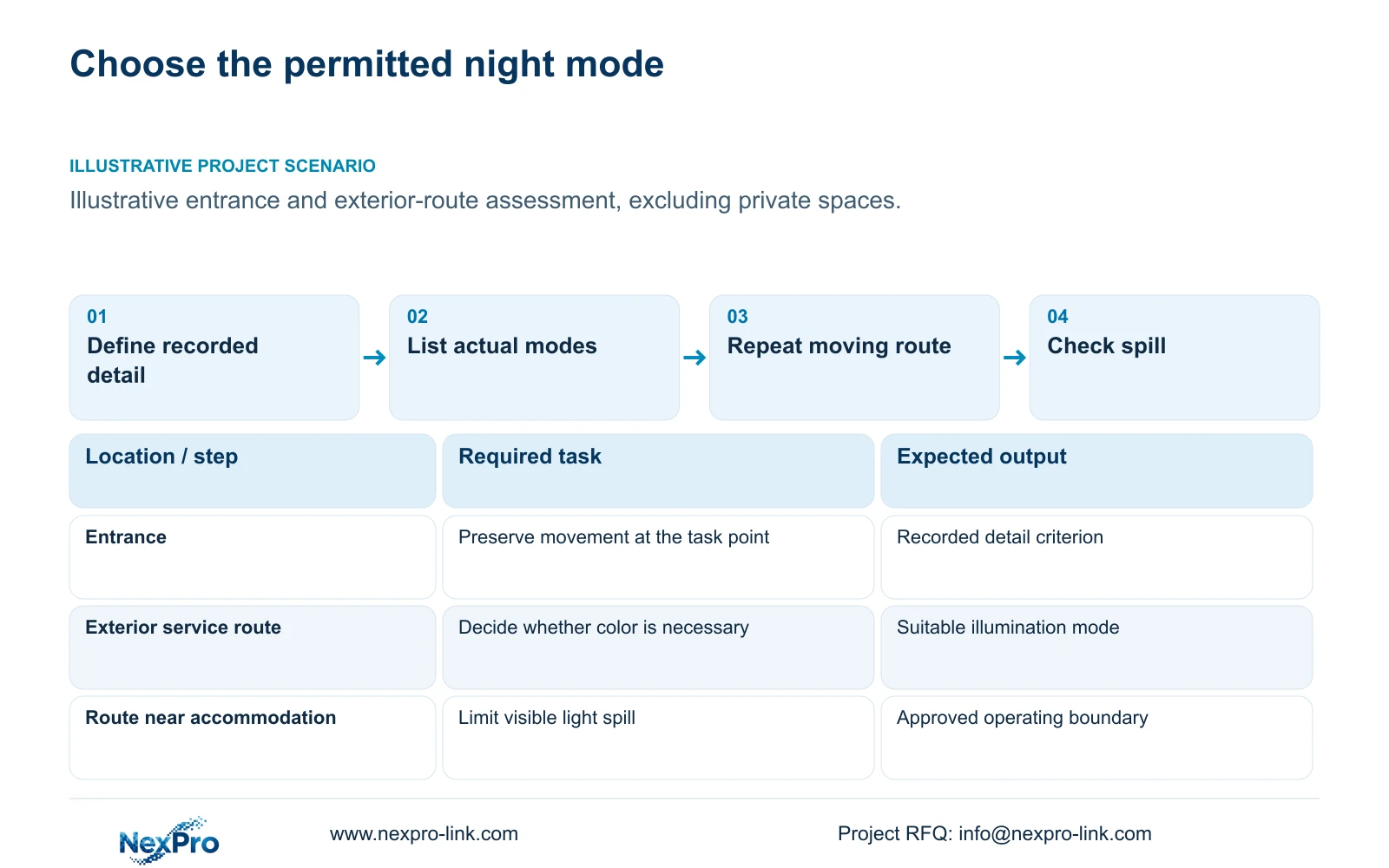
Separate the need to see a subject from the need to retain color information or useful motion detail. An exterior service overview can have a different requirement from an entrance incident view. State the required recorded outcome before comparing a minimum-lux headline or a bright still image.
Imaging capability and lamp control are separate decisions. Sensor and optical fields describe part of the image system, while illumination modes determine when IR or visible light operates. A buyer needs both to qualify a night proposal. The comparison below defines an assessment method; it contains no measured winner among the named product families.
| Required task | Given information | Decision still needed |
|---|---|---|
| Entrance movement | Night incident view required | Detail, exposure and permitted illumination |
| Exterior service overview | Limited ambient light | Whether color is necessary |
| Route near accommodation | Potential light spill | Approved lighting boundary |
Section 02
Record the available operating modes
For each exact candidate, list documented IR, visible-light and event-triggered choices. Identify what controls switching and whether an operator can select a fixed mode. Leave unsupported fields unresolved. A family label cannot supply a trigger rule, switching delay or simultaneous-light behavior for an unspecified camera.
The supplied BL2812M PDF lists NexPro-BL2812M55-5MP-DIC-AI with dual light, 25 fps at 5MP, 2880×1620 main output and a 2.8-12 mm motorized lens. It does not provide a verified maximum power value or the full mode logic needed for this comparison. Obtain those fields for the offered configuration before approving its night operation.
A Hikvision hotel overview does not define the operating modes of an offered ColorVu model. Likewise, a named Dahua regional product cannot define every Smart Dual Light camera. Obtain each exact model's mode description. Minimum-lux values need their aperture, exposure and gain conditions; retain unmatched figures separately instead of constructing a numerical night ranking.
Section 03
Fix a representative moving target
Use an authorized representative target on a defined public route, with a repeatable movement and relevant lighting. Agree where the recording must preserve detail and which stream the reviewer will examine. Compare clips at the same task point. A color still taken after movement stops cannot resolve whether the preceding incident was recorded clearly.
Frame rate and exposure address different parts of motion. Frame rate sets sampling intervals; exposure affects movement within an individual frame. Shortening exposure changes the light and noise balance. Record those conditions so a darker but sharper clip and a brighter blurred clip can be evaluated against the hotel's actual task.
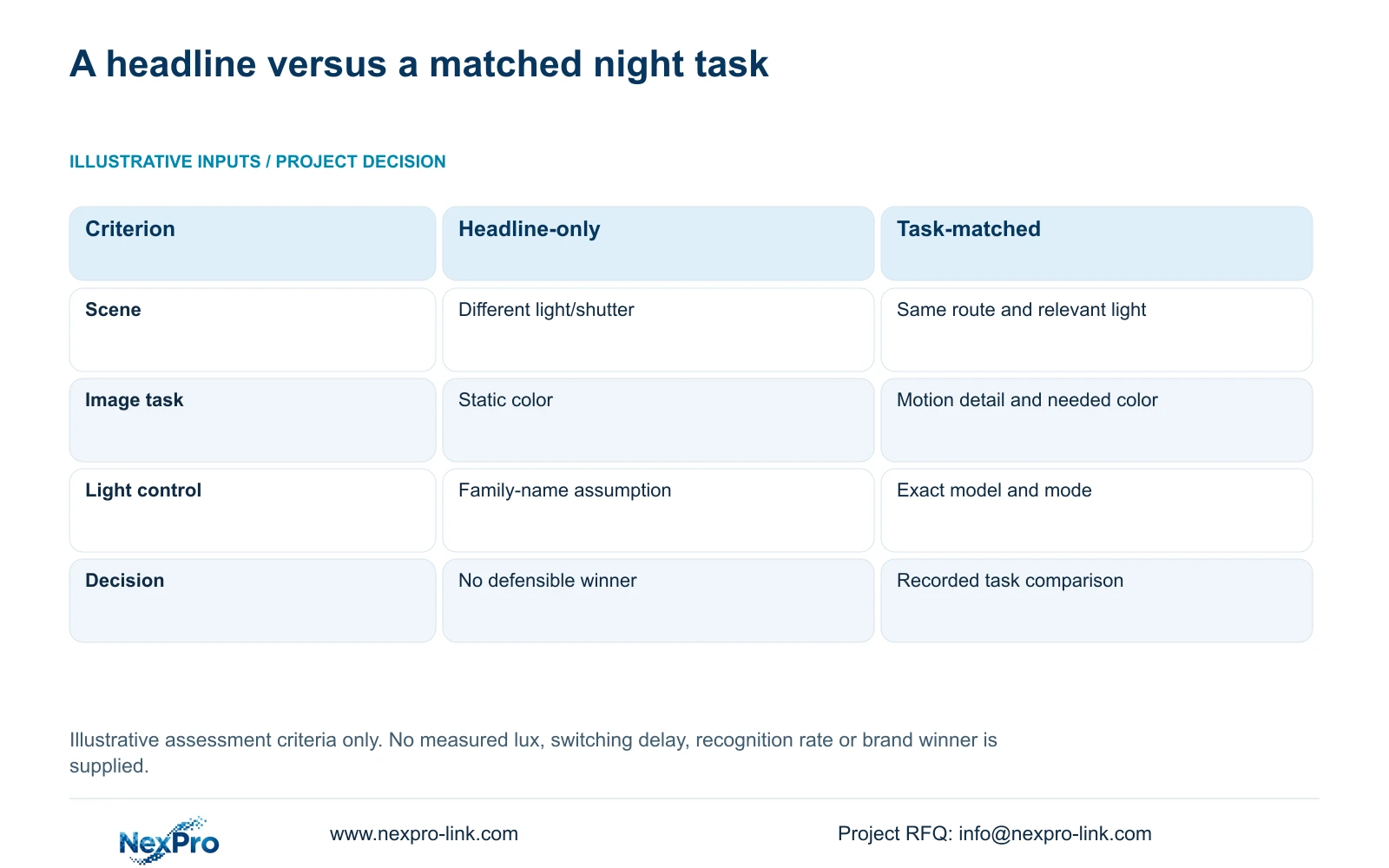
The decision table keeps this assessment separate from product claims. Its preferred method is the task-matched comparison because the route and operating conditions are controlled. It supplies no passed test results. If candidates require different illumination to meet the same task, retain that difference and carry its power, installation and guest-impact consequences into the proposal.
| Metric / condition | Single low-lux headline | Task-matched night comparison |
|---|---|---|
| Scene | Different light and shutter conditions | Same target route and relevant light |
| Image task | Static color appearance | Motion detail plus required color/overview |
| Light control | Assumed by marketing family | Exact model and selected mode |
| Decision | No defensible winner | Choose after recorded task comparison |
Section 04
Compare transitions and scene suitability
Include the approach to the target point, the illumination transition and the subject's departure in the recorded review. An event-triggered arrangement must be assessed during the event it is intended to support. Check whether the required detail is available at the relevant moment, rather than reviewing only the settled image after a lamp has switched.
Hotel glass and reflective finishes can change an apparently suitable view. Compare the proposed position with alternatives that avoid troublesome reflections while retaining the approved public task. A position change can be worth evaluating before increasing resolution. Do not extend the view into guest rooms or other sensitive spaces to solve a framing problem.
Describe results as observed only after the assessment takes place. Retain the model, firmware, exposure and lighting conditions with the clip review. If the transition fails the agreed task, revise the mode, location or lighting arrangement and repeat under the same conditions. The source package establishes this evaluation design, not switching performance for any named camera.
Section 05
Include lighting power and guest impact
Request camera power for the selected night state, including the relevant illumination peak. Budget each PoE group at the device and switch-output boundaries, then carry an appropriate AC load into its protected-power zone. The hypothetical 12 W per-camera value in CASE01 cannot fill the missing maximum-power field for a dual-light SKU.
NexPro SW-POE1618G has no numerical total PoE budget in the supplied record and has conflicting access-speed fields. It remains a candidate for clarification, not proof that every proposed night mode can be powered. Check per-port capability and simultaneous group demand before accepting a switch configuration.
Assess visible light from the affected public route and nearby accommodation. Define permitted spill and trigger behavior with the hotel team, and include any external lighting in the scope. Use dual light where those conditions permit it; consider an appropriate IR arrangement where color is unnecessary or visible light is restricted. Ordinary optical cameras do not become thermal cameras through a night-mode setting.
| Retained outcome | Additional scope worth considering | Condition changing the choice |
|---|---|---|
| Required night color detail | Approved visible illumination and its power | Light spill or switching fails the task |
| Public-route overview | Suitable IR mode | Color is essential to the incident task |
Section 06
Recommend value for the selected mode
Use a task-matched night comparison as the selection basis. Recommend a documented dual-light configuration for positions where visible light is permitted and its recorded movement meets the agreed requirement. Change to an appropriate IR or other arrangement when spill restrictions, reflections or transition behavior make that configuration unsuitable. A different entrance exposure can also require a different candidate.
Compare complete costs after mode selection. Include the associated PoE requirement, any added lighting and the supported recording profile. A more attractive color preview cannot compensate for missing motion detail or unsupported recorder modes. NexPro-Link can discuss candidate matching and coordinated equipment supply, while local lighting placement and installation remain separately assigned responsibilities.
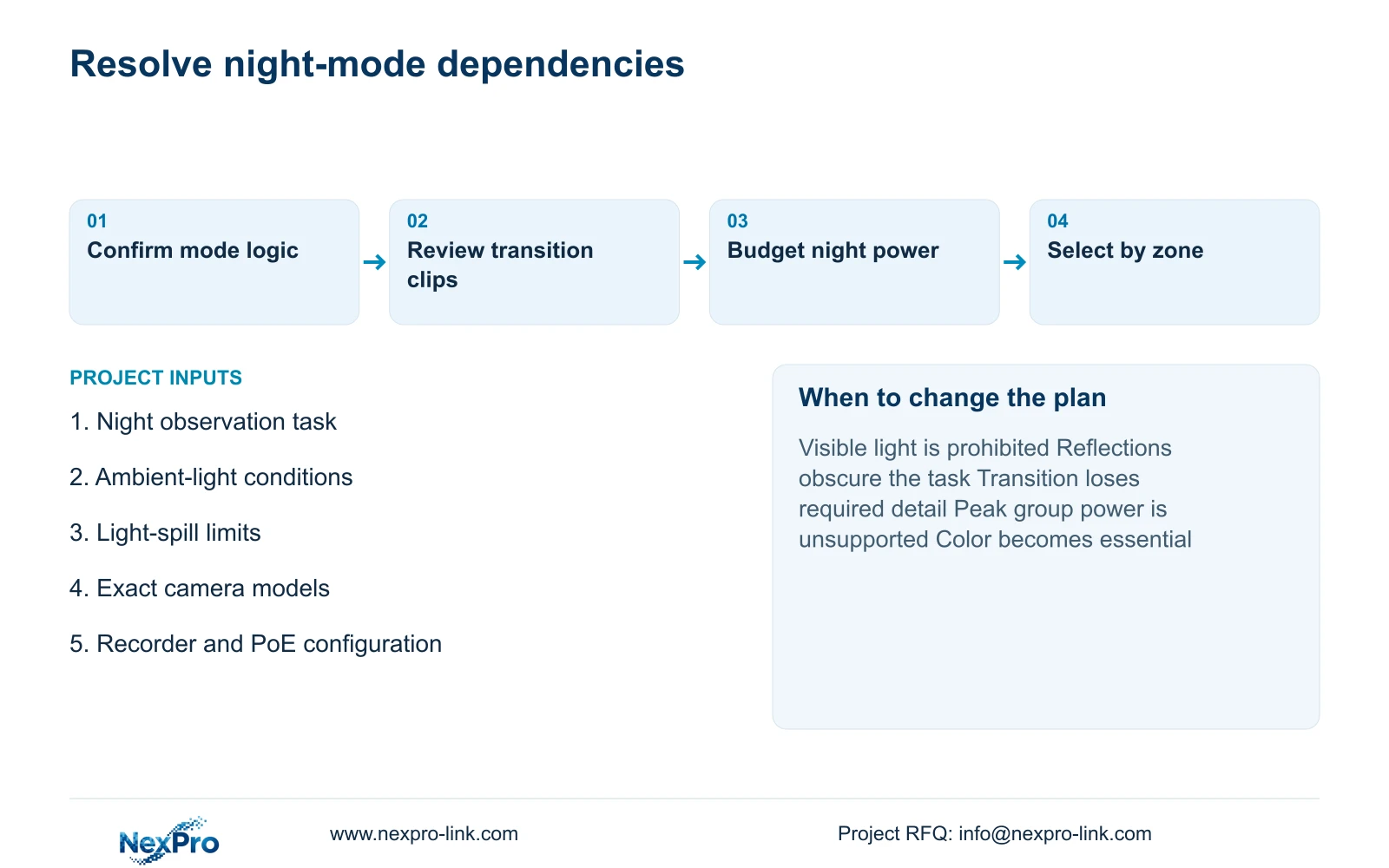
Send the night task, relevant ambient-light conditions and light-spill limits to info@nexpro-link.com with the exact camera candidates and recorder. State whether event-triggered visible light is acceptable. The hotel project equipment support and BOQ and tender support routes can use that focused brief without requiring guest footage or credentials in the initial inquiry.
Section 07
Buyer questions
Can a low-lux value replace a night trial? No. It describes performance under stated conditions, which may differ from the hotel's moving-target task. Use it to understand the specification, then compare the relevant recorded workflow.
Must dual-light capability be used at every point? No. Select a supported operating mode for each position. The hotel may permit visible light on a service route while restricting it near accommodation; confirm that the offered model supports the intended choice.
What should a supplier provide when mode details are missing? Request the exact model's mode descriptions, control behavior and peak power conditions. Keep the affected selection open until those details support the task and network-power budget.
Engineering references
These sources support the general planning principles. Always use the selected product's current datasheet and applicable project standards for final design.