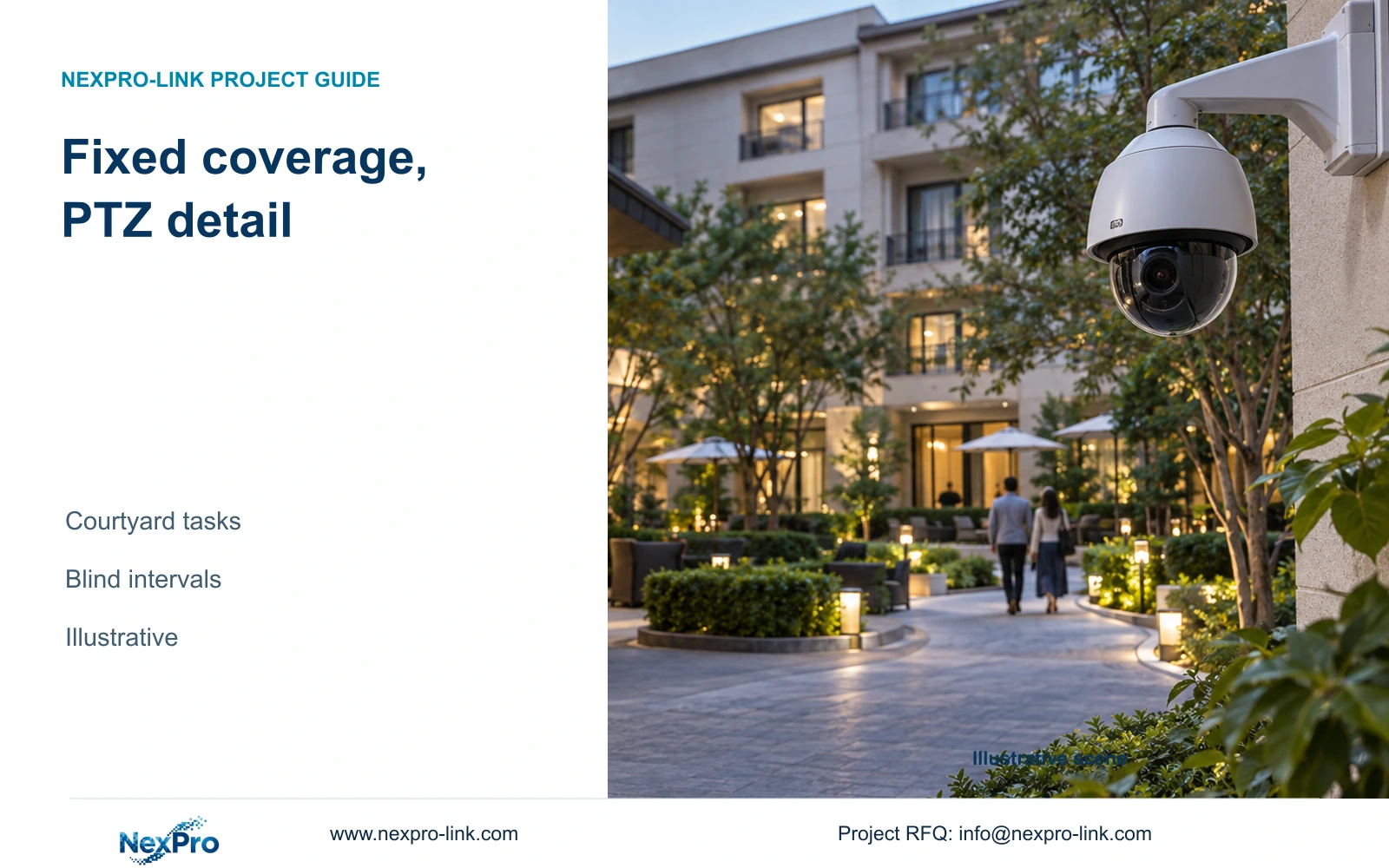
Use fixed cameras for courtyard actions that must remain recorded continuously. Add PTZ only for a defined patrol or detail task, with its blind intervals and operating responsibilities explicit.
Section 01
Assign continuous courtyard tasks to fixed views
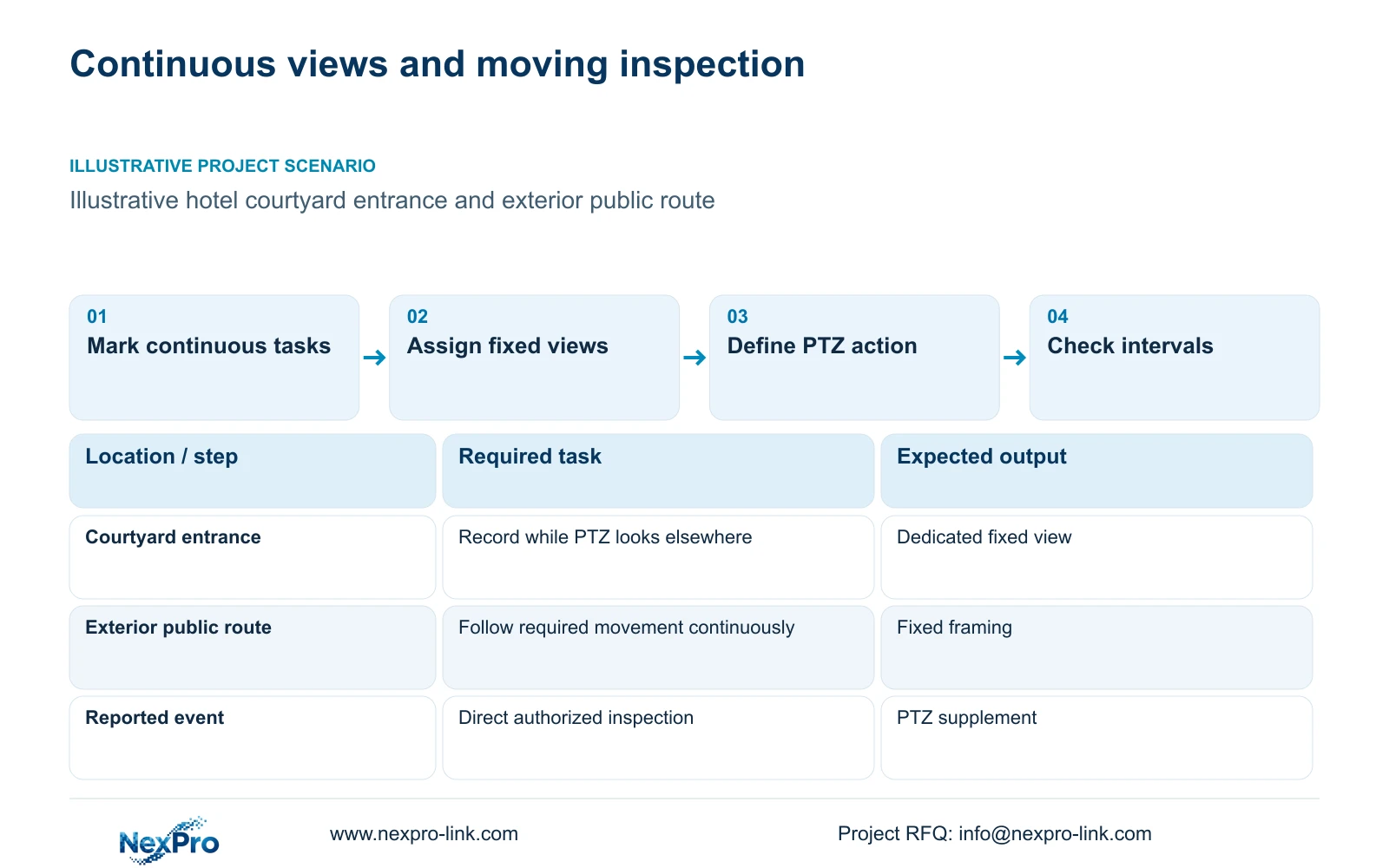
Use fixed views for courtyard entrances and public routes that must remain visible continuously. Add a PTZ camera when the hotel has a defined patrol or operator-directed detail task that the fixed layout cannot provide economically. A camera that turns between areas leaves some areas outside its current view, so its movement cannot establish continuous coverage of every target.
Begin with the hotel's required actions, such as following a person through a public courtyard entrance or reviewing movement along an exterior service route. Identify the locations where an event must remain recorded even while an operator investigates elsewhere. Give each location a permitted view boundary and a continuous or intermittent observation requirement.
A courtyard overview and entrance detail may require different framing. Combine them only when the recorded image preserves both tasks. The 100-room CASE01 reference illustrates task-based camera allocation, not a camera-per-room rule or a delivered courtyard project. Its exterior counts should not be copied onto another plan without reviewing the actual routes.
| Required task | Given information | Decision still needed |
|---|---|---|
| Record a public entrance continuously | Events can occur during patrol movement | Fixed view and required detail |
| Inspect a reported courtyard event | Operator can direct a camera | PTZ control and return workflow |
Section 02
Define who uses PTZ and for what action
Specify the action that justifies PTZ control. An authorized operator might select a reported location, inspect it and return to the agreed overview or patrol state. Define who receives the report, who can move the camera and how the resulting recording is found. A joystick or control menu alone does not establish a useful operating workflow.
Separate hotel security, IT and installer responsibilities. Security may need daily viewing and PTZ control; IT may manage access and network settings. Installer access should follow the hotel's approved support arrangement. Confirm these roles against the actual client and device capabilities rather than assuming every user can receive a suitable permission level.
If a proposal includes presets, tours or automated movement, request the exact supported functions and software versions. Verify control, recall and recovery behaviour in the selected configuration. ONVIF profile matching can support relevant compatibility checks, but it does not establish every PTZ function, event workflow or third-party account behaviour.
| Operating point | Fixed layout | PTZ supplement |
|---|---|---|
| Routine view | Assigned framing remains in place | Current direction must be known |
| Incident detail | Open the relevant fixed recording | Authorized control and retrieval required |
| Continuous entrance record | Dedicated fixed view | Retain a separate view during movement |
Section 03
Compare preset detail and blind intervals separately
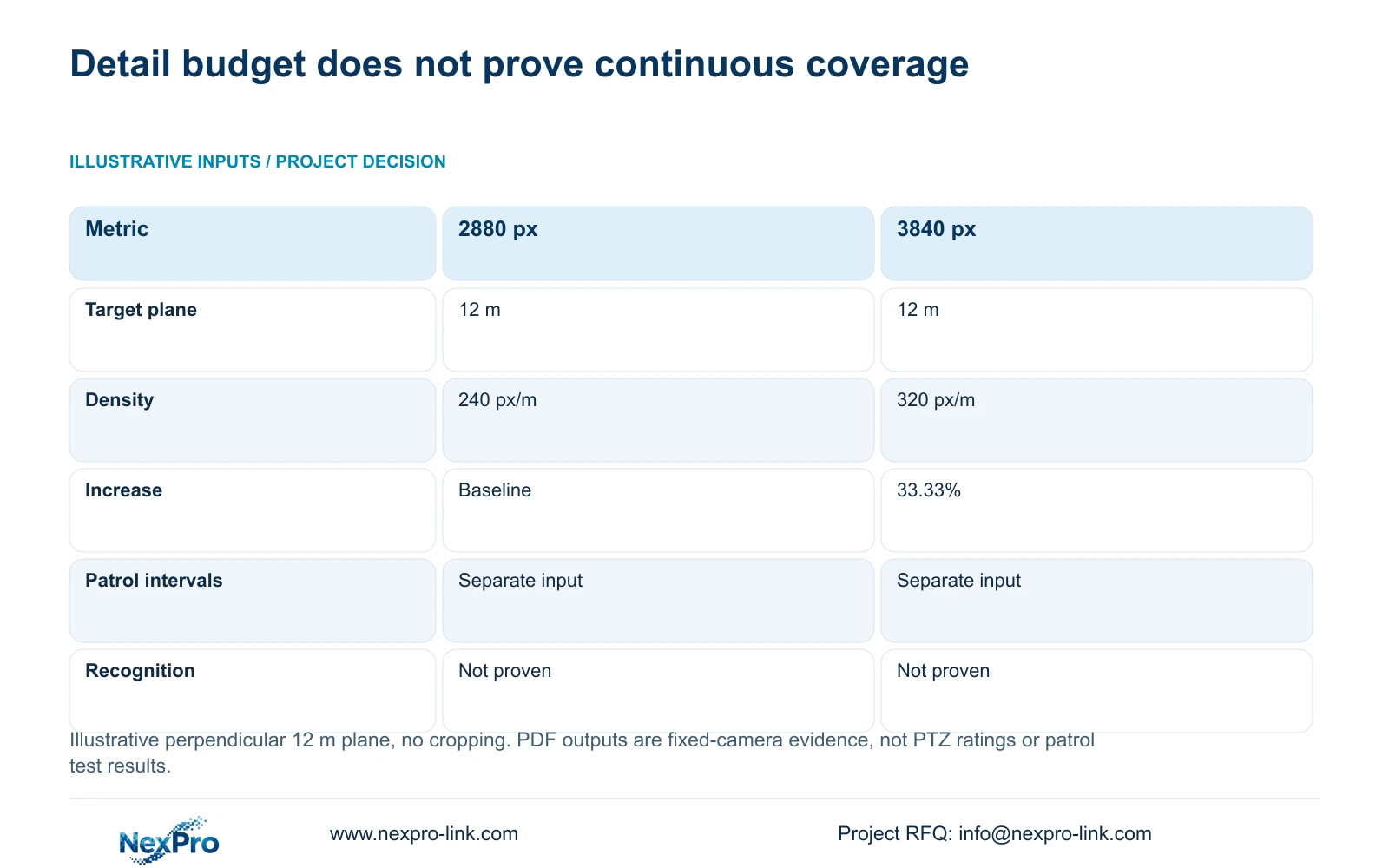
For each proposed preset, record the target area and dwell time. The interval before that area is seen again includes time spent at other positions and movement between them. Obtain the actual configured sequence before calculating those intervals. No patrol timings are supplied here, so the comparison cannot claim a numerical blind interval or a completed coverage result.
Evaluate detail while the camera is looking at a target separately from whether it is looking there when an event occurs. The supplied fixed-camera PDF output widths provide an illustrative geometric comparison at a 12 m perpendicular target plane. Planning density equals horizontal pixels divided by width: 2880/12 gives 240 px/m and 3840/12 gives 320 px/m.
The 33.33% increase concerns equal-width pixel allocation. It is not a PTZ specification, a recognition result or evidence that a preset can replace an always-on entrance view. A preset with adequate detail still needs a fixed companion when the hotel's task requires uninterrupted observation while the PTZ looks elsewhere.
| Metric / condition | 2880 px output | 3840 px output |
|---|---|---|
| Output width (px) | 2880 | 3840 |
| Same target width (m) | 12 | 12 |
| Planning pixel density (px/m) | 240 | 320 |
| Increase relative to first option | Baseline | 33.33% |
| What is not proven | Recognition / night performance | Recognition / night performance |
Section 04
Map each camera's network and power requirements
Draw the fixed and proposed PTZ connections on the actual courtyard topology. Identify access ports, uplinks and the recorder receiving each stream. Add control and simultaneous viewing tasks where they use the same path. Do not copy the total system traffic onto every segment or assume a camera's resolution supplies its bitrate.
Select the PTZ power arrangement from its exact specification, including relevant peak operating states. The evidence package supplies no verified PTZ SKU or peak wattage. A motorized varifocal lens is not a PTZ mechanism: NexPro-DM2812M55-5MP-DIC-AI and NexPro-DM2812M88-8MP-DIC-AI are documented dome candidates with 2.8–12 mm lenses, not confirmed patrol cameras.
NexPro SW-POE1618G can be discussed as a 16-port PoE candidate, but the supplied record lacks a numerical total PoE budget and has conflicting access-port speed descriptions. It cannot be declared suitable for an assumed PTZ load. Where a remote courtyard node uses a fibre backbone, include its local power and backup boundary because the fibre data path does not automatically power cameras.
Section 05
Price a hybrid layout with the fixed baseline retained
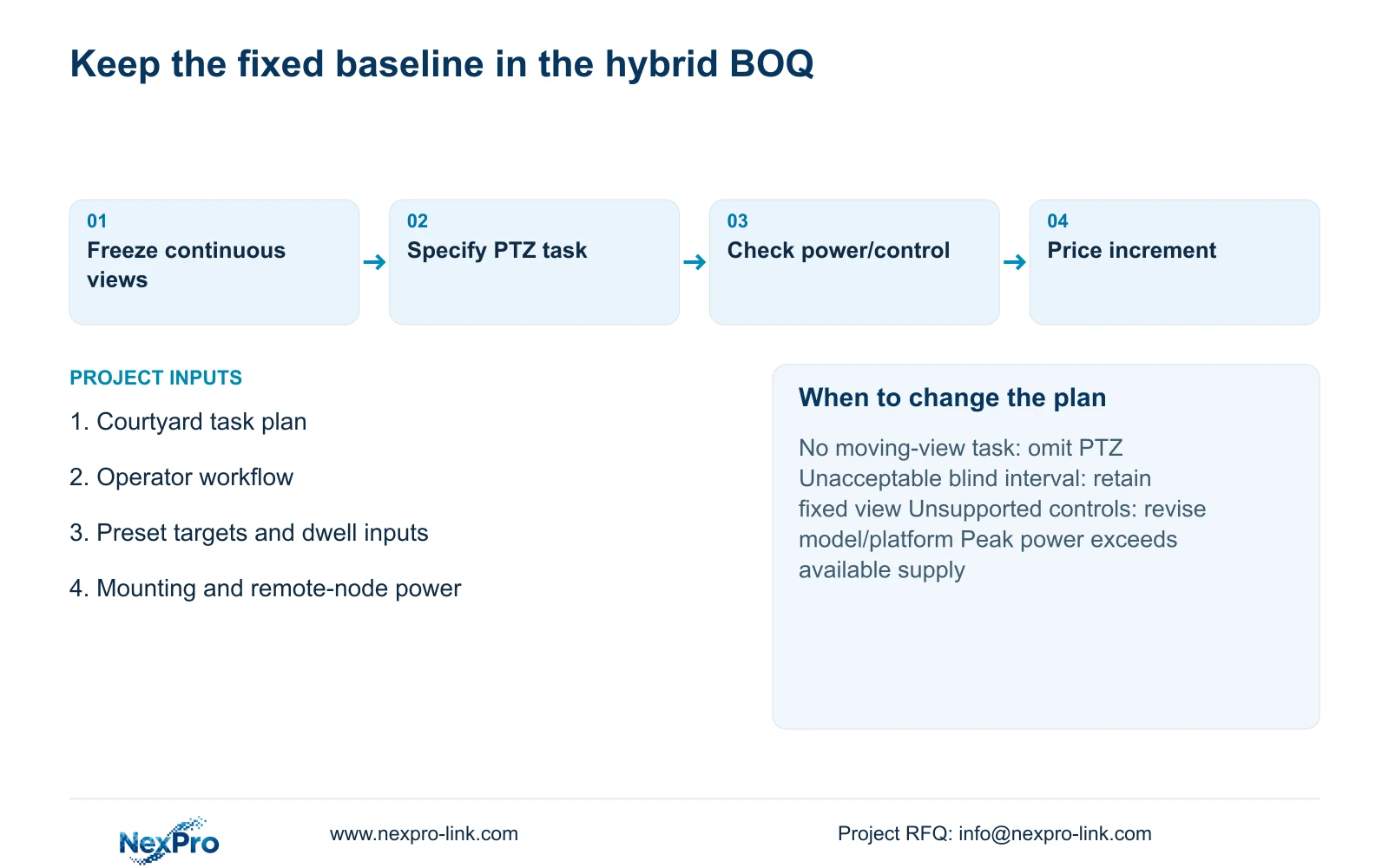
Compare a complete fixed layout with that same layout plus the proposed PTZ task. Keep required recording and public-route coverage equal. Include the PTZ mount, supported power equipment, network connection and any control or software scope. Identify whether additional recording or backup capacity is needed before comparing totals.
A lower camera count can conceal a reduced service. If fixed entrance views disappear from the PTZ option, price it as a changed coverage scope and show the lost continuous task. Keep installation access and maintenance work in the evaluated cost because those requirements can differ between a simple fixed mount and the selected moving camera.
Use actual scope-matched quotations to decide whether the added patrol capability is worth its cost. No PTZ prices, maintenance rates or savings are supplied. If the commercial advantage relies on removing another device, specify the condition that permits removal and verify the retained task before treating that credit as available.
| Retained outcome | Additional scope | When justified |
|---|---|---|
| Continuous entrances and routes | Fixed cameras and recording | These actions must remain visible |
| Operator-directed detail | PTZ, control and supported power | A staffed task needs changing views |
| Routine patrol observation | Supported presets and documented intervals | Intermittent observation is acceptable for that area |
Section 06
Omit PTZ when fixed views meet the operating task
Choose a fixed-only layout when the necessary actions occur at known locations, the recorded detail is adequate and the hotel has no defined moving-view task. Reconsider PTZ when an authorized operator needs variable detail across the permitted courtyard, or a supported patrol provides a useful intermittent task. Keep the fixed continuous baseline in either case.
Revise the layout when landscaping, furniture or lighting creates an obstruction at an agreed target. A new angle can be more useful than more pixels. Select a different equipment configuration if environmental requirements, operator standards or the actual control platform exclude the proposed candidate. No product should inherit PTZ or environmental capabilities from its housing appearance.
Send a courtyard plan marked with continuous tasks, proposed patrol targets, mounting constraints and the operator workflow to info@nexpro-link.com. NexPro-Link can support the camera schedule and coordinated BOQ through its hotel project and tender-support routes. State which equipment it manufactures and which supporting items it coordinates, with local installation and integration responsibilities written separately.
Section 07
Buyer questions
Can one touring PTZ replace every fixed courtyard view? Only tasks that explicitly permit intermittent observation can be evaluated that way. Keep a separate fixed view where the hotel requires continuous entrance or route recording while the PTZ turns elsewhere.
Are the DM2812M motorized cameras PTZ models? The supplied PDFs support their varifocal lens information, not PTZ patrol capability. Request an exact PTZ model and supported control functions for a moving-view task; do not infer them from motorized focus or zoom.
What makes a PTZ supplement worth quoting? A named operating task, an authorized user or supported patrol workflow, and a defined target area. Provide those with the plan so the proposal can price the additional capability while retaining essential fixed coverage.
Engineering references
These sources support the general planning principles. Always use the selected product's current datasheet and applicable project standards for final design.