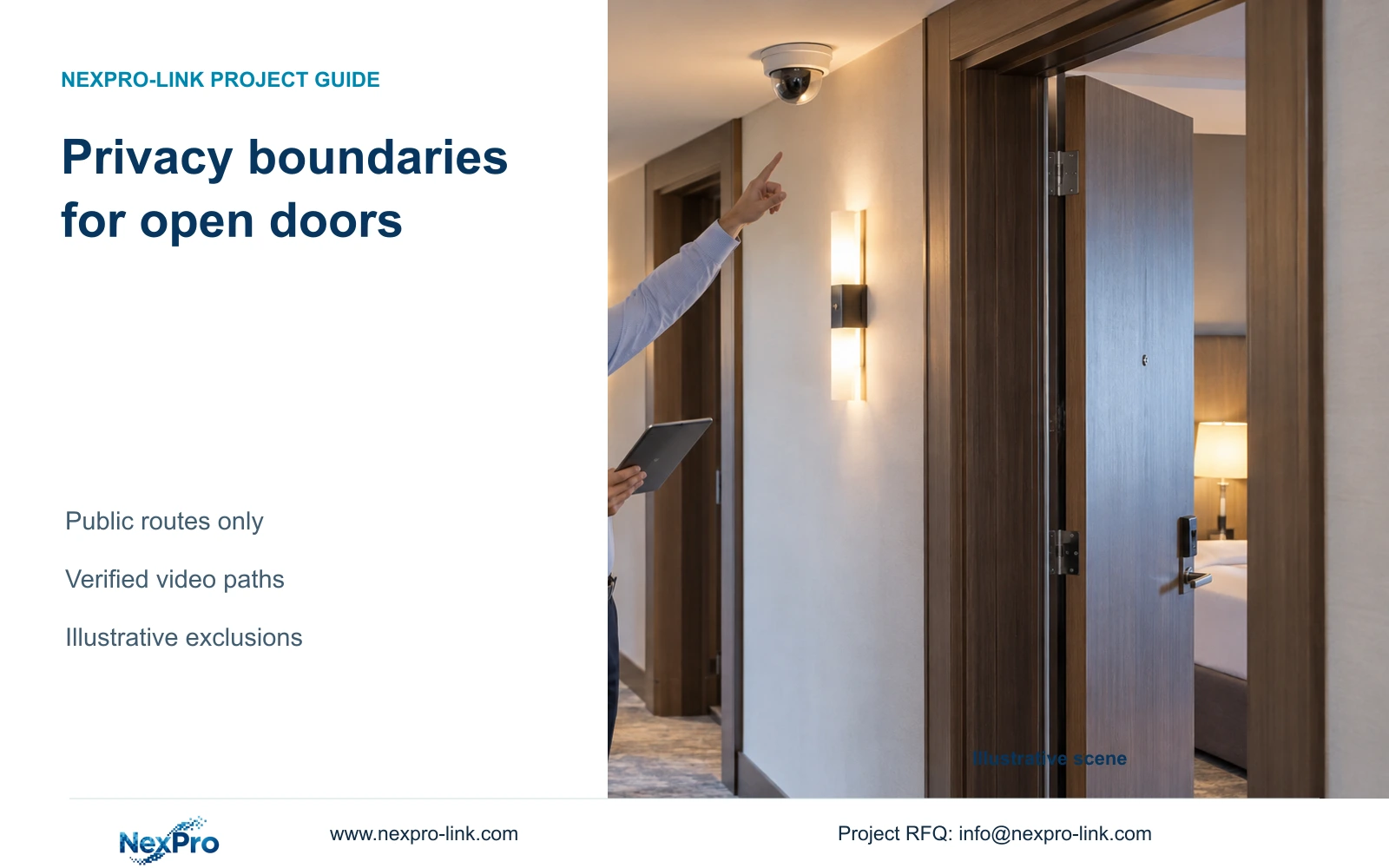
An accepted closed-door view can expose private space when a guest door opens. Prefer suitable framing and verify any required mask across every used video path.
Section 01
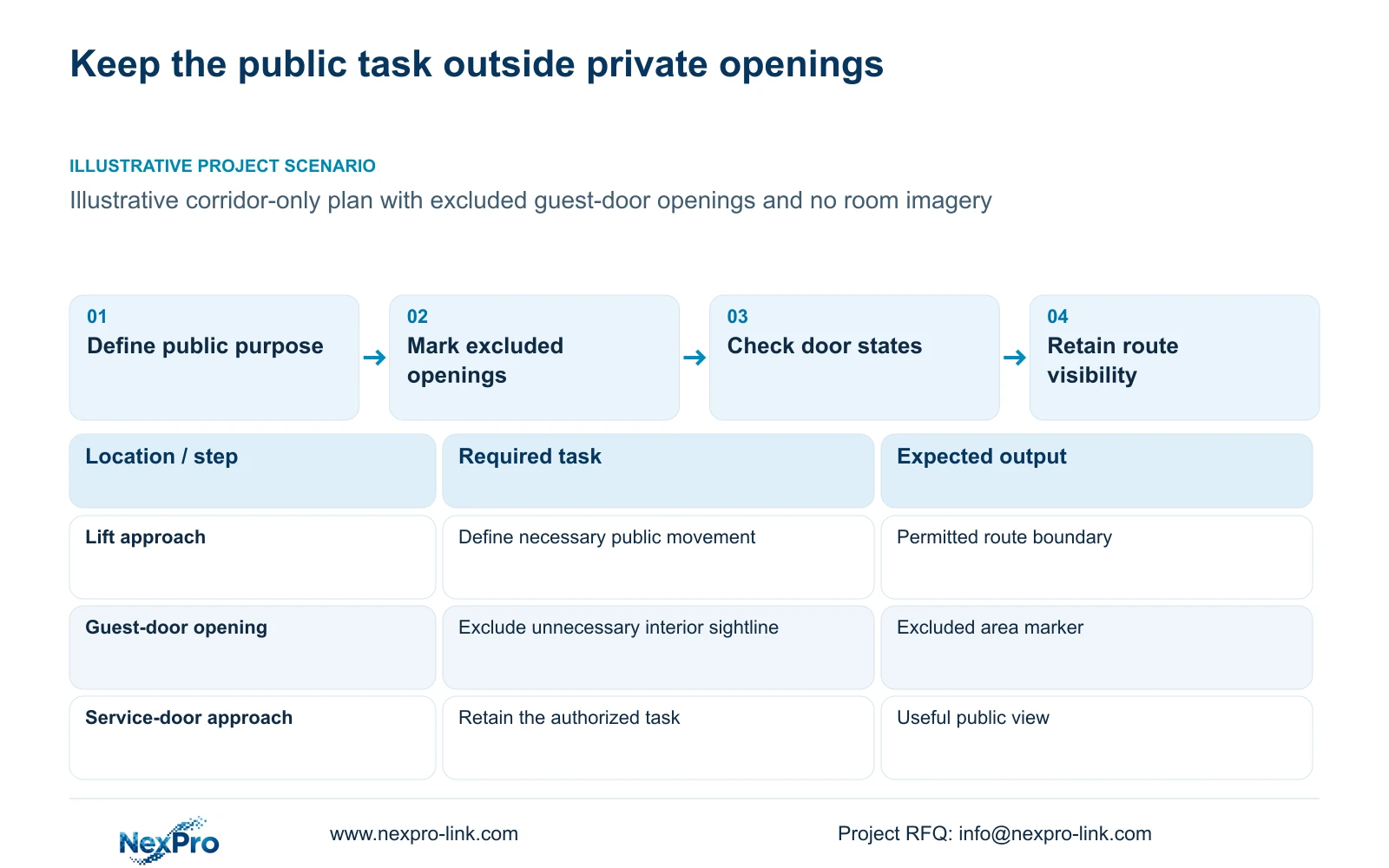
Define the permitted public view
Choose a corridor position and framing that exclude unnecessary views through open guest doors. Use supported masking where geometry alone cannot retain the required public task, and accept that solution only after checking its effect in recording, remote viewing and export. A masked local preview is insufficient evidence for the complete workflow.
Name the public observation purpose before drawing capture boundaries. The hotel may need to follow movement toward lifts or observe a service-door approach. Describe the route and the responsible hotel function. Guest-room interiors, bathrooms and changing spaces remain outside this article's routine CCTV scope.
Separate permitted public content from deliberate exclusions on the plan. The supplied ICO guidance discusses purpose limitation, access and purpose-based retention in a UK context and notes that the guidance is under revision. It supplies no global hotel rule. The hotel's responsible local advisers must determine applicable requirements; product features alone cannot establish a legal conclusion.
| Required task | Given information | Decision still needed |
|---|---|---|
| Observe lift approach | Public route identified | Minimum useful view boundary |
| Exclude guest-room interior | Door opening faces the corridor | Position, framing or supported mask |
| Retrieve an authorized event | Hotel recipient identified | Permitted time window and disclosure scope |
Section 02
Model the open-door scene
Add door handing, opening direction and recess geometry to the camera-position assessment. A closed door hides the interior boundary; an open leaf can also block a public approach. Model both effects. A privacy correction that removes the required corridor task needs a revised position or a different view.
Use staged checks without guest images or occupied-room surveillance. The test should establish the exclusion boundary and movement along the public route under the relevant door states. Door and frame information can support the design before installation; the final angle and lens setting need confirmation in the selected configuration.
Keep door operation independent of CCTV convenience. Safe release and emergency egress belong to the responsible local specialists. Do not change an approved door state merely to preserve camera framing. If a proposed mask depends on a door event, request evidence for the actual controller, platform version and interface. A shared order for locks and cameras does not establish that capability.
| Item | Closed-door review | Open-door review | Effect on task |
|---|---|---|---|
| Private opening | Interior boundary concealed | Potential sightline exposed | Exclusion must be assessed |
| Door leaf | Little or different obstruction | Public route may be blocked | Placement may need revision |
| Required public detail | Assessed in one state | Checked under operating states | Privacy and visibility are evaluated together |
Section 03
Compare repositioning and masking
Assess relocation first where it can keep unnecessary private content outside the view while retaining the public task. Narrower framing is another option, but it may remove a required endpoint. A supported privacy mask can address a remaining image area; its size and placement must leave the agreed public content usable.
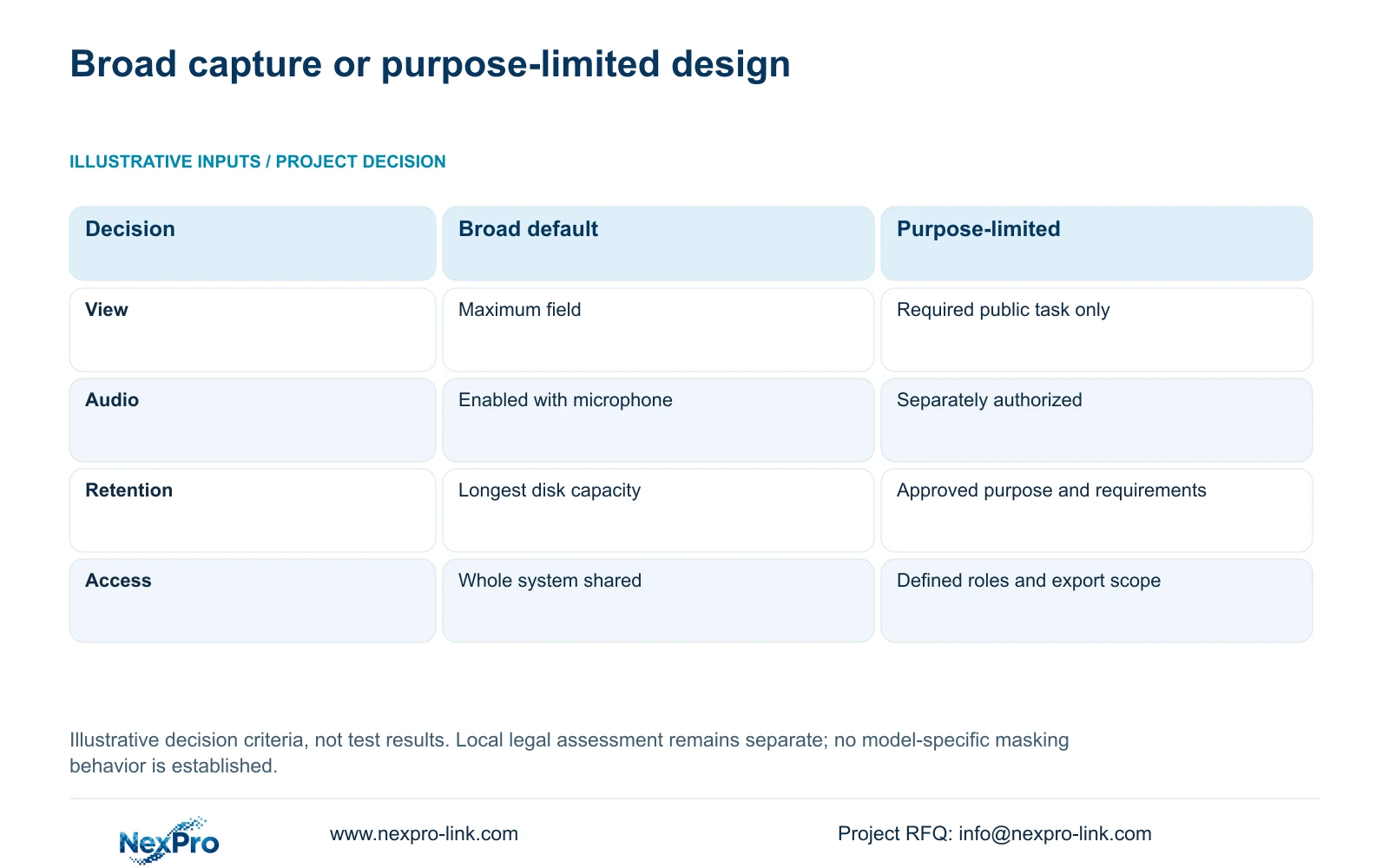
The comparison below is a decision matrix with illustrative inputs. It is not a product test or a brand ranking. Purpose-limited design is the recommended approach because it sets the capture boundary and separately addresses audio, retention and access. Masking alone does not answer those other decisions.
Choose audio functions independently. A microphone or two-way-audio feature does not authorize continuous corridor recording. Retention should follow the hotel's approved purpose and applicable requirements, not the longest period available disks can hold. Likewise, a permitted view does not imply that every user should receive every stream or export.
| Metric / condition | Broad capture by default | Purpose-limited design |
|---|---|---|
| View boundary | Maximum field regardless of purpose | Required public task; excluded private space |
| Audio | Enabled because hardware includes a mic | Separate justified and authorized decision |
| Retention | Longest disk can hold | Approved purpose and applicable requirements |
| Access | Whole system shared | Defined recipients, roles and export scope |
Section 04
Trace masking through all viewing paths
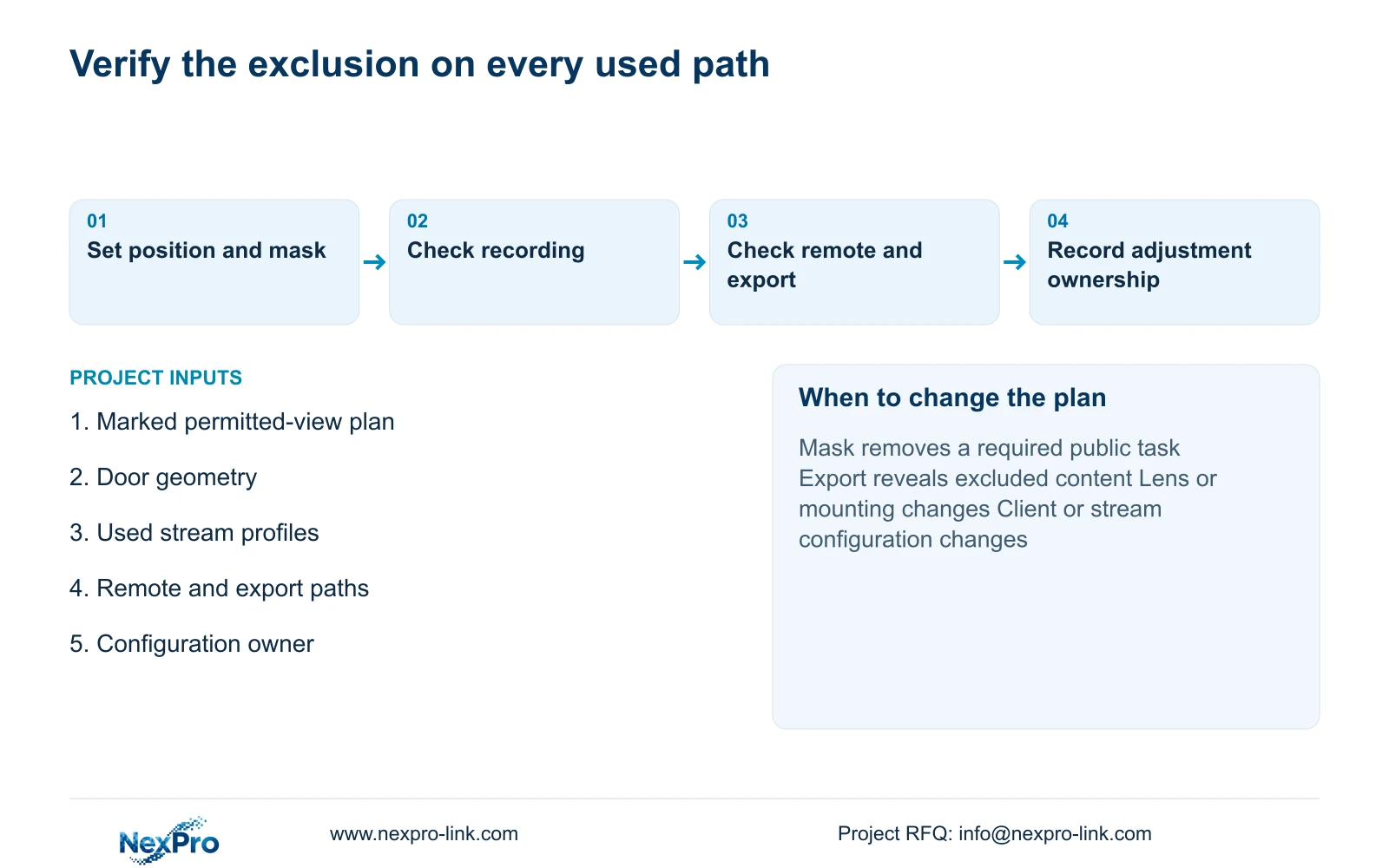
Identify where the proposed mask is applied and which outputs use that configuration. The acceptance task should cover the camera streams used for recording, the recorder's playback, authorized remote clients and exported files. A display overlay can conceal content for an operator without establishing that the stored or exported content has the same boundary.
Use the same staged scene to review each path actually included in the proposal. Record model and software versions, selected stream profiles and the observed masking behavior. If the main and substreams are both used, check both. Any requested snapshot or alternate playback route should enter the same task list.
The supplied product evidence does not establish a complete masking implementation for a particular SKU. ONVIF support is also insufficient proof of mask behavior across third-party clients. If an intended path fails the exclusion requirement, change the position, configuration or supported equipment combination before using that path. Neither a larger recorder nor extra storage corrects this failure.
Section 05
Assign controlled adjustment rights
Assign responsibility for changing camera direction, lens settings and mask regions. These adjustments can alter the accepted exclusion boundary. Routine viewing, footage export and configuration changes are different tasks, so the hotel should identify the authorized people for each and check that the delivered device or platform supports the required separation.
A shared unrestricted administrator account makes ownership of privacy changes unclear. Where supported roles can limit configuration, specify them in the purchase scope. If the hardware cannot provide the required control, compare a suitable platform or a more restrictive operating arrangement. Do not promise role granularity that the selected software has not established.
Remote support should use a hotel-approved path with a defined task and revocation process. After an authorized adjustment, repeat the affected open-door and output-path checks. Budget the configuration and handover work explicitly. A security display upgrade contributes nothing to this decision unless the hotel has a separate, documented display requirement.
| Retained outcome | Extra scope | Worth buying when | Counter-condition |
|---|---|---|---|
| Stable exclusions | Supported configuration-role controls | Routine users must not change masks | Existing verified controls meet the need |
| Approved support access | Limited authorization and revocation workflow | Remote adjustment is required | Local authorized adjustment is sufficient |
| Usable public view | Relocation or reframing work | Mask removes required route detail | Current position retains both boundaries |
Section 06
Record the accepted privacy configuration
Keep the accepted camera position, lens setting and exclusion description with the camera tag and configuration version. Record the output paths checked, relevant door states and actual observations. Use controlled diagrams or staged material that does not introduce guest information into the design record.
Include the approved audio state, retention policy and export ownership in the handover. Storage calculations must satisfy the permitted recording policy; excess capacity is no reason to extend it automatically. CASE03 is an independent illustrative hotel-system reference. Its camera count and retention assumptions do not authorize this corridor's capture or retention decisions.
Select purpose-limited positioning with verified masking only where needed. Reopen the configuration when a lens adjustment, door alteration, client change or failed export check affects the boundary. Send a marked typical-floor plan, relevant door geometry, permitted public tasks and the intended recording and remote-viewing paths to info@nexpro-link.com. NexPro-Link can discuss model matching and scoped technical documentation; local privacy decisions and operational responsibility remain with the designated project parties.
Section 07
Buyer questions
Does a mask on the control-room display prove exported footage is masked? No. Accept the export path through a staged file check for the selected configuration. The local display, recorded stream and exported file may involve different processing, so each required path needs its own observed result.
Should a longer retention period be purchased with spare disk capacity? Only where the approved purpose and applicable requirements support that period. Capacity is an engineering resource, not authorization. The hotel's retention decision should be established before the storage configuration is finalized.
What information is useful for an initial masking proposal? Provide permitted public-route tasks, door geometry and the proposed viewing and export paths. Include who owns configuration changes. Do not send guest images, occupied-room recordings or account credentials in the first inquiry.
Engineering references
These sources support the general planning principles. Always use the selected product's current datasheet and applicable project standards for final design.