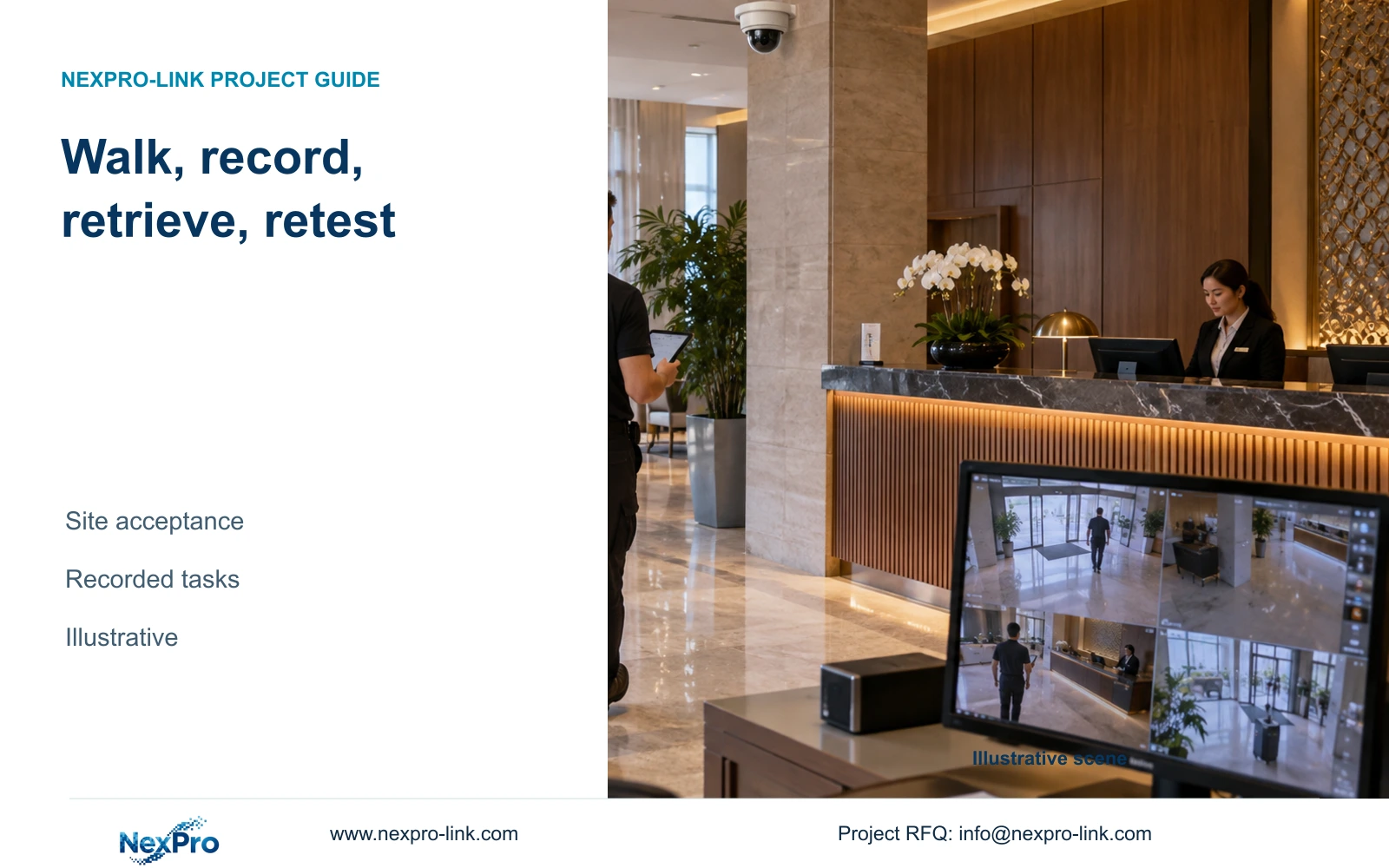
Accept hotel camera views through repeatable recorded tasks, not clear live screenshots. Fix the route and settings, review exports, and retest corrections under the original conditions.
Section 01
Define the route and observable acceptance task
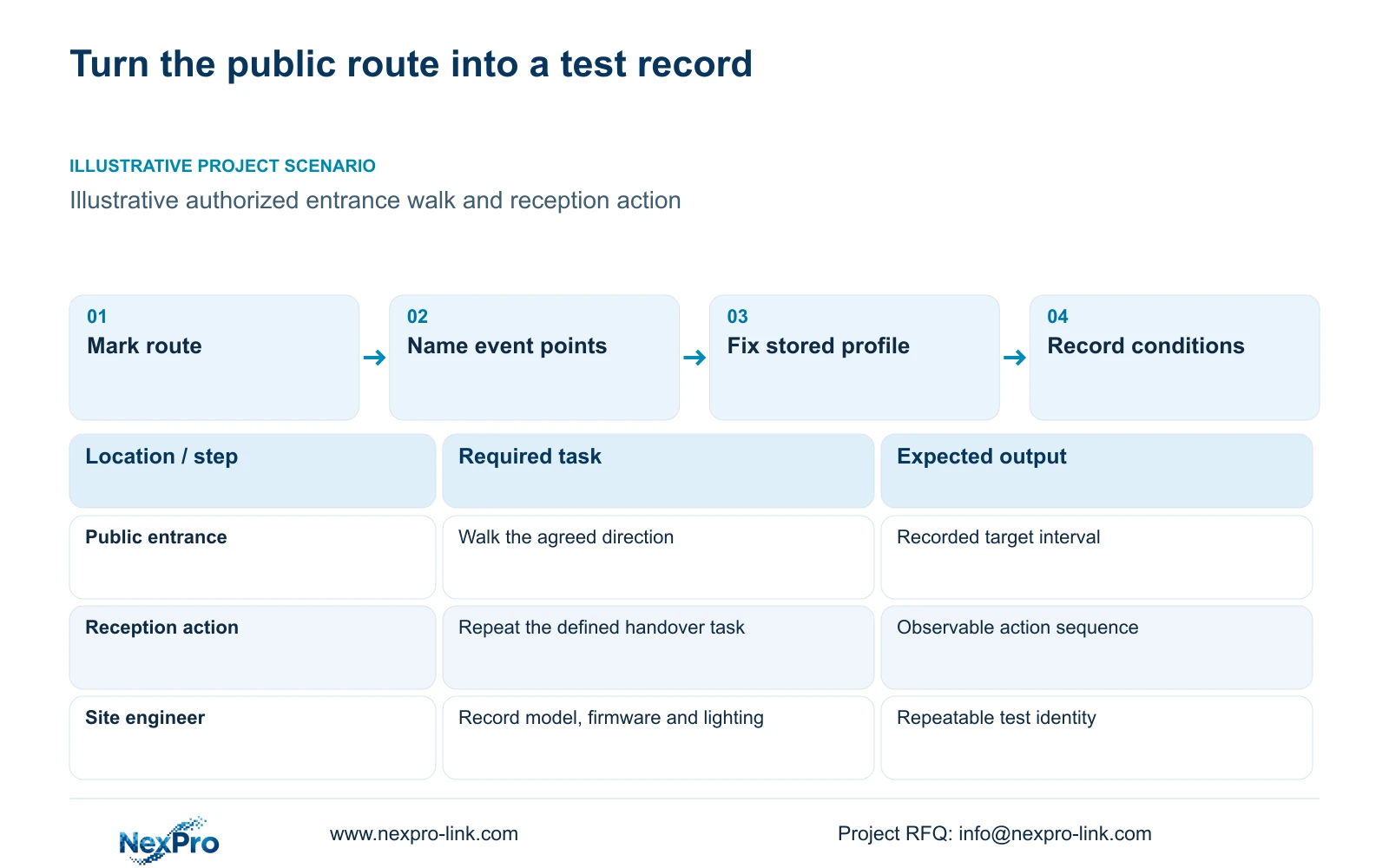
Approve a hotel camera view when recorded footage of an agreed route preserves the required action under the specified operating conditions and can be retrieved and exported. Use a repeatable walk test with fixed direction, event points and lighting periods. A clear live screenshot can help adjust a camera, but cannot complete acceptance of moving-target recording.
Mark the public route on the relevant plan. Identify its start and end, direction of travel and the points at which the hotel needs useful detail. An entrance test can follow an authorized participant through the permitted public approach. A reception test can include an agreed handover action. Keep unrelated private spaces outside the test view.
Write the expected observation in terms the owner can inspect. State whether the task concerns route continuity, action sequence or detail at a defined target. Record target widths, distances and mounting constraints so a failed observation can be traced to the design assumption. Avoid an unexplained pass label such as high image quality.
| Required task | Given information | Decision still needed |
|---|---|---|
| Review entrance movement | Marked public route | Required detail at the event point |
| Find the recorded test | Camera tag and planned interval | Authorized retrieval and export method |
| Maintain agreed outage recording | Protected service is specified | Supervised full-path demonstration scope |
Section 02
Fix the configuration used for the recording
Record the exact camera model, firmware and recording profile before the test. Include output dimensions, frame rate, bitrate configuration and relevant exposure or illumination settings. Identify the recorder channel and whether the operator preview uses a different stream. A successful substream preview cannot establish the quality of the footage actually stored.
Keep the comparison configuration stable unless the purpose is to evaluate a named change. If an installer adjusts framing or exposure between runs, record the revision and repeat the original route. Otherwise the owner cannot determine whether the correction improved the failed task or simply changed the conditions being observed.
Separate factory and site responsibilities. Factory checks can address reproducible device and configuration tasks, while the hotel introduces its own lighting, cable routes and network conditions. A factory result cannot complete every site acceptance item. Specify the sample and scope of each check, leaving results unfilled until the observations occur.
| Item | Uncontrolled preview | Repeatable recording test |
|---|---|---|
| Device identity | Model or version unclear | Exact model and firmware recorded |
| Stream | Current live tile only | Stored profile identified |
| Adjustments | Changed without a revision record | Change recorded and route repeated |
Section 03
Repeat the route in relevant day and night conditions
Repeat the same direction and target points during the lighting periods relevant to the hotel task. Include the entrance's backlit condition or the courtyard's intended night mode where applicable. Record which lights are operating and any temporary condition that differs from normal use. A bright daytime run does not establish night movement detail.
Inspect reflections from glass and hotel finishes, as well as illumination near guest accommodation. A revised position can remove a reflection or unwanted light spill without replacing the camera. When comparing night modes, keep the permitted view and required action equal so the recording shows the effect of the selected change.
Frame rate and exposure affect different parts of moving-target observation. A stated 25 fps does not establish that each frame retains the required detail. Review the recorded movement instead of ranking models by a low-lux headline whose aperture, gain or shutter conditions are incomplete. The evidence package contains no completed night-test results.
Section 04
Review retrieval and exported footage
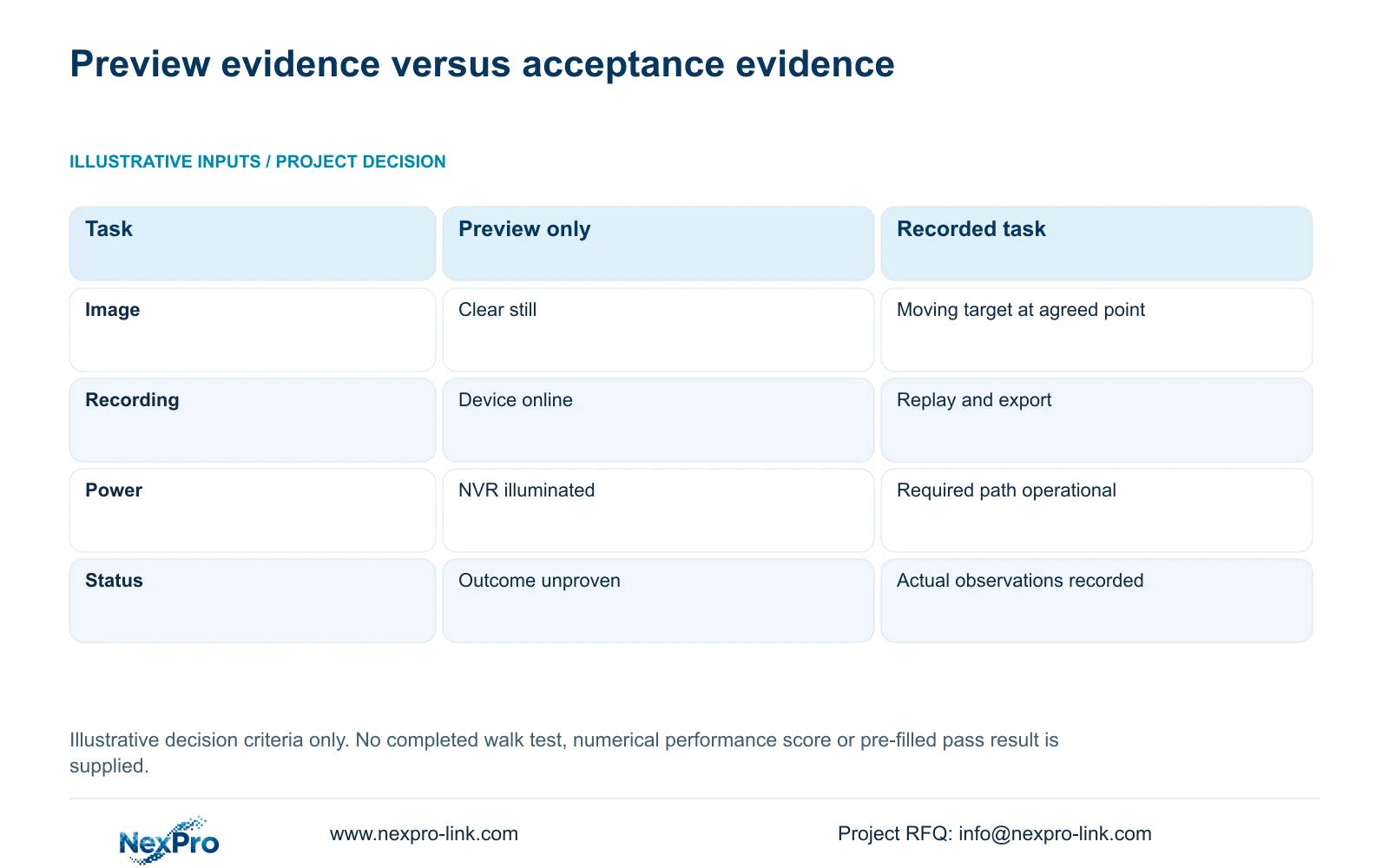
Retrieve the test through the intended authorized workflow using its camera tag and time interval. Watch the recorded action at the agreed point, then export the relevant footage and open it through the proposed playback method. This checks an operational outcome that a device-online status or still image cannot show.
The comparison below is an illustrative acceptance matrix, not a completed test report. Its input is the defined hotel task, and its output is the evidence each acceptance decision requires. Use it to keep image, recording and protected-path results separate. A failure in one row should remain visible even when another row succeeds.
Where outage recording is part of the agreed scope, review whether the required camera and network path remained operational. An illuminated NVR alone does not establish that remote PoE nodes continued supplying video. Any power interruption or switching demonstration belongs under appropriate professional supervision and the approved site procedure.
Preserve the test interval, configuration identity and relevant playback information with the observation record. A small successful sample supports the tested scope; it cannot establish a population failure rate, lifetime performance or zero defects across the complete equipment batch.
| Metric / condition | Preview-only acceptance | Task-based acceptance |
|---|---|---|
| Image | A still preview appears clear | Recorded moving target reviewed at the agreed point |
| Recording | Device online | Relevant footage can be replayed and exported |
| Power | NVR stays illuminated | Required camera and network path remains operational |
| Result status | Cannot prove complete outcome | Record actual observations; not pre-filled passes |
Section 05
Assign corrections to the observed cause
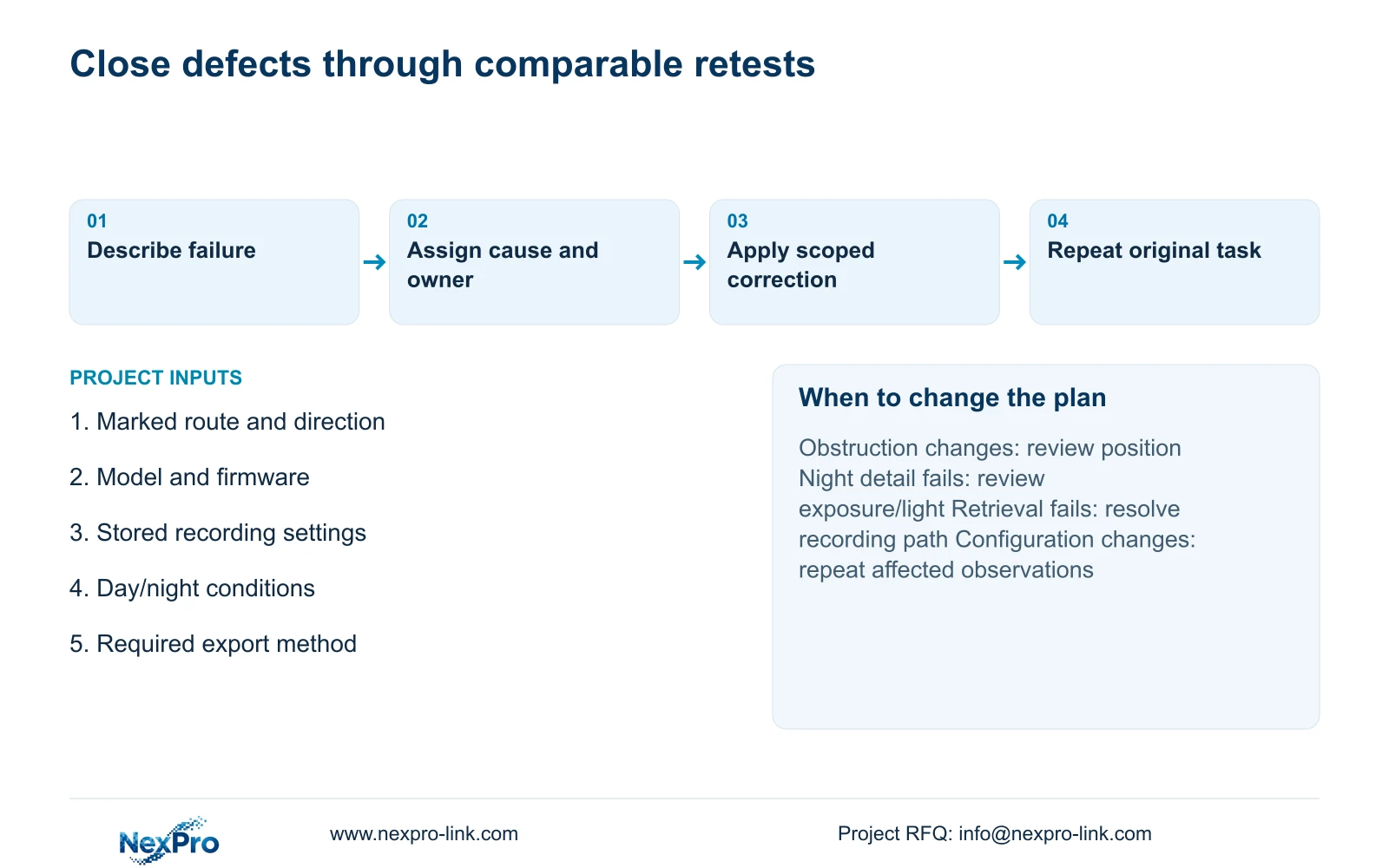
Describe a defect by the failed task and its conditions. A target hidden behind a column suggests a position problem. Movement detail that becomes unusable at night calls for review of exposure and lighting. Missing recorded footage requires investigation of the recording path. Use those categories to assign the next action without assuming every failure needs a new camera.
Keep the responsible party and intended correction in the issue record. Camera positioning, network configuration and electrical work may belong to different teams. A supplier can provide equipment or configuration guidance within its scope, while local installation and specialist electrical responsibility remain separately assigned.
Before buying additional scope, identify what outcome it restores. An added detail view can be justified when the permitted existing position cannot preserve the action. A larger display does not remedy detail absent from the stored recording. After the correction, repeat the same task and retain any new limits; administrative closure alone does not demonstrate restoration.
| Observed failure | Correction to evaluate | Retest condition |
|---|---|---|
| Required action obstructed | Relocate or add a justified view | Same route and event point |
| Night movement detail inadequate | Review exposure, light and position | Same relevant night condition |
| Footage unavailable for export | Resolve recording or retrieval path | Find and open the agreed interval |
Section 06
Approve only the demonstrated task and conditions
Record acceptance against the camera tag, tested configuration and agreed task. State any excluded condition or unresolved item beside the result. Approval of one view does not approve every model, a complete brand or a purchase order. The owner and project team retain their respective decision authority.
Use a representative trial where it can settle an uncertain position or operating profile before repeating that configuration. Change the equipment recommendation when the authorized mounting position, relevant night mode or actual retrieval platform cannot meet the task. If firmware, framing or the required action changes materially, review which acceptance observations need repeating.
NexPro-Link can discuss model matching, technical records and a scoped equipment proposal through its hotel and BOQ support routes. Send the marked public test route, failed task, model/firmware references and observed lighting conditions to info@nexpro-link.com. Include mounting constraints when relocation is being considered. Initial technical discussion does not require guest recordings, passwords or unrelated confidential documents.
Section 07
Buyer questions
Is factory acceptance enough for a hotel camera view? Factory checks cover the conditions they can reproduce. Hotel-specific lighting, sightlines, cabling and retrieval workflows still need their agreed site checks. Keep the scope of each result explicit.
Must a failed walk test lead to a camera replacement? No. Classify the failed observation first. Position, exposure, recording settings or a network dependency may need correction. Purchase additional equipment only when it addresses the identified task failure.
What should remain unchanged during a correction retest? Retain the original route, direction, event points and relevant lighting condition. Record the specific configuration change being evaluated. That makes the new observation comparable with the failed one.
What can be sent for an initial technical review without guest footage? Provide the marked route, camera tag, exact model and firmware, stored-stream settings and a written description of the failed observation. Include target width and mounting limits if the issue concerns detail or obstruction.
Engineering references
These sources support the general planning principles. Always use the selected product's current datasheet and applicable project standards for final design.