Choose access groups around the public-area tasks the hotel can afford to lose together. Splitting switches limits some local faults, but shared uplinks, power and recording equipment can still interrupt wider coverage.
Section 01
Define which public-area views may be lost together
Split camera access groups when a consolidated switch fault would interrupt more public-area coverage than the hotel accepts. Consolidate only when the combined interruption boundary and restoration arrangements are acceptable. Decide from the tasks lost and complete maintenance scope; equipment quantity alone does not establish reliability or a lower evaluated cost.
Ask the owner to identify the views needed during a local fault, such as entrance activity, reception handovers or a service route. Describe continued recording separately from live display and later retrieval. Losing a monitor may leave recording intact, while losing the supplying PoE switch can remove the camera stream before it reaches the recorder.
CASE01 is an illustrative 32-camera reference whose counts come from public-zone tasks, not its 100-room background. Its four groups of eight provide a useful starting point for examining local interruption. Actual group assignments should follow drawings, routes and the owner's priorities. Do not extend coverage into guest-room interiors or other sensitive spaces to compensate for a network design problem.
| Public task | Loss to describe | Owner decision |
|---|---|---|
| Entrance observation | Which entrance streams stop together | Acceptable simultaneous loss |
| Public corridor recording | Affected route and recording gap | Permitted local group boundary |
| Incident retrieval | Whether existing footage remains accessible | Required recovery priority |
Section 03
Count affected cameras for each defined fault
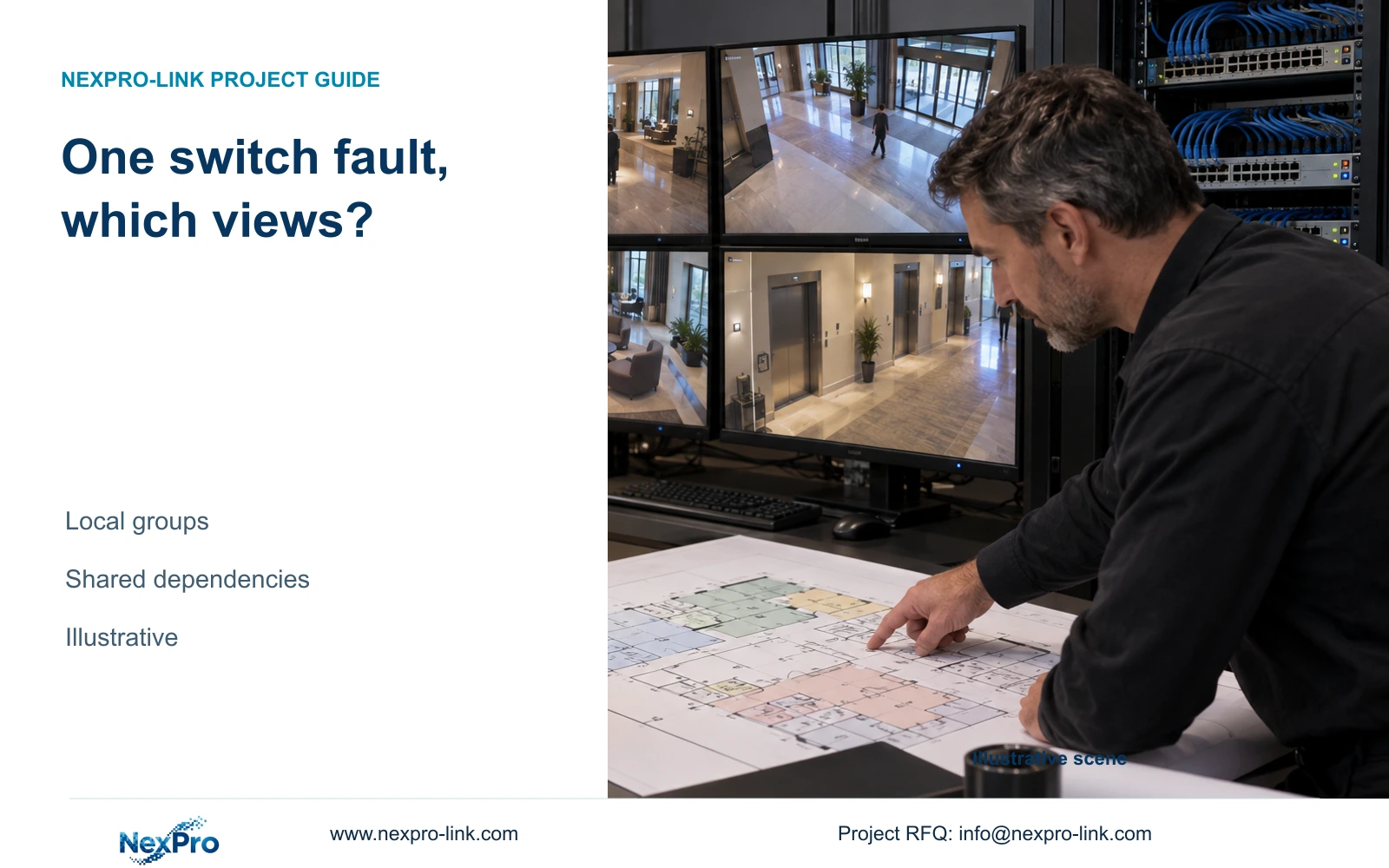
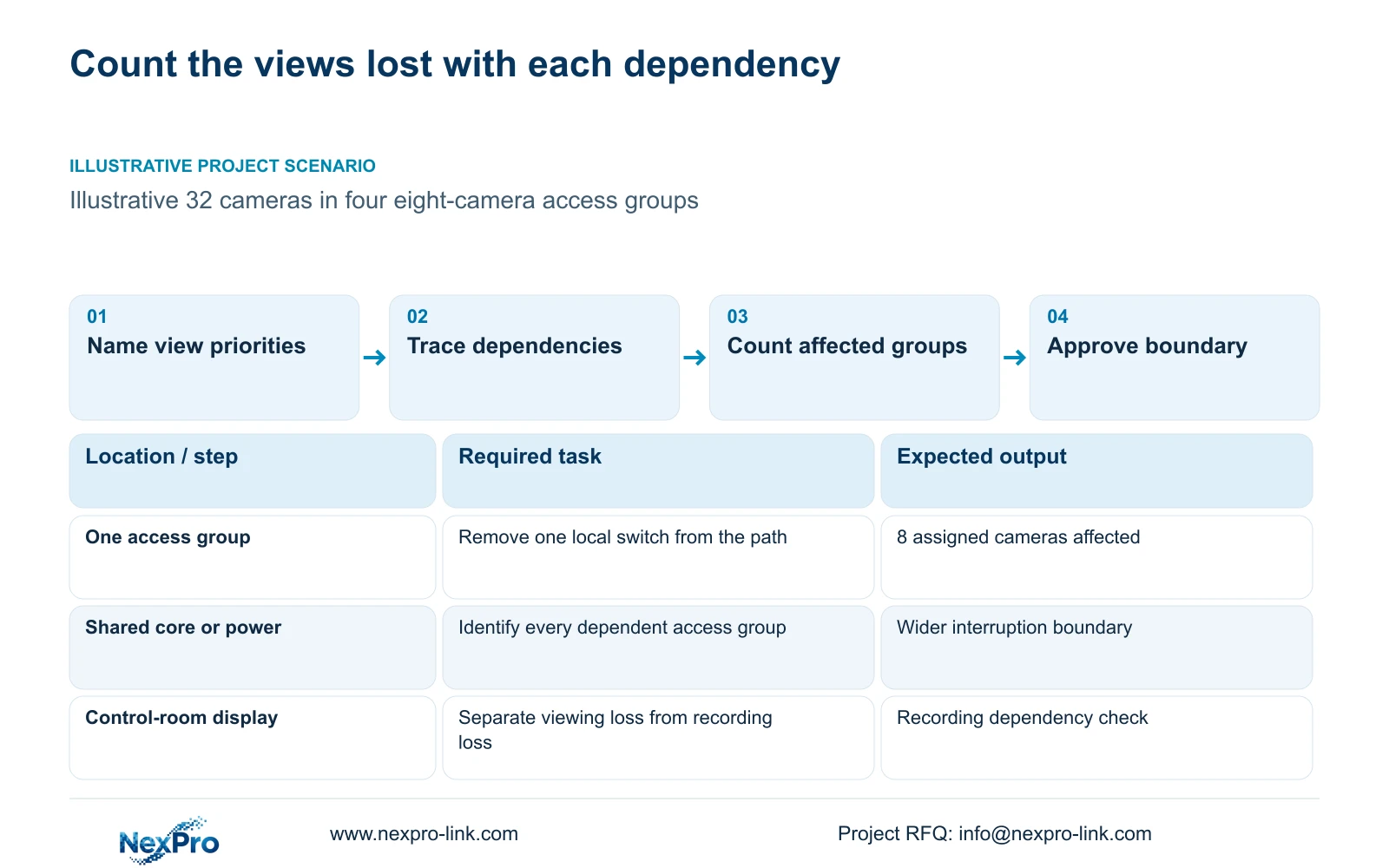
For the illustrated four-node arrangement, a fault confined to one access switch affects its eight assigned cameras. A consolidated access arrangement serving all 32 would place those 32 streams within one local switch-fault boundary. These are dependency counts, not failure probabilities, and the result changes if actual camera assignments differ.
Repeat the count for a shared uplink, core device, power source and recorder. An eight-camera switch boundary does not mean every fault is limited to eight cameras. Distinguish loss of camera capture from loss of access to existing recordings. Record which approved functions remain available and which require restoration.
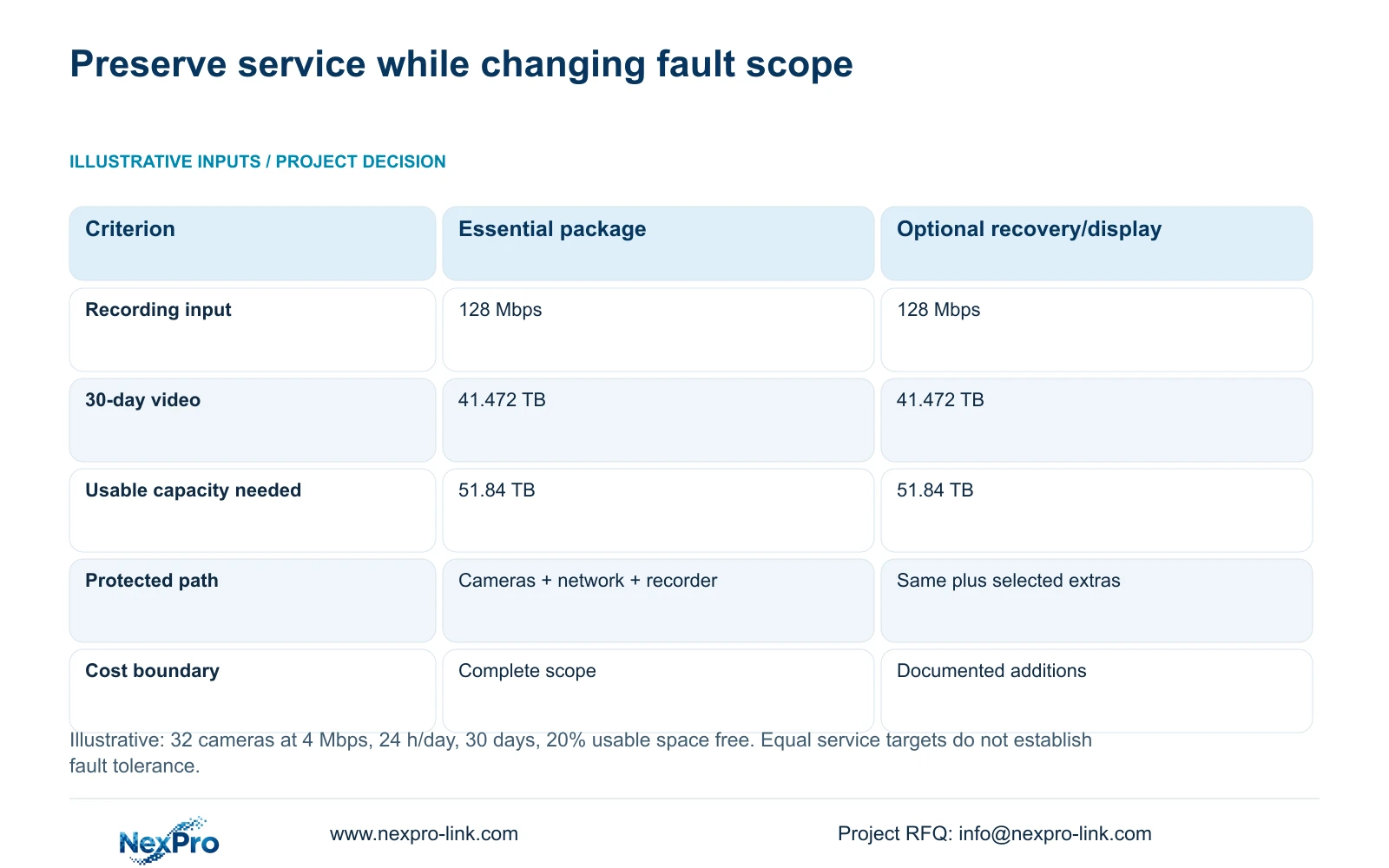
Keep the full recording requirement unchanged while comparing grouping. With 32 cameras at an assumed average 4 Mbps, total input is 128 Mbps. Continuous recording for 30 days produces 41.472 decimal TB: 0.0108 times 32 times 4 times 30. Reserving 20% of usable space requires 41.472 divided by 0.80, or 51.84 TB. This requirement describes planned service before interruption, not a prediction of footage recorded during a fault.
Section 04
Compare access arrangements with the same recording target
Compare split and consolidated access while retaining the same camera tasks, recording profiles and approved retention. Splitting can narrow the local switch interruption, but it adds equipment locations and maintenance scope. Consolidation may simplify some connections, while enlarging the local dependency group. Obtain complete quotations before asserting which arrangement costs less.
The supplied system comparison separates an essential recording-first package from the same core with optional display or recovery scope. Both keep the same data target. Use that baseline when evaluating access changes: a lower price achieved by removing required storage or protected network components is not an equivalent proposal.
CASE01 considers NexPro-NVR4449-4K with four 16 TB drives under a separate no-RAID-loss planning assumption. Its published fields include 49 channels, 320 Mbps input and four SATA positions, but 49 channels do not establish arbitrary 49-camera 8MP operation. RAID levels are unresolved in the supplied record. Check the selected modes and disks without using recorder capacity as evidence that switch failures are contained.
| Metric / condition | Essential recording-first package | Same core plus optional scope |
|---|---|---|
| Recording input (Mbps) | 128 | 128 |
| 30-day video data (TB) | 41.472 | 41.472 |
| Required usable capacity (TB) | 51.84 | 51.84 |
| Protected path | Cameras + network + recording | Same plus explicitly selected extras |
| Operator display | Task-sized monitor/workstation | Optional wall; independent recording |
| Cost comparison | Complete scope quotation required | Add only documented incremental scope |
Section 05
Include local protected power and usable replacement stock
Calculate protected AC load by actual supply zone and compare both watts and VA with the chosen UPS. Capacity reserve does not establish runtime. SP2KR(S) is a rack online UPS rated 2 kVA and 1,800 W in the supplied record; its runtime needs the actual supported battery configuration and load curve. A centrally totaled load does not resolve supplies in distributed closets.
Select a spare switch by functional replacement requirements, including port rates, usable PoE output and necessary configuration behavior. NexPro SW-POE1618G's total PoE budget is unstated and its speed fields conflict, so its name alone cannot qualify it as a replacement. Retain configuration identities and check a stored spare against later system changes.
Assign the local replacement task, access to the closet and replenishment responsibility. Stock can shorten part of a restoration process but cannot eliminate every interruption. The supplied policy gives applicable main equipment a 24-month limited hardware baseline from receipt; batteries, storage, cable, OEM and associated service costs follow their relevant written scope. Hardware cover does not automatically include local labor or urgent transport.
Section 06
Specify the interruption boundary and restoration task
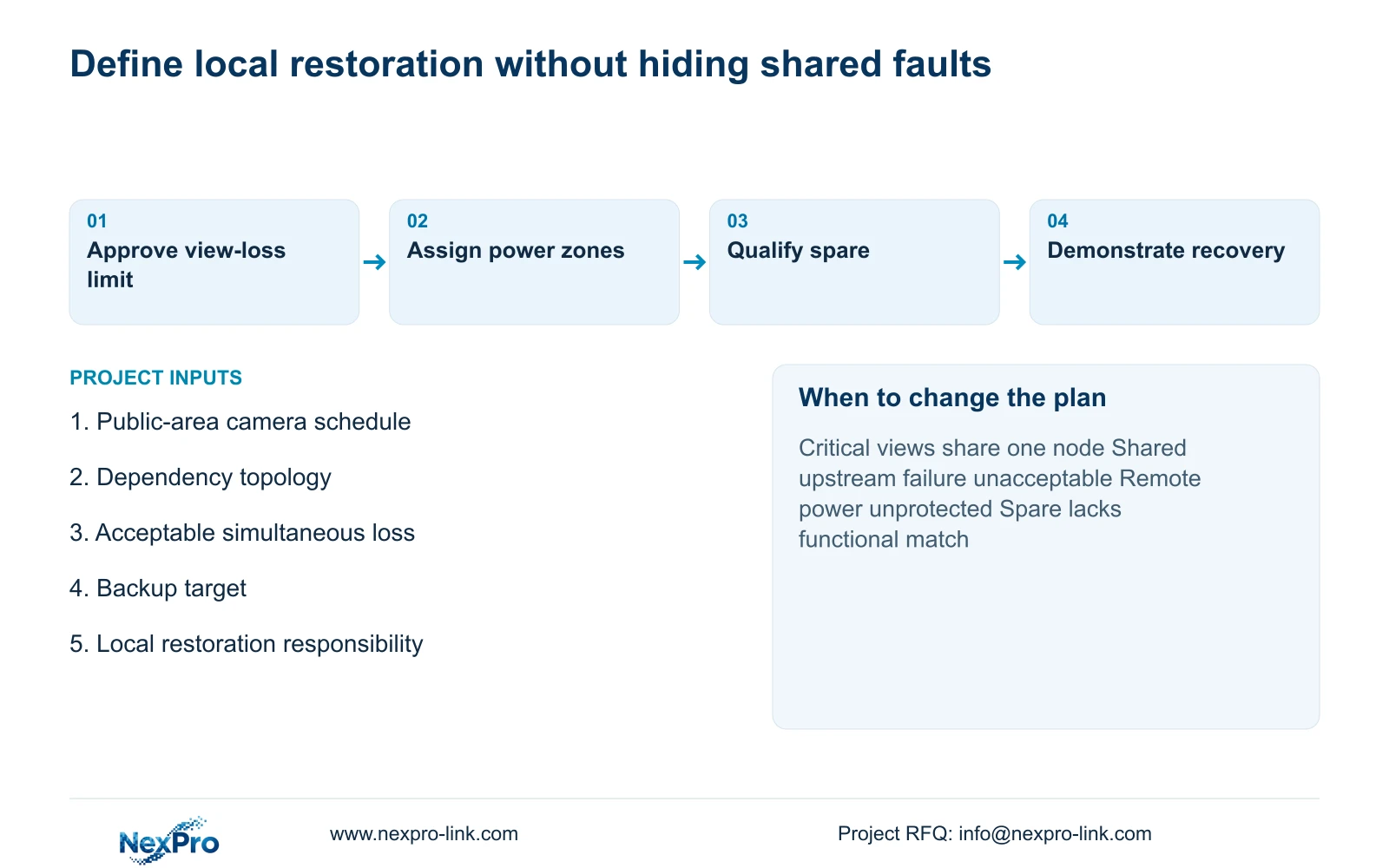
Recommend the four-group arrangement as an illustrative starting point when the owner accepts losing the assigned eight-camera group during a fault confined to that access node. State the remaining shared core, recorder and power dependencies. Change the grouping when it would remove an unacceptable combination of entrance or public-route views.
If the hotel requires continued operation through a shared upstream fault, splitting access alone does not meet that requirement. Develop a supported recovery or alternate arrangement and demonstrate its actual behavior. If consolidation remains acceptable, verify combined PoE, routes and maintenance scope before selecting the larger node.
Send info@nexpro-link.com the public-area camera schedule, dependency topology, acceptable simultaneous view loss and local restoration arrangements. Add the backup-power target and destination for coordinated supply. NexPro-Link can help map an equipment package and BOQ to those requirements, with CCTV manufacturing, supporting supply and local installation responsibilities stated separately.
Section 07
Buyer questions
Will four switches make the system four times more reliable? No reliability multiplier follows from switch count. Four groups can limit a fault confined to one access node, while shared power, core or recording dependencies may still affect all groups. Evaluate those consequences separately.
Can a spare switch provide uninterrupted recording? A manual spare supports restoration after identification, replacement and configuration. Any claim of uninterrupted service needs a supported alternate mechanism and observed operation. State the replacement workflow and expected service boundary without inventing a recovery time.
Should replacement stock cover every device equally? Prioritize the devices whose loss removes important hotel tasks and whose replenishment is difficult. Verify replacement compatibility and local action requirements. An unexplained percentage of every SKU does not express those priorities.
Engineering references
These sources support the general planning principles. Always use the selected product's current datasheet and applicable project standards for final design.