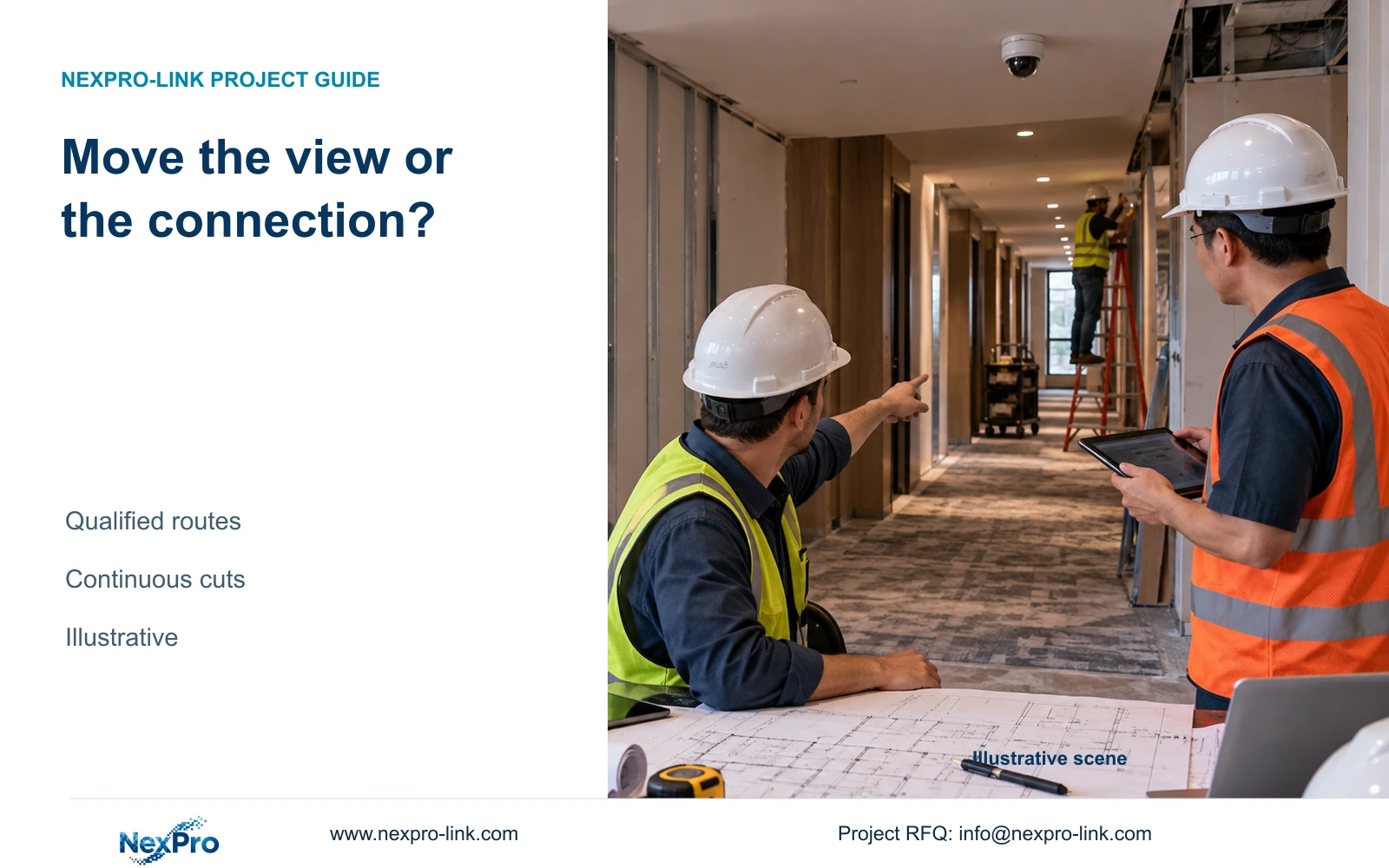
Move a hotel camera only if the revised position preserves its observation task. If it cannot, compare a shorter route or another cable closet with the full network, power and maintenance scope.
Section 01
Decide which constraint has changed
Move the camera when a permitted new position preserves the required view and produces a qualified cable route with less disruption. Keep the camera position and revise the route or cable closet when relocation would lose the observation task. Compare the complete installation and protected-power scope before approving either option.
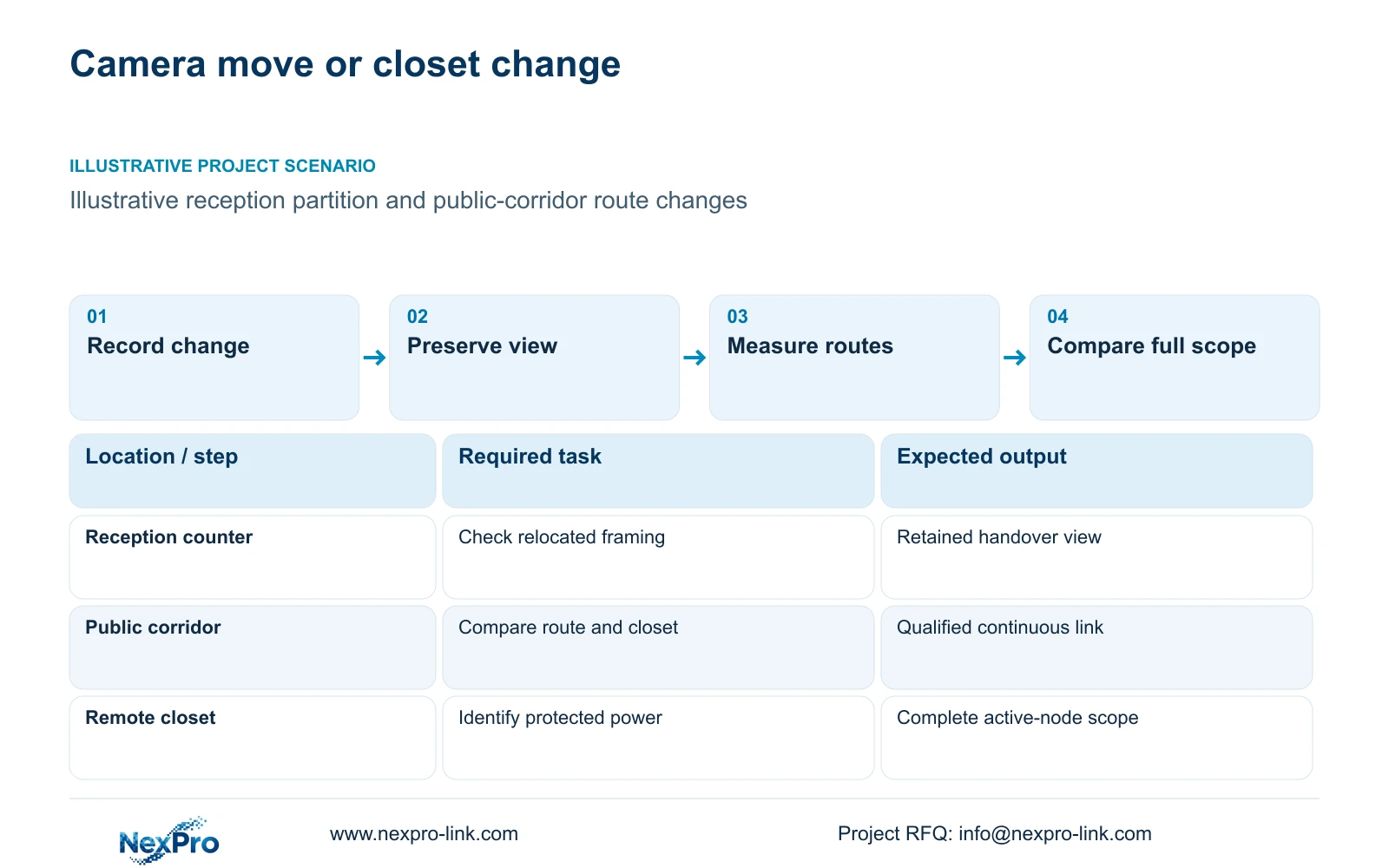
Start from the dated approved drawing, camera schedule and quoted scope. Identify whether the change comes from a new partition, a closed ceiling route, a relocated reception desk or a longer installed cable path. These events affect different parts of the design. A blocked route does not automatically justify changing the view, while an obstructed view may require a position change even when the cable remains short.
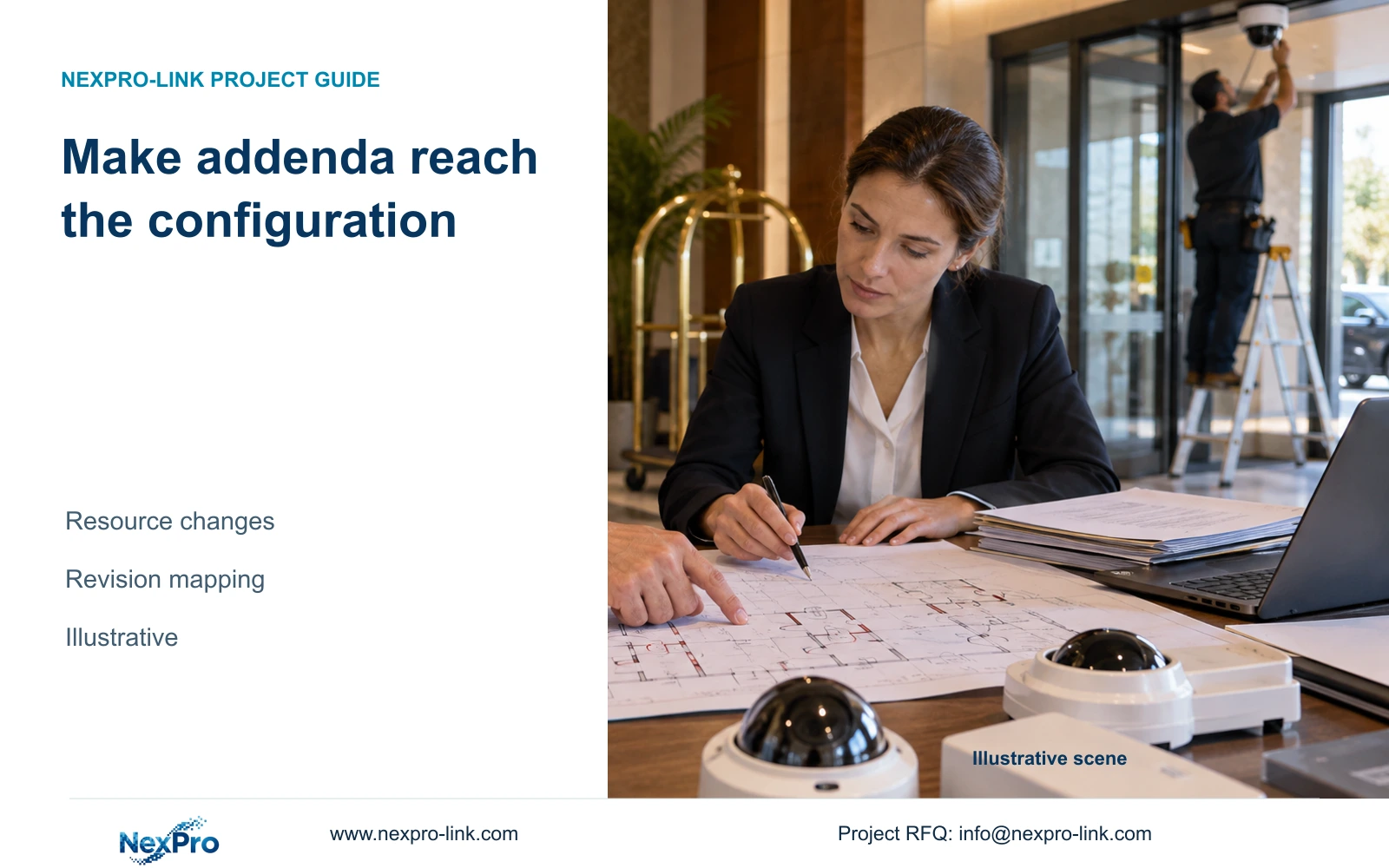
Record the original quantity, model, connection point and installation boundary beside the proposed revision. Separate additional cameras from replacement cable, new accessories and changed access conditions. This gives the project manager a defined decision and lets the cost manager explain the resulting work without treating every change as an unexplained price increase.
| Required task | Given information | Decision still needed |
|---|---|---|
| Observe reception handover | Desk or partition position changed | Can a revised position retain the required view? |
| Connect the public-corridor camera | Approved route is blocked or longer | Can a qualified replacement route use the existing closet? |
Section 02
Preserve the observation task before relocating
Recheck the target plane, permitted mounting position and obstructions using the revised architectural layout. At reception, the camera may need to show an exchange at the counter. In a public corridor, it may need to retain a view of an endpoint that a new wall obscures. Moving closer to a cable closet is acceptable only when the resulting view still supports that task.
Compare the proposed framing with the original schedule. A wider view can include more space while allocating fewer image pixels to the relevant activity. Optical adjustment can change framing, but digital enlargement cannot restore detail that was never recorded. An available motorized lens also does not turn a fixed camera into a patrol-capable PTZ.
Keep unnecessary private areas outside the view. Public-route coverage should avoid incidental views into rooms when doors open. Once a position is technically acceptable, recalculate its route and continuous cable requirement. Do not approve a visually convenient relocation using an old cable quantity that belongs to the previous position.
| Item | Move the camera | Revise the closet or route | Effect on the hotel task |
|---|---|---|---|
| Observation position | Changes | Can remain unchanged | Relocation needs renewed view assessment |
| Cable connection | New route to existing closet | New route or access node | Both require measured link lengths |
| Service access | Recheck mounting access | Recheck closet access | Maintenance remains part of the decision |
Section 03
Measure routes and prove the cutting plan
Measure the installed path through horizontal runs, risers and the required termination allowances. Keep permanent-link length separate from the full channel with patch cords. The supplied Fluke Networks reference describes the typical 90 m permanent-link and 100 m channel basis; the project must still specify its category, connector arrangement and test configuration.
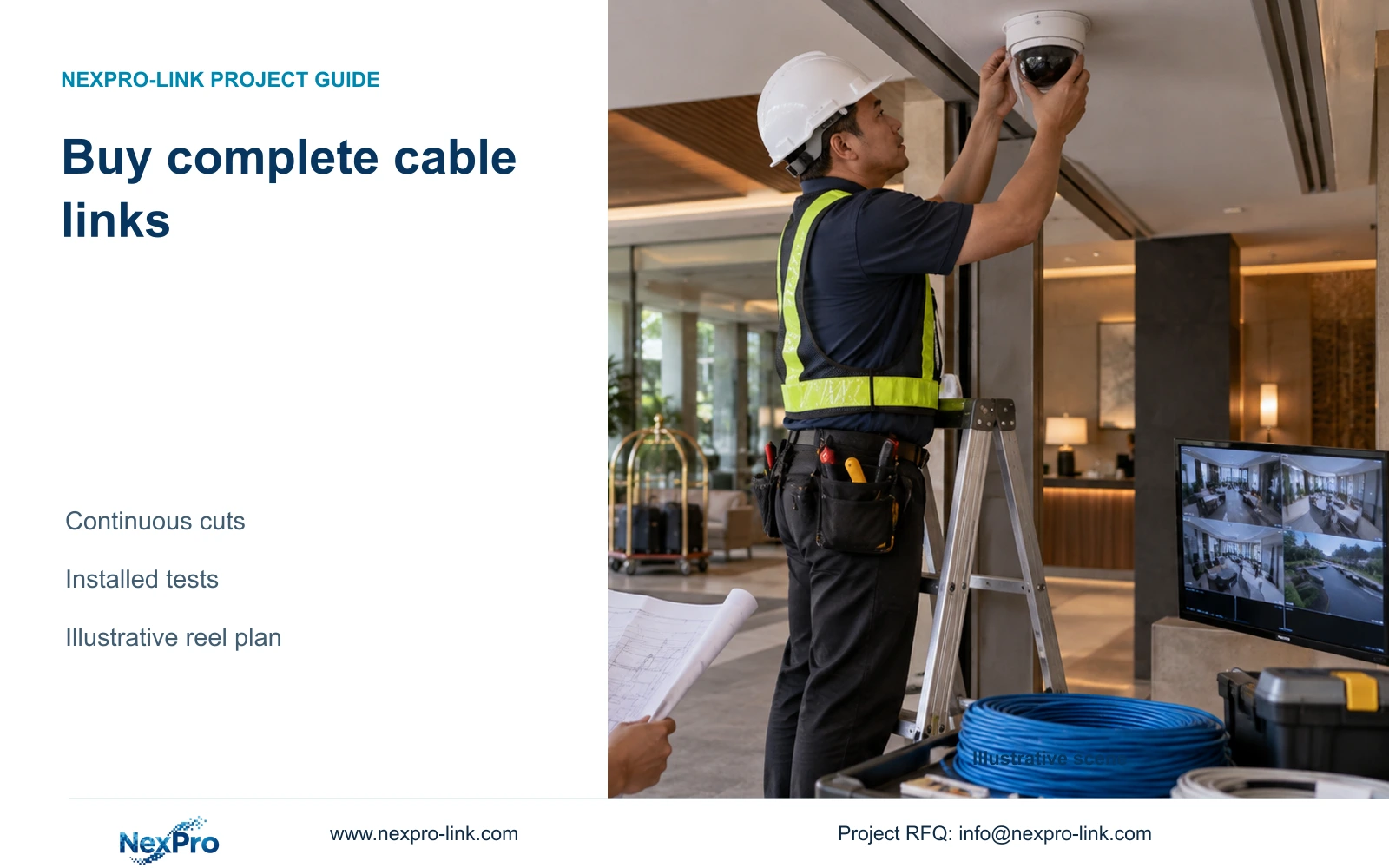
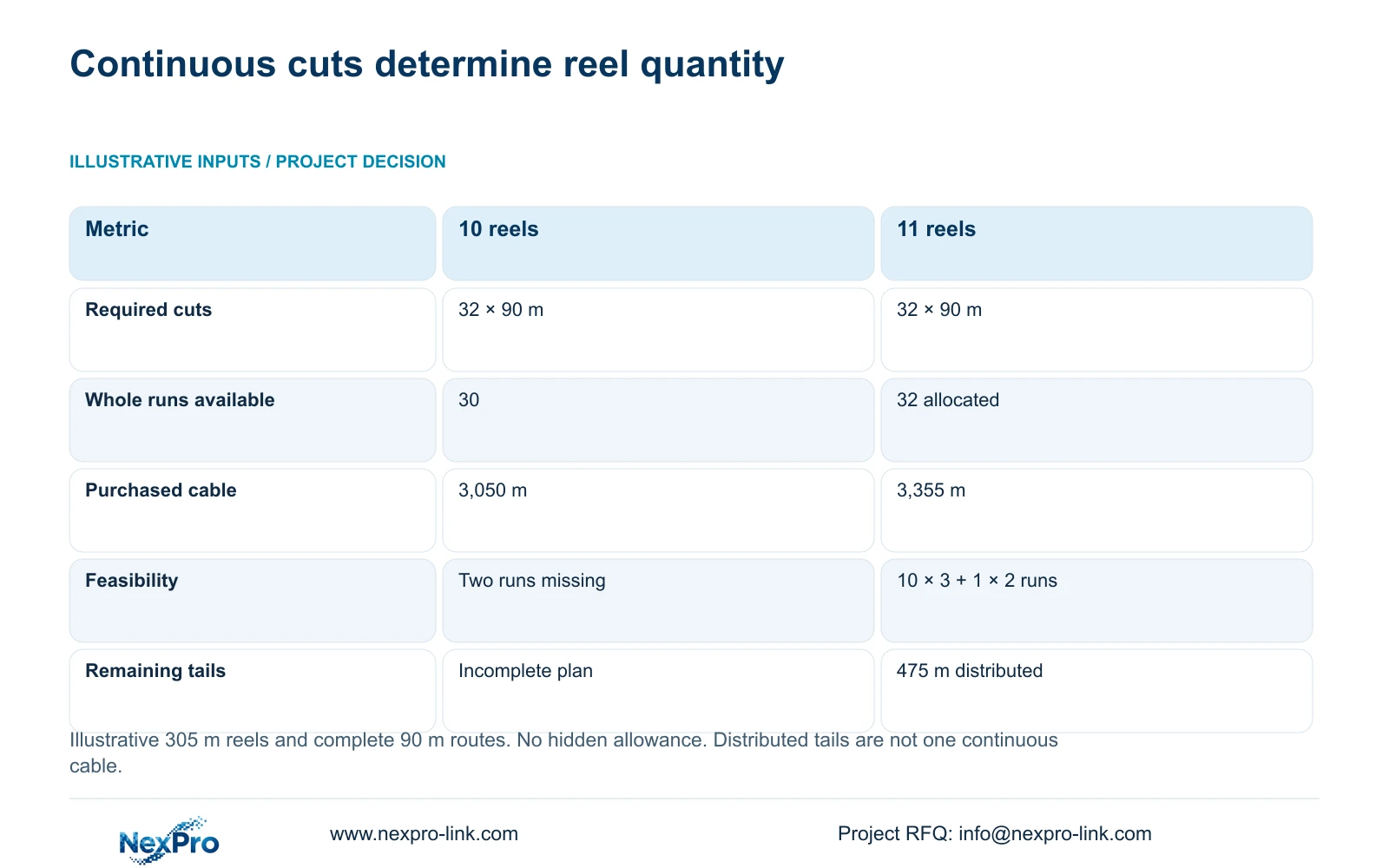
The independent illustration below assumes 32 continuous permanent routes of exactly 90 m and purchased reels of 305 m. Each 90 m already includes the planned allowances. Total cut length is 32 × 90 = 2,880 m. Rounding 2,880 ÷ 305 upward gives a ten-reel lower bound, but each reel supplies only three whole 90 m runs.
Ten reels therefore supply 30 runs. Eleven supply all 32 through ten reels with three cuts each and one reel with two cuts. Purchased length is 3,355 m, leaving 475 m of distributed tails. Those tails are not one continuous cable and cannot be assumed to fill a long replacement route.
This result changes procurement: request a feasible cutting schedule alongside total metres. It does not prove that moving a closet is necessary. CASE06 uses a separate 64-route illustration with varied lengths and a feasible 13-reel plan; its quantities must not be substituted into this 32-run calculation.
| Metric / condition | Rounded total-length lower bound | Feasible continuous-run plan |
|---|---|---|
| Total cut length | 2,880 m | 2,880 m |
| 305 m reels | 10 | 11 |
| Can every run be cut? | No: only 30 runs | Yes: 10 × 3 runs + 1 × 2 runs |
| Purchased length | 3,050 m | 3,355 m |
| Remaining tails | Not a feasible complete plan | 475 m, distributed across reels |
Section 04
Include power and network dependencies
A remote access switch can shorten copper tails while adding an enclosure, backbone connection and local power dependency. Fiber transports data; it does not automatically supply the remote camera or switch. Identify the protected-power source for every active node needed to maintain recording during the agreed outage state.
Check each link's traffic and each switch's port capability and total PoE output separately. The NexPro SW-POE1618G source lists 16 PoE access ports and two uplinks, but its speed descriptions conflict and its total PoE wattage is not stated. It remains an inquiry candidate, not a confirmed solution for a changed closet.
Include the full terminated link in the material schedule. SP5648 is a Cat6 48-port patch panel and DT968MX is a Cat6 module. Neither identifies a cable reel or proves the installed channel category. Revised labels and operator support records should show the actual camera, switch port and closet location so a later fault can be traced.
Section 05
Price the revised work as a complete package
Build the variation from the original scope, showing retained material, cancelled work and additions. Include route access, cable removal where required, termination, testing and reinstatement. For a new closet, add the supporting network and electrical work, cabinet requirements and maintenance access. An inexpensive extender cannot be evaluated independently of its supported service and added dependencies.
Check whether additional cameras or a changed connection arrangement cross recorder, switch, storage or UPS thresholds. Such changes can create step costs that a simple cable metre rate will miss. Keep quantity effects separate from specification effects and count shared equipment once. Use actual scoped quotations before assigning a financial preference.
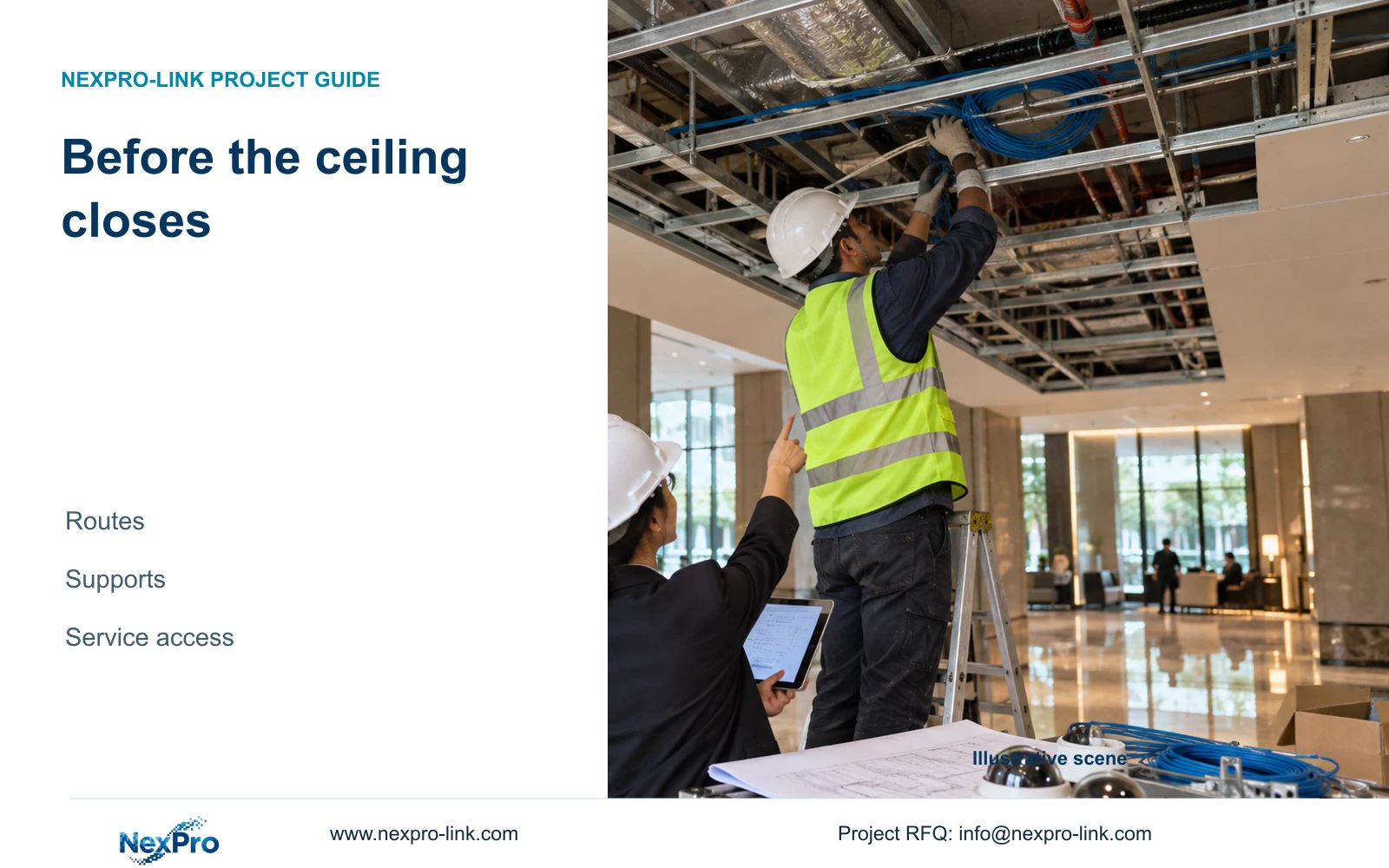
Compare the work windows as well. A route through an accessible service corridor may be practical before ceiling closure but disruptive afterward. A closet change can preserve the view while requiring another trade's readiness. Neither option has a fixed programme advantage without the actual access dates and dependencies.
| Retained outcome | Extra scope | Worth buying when | Condition against it |
|---|---|---|---|
| Required public-zone view | Camera relocation and new cable | Framing remains acceptable and access is simpler | Relocation loses required detail |
| Original camera view | New closet or remote node | Existing routes cannot qualify | Power or maintenance access is unresolved |
Section 06
Approve the least disruptive qualified design
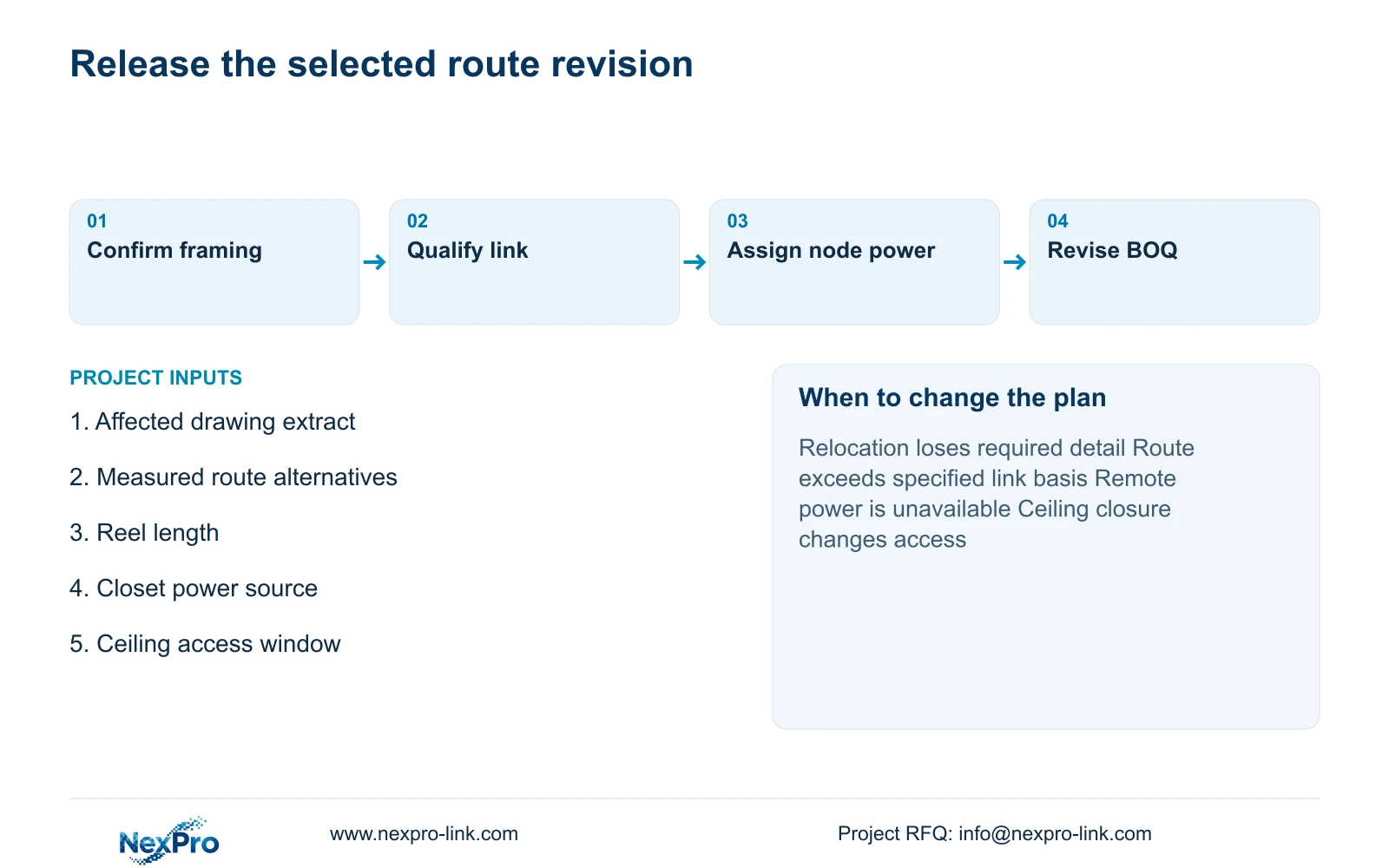
Select relocation when the revised view, tested-link basis and service access remain acceptable. Select a route or closet revision when the view must stay fixed and the added node has defined power, network and maintenance responsibilities. Reopen the comparison if measured lengths, ceiling access or the permitted camera position changes.
Issue the selected camera position, route schedule and revised BOQ together. NexPro-Link can support model matching and coordinated equipment supply, with CCTV manufacturing responsibilities separated from supporting categories and local installation. Send the affected drawing extract, original and revised route lengths, reel length and available closet power to info@nexpro-link.com. Include the opening milestone and access window that this change could affect.
Section 07
Buyer questions
Can spare cable tails complete a missing long run? Only a tail long enough for the whole approved continuous route can be allocated to it. The illustration's 475 m is spread across reels. Total spare metres do not demonstrate that any individual tail can complete the missing link.
Can equipment be ordered before the route decision is final? Release only items whose quantity, specification and interface remain unchanged, under the project's purchasing authority. Hold affected cable quantities and remote-node equipment until the selected route defines their scope. Partial release should identify later additions and any changed delivery costs.
What information supports a useful first comparison? Provide the affected camera task, drawing revision, measured route alternatives and existing closet connection details. State whether the ceiling remains accessible and whether a remote node can receive protected power. A full unrelated tender package is unnecessary for this focused decision.
Engineering references
These sources support the general planning principles. Always use the selected product's current datasheet and applicable project standards for final design.