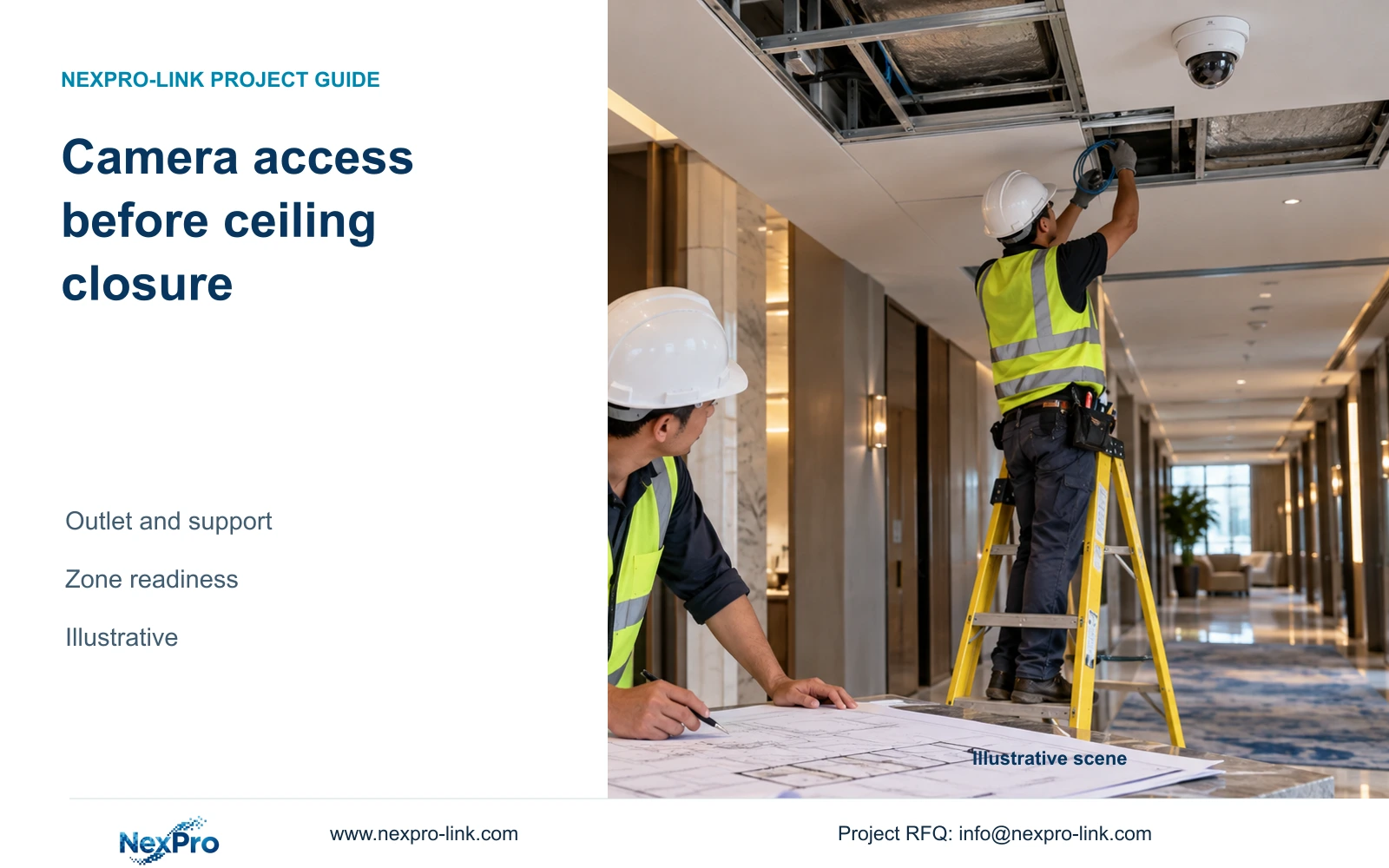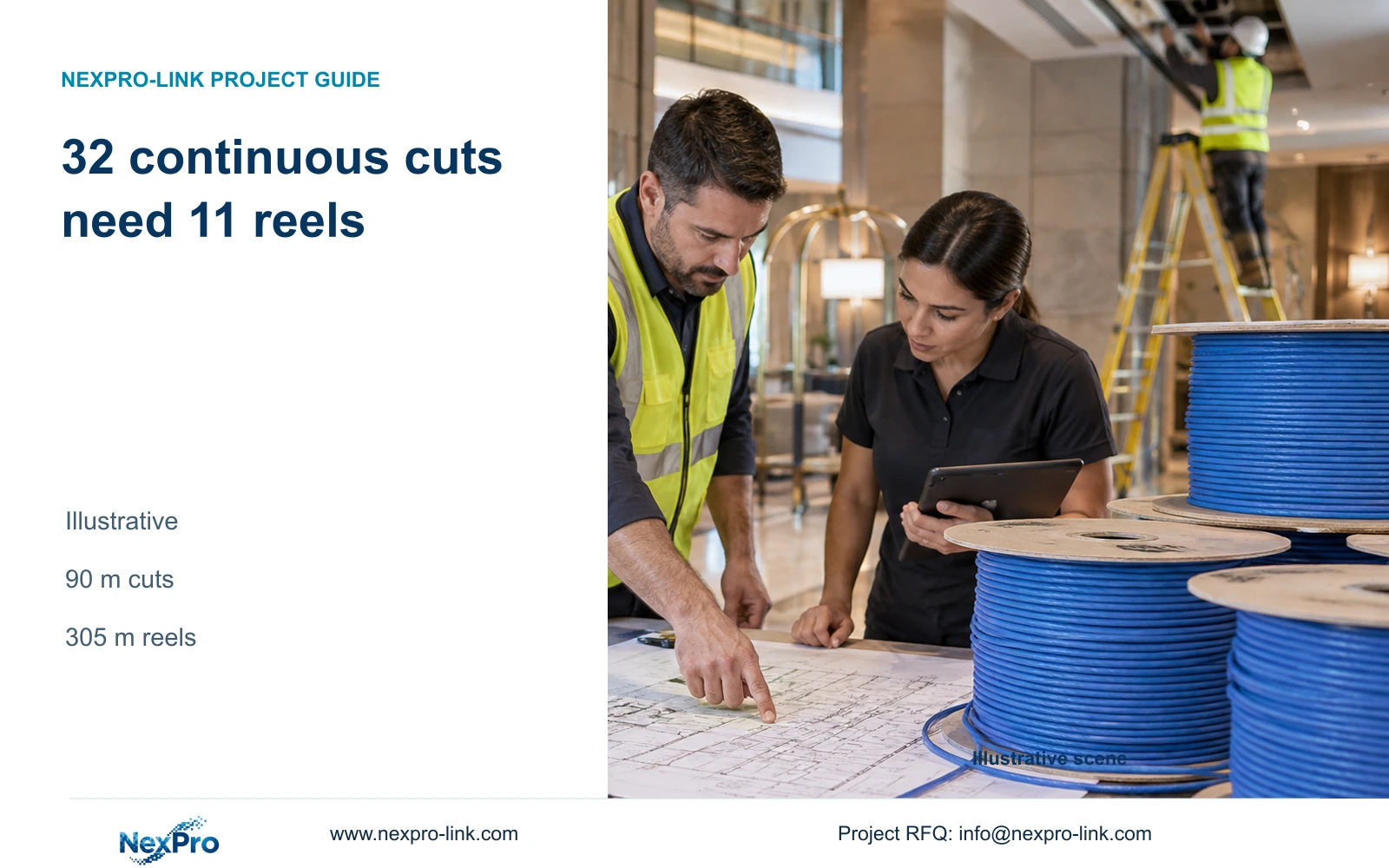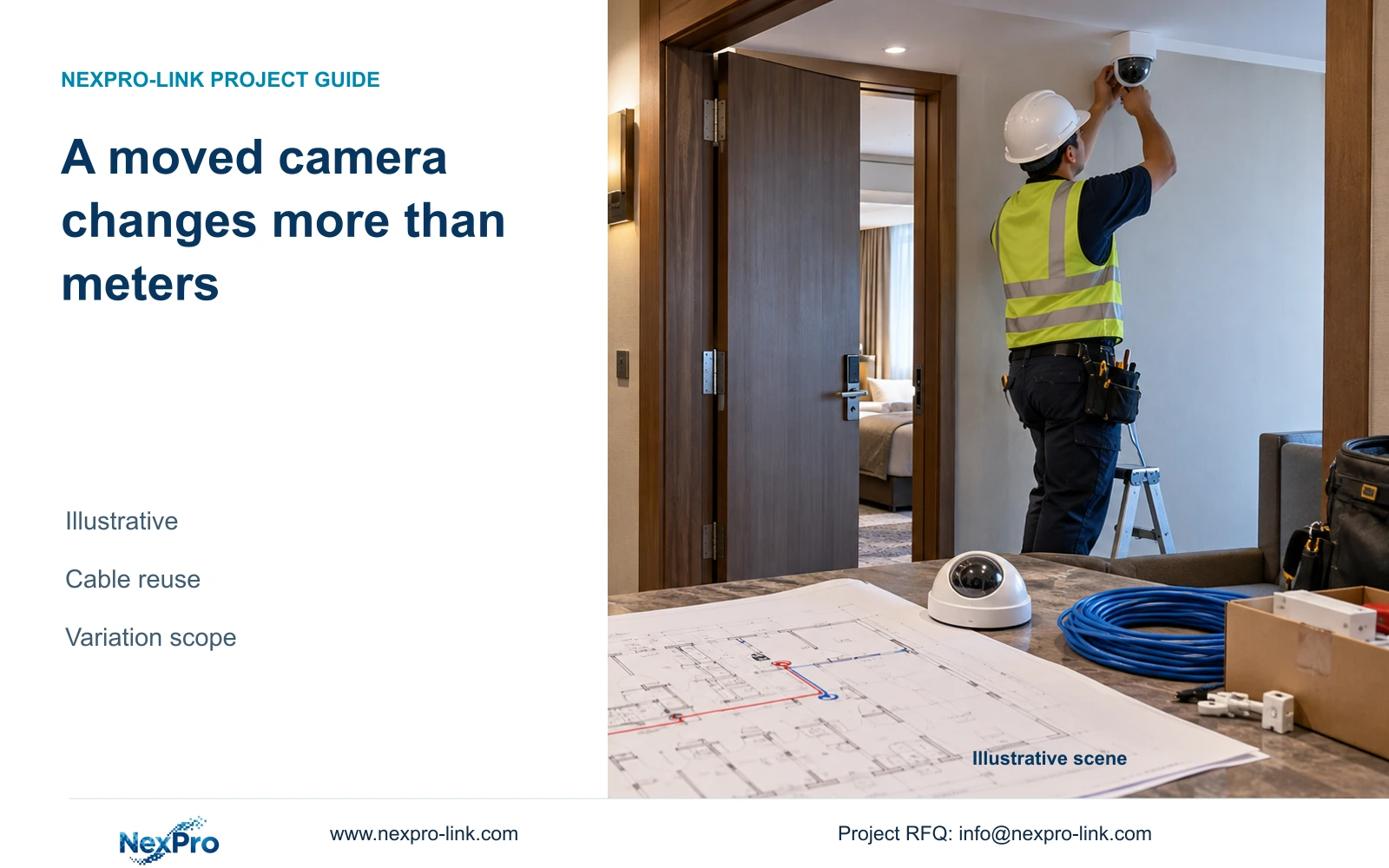
A camera relocation can change the complete route and its installation interfaces. Evaluate reuse, replacement and shared-system thresholds before approving a cable-only variation.
Section 01
Confirm the revised public-area observation task
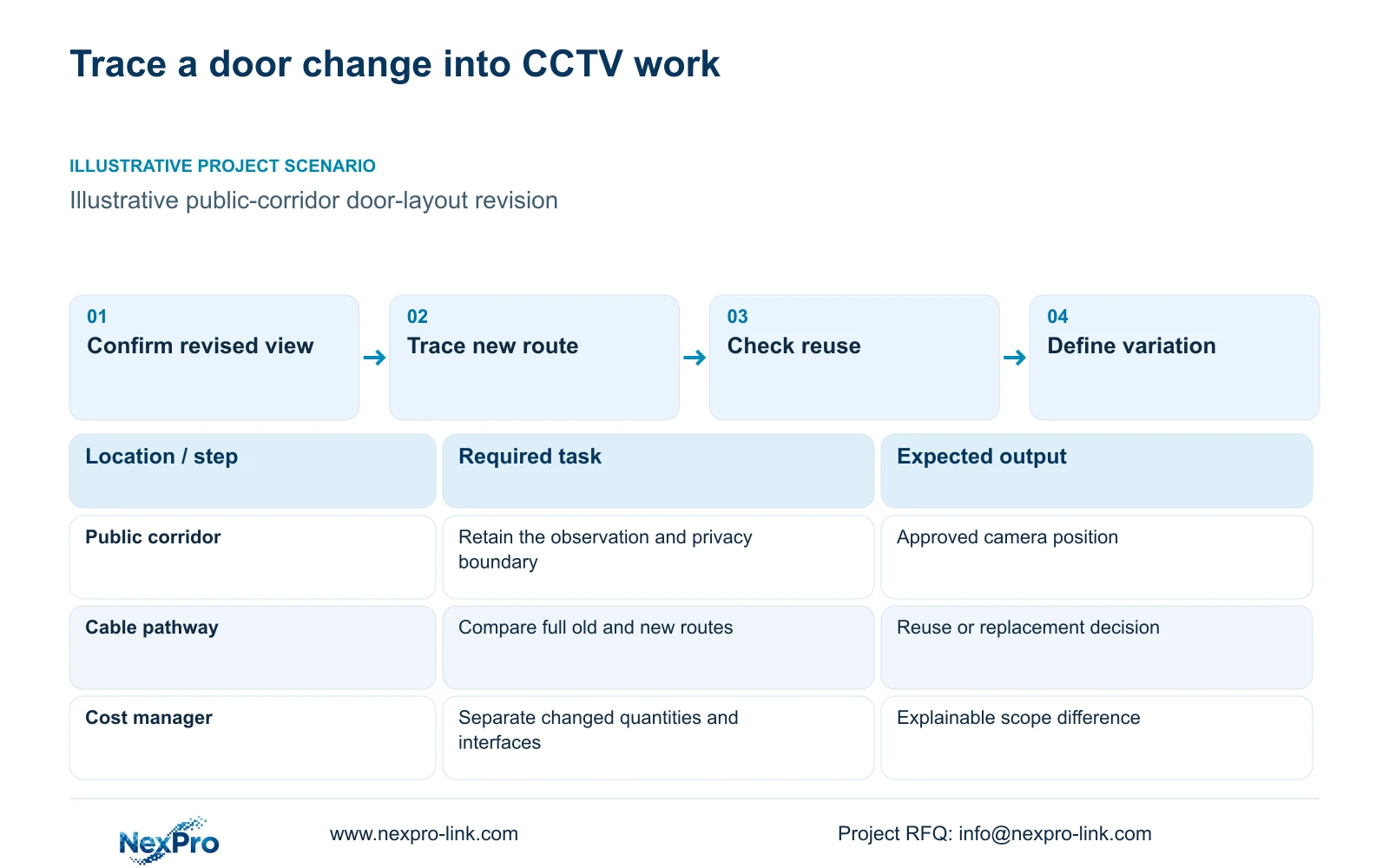
Assess a hotel camera relocation as a complete interface change. Approve a cable-only extension of the allowance only when the revised view, continuous cable reuse and installation scope support it. If the existing run cannot reach the new position appropriately, or the move changes mounting and access work, evaluate a replacement route and its associated costs.
A revised door location can change what a public-corridor camera needs to see. Record the intended observation task and compare the old and proposed positions. Keep unnecessary views into private spaces outside the coverage boundary. A camera moved a few meters on a plan may need a different orientation or mounting arrangement to preserve the approved task.
Retain a dated commercial and technical baseline. It should identify camera positions, models, interfaces and the quantity and scope previously priced. Separate a relocation from an added view or specification change. Those distinctions determine which quantities change and prevent the cost manager from interpreting every adjustment as the same additional camera point.
| Required task | Given information | Decision still needed |
|---|---|---|
| Observe a public corridor | Revised door and camera positions | Retained view and privacy boundary |
| Reconnect the relocated camera | Existing route and termination | Reuse or replacement scope |
Section 02
Trace the old and new installed routes
Measure both routes through the actual pathway. Include horizontal sections, risers, detours and stated termination allowances. The difference between camera positions is not the same quantity as the difference between installed cable routes. A changed access point can require work along a longer part of the pathway even when the endpoint moves only slightly.
Keep the permanent cable separate from patch cords and any backbone. The supplied Fluke Networks record uses the typical 90 m permanent-link and 100 m channel distinction. Review the revised link against the project's specified test basis instead of adding length without checking the complete arrangement.
A relocated closet or new intermediate node changes more than cable meters. Show its communication interfaces and local power, including protection if outage recording is required. Fiber can carry data to a remote location but does not automatically supply its active equipment. These dependencies belong in the variation scope before the buyer compares reuse with a new route.
Section 03
Establish whether the existing continuous cable can be reused
Compare the available continuous cable with the complete revised route, including its termination needs. Record which material remains usable and where installation work is still required. Do not assume that a spare tail at one endpoint is available throughout the pathway or that distributed offcuts can complete a longer permanent run.
Review brackets, modules and patching alongside the cable. SP5648 is a Cat6 48-port patch panel and DT968MX a Cat6 tool-free module; their identities should remain distinct from the bulk-cable specification. Reusing a component needs an interface check, and the revised installed link still needs the specified acceptance work.
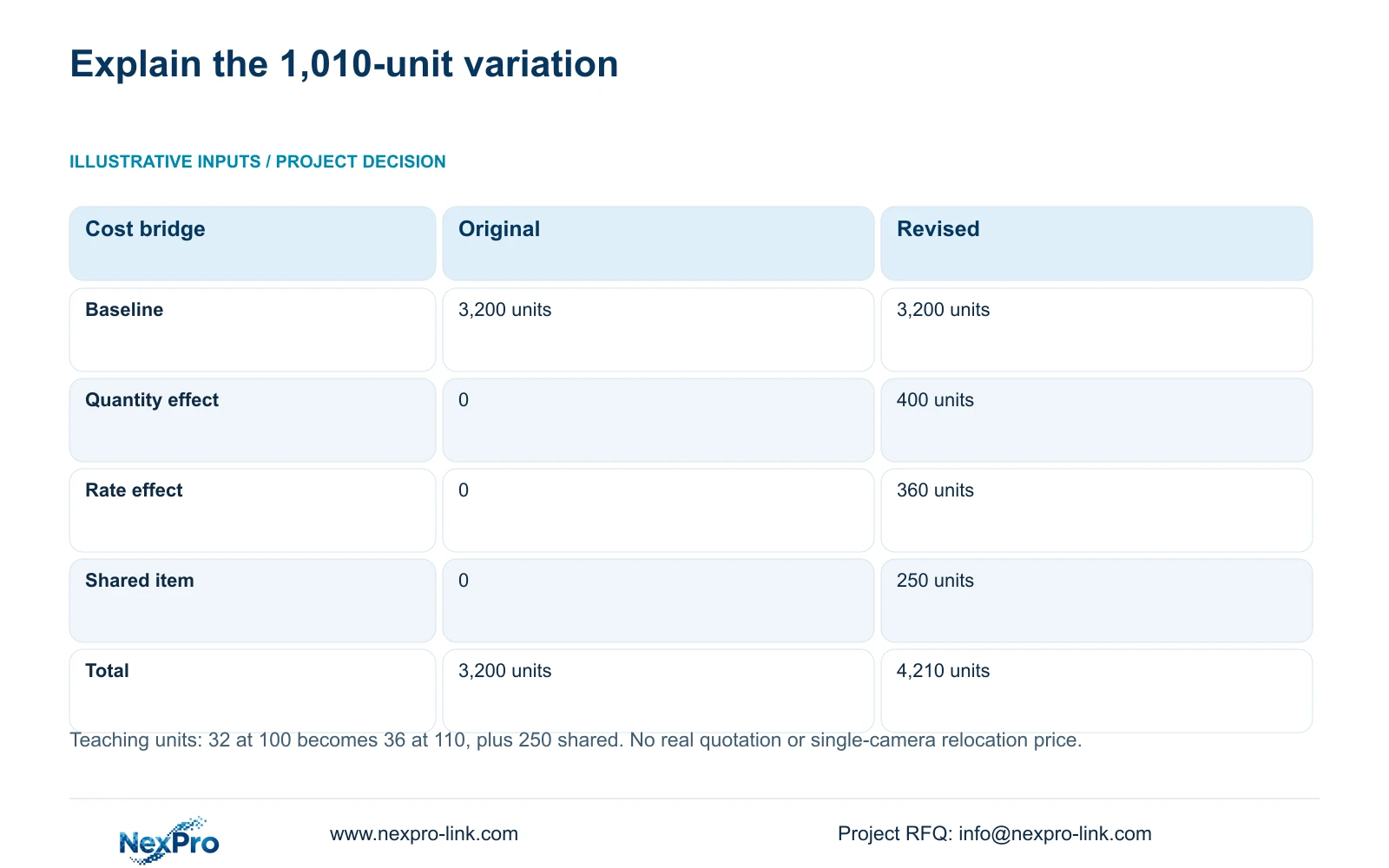
The cost bridge in the next section assumes an original quantity of 32 at 100 teaching cost units, a revised quantity of 36 at 110 units and one shared addition of 250 units. It represents a combined quantity and rate change, not the price of one camera move. Keep actual reuse credits, cancellation charges and labor evidence separate when applying the method to a real variation.
Section 04
Separate quantity, rate and shared-resource changes
Begin with 32 × 100 = 3,200 teaching cost units. Price the quantity change at the original rate: (36 minus 32) × 100 = 400. Then apply the rate change to the revised quantity: 36 × (110 minus 100) = 360. Add the separately identified shared item of 250 to reach 4,210.
The difference is 1,010 units, comprising 400 for quantity, 360 for specification or rate and 250 for shared resources. This fixed calculation order avoids counting the same rate change twice. The units are illustrative, without a currency or supplier price, and the calculation is independent of the complete 32-camera reference hotel's equipment and cable budgets.
Use the same structure for actual priced work, with each rate's inclusions stated. Added cameras may cross recorder-channel, PoE-power, storage or UPS thresholds. Check those limits individually; the extra four points do not establish a particular shared-device upgrade. Labor, access and reinstatement should be visible wherever they change, rather than assumed to follow cable length proportionally.
| Metric / condition | Original: 32 at 100 units | Revised: 36 at 110 units |
|---|---|---|
| Original total | 3,200 | 3,200 |
| Quantity effect | 0 | 400 |
| Rate/specification effect | 0 | 360 |
| Shared-resource change | 0 | 250 |
| Final teaching total | 3,200 | 4,210 |
Section 05
Coordinate drawing and schedule revisions
Carry the change identifier into the camera schedule, route drawing and connectivity records. Retain the old version for comparison and identify the version proposed for purchase and installation. An updated architectural plan alone does not tell the installer which cable, port or camera setting has changed.
Distinguish technical agreement from commercial authorization. The engineer can confirm whether a revised view retains the required task, while the cost manager evaluates the changed scope. The person authorized under the project arrangements decides whether the variation proceeds. A calculation or draft drawing should not silently become an instruction to order additional equipment.
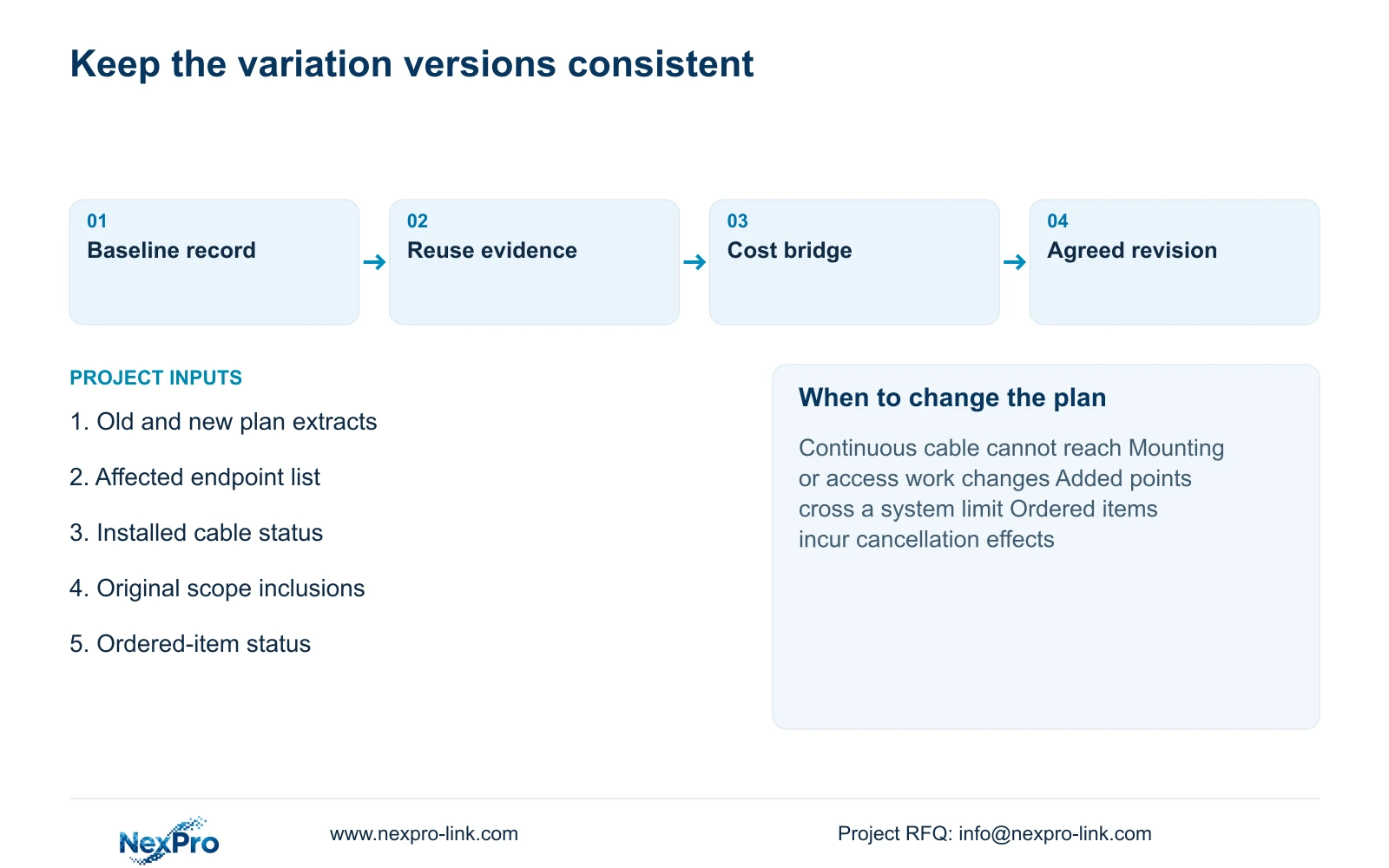
Compare genuine alternatives, such as reusing an adequate continuous run, installing a replacement or retaining the original camera position with a suitable revised view. Show their remaining work and programme implications. Where a component has already been ordered or a pathway closed, identify cancellation or access effects rather than assuming every late change is free or immediately executable.
Section 06
Approve the complete variation and its remaining work
Approve the reuse option when the existing continuous cable and connections suit the revised route, the observation task is retained and the required installation and testing are included. Select replacement when those conditions fail. Reopen the equipment comparison if revised quantities or stream configurations cross a shared-system limit, even if the cabling work itself appears small.
The variation record should state retained items, removed items, additions and the work still required on site. Include credits only where reuse or cancellation is genuinely available under the relevant scope. The chosen solution needs an agreed drawing version and explicit commercial boundaries so procurement and installation act on the same decision.
Send the old and revised plan extracts, affected endpoint list, cable status and original scope inclusions to info@nexpro-link.com. NexPro-Link can discuss model matching and coordinated BOQ changes, with supporting supply distinguished from its CCTV manufacturing core. Local labor, access and reinstatement remain project-specific responsibilities. Share the affected information first; guest images, passwords and unrelated confidential tender material are unnecessary for this comparison.
Section 07
Buyer questions
Can a camera moved a few meters be priced as a few extra meters of cable? Only if the existing continuous run can serve the approved new route and the remaining scope supports that basis. Review mounting, connections, access, reinstatement and testing before accepting a meter-only variation.
Should the new rate apply only to the four added points? That depends on the agreed changed scope. In the teaching example, all 36 revised items use the new rate, producing a 360-unit rate effect. If only added items change specification, use a different bridge that reflects that actual boundary.
What information is enough for an initial variation review? Provide the two drawing revisions, affected endpoint identities, existing cable status and the original quotation's inclusions. Identify what has already been ordered or installed so reuse and cancellation can be assessed realistically.
Engineering references
These sources support the general planning principles. Always use the selected product's current datasheet and applicable project standards for final design.