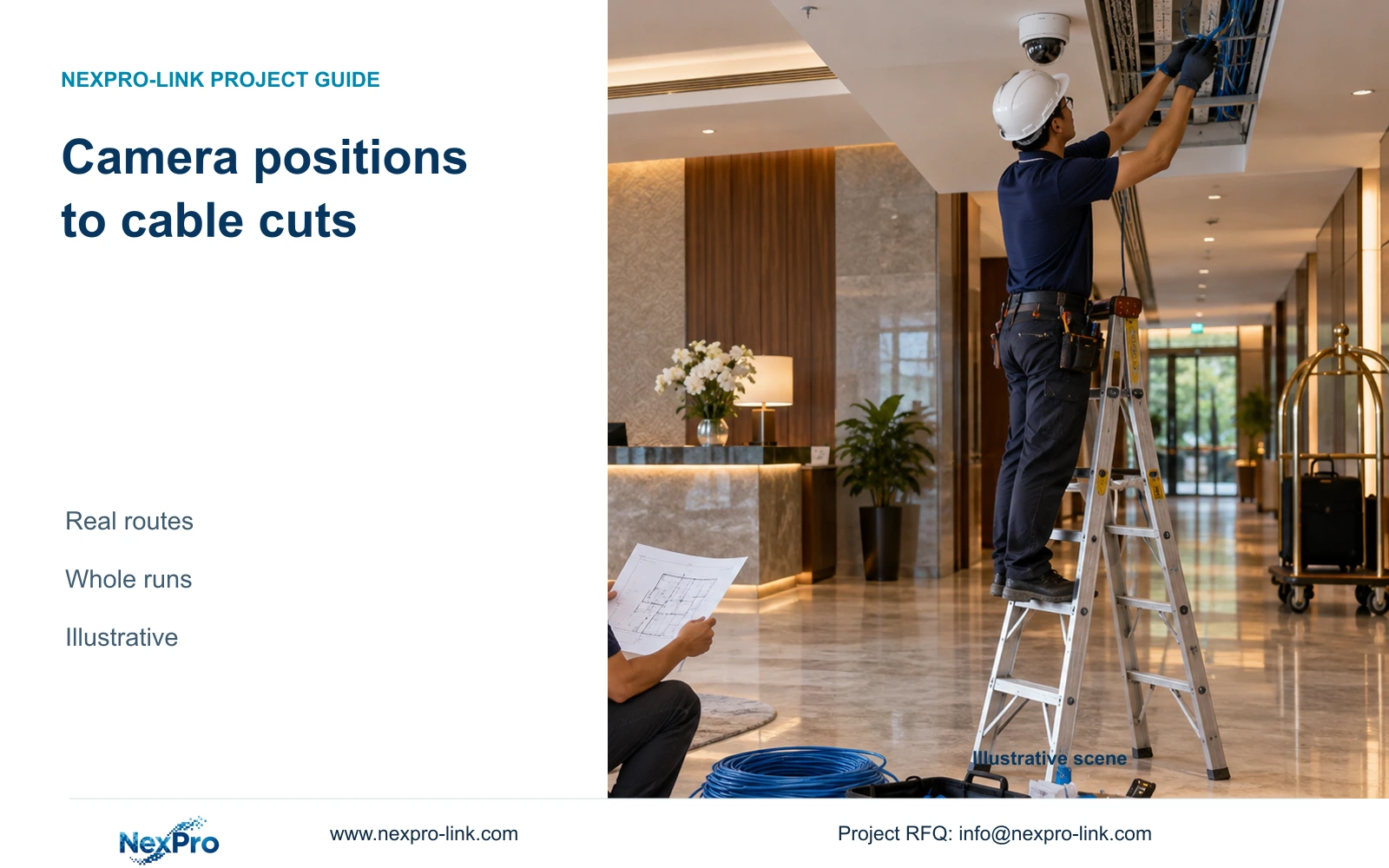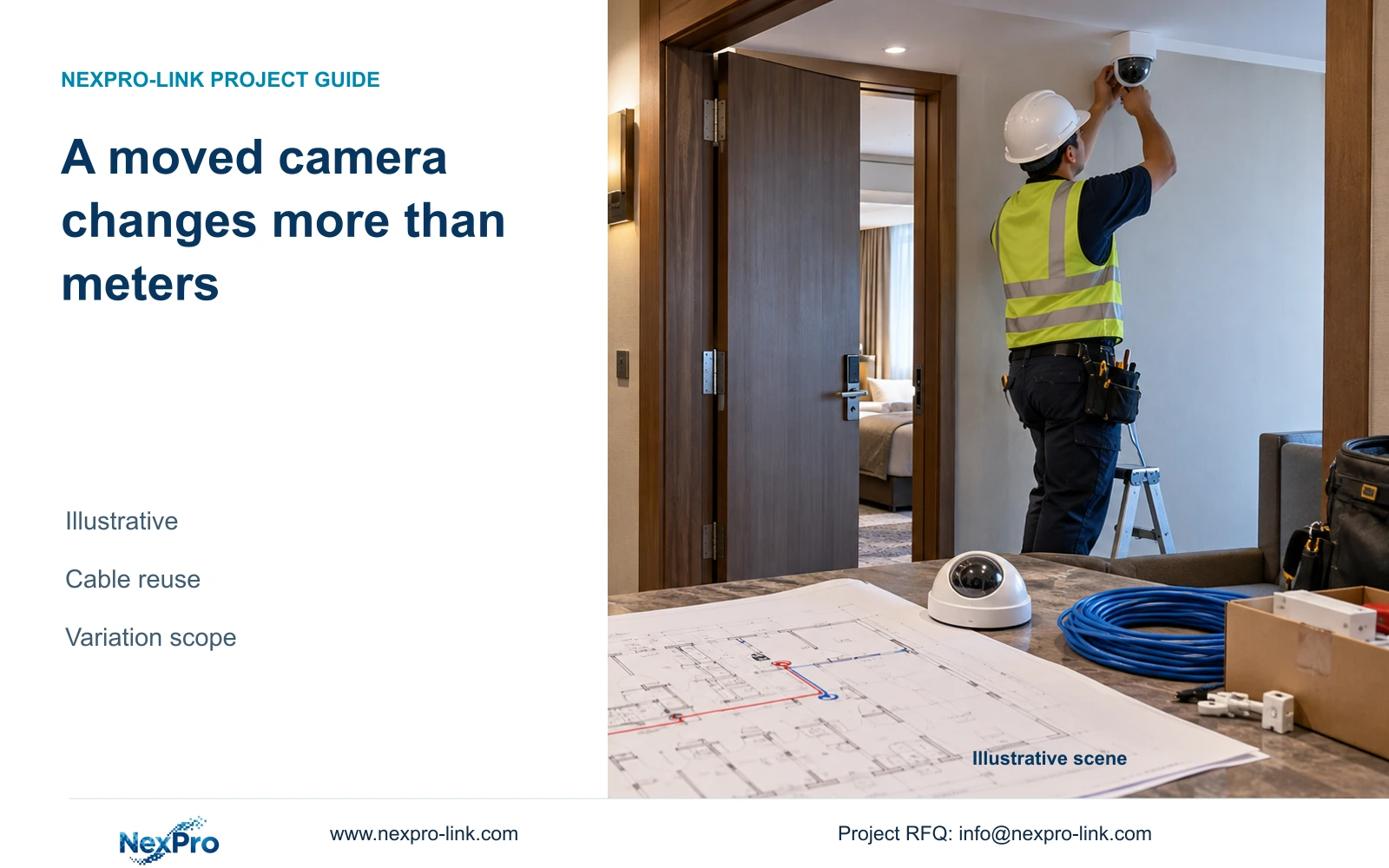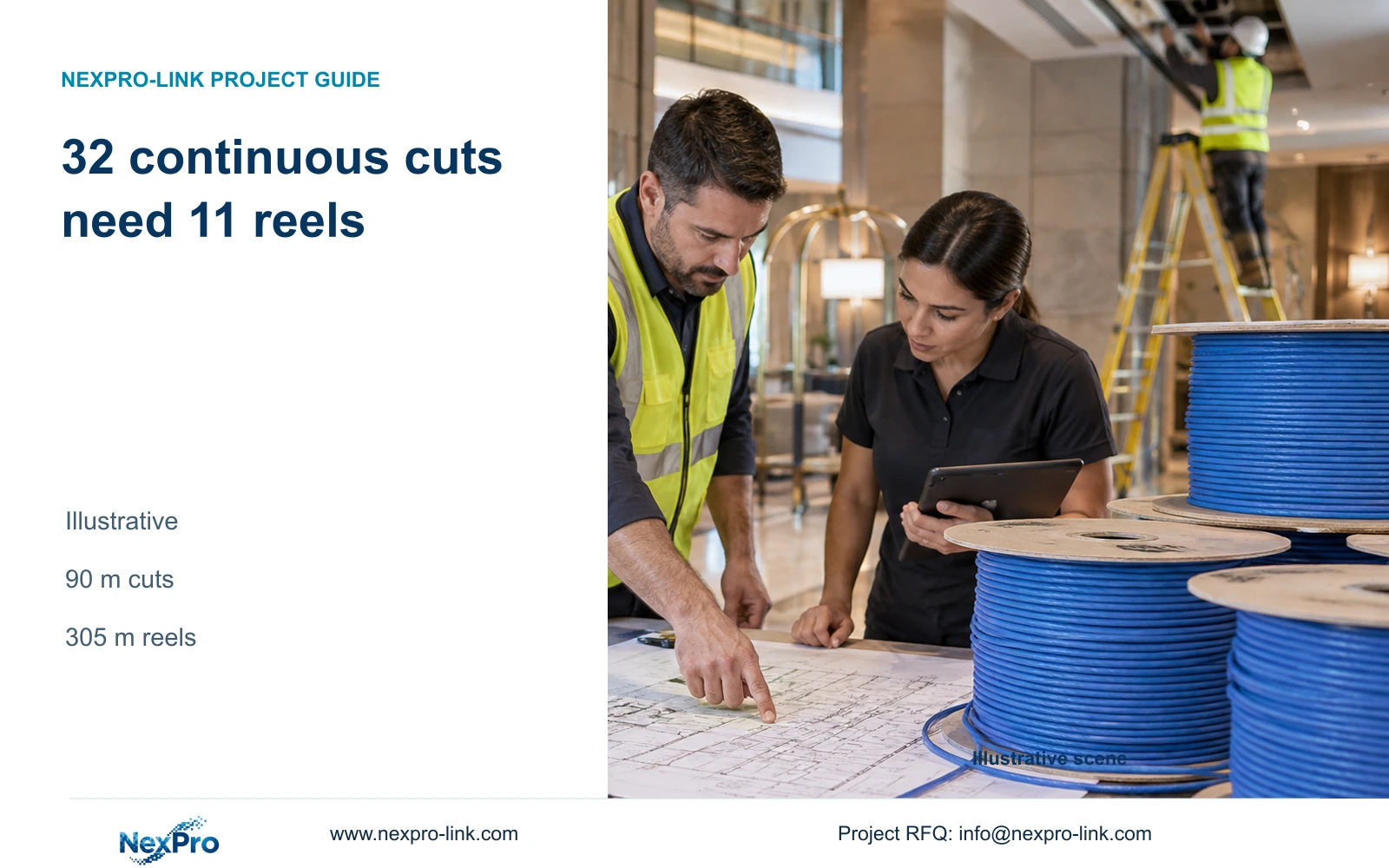
Before reordering, inventory every partial reel or tail as an individual continuous piece. Allocate a piece only to a run it can complete with its stated allowances.
Section 01
List complete continuous runs before estimating reels
Before reordering, inventory every partial reel or tail as an individual continuous piece. Allocate a piece only to a run it can complete with its stated allowances. Recalculate remaining whole-reel cuts after that allocation. Do not pool disconnected tails into metres that imply a feasible permanent run or add undocumented joints to make the count fit.
Order hotel CAT6 from a feasible continuous-run allocation. For the illustrative requirement of 32 independent 90 m cuts from 305 m reels, select 11 reels. Ten reels satisfy the rounded total-length lower bound but can supply only 30 complete cuts. Recalculate the order if endpoint lengths, allowances or the supplied reel length change.
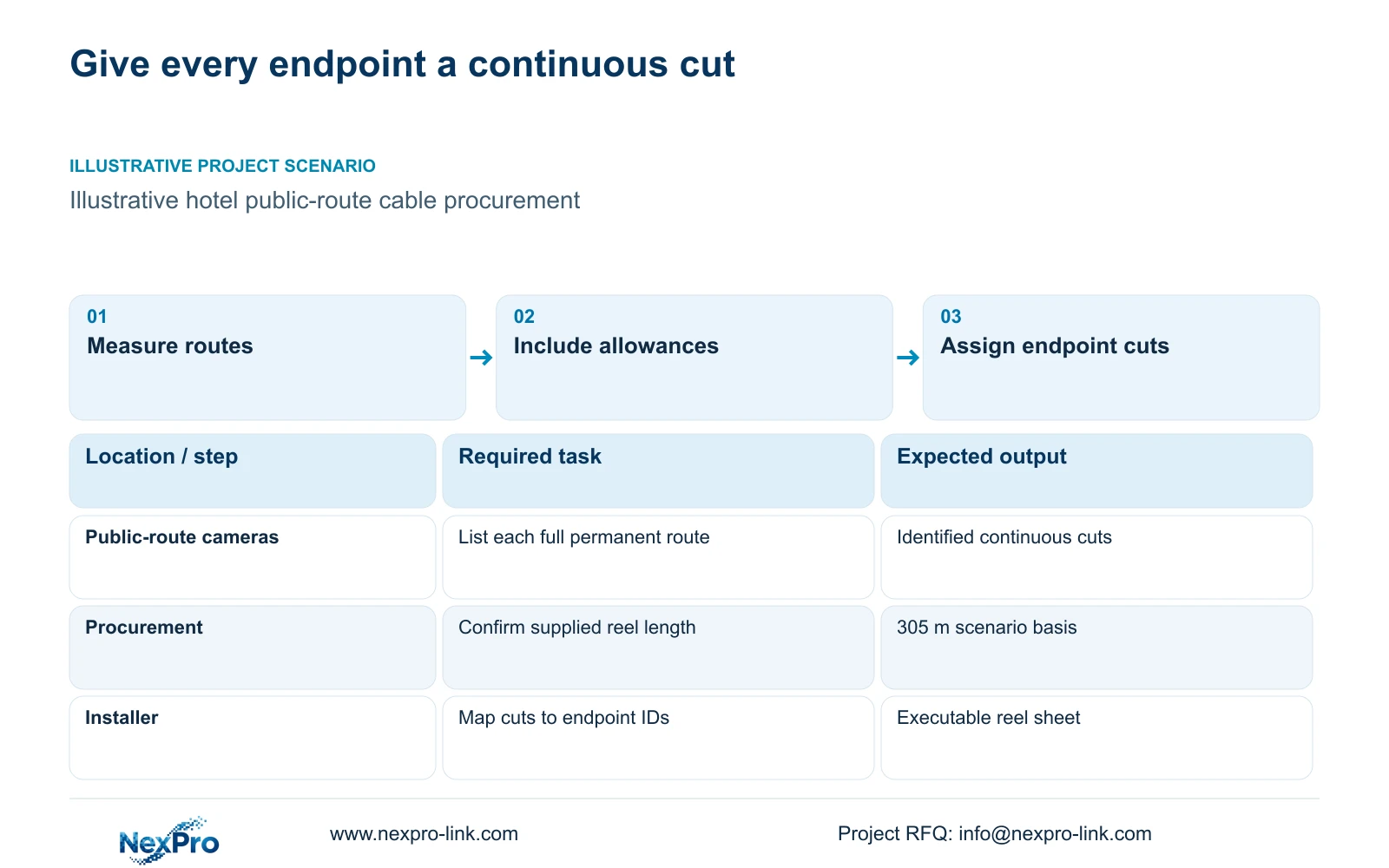
Start with a route schedule that identifies both ends of every cable and the full installed path. Include horizontal routing, risers and justified termination allowances in the individual cut length. An average can support an early estimate, but it conceals the long runs that determine whether the final reels can supply every endpoint.
Keep permanent-link lengths separate from patch cords. The supplied testing record distinguishes the typical 90 m permanent-link basis from the 100 m channel including patching. Each 90 m cut in this example already includes its planned permanent-route allowances. Adding hidden extra length after reel planning would invalidate both the allocation and the stated length comparison.
| Required task | Given information | Decision still needed |
|---|---|---|
| Complete each camera route | Endpoint and measured path | Full continuous cut length |
| Select purchased reels | Cable specification | Actual supplied reel length |
Section 02
Calculate the total-length lower bound
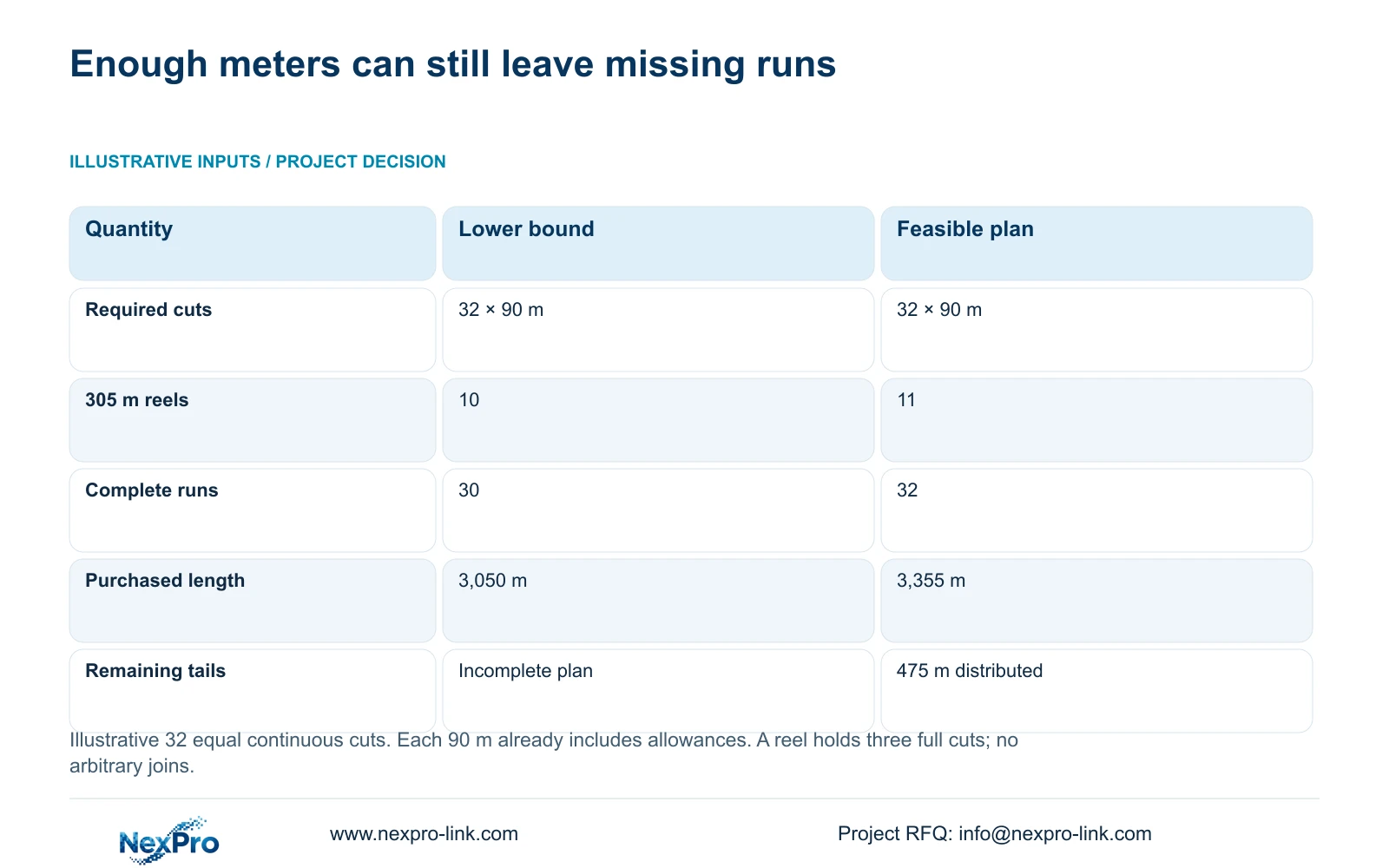
The total required length is 32 × 90 m = 2,880 m. Divide that quantity by the assumed 305 m reel length and round upward: the arithmetic lower bound is 10 reels. Those reels contain 3,050 m in total, which exceeds the required meters. This first calculation is useful for checking scale, but it does not allocate the individual cuts.
Continuous cuts impose another limit. Each reel fits floor(305 ÷ 90) = 3 complete runs, using 270 m and leaving a 35 m tail. A fourth 90 m run cannot fit on that reel. Ten reels therefore provide only 30 runs, leaving two endpoints without their required continuous cables.
Keep the lower-bound quantity visible in the estimate and label it accurately. It can help explain why a purchasing quantity is greater than a simple total-meter calculation. A buyer who sees both calculations can evaluate the additional reel without assuming that the supplier has inserted an unexplained blanket waste percentage.
Section 03
Build a reel allocation that completes every endpoint
Allocate three 90 m cuts to each of the first ten reels and two cuts to the eleventh. The first ten reels provide 30 runs, and the last provides the remaining two. This arrangement purchases 11 × 305 m = 3,355 m and supplies all 2,880 m of required cuts.
The resulting tails total 475 m: ten pieces of 35 m and one piece of 125 m. Their sum is useful for stock accounting, but their individual lengths control reuse. These figures are teaching inputs and arithmetic results, not a quotation or a measured hotel's cable consumption.
The equal-length scenario also establishes why fewer reels cannot work under its assumptions: no reel supplies more than three required cuts, so 32 cuts need at least 11 reels. For a real mixed-length schedule, demonstrate feasibility with a per-reel allocation and avoid describing a heuristic result as mathematically optimal without supporting analysis.
| Metric / condition | Rounded total-length lower bound | Feasible continuous-run plan |
|---|---|---|
| Total cut length | 2,880 m | 2,880 m |
| 305 m reels | 10 | 11 |
| Can every run be cut? | No: 10 reels fit only 30 runs | Yes: 10 × 3 runs + 1 × 2 runs |
| Purchased length | 3,050 m | 3,355 m |
| Total remaining tails | Not a feasible complete plan | 475 m |
Section 04
Compare longest-first planning for mixed routes
Where route lengths differ, sort the required cuts from longest to shortest and place each into a reel with sufficient remaining length. This gives the planner a practical starting allocation. Keep endpoint identities attached to the cuts so the result can be issued to the installation team without translating anonymous lengths back into camera positions.
The separate complete hotel reference uses 32 mixed routes totaling 1,826 m and presents a feasible seven-reel plan using 305 m reels. Its total-length lower bound is six reels. That reference demonstrates a mixed-length allocation; it is independent of this article's 2,880 m, eleven-reel scenario and should never replace its inputs.
Compare proposed allocations by checking that every endpoint appears once, each reel stays within its supplied length and no required run is assembled from tails. A changed closet can shorten routes, but it may add power and maintenance responsibilities. Treat that as a design alternative with its own scope, rather than changing the approved route merely to improve reel utilization.
Section 05
Track reusable tails as individual stock pieces
Record each remaining piece by length and cable identity. A tail becomes useful stock only when a later approved continuous route fits it and the cable specification suits that installation. Its presence in a store does not justify subtracting the entire tail total from a future purchase allowance.
In this example, the 125 m tail can accommodate another 90 m cut if a matching route is later approved. The 35 m pieces cannot supply that cut individually. Do not combine them through arbitrary joins to complete a permanent run. Any proposed change to the connection arrangement needs its own design and testing basis.
Keep reuse credits separate from the present executable order. Track whether a piece is available, reserved for another endpoint or unsuitable for the required environment. Category, jacket and installation conditions remain relevant even when its length is sufficient. This makes offcut accounting useful to the cost manager without converting distributed material into an imaginary continuous reel.
| Situation | Required record | Decision boundary |
|---|---|---|
| Partial reel recorded | Its individual continuous length | Allocate only a complete feasible run |
| Several tails remain | Separate piece identities | Do not pool them into one long cut |
| Usable piece allocated | Run allowances and remaining demand | Recalculate whole-reel cuts without hidden joints |
Section 06
Order against a versioned cutting plan
Issue the reel count with the route schedule, cut allocation and specification for the cable family. Include patch panels, modules, cords and installed-link testing in the connectivity scope. SP5648 is a Cat6 48-port patch panel and DT968MX a Cat6 tool-free module; neither is the model identity for the bulk cable being cut.
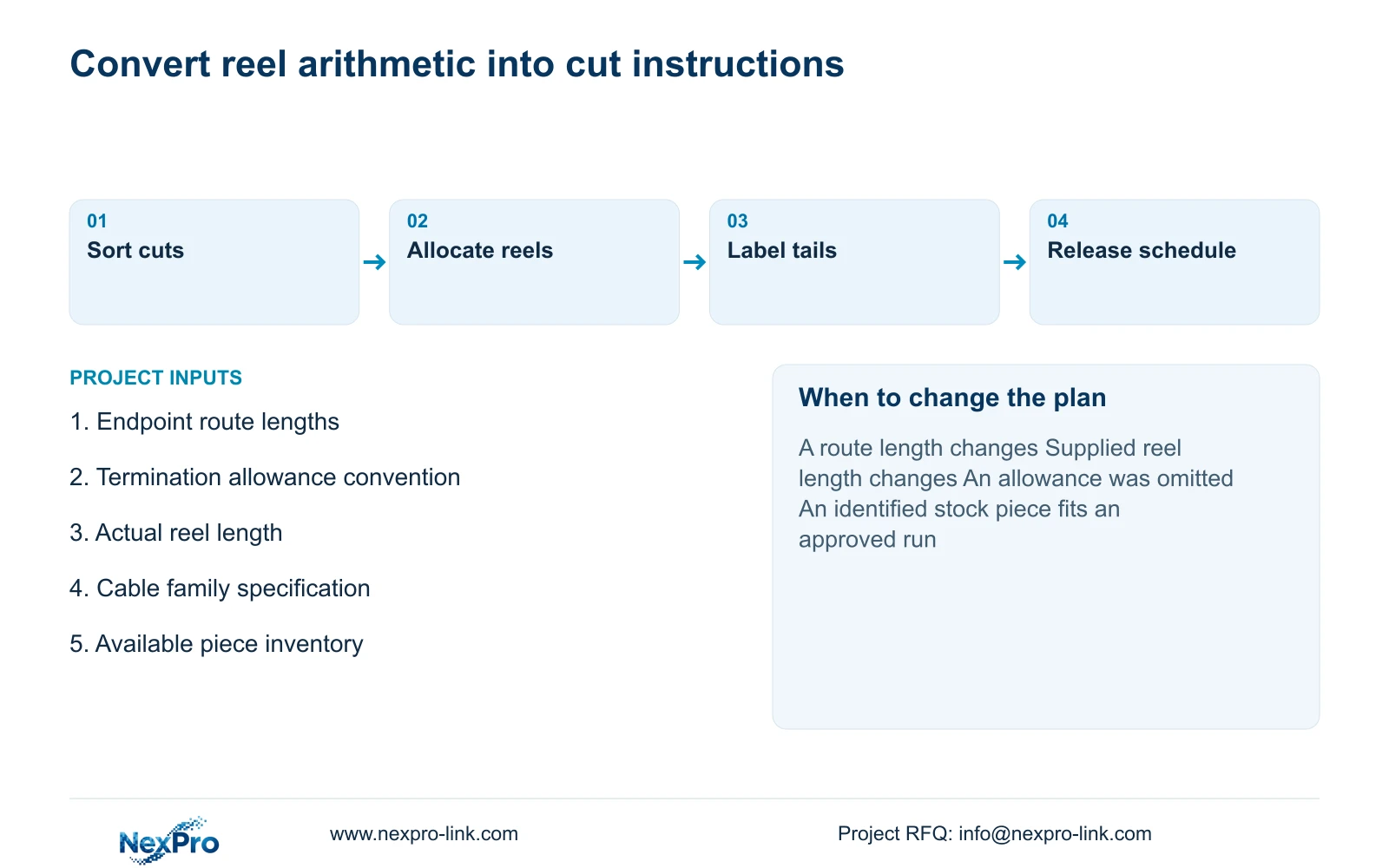
For the stated equal-run scenario, the eleven-reel plan is the purchase basis. Change it when actual routes, termination allowances or reel lengths differ, or when stock pieces are assigned to specific qualifying runs. Keep any allowance for additional work explicit instead of hiding it inside the already calculated 475 m of distributed tails.
Send the endpoint route schedule, confirmed reel length, allowance convention and destination cable specification to info@nexpro-link.com. NexPro-Link can discuss coordinated equipment and BOQ support, with local installation and testing boundaries identified. Its CCTV manufacturing core and supporting supply coordination should remain distinct in the quotation. The final cable order should name the supplied cable specification and retain the allocation version used to approve its quantity.
Section 07
Buyer questions
Can procurement order ten reels now and use the tails for the last two runs? No, under the stated inputs. Ten reels produce 30 complete 90 m cuts and leave ten 35 m pieces. Those pieces cannot individually supply either remaining run, so the eleventh reel is required.
Is all 475 m of remaining cable waste? It is distributed remaining stock, not automatically waste or reusable credit. The ten 35 m pieces and one 125 m piece need individual identities and suitable future continuous routes before they can be allocated.
Should we add termination allowance to every 90 m cut? The example's 90 m already includes the full planned permanent route and its allowances. If the actual design requires more length, revise each affected cut, review the link-length basis and rebuild the reel allocation before ordering.
Engineering references
These sources support the general planning principles. Always use the selected product's current datasheet and applicable project standards for final design.