A hotel CAT6A upgrade needs a defined application and a complete compatible channel. Route length, PoE conditions and future use can change the choice independently.
Section 01
Define the application that justifies an upgrade
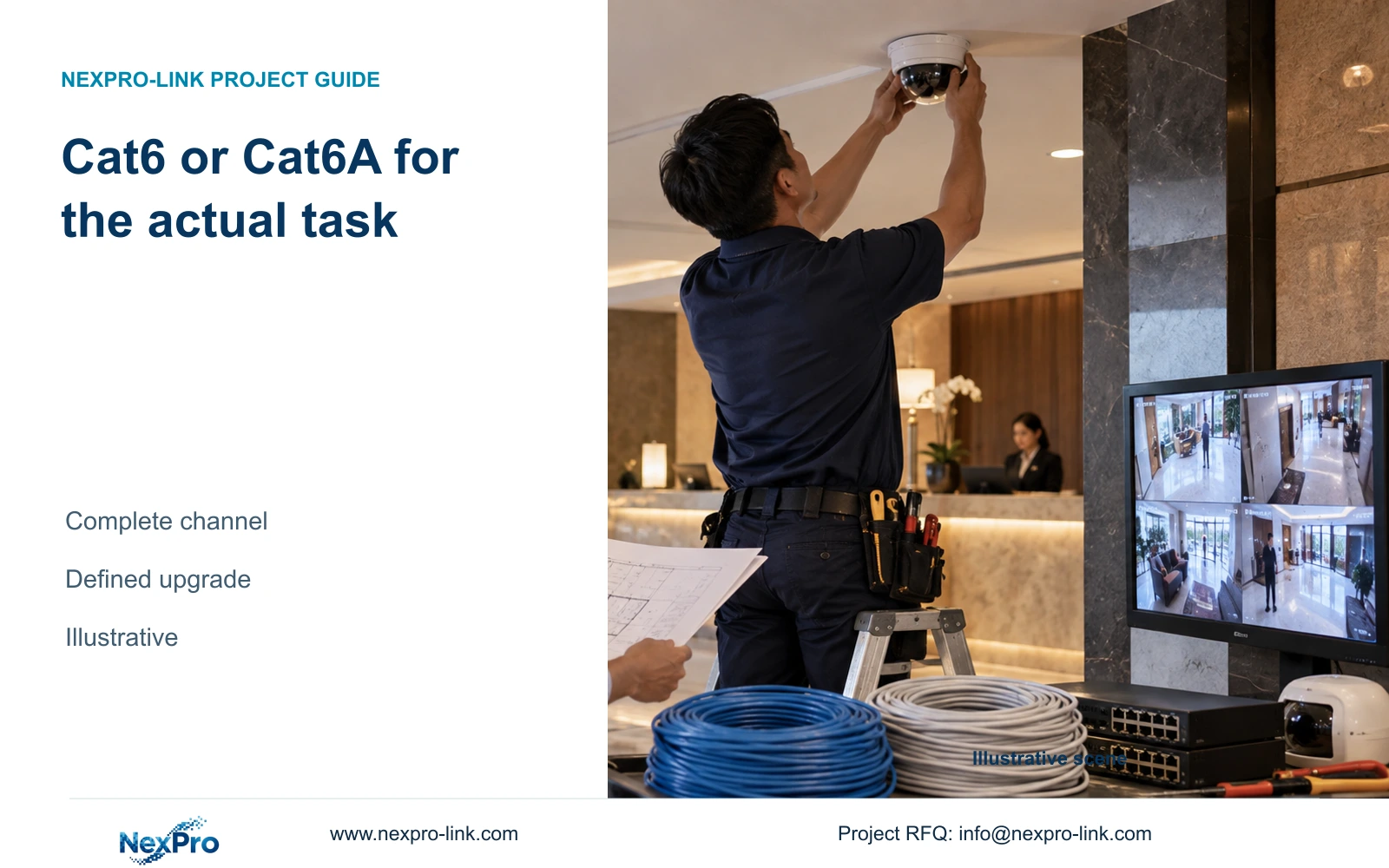
Keep Cat6 where a complete, tested channel satisfies the hotel’s approved camera application. Specify Cat6A where a documented application, operator requirement or future-use plan calls for it and the complete installation supports that choice. A higher cable category does not by itself improve camera image quality, and it does not resolve an overlength permanent route.
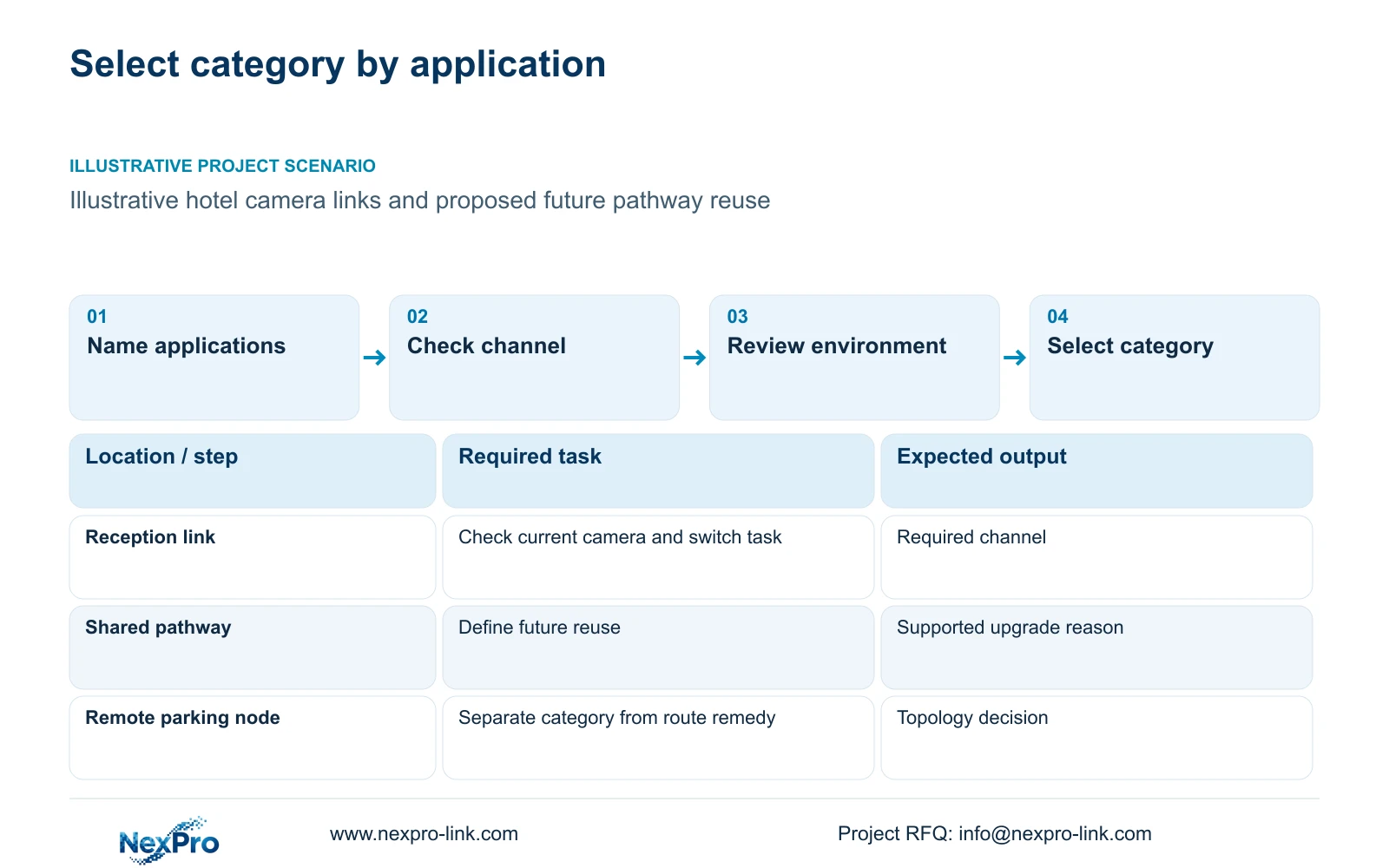
Separate today’s camera connection from future applications proposed for the same pathway. Record the required endpoint interface, traffic and intended service for each. A general wish to accommodate expansion gives the buyer little basis for choosing components or evaluating the upgrade price. A defined future task can be checked against the selected channel and equipment.
One concrete upgrade reason is a required 10GBASE-T copper channel across the full 100 m channel basis. Leviton's Cat 6A documentation identifies that application. Specify a complete qualifying channel and compatible endpoints; this does not certify a NexPro-Link component combination or permit a 100 m fixed permanent run. For ordinary camera traffic, confirm the actual interface and application before buying that upgrade.
Draw data and power boundaries alongside that application schedule. Camera traffic may travel through an access switch and backbone before reaching the recorder. The camera’s power may come from that access switch, while a remote fiber node needs local power. Decide which part of the network is under review before applying one cable category across every hotel connection.
| Task | Known input | Required decision |
|---|---|---|
| Current CCTV connection | Selected camera and switch interfaces | Complete channel and test basis |
| Future pathway reuse | Proposed application | Documented requirement or provisional allowance |
Section 02
Compare complete channels and route limits
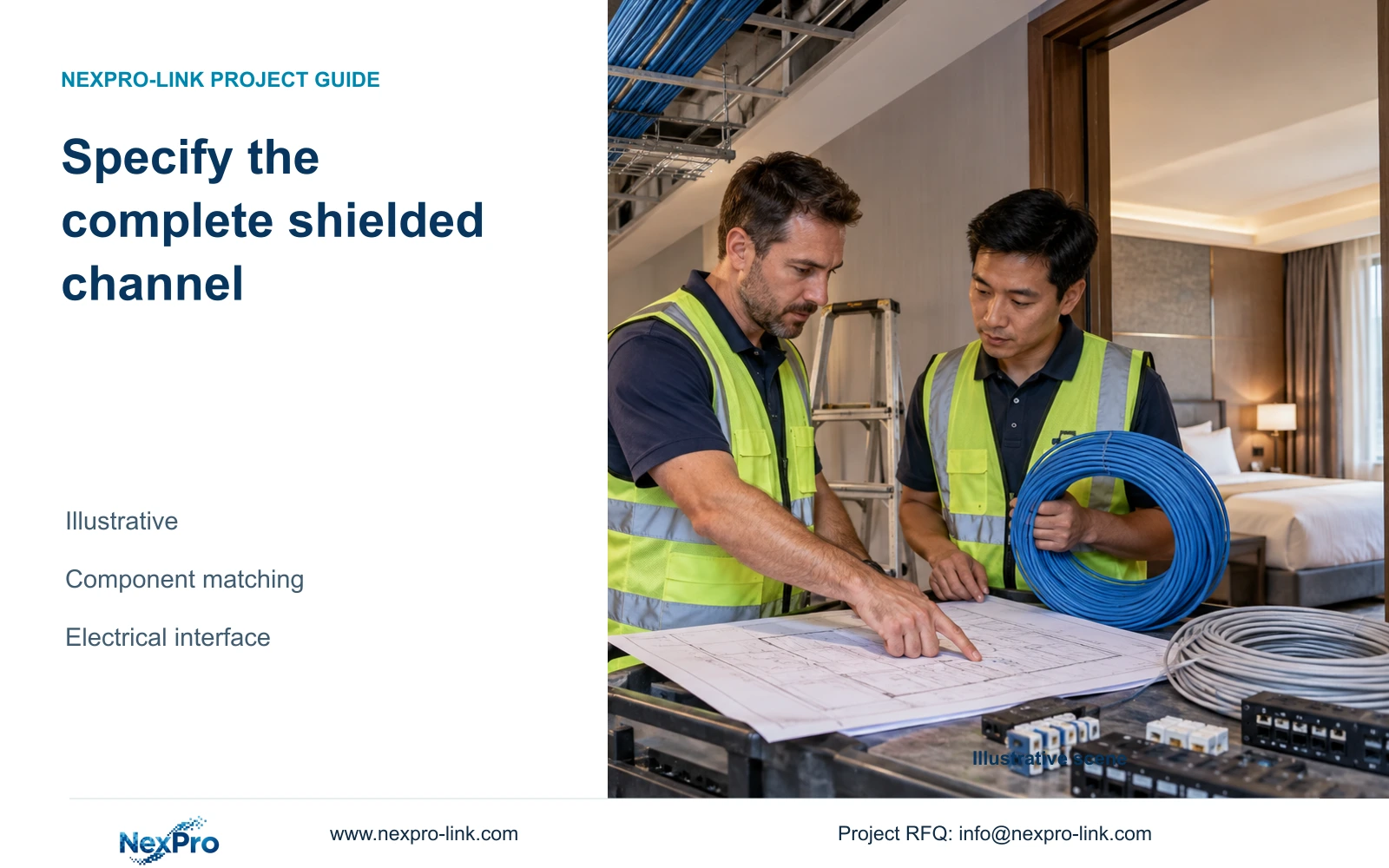
Compare the cable, termination components and patch cords as one channel. The category printed on a reel is only one part of that specification. Keep the fixed permanent route separate from equipment cords, and identify the connection arrangement that the installer will actually deliver.
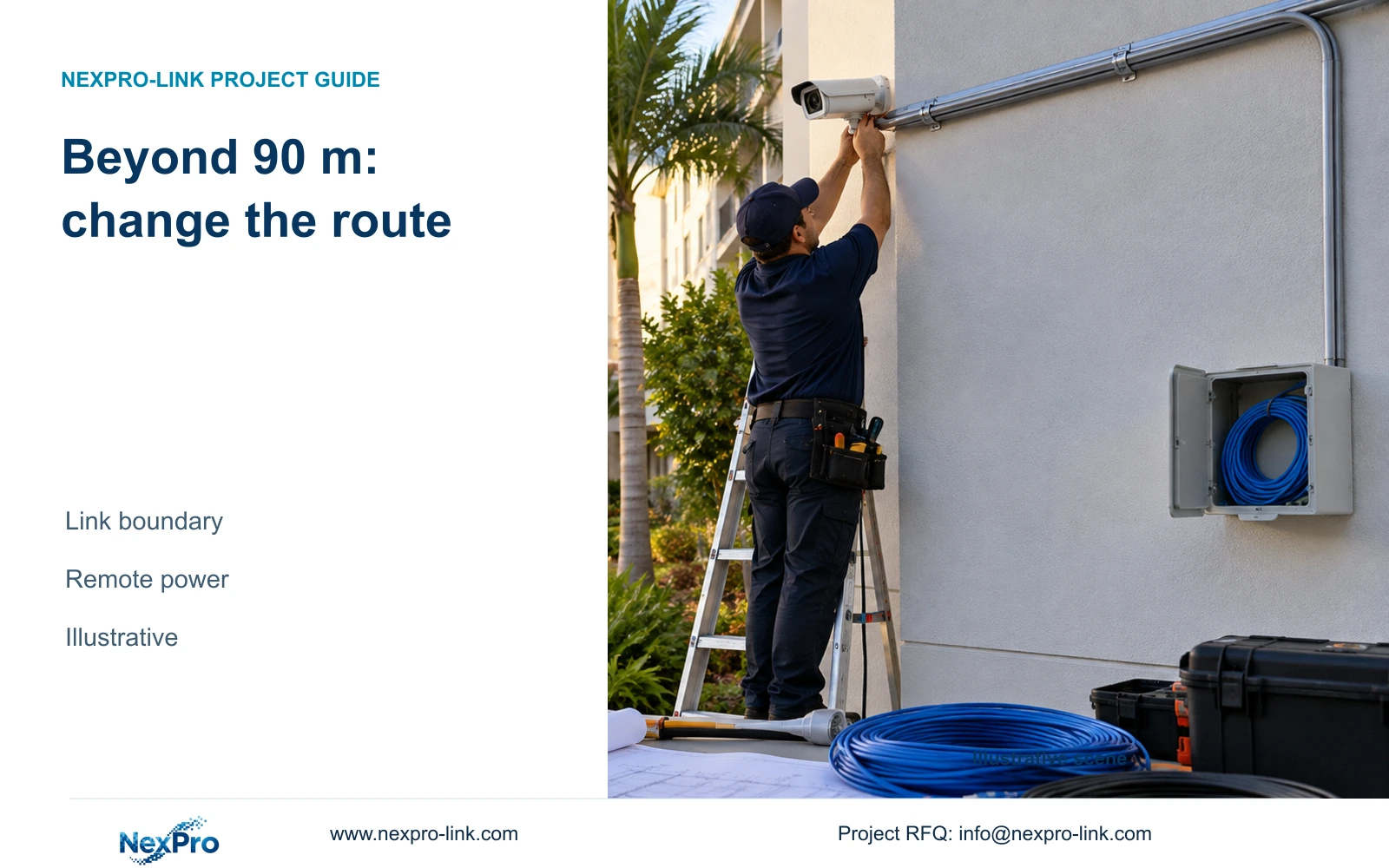
The supplied Fluke Networks guidance uses the typical 90 m permanent-link and 100 m complete-channel bases. Assess each design against its specified test basis and application. A route that exceeds the permanent-link basis needs a route or topology decision; selecting a higher category alone does not establish an acceptable extended connection.
Price route alternatives separately from category alternatives. Moving a closet can shorten fixed copper while changing cabinet access and power requirements. A qualified fiber backbone can serve a remote access node with short copper tails, but adds active equipment. An extension arrangement needs explicit support for its actual distance, speed and power task. These choices can affect the proposal more than the difference between two cable reels.
Section 03
Review cable bundles and installation conditions
Record the installation environment before choosing the channel construction. Include the shared pathway, cable grouping, enclosure conditions and any outdoor section. The project team should review those inputs with the selected cable and connection specifications. A category label alone does not establish that the jacket or installation arrangement is suitable for the location.
PoE requirements belong in the same review, with actual camera peak demand and the selected switch’s supported output. Cable delivery losses and switch output are separate from network speed. Do not infer a verified camera wattage from resolution or adopt a generic power figure as a product specification.
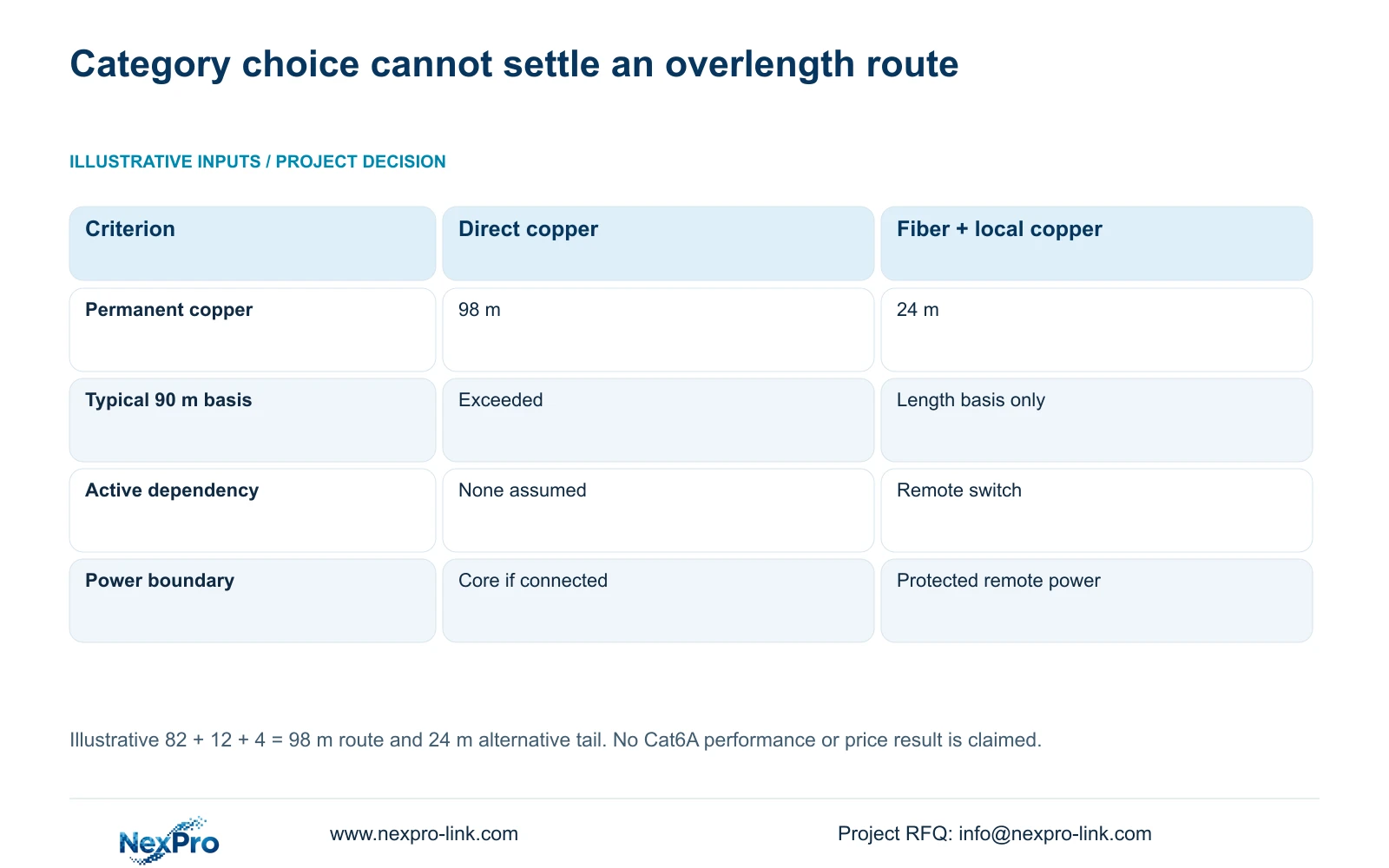
The illustrative route comparison uses 82 m of horizontal pathway, 12 m of vertical pathway and 4 m of termination allowance. Their sum is 98 m of permanent copper. The alternative has a 24 m local copper tail after a qualified fiber node. These lengths are teaching inputs, not measurements from the complete hotel case. The comparison tests route suitability and dependencies; it does not rank Cat6 against Cat6A on throughput or image quality.
Section 04
Check every component against the selected channel
The 98 m route exceeds the stated typical 90 m permanent-link basis. The 24 m tail is within that length basis only. It still needs suitable cable, termination components and an installed-link test. For this scenario, resolve the long route first, then select the category required for each resulting channel.
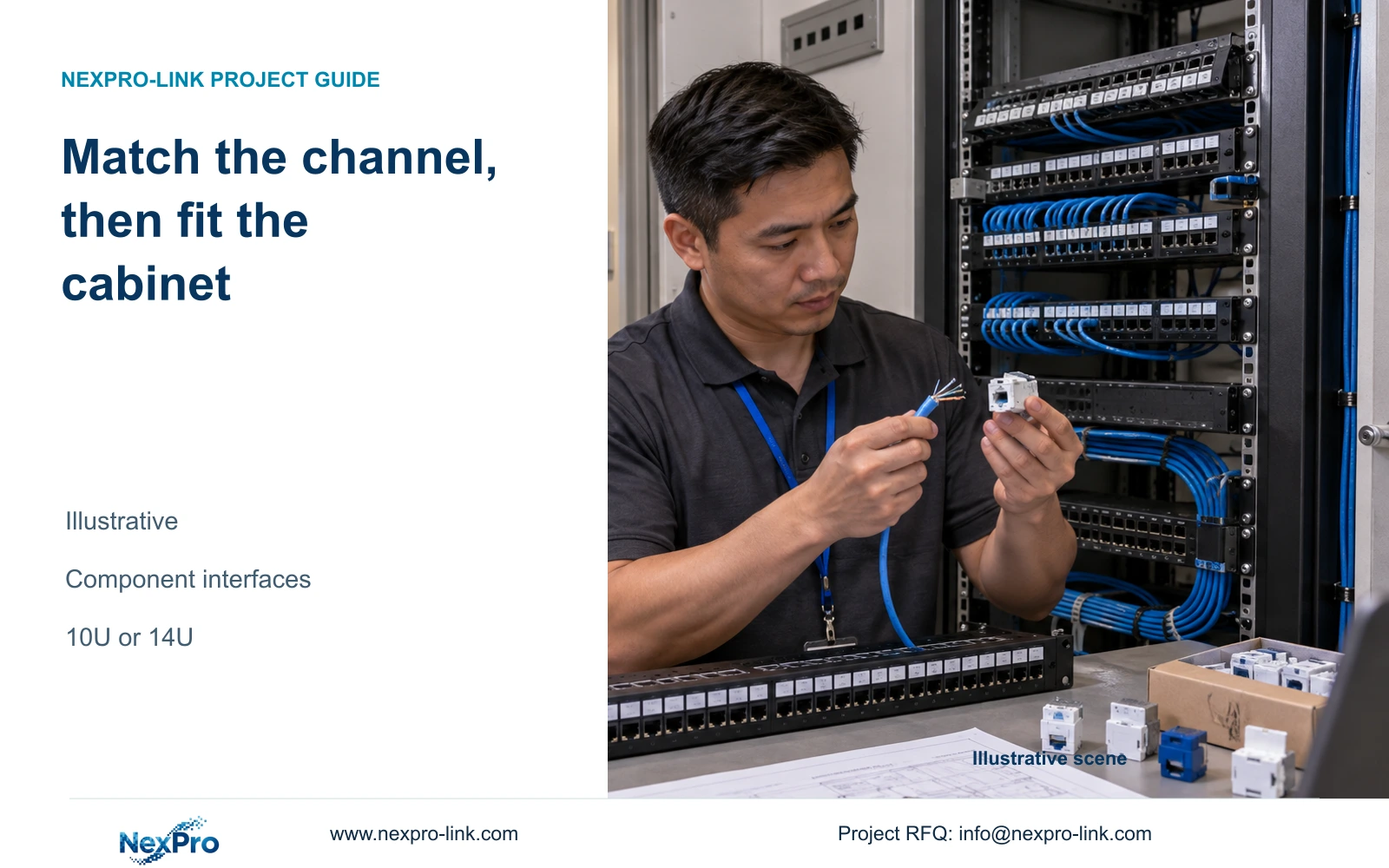
SP5648 is a Cat6 48-port data patch panel, and DT968MX is a Cat6 tool-free module. They are useful named Cat6 connectivity candidates. Their descriptions do not support presenting them as a verified Cat6A channel package. A Cat6A proposal needs explicitly suitable connectivity throughout its intended channel.
NexPro SW-POE1618G has 16 PoE access ports and two uplink ports in the supplied record, with af/at descriptions. Its title and detailed access-port speed fields conflict, and a numerical total PoE budget is absent. Keep it as an inquiry candidate until the required speed and output budget receive an explicit response. Upgrading cable cannot settle an unresolved switch capability.
| Metric / condition | Direct copper route | Qualified fiber node + local copper |
|---|---|---|
| Planned copper permanent route (m) | 98 | 24 |
| Typical 90 m permanent-link basis | Exceeds this basis | Within length basis only |
| Extra active dependency | None assumed | Remote switch and local power |
| Backup boundary | Core supply if fully connected | Remote node must also be protected |
Section 05
Price the installed channel and future-use scope
Request comparable quotations that preserve the same camera task, route and installation responsibilities. Separate bulk cable from panels, modules and cords. Include termination, labeling and the required testing. A lower reel price can conceal omitted work or incompatible connectivity, so compare the complete evaluated scope.
For a remote-node option, add the fiber interfaces, switch, enclosure and protected local power where required. Include access arrangements and responsibility for service. The cost comparison should show which items disappear from the direct route and which are added. It should also identify work that is unchanged, such as the camera’s approved observation task.
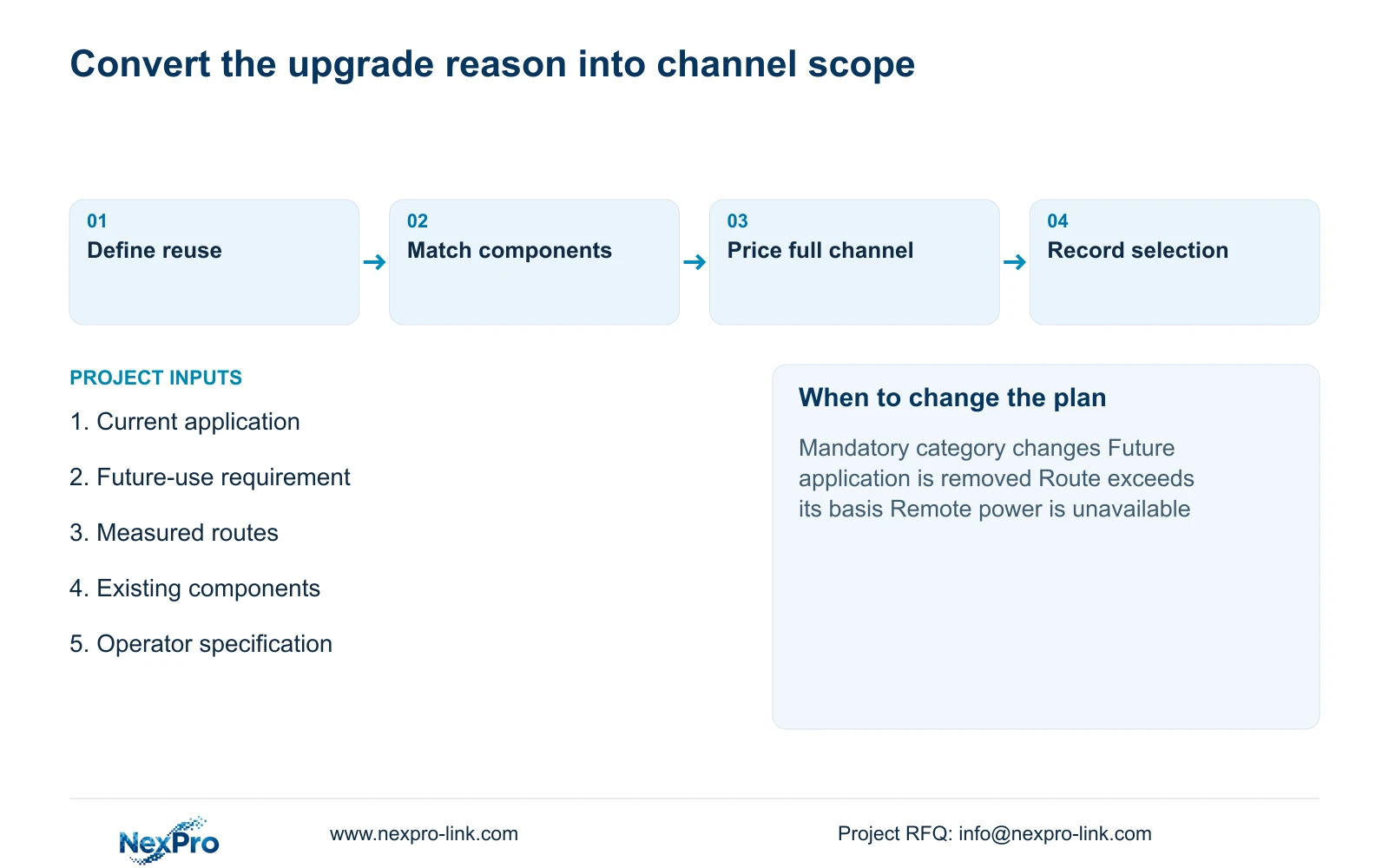
Where future reuse is the reason for Cat6A, ask the buyer to identify the expected application and the cost or disruption of later replacement. Without actual scope-matched prices, a monetary break-even cannot be claimed. Compare the quoted upgrade increment with the stated future requirement, and reopen the recommendation if that requirement is removed, deferred or assigned to a separate backbone.
Section 06
Upgrade the links that have a supported use
Use a link-by-link recommendation. Retain a suitable Cat6 channel where the current task and approved future scope are satisfied. Select a complete Cat6A channel when the documented application or mandatory specification requires it. For an overlength route such as the illustrative 98 m run, compare relocation and a qualified fiber node before making a category purchase.
Choose the 24 m local-tail arrangement only if the remote node’s power, environment and maintenance access can be provided. If the hotel cannot support those dependencies, reconsider closet placement or another explicitly supported design. Keep the agreed recording and outage behavior unchanged across the options.
Send the application schedule, measured routes, existing connectivity specification and any mandatory operator category requirement to info@nexpro-link.com. Identify whether alternatives are permitted. NexPro-Link’s hotel and BOQ support can discuss model matching and coordinated supply, with CCTV manufacturing and supporting equipment supply distinguished. The installation proposal should name who terminates and tests the channel and who maintains any added node.
Section 07
Buyer questions
Does choosing Cat6A remove the need to check switch speed? No. The switch interface and forwarding task remain separate requirements. Request the exact access-port and uplink specifications, especially when a source has conflicting speed descriptions.
Can existing Cat6 panels stay in a proposed Cat6A channel? Do not assume they establish the proposed channel category. Ask the designer to specify the complete connection arrangement and suitable components. SP5648 is documented as Cat6, so it cannot be presented as verified Cat6A connectivity.
What makes an upgrade quotation comparable? It must cover the same routes, endpoint tasks, cords, terminations and testing. Show any additional cabinet, remote-node or protected-power scope separately so the buyer can identify the actual upgrade increment.
Engineering references
These sources support the general planning principles. Always use the selected product's current datasheet and applicable project standards for final design.