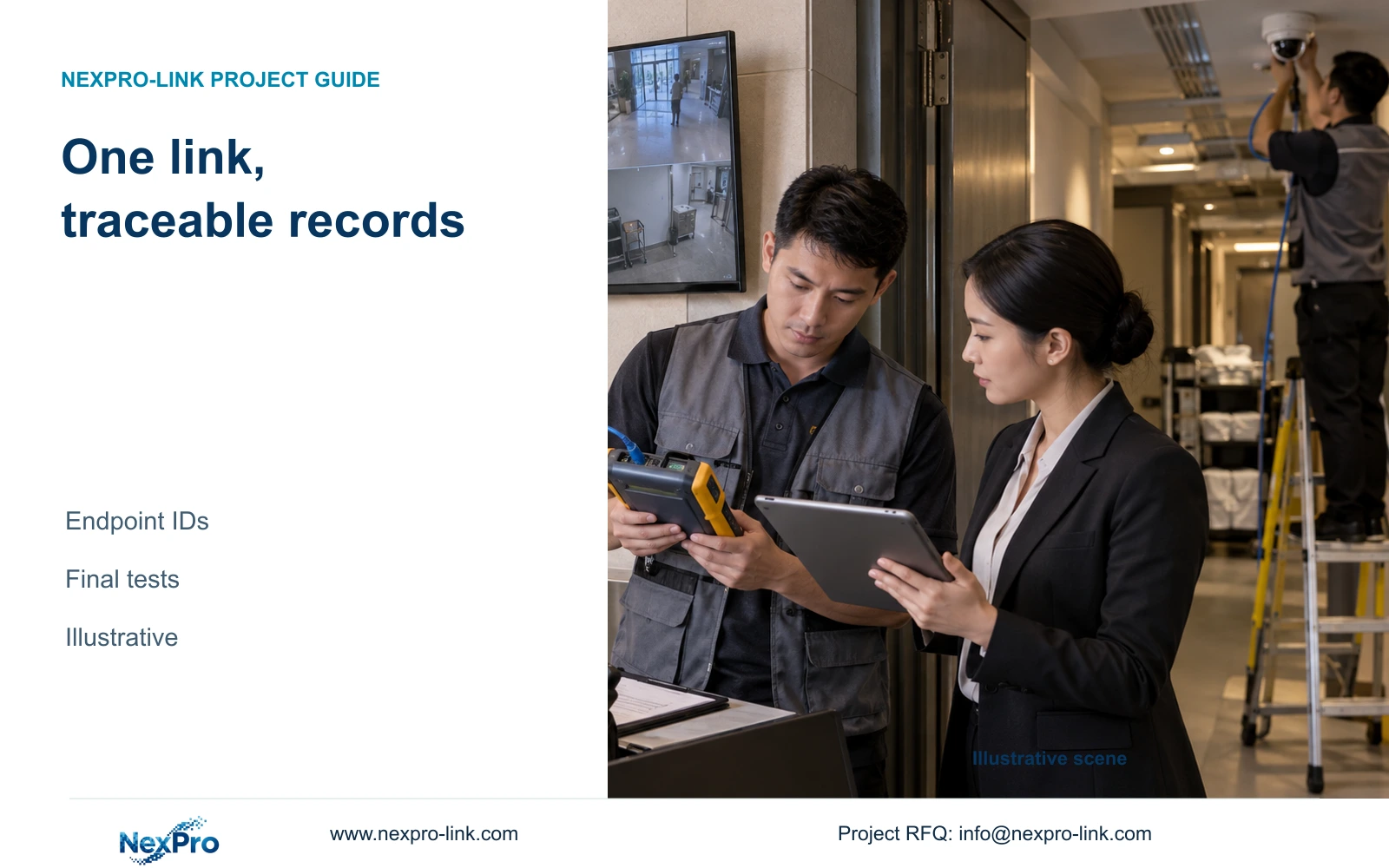
Accept a hotel cabling handover when each final test record can be traced to both physical endpoints and its camera task, with the agreed test basis and correction history.
Section 01
Choose a stable installed-link identifier
Accept the CAT6 handover only when every final report identifies the installed link, its endpoints and the agreed test basis. Use a stable physical-link ID as the main reference, with the camera tag recorded separately. If reports cannot be matched to labels at the hotel, return the affected records for reconciliation before treating those links as accepted.
Choose a naming scheme that identifies the building or floor, cabinet and link without depending on the current camera model. A camera may be replaced or moved while the cable remains. Keeping those identities separate lets the engineer update the equipment schedule without losing the installed-link history.
Apply the same ID at both ends and in the test record. Avoid using a PDF filename as the only identifier, since files may be renamed during collection. The handover index should preserve the link ID even when the cabinet designation or camera task changes, with a clear cross-reference to the revised drawing.
| Required task | Given information | Decision still needed |
|---|---|---|
| Locate a reception link | Camera tag and drawing position | Stable link ID and both endpoint labels |
| Find the cabinet termination | Cabinet designation | Patch-panel port and report reference |
| Trace a replacement camera | New equipment identity | Retain or revise the physical-link mapping |
Section 02
Match endpoints to camera tasks
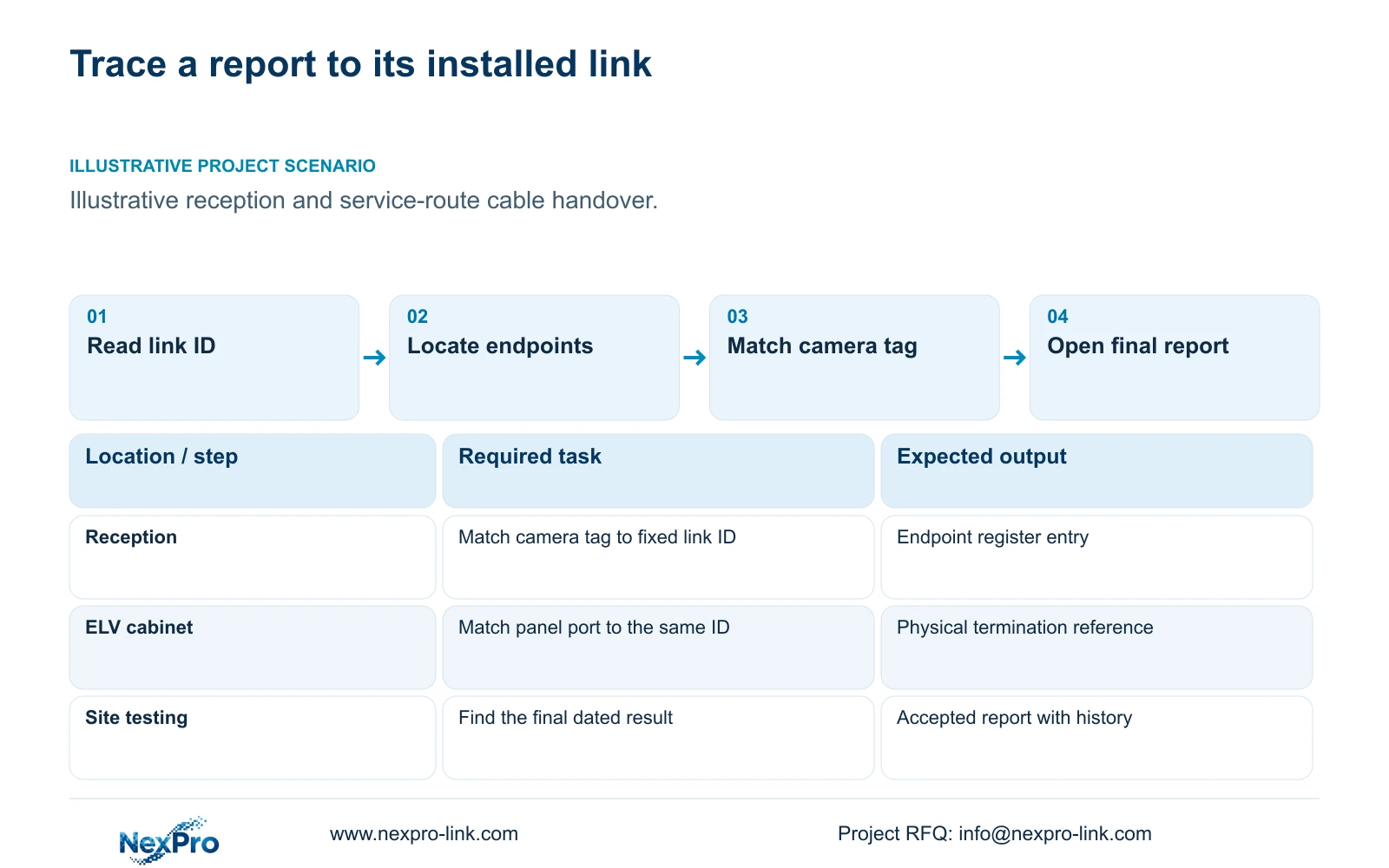
Build one endpoint register connecting the link ID to its patch-panel port and field termination. Add the camera tag and public-zone task, such as entrance overview or service-route observation. Where two nearby views have separate cables, preserve both links even if their location descriptions sound similar.
Check the register against the installed labels and current camera schedule. A report showing a passing result for an unidentified cable does not establish that the required entrance camera has a tested route. Equally, a camera appearing online does not show which permanent link was tested or whether the report covers the delivered configuration.
Separate fixed termination records from changeable network assignments. A switch port or camera account may change during commissioning. Recording that assignment alongside the stable link ID helps the IT and installation teams diagnose a problem without rewriting the cable identity. The engineer should resolve duplicate or missing tags before the final index is issued.
Section 03
Select the agreed permanent-link or channel basis
State whether acceptance covers the permanent link or the complete channel, including its patch cords. The supplied Fluke Networks source distinguishes the typical 90 m permanent-link basis from a 100 m channel including cords. Confirm the project's category, test configuration and connection arrangement; those length figures alone do not determine a passing result.
The report should identify the selected limits and date, together with the endpoints and recorded result. A continuity check answers a narrower question than the required installed-link performance test. Keep continuity observations useful for fault finding, but do not substitute them for the acceptance evidence specified for the project.
Product identity also has a boundary. SP5648 is a Cat6 48-port data patch panel and DT968MX is a Cat6 tool-free module. Neither is a bulk-cable SKU or proof of the complete link category. Cable construction, cords and connections remain part of the selected system, while jacket and destination requirements need their own specification.
Factory preparation can confirm supplied component identities. Site acceptance must address the actual installed route and terminations. Record any links outside the observed scope as outstanding so a small set of completed reports cannot be mistaken for acceptance of the whole hotel.
Section 04
Compare failed links with their corrected records
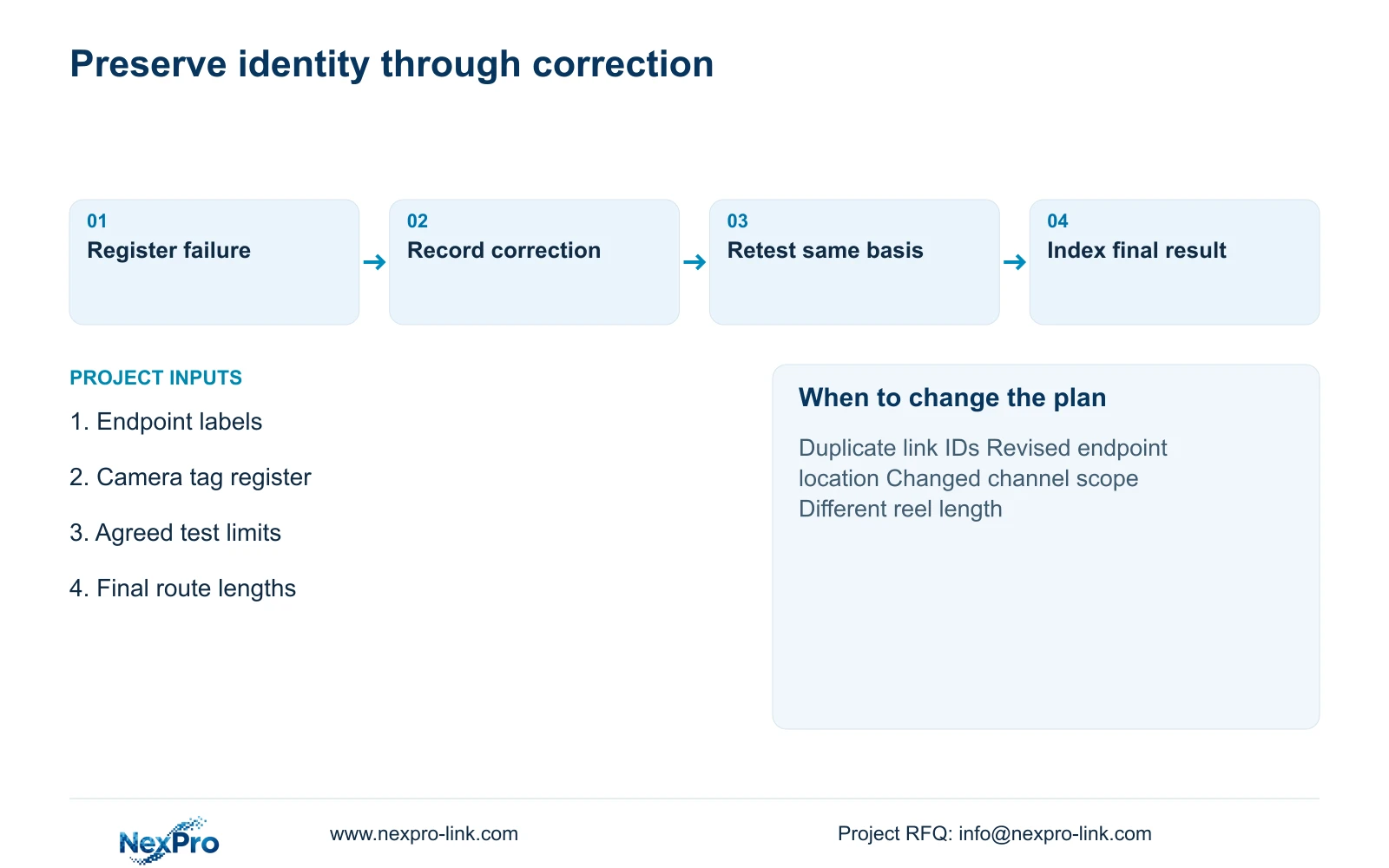
Keep the original failed report attached to the same link ID when a termination or route is corrected. Record the action, responsible party and repeat-test date. The final record should show which result governs acceptance, while the earlier record explains why work was required.
Repeat the agreed test basis after correction. Changing a limit or testing a shorter portion of the link can produce a different result without resolving the original requirement. If the physical route changes, revise the endpoint register and length record before issuing the replacement report.
Distinguish an administrative error from an installed-link failure. A mislabeled report may require identification work, while a correctly identified failed link requires technical correction. Both can block handover, but their owners and closure evidence differ. Do not describe either as closed merely because a camera currently displays video.
Section 05
Reconcile final lengths with continuous cable cuts
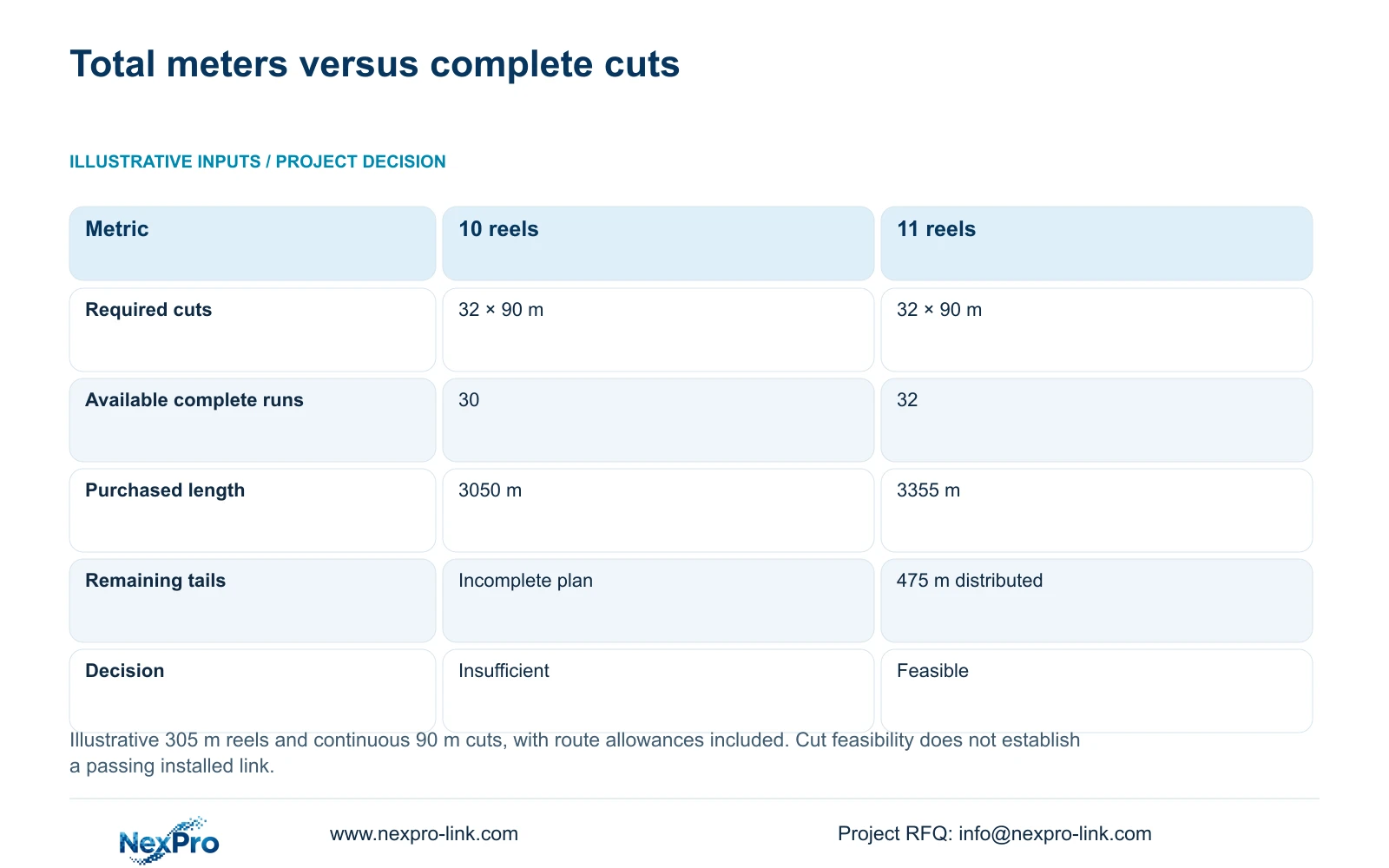
A route schedule supports both procurement and handover. In this independent illustrative example, thirty-two links each require a continuous 90 m cut, including all planned permanent-route allowances. Total cut length is 32×90 = 2880 m. With assumed 305 m reels, rounding 2880÷305 upward gives ten reels as an arithmetic lower bound.
Each reel fits only floor(305÷90) = three complete runs. Ten reels therefore supply thirty runs, leaving two links without complete cuts. Eleven reels are feasible: ten supply three runs each and the last supplies two. Purchased length is 3355 m, with 475 m remaining as separate tails.
This calculation explains why final link lengths and cut allocations belong beside the procurement quantity. Distributed tails cannot be treated as one continuous cable or casually spliced to finish another route. If actual routes or reel lengths change, redo the allocation. A planned 90 m cut at the typical permanent-link length boundary still needs the agreed installed test; length planning is not a pass certificate.
CASE01 uses different route lengths totaling 1826 m and a feasible seven-reel plan. Those values describe another teaching schedule and do not replace this article's 2880 m calculation.
| Metric / condition | Rounded lower bound | Feasible continuous-run plan |
|---|---|---|
| Total cut length (m) | 2880 | 2880 |
| 305 m reels | 10 | 11 |
| Can every run be cut? | No: 10 reels fit only 30 runs | Yes: 10×3 runs + 1×2 runs |
| Purchased length (m) | 3050 | 3355 |
| Total remaining tails (m) | Not a feasible complete plan | 475 |
Section 06
Deliver a searchable endpoint and report index
Deliver a searchable register linking each installed ID to both endpoints, camera tag, final test reference and date. Include the applicable limit and final length, with correction records accessible from the same entry. The hotel should be able to start from an entrance camera tag or a cabinet port and reach the same accepted link record.
Use this indexed handover when the project needs traceable installed-link acceptance. Change the record structure if the operator has a mandatory asset format, and revise the test scope if the agreed channel arrangement changes. Preserve the underlying link IDs during those changes so the installation history remains readable.
Send a sample endpoint register, route schedule, specified test basis and cable destination requirements to info@nexpro-link.com for coordinated equipment and BOQ discussion. NexPro-Link can address component matching and supply scope. Identify separately who performs installed testing, reconciles labels and accepts the final site records.
Section 07
Buyer questions
Can a live camera image replace a CAT6 acceptance report? No. It shows operation at that moment, without establishing the agreed link performance or identifying the tested boundaries. Retain the installed-link record and test the camera workflow separately.
Should old failed reports be removed from the handover? Keep them as correction history, clearly marked as superseded by the final accepted record. This prevents an earlier failure or a later PDF filename change from obscuring which result applies.
What should the cable purchase schedule show? List individual continuous runs, reel length and cut allocations, plus termination allowances already included. State the cable specification separately from patch panels and modules, and identify the installed testing responsibility.
Engineering references
These sources support the general planning principles. Always use the selected product's current datasheet and applicable project standards for final design.