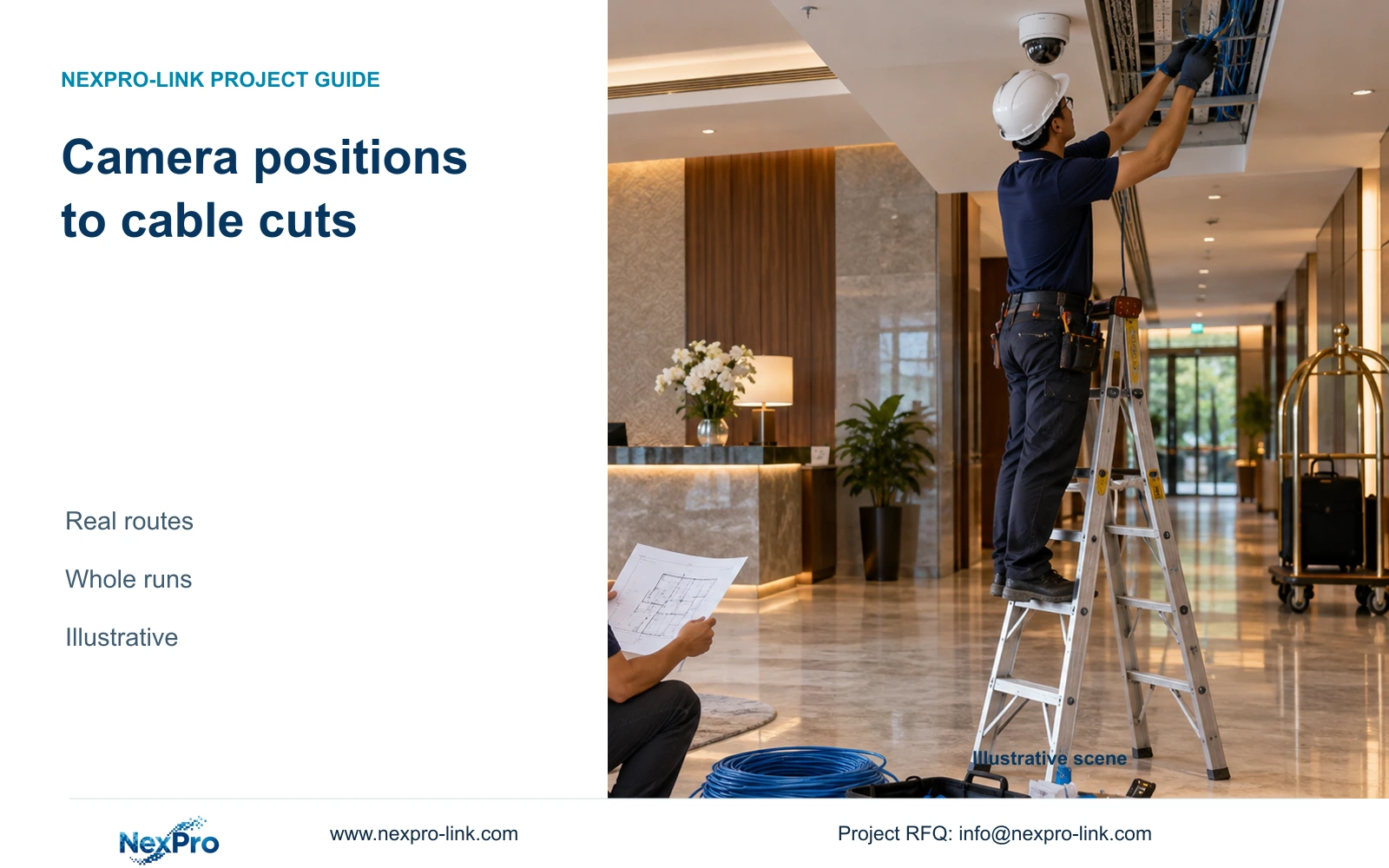
Verify the quoted and delivered continuous reel format against the cutting plan before crews issue cable. If a supplier changes reel length or supplies partial reels, rerun allocation by actual piece rather than accepting unchanged aggregate metres.
Section 01
Build the run-length list
Verify the quoted and delivered continuous reel format against the cutting plan before crews issue cable. If a supplier changes reel length or supplies partial reels, rerun allocation by actual piece rather than accepting unchanged aggregate metres. Separate cut-feasibility adjustment from approved reserve stock. Retain the revised allocation with the receiving discrepancy.
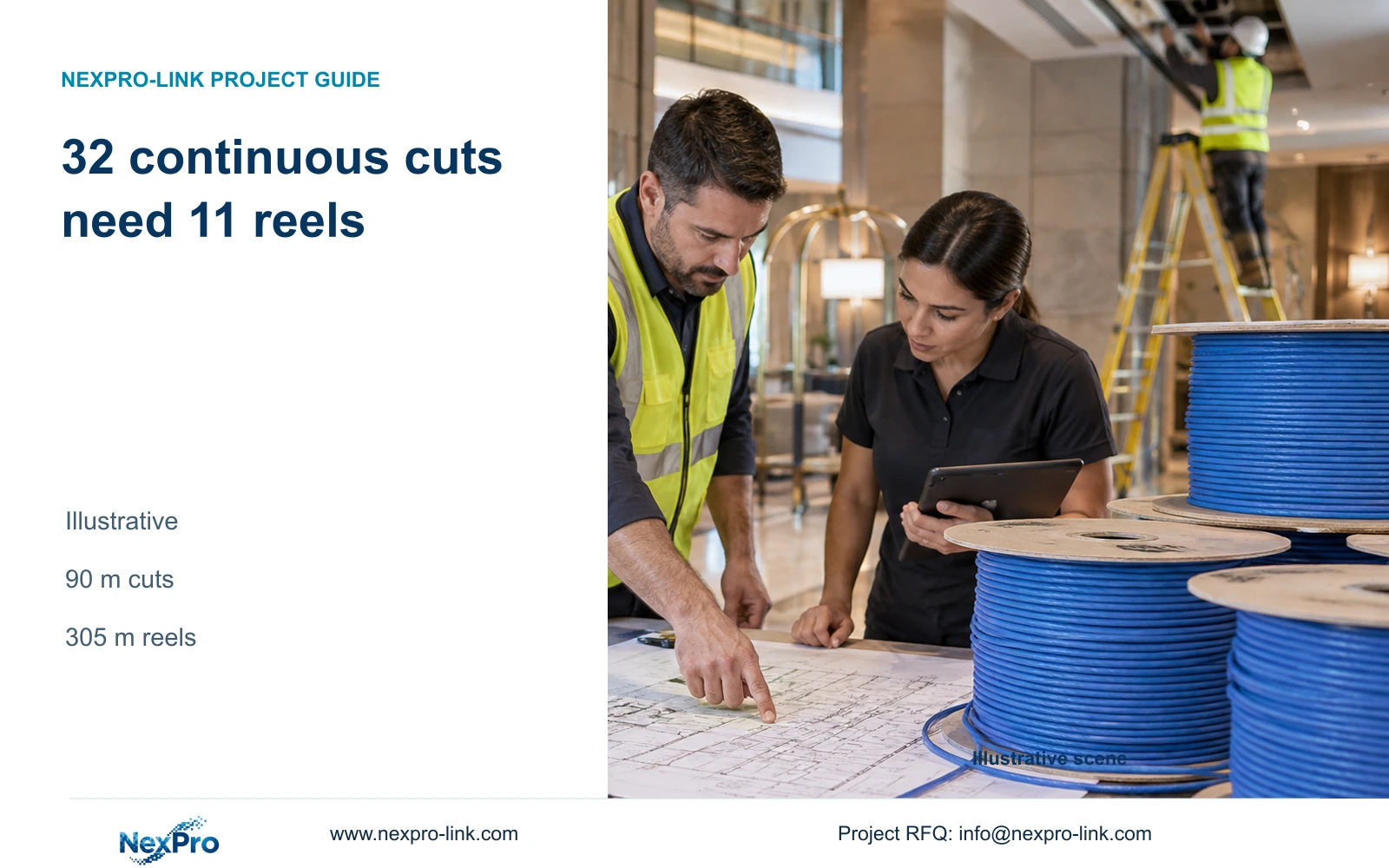
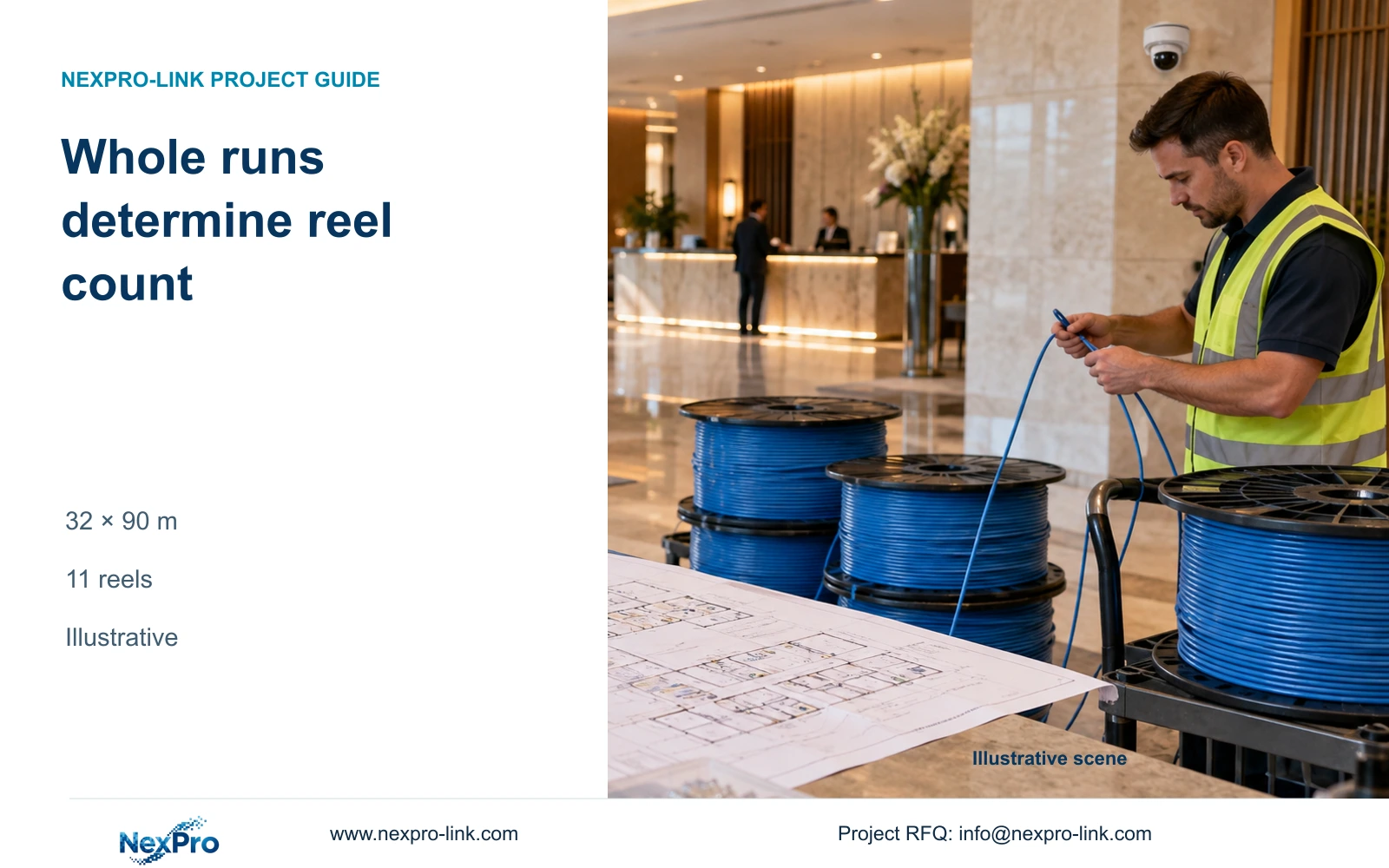
Order cable from a feasible continuous-run allocation. For the illustrative requirement of 32 independent 90 m runs and 305 m reels, select 11 reels; the rounded total-length result of 10 reels cannot complete all links. Recalculate when route lengths, allowances or reel format change. Extra purchased metres can be necessary even without adding reserve stock.
Prepare one entry for each endpoint, connecting its camera task to the assigned cabinet. Measure the installed pathway, including vertical changes and explicit termination allowances. Mark provisional routes so the purchase calculation does not turn an unresolved drawing estimate into a final cutting instruction. Avoid replacing the list with a single average route length.
Keep permanent cable and patch cords separate. In this example, each 90 m is already the full planned permanent route. Adding hidden allowances would change the input and could affect the length basis. The supplied Fluke guidance describes typical 90 m permanent-link and 100 m channel bases; final configuration and acceptance requirements remain project-specific.
| Required task | Given information | Decision still needed |
|---|---|---|
| Supply each continuous route | Endpoint and cabinet IDs | Full route length with stated allowances |
| Allocate purchased cable | Supplier reel format | Whole-run cuts on each reel |
| Accept installed links | Specified connection arrangement | Category, jacket and test requirements |
Section 02
Calculate the simple lower bound
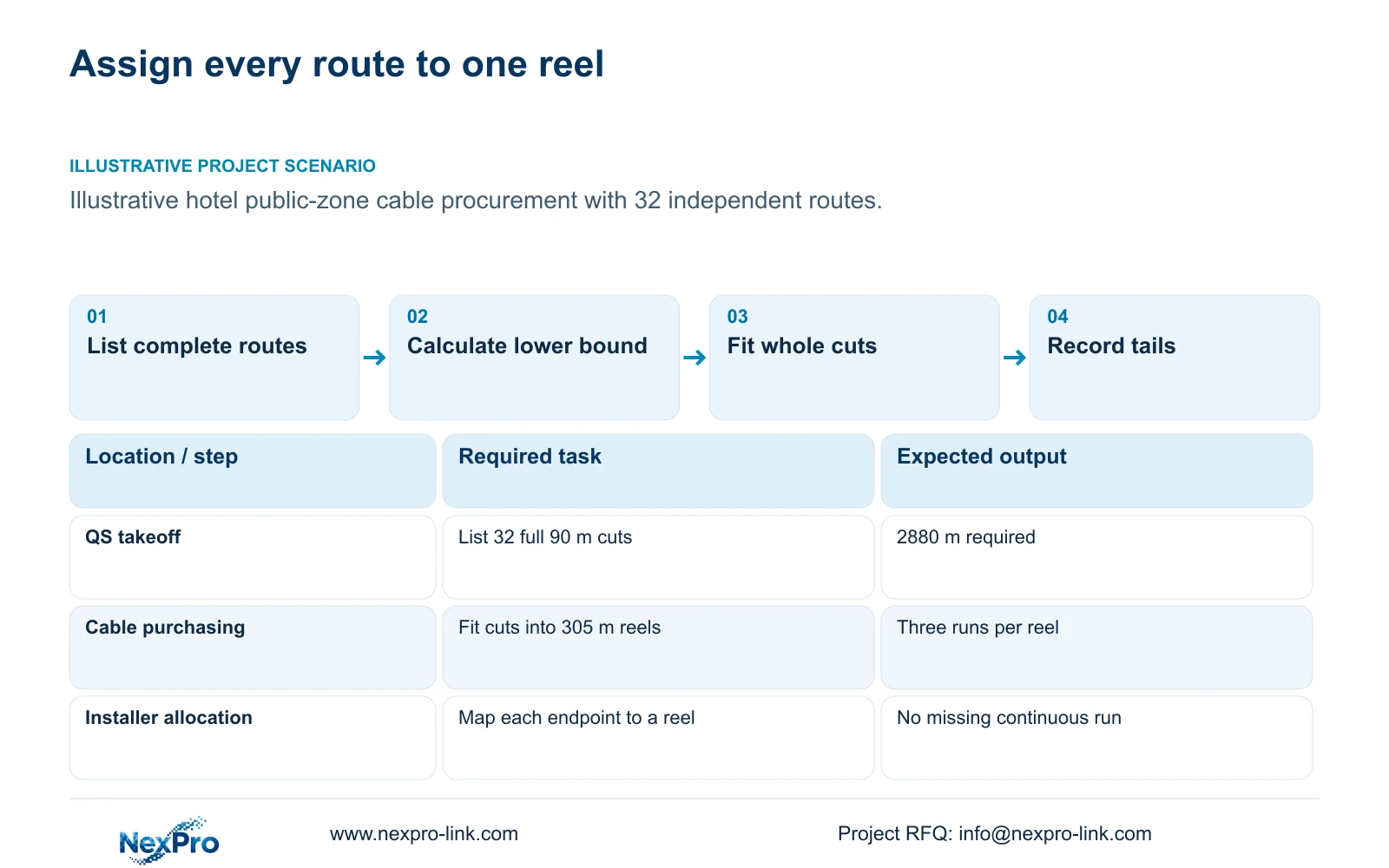
Sum the required cuts before considering reels. The teaching list contains 32 × 90 m = 2880 m. The simple lower bound is the total divided by reel length, rounded upward: ceil(2880 ÷ 305) = 10 reels. Ten reels contain 3050 m, so their aggregate purchased length exceeds the required cuts.
That result assumes the lengths can be distributed without restricting individual runs. Continuous camera links impose a second condition: each full cut must fit on a single reel. A collection of short remaining pieces cannot automatically supply the next long route. The total-length result is therefore useful as a screening minimum, not a release-ready purchase quantity.
Retain the lower bound in the procurement record because it explains the difference between aggregate length and feasible ordering. If the actual cut list changes, both calculations need review. A supplier offering another reel length may alter the feasible count even when total required metres stay unchanged. Compare the allocation before judging the new reel price.
Section 03
Allocate continuous runs to reels
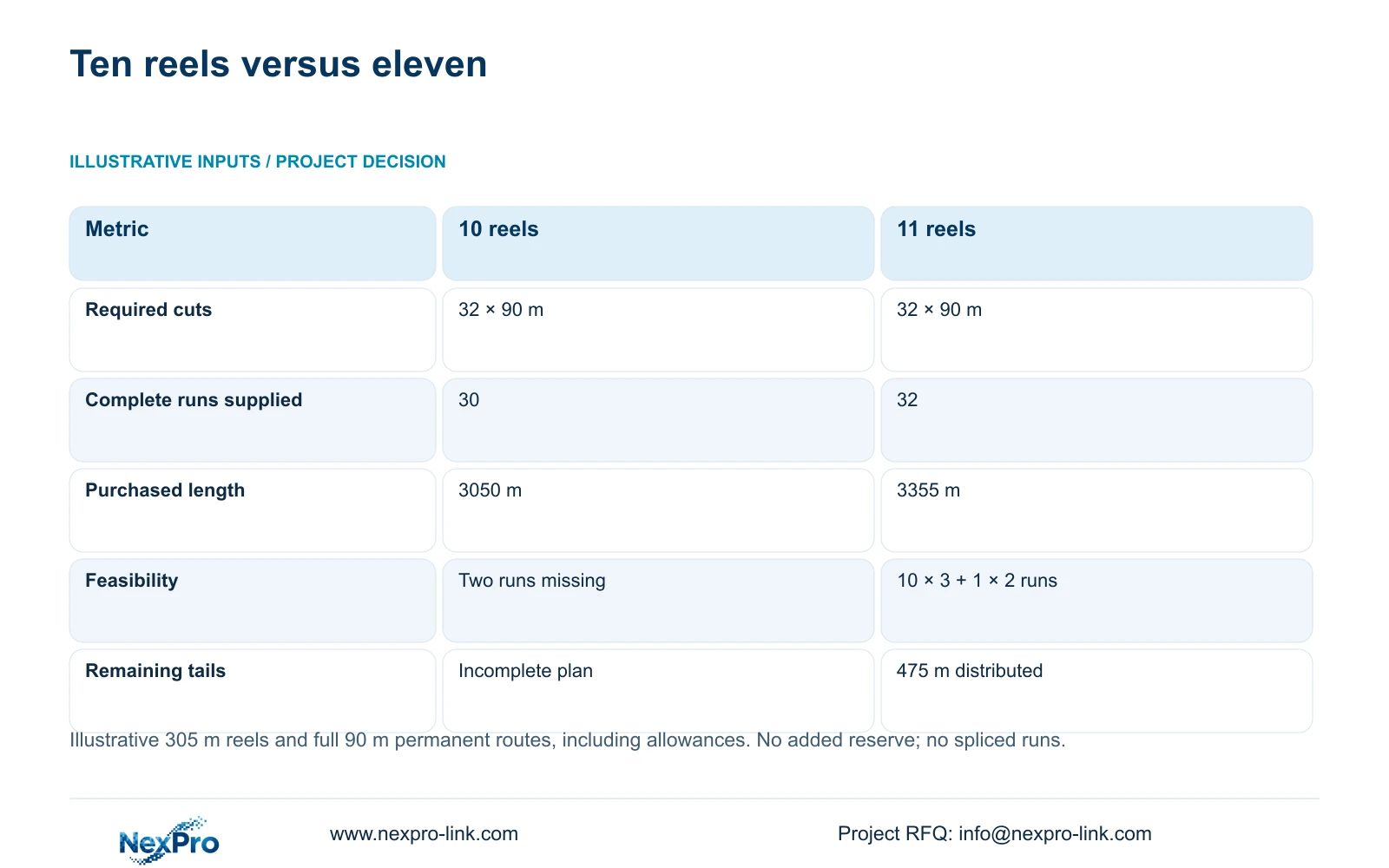
For a 305 m reel, floor(305 ÷ 90) = 3 complete runs. Three cuts consume 270 m and leave 35 m. Four cuts would require 360 m and cannot fit. Consequently, ten reels provide only 30 complete runs, leaving two required camera routes without a continuous cut.
Eleven reels provide a feasible plan: ten reels each supply three 90 m runs, and the last supplies two. Purchased length is 11 × 305 = 3355 m. Subtracting the 2880 m installed cuts leaves 475 m. This consists of ten 35 m tails and one 125 m tail, whose sum is 475 m.
The table compares the arithmetic lower bound with that feasible allocation. For this equal-length example, eleven is also the minimum reel count because no reel can provide more than three runs. This conclusion applies to the stated cuts and reel length. It does not establish a universal reel quantity for every 32-camera hotel or endorse splicing tails into camera routes.
| Metric / condition | Rounded lower bound | Feasible plan |
|---|---|---|
| Total cut length (m) | 2880 | 2880 |
| 305 m reels | 10 | 11 |
| Can every run be cut? | No: 10 reels fit only 30 runs | Yes: 10 × 3 runs + 1 × 2 runs |
| Purchased length (m) | 3050 | 3355 |
| Total remaining tails (m) | Not a feasible complete plan | 475 |
Section 04
Compare feasible cutting patterns
Mixed route lists need an explicit cutting pattern. Arrange longer cuts first, then fit shorter complete routes into the remaining space where practical. Check that every endpoint appears once and that no reel's allocated cuts exceed its length. A workable allocation can be accepted without claiming that the method produces a mathematical optimum for every list.
The independent CASE01 reference uses different teaching routes, cycling through 38, 48, 58, 68 and 78 m for 32 links. It totals 1826 m and has a documented feasible seven-reel allocation. Those values must remain separate from this article's 2880 m and eleven-reel example. Equal camera counts do not imply equal cabling purchases.
Compare a revised route design before introducing an active remote node solely to save cable. A changed cabinet location may shorten cuts while adding power, network and maintenance dependencies. Preserve the required camera connection and evaluate the complete changed scope. Cable-reel efficiency cannot establish that a new topology is the better hotel system.
Section 05
Separate reserve stock from waste
The 475 m remaining in the feasible example is distributed stock, not one continuous cable. Its usefulness depends on the individual remaining lengths and future qualified routes. A 35 m tail cannot complete a 90 m link. An undamaged 125 m tail may support a suitable shorter continuous cut, subject to the project's material and route requirements.
Record usable tails by reel identity and remaining length. Keep damaged material and unusable short pieces distinguishable from reusable stock. Do not deduct their total from a future order unless the new endpoint allocation shows where each piece will be used. The presence of tails alone does not mean the original purchase was incorrectly calculated.
An additional unopened reserve reel is a separate purchasing decision. It can be justified by an explicit extra-work or replacement scenario, but this illustration does not prescribe one. Add reserve only after stating its purpose and quantity. Keep patch panels, modules and cords in their own schedule; SP5648 and DT968MX are connection components, not substitutes for a bulk cable quantity.
Section 06
Publish an auditable reel count
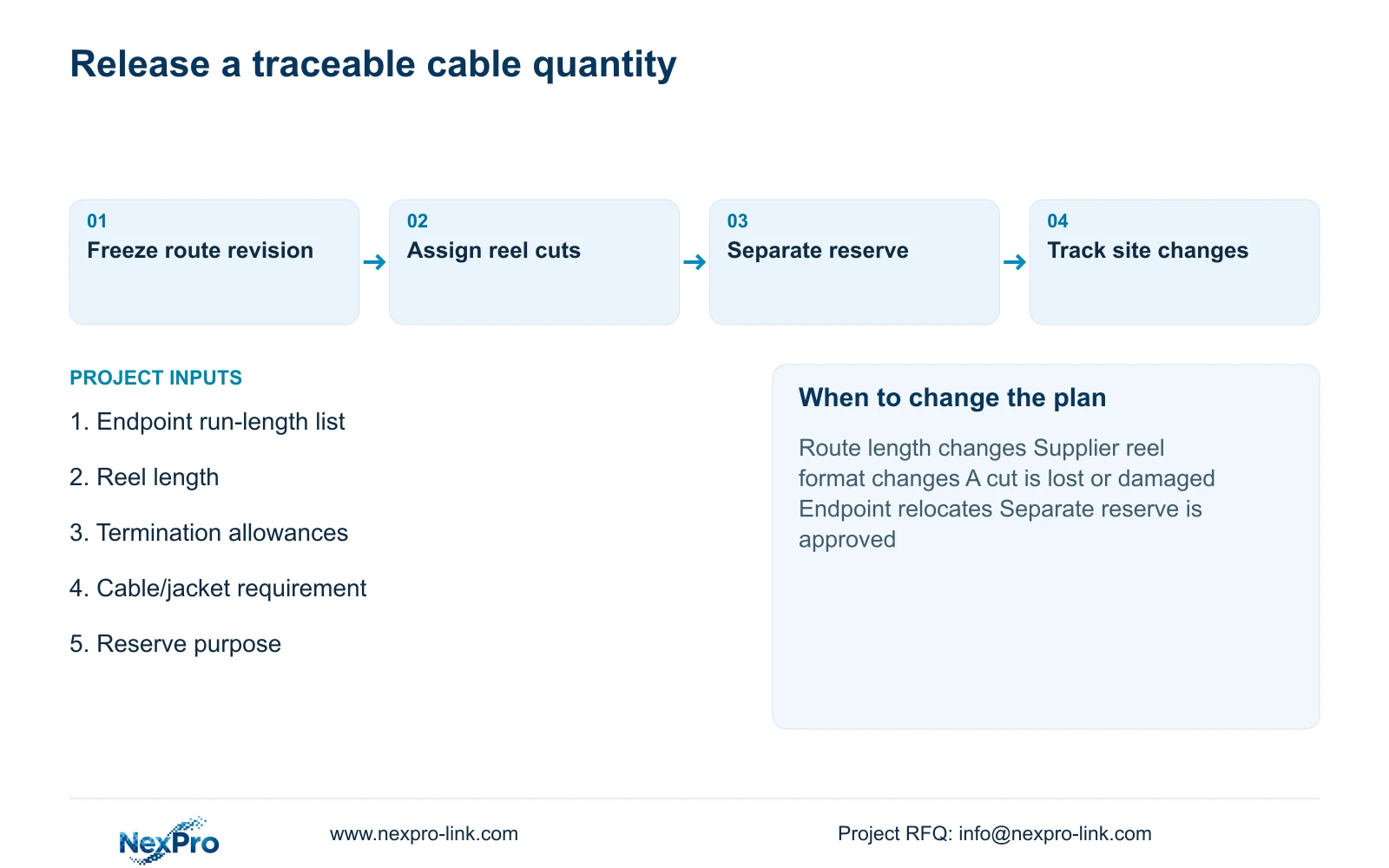
Issue the endpoint list and reel allocation together, with the route revision and allowance basis. Show total cuts, purchased length and remaining pieces as different quantities. The installer should be able to identify which reel provides each planned run before cutting. Record site changes so the unused allocation can be reassessed.
Recommend eleven 305 m reels for the stated 32 continuous 90 m cuts, excluding any separately approved reserve. Change that recommendation when actual routes, reel length or material specification changes. A longer route also requires a technical length review; purchasing a larger reel does not resolve an installed-link limit. Recheck the cut plan after a mistaken cut or an endpoint relocation.
Send info@nexpro-link.com the route-length schedule, proposed reel format and termination-allowance basis for a coordinated supply discussion. Include the destination cable and installed-link requirements. NexPro-Link can discuss the related equipment schedule and BOQ support, while the actual cable specification, site installation and testing responsibilities remain explicit in the proposal.
| Situation | Required record | Decision boundary |
|---|---|---|
| Delivered format matches offer | Continuous lengths and receiving record | Apply the accepted cutting allocation |
| Shorter or partial reels arrive | Actual piece-by-piece inventory | Rerun feasible allocation before issue |
| Aggregate metres still match | Changed cut feasibility and reserve | Resolve receiving variation independently |
Section 07
Buyer questions
Why are 10 reels insufficient when they contain 3050 m? Each 305 m reel fits only three continuous 90 m cuts. Ten reels supply 30 runs, although their combined length exceeds 2880 m. The remaining pieces cannot complete the two missing 90 m runs.
Are the 475 m of tails a spare reel? No. They are ten 35 m pieces and one 125 m piece in the stated allocation. Record them individually and allocate them only to suitable future continuous routes.
Can we use an average route length for the final order? An average can support an early allowance. Release the final order against individual endpoint lengths and feasible cuts. Update provisional routes before relying on the count for installation.
Engineering references
These sources support the general planning principles. Always use the selected product's current datasheet and applicable project standards for final design.