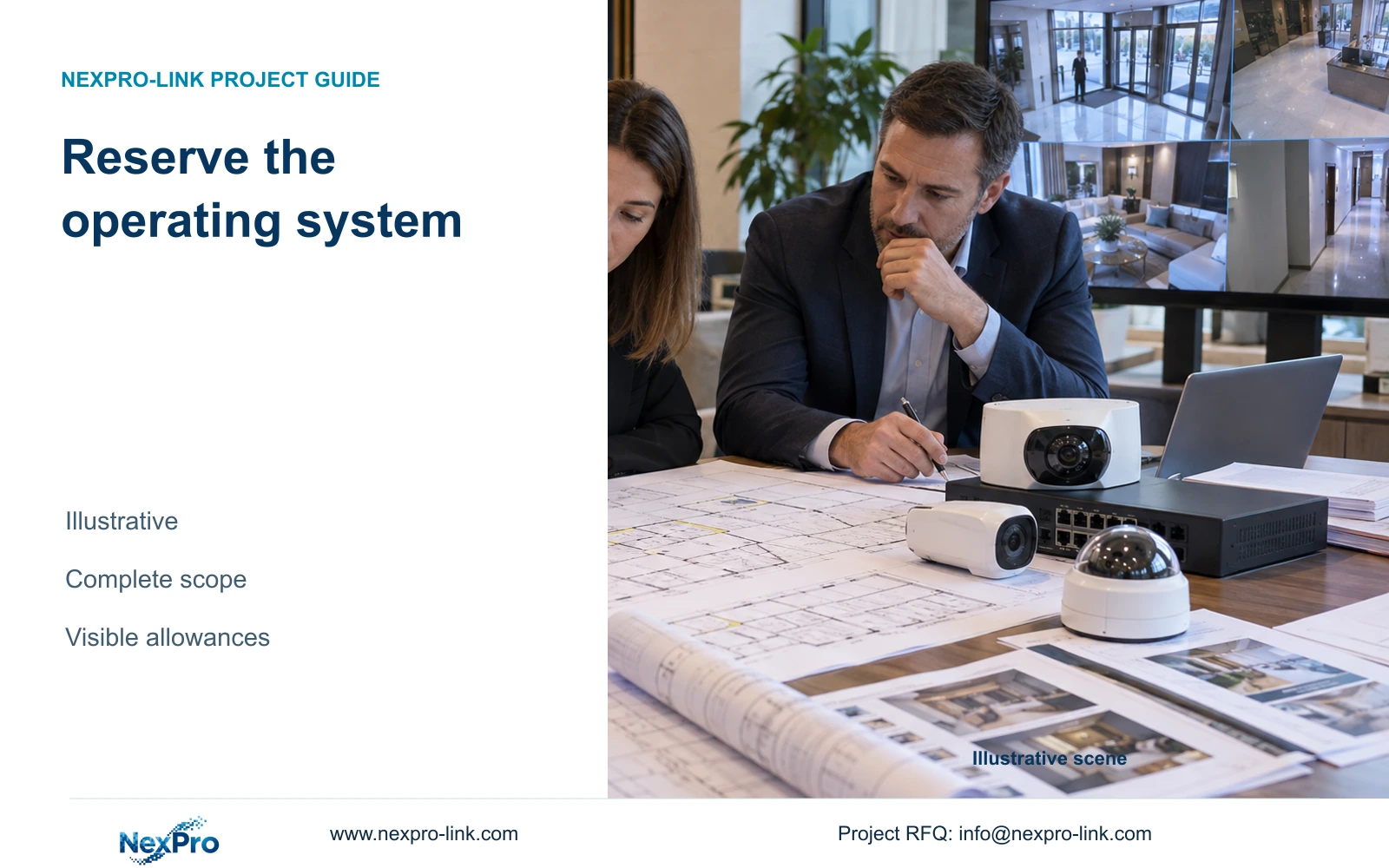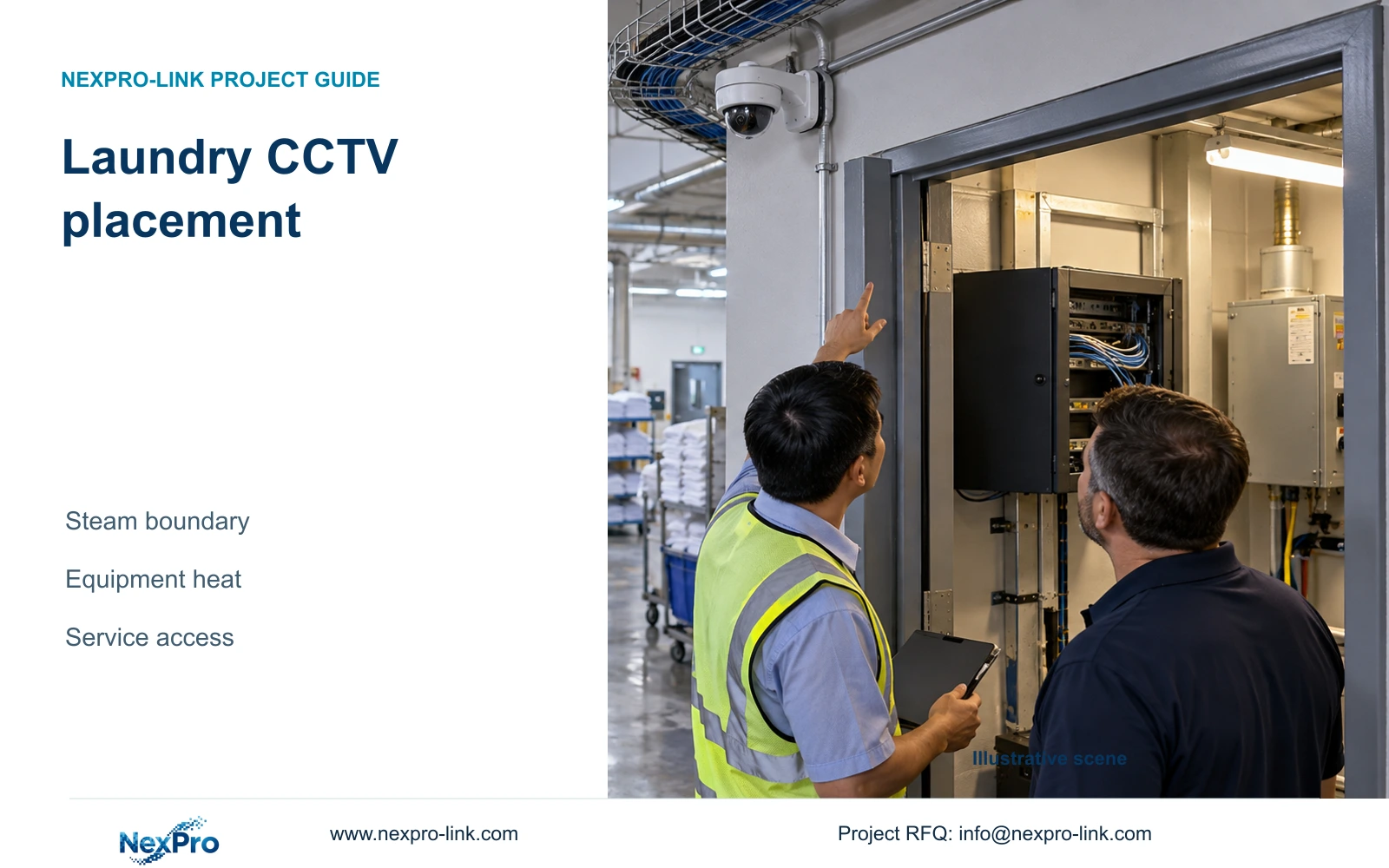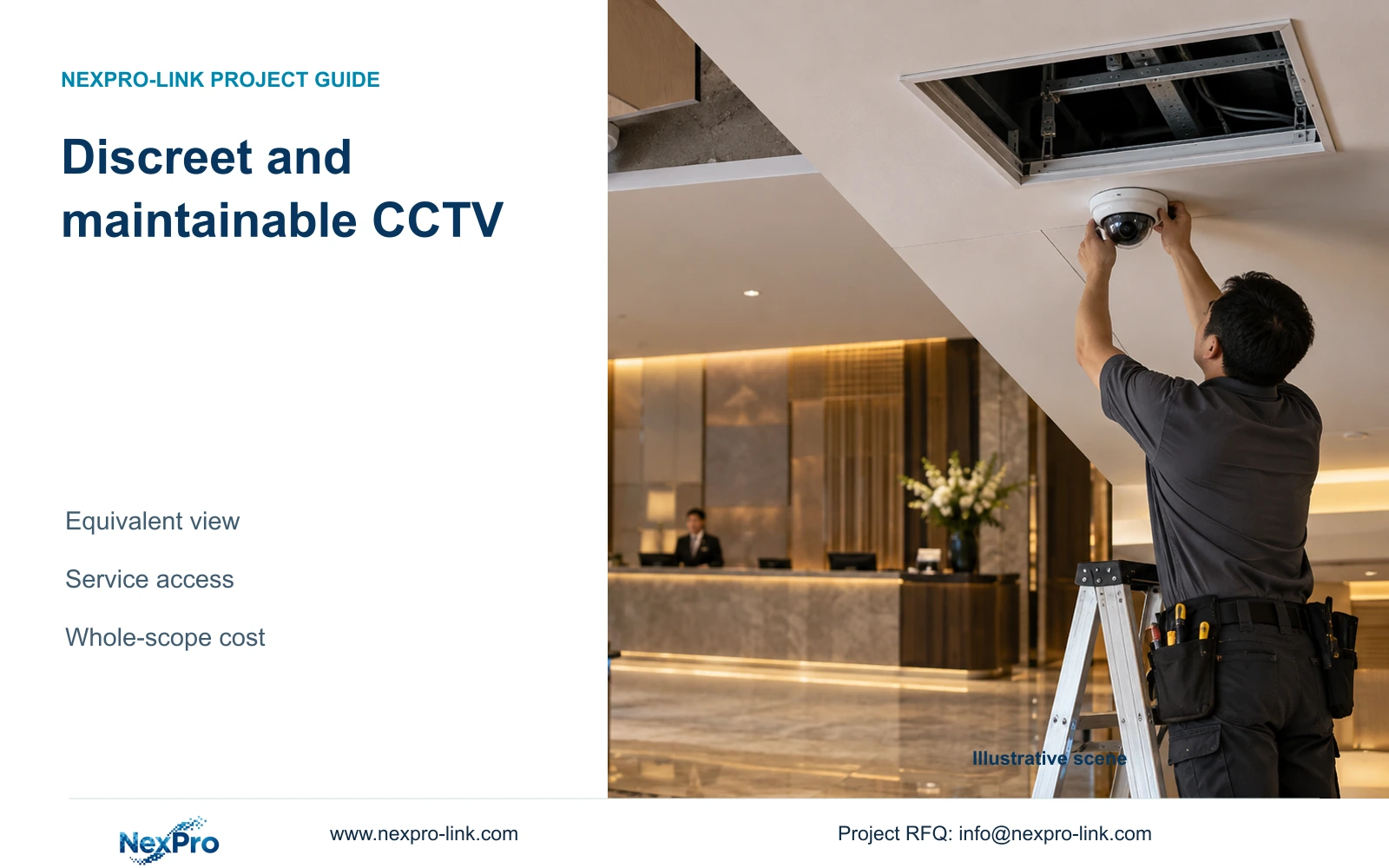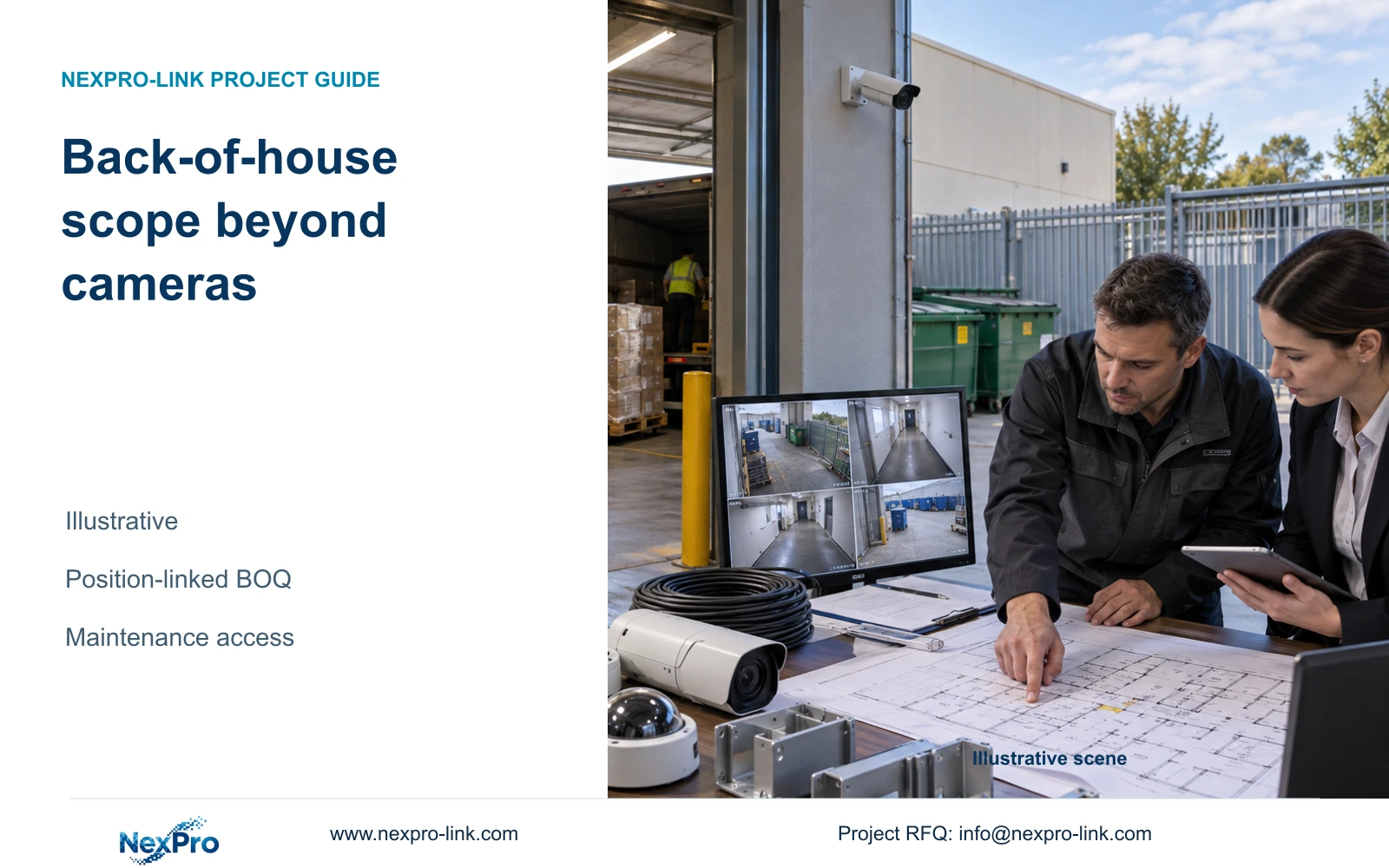
Price back-of-house CCTV as an installable, maintainable system. Link accessories to positions, count shared resources once, and separate cleaning from initial supply.
Section 01
Group camera positions by environment
Build a position-linked BOQ covering mounting, connection protection, shared equipment space and maintenance access. Use itemized quantities when the layout and installation method are known; keep unresolved work as identified provisional scope. A percentage on camera prices is insufficient when service-yard exposure, cleaning access or remote network equipment changes the installation.
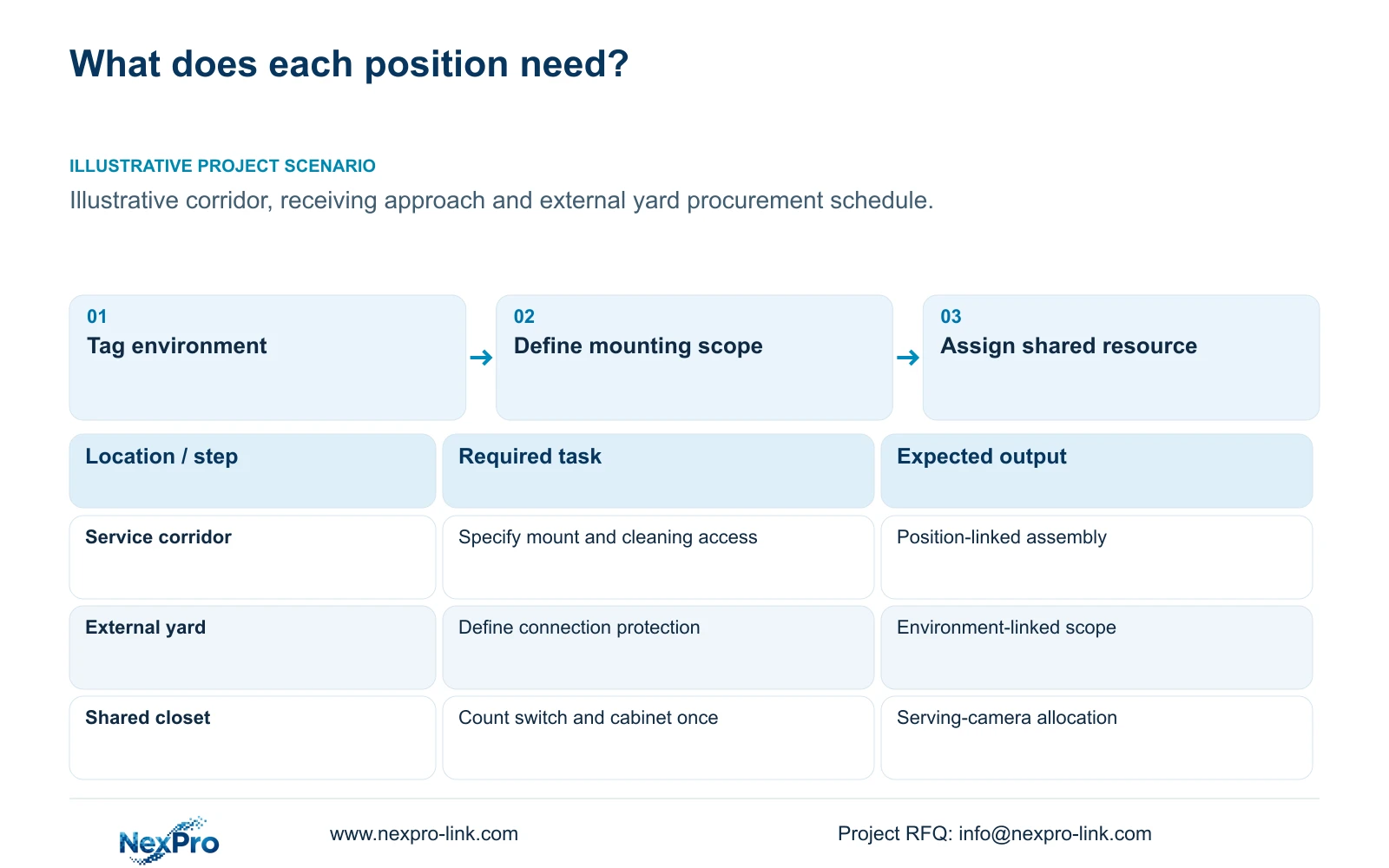
Group the positions by the conditions that affect their supporting work. An indoor service corridor, receiving approach and external waste yard may use different mounting surfaces, routes and access arrangements. Record the condition for each camera tag instead of applying one accessory package to the entire back-of-house area. Environmental suitability still requires the actual selected equipment and local design inputs.
Separate measured quantities from assumptions. A confirmed camera location does not automatically confirm its cable length, bracket or serving closet. The cost manager should preserve these distinctions through tender revisions so a provisional allowance is not mistaken for an agreed installed rate. Hotel room count is background information and cannot replace the camera and route schedules.
| Position context | Known scope input | Decision still needed |
|---|---|---|
| Service corridor | Camera tag and mounting surface | Bracket, connection and cleaning access |
| External service yard | Required view and exposed location | Protection method and serving network node |
Section 02
List mounting accessories by position
For each camera tag, identify the mounting arrangement, fixing surface and connection enclosure or protection method. State whether the quoted equipment includes the relevant accessories. An apparently low camera rate can omit the means to install it at the approved position, while an accessory listed separately may already be inside a priced kit.
Compare an equipment-only item with a defined installation assembly. The latter should make the camera, bracket and connection boundary legible without hiding local fixing or route work. Where the bracket is not yet selected, describe the requirement and mark the item provisional. Do not invent a matching SKU from the camera's model naming pattern.
Include access equipment and local work where the mounting method requires them, with responsibility assigned to the appropriate installer. A difficult position can affect initial installation and later cleaning differently. Changing the camera housing or height may alter those costs without changing the required view, so quotations should explain that substitution against the same observation task.
Section 04
Compare complete installation scopes
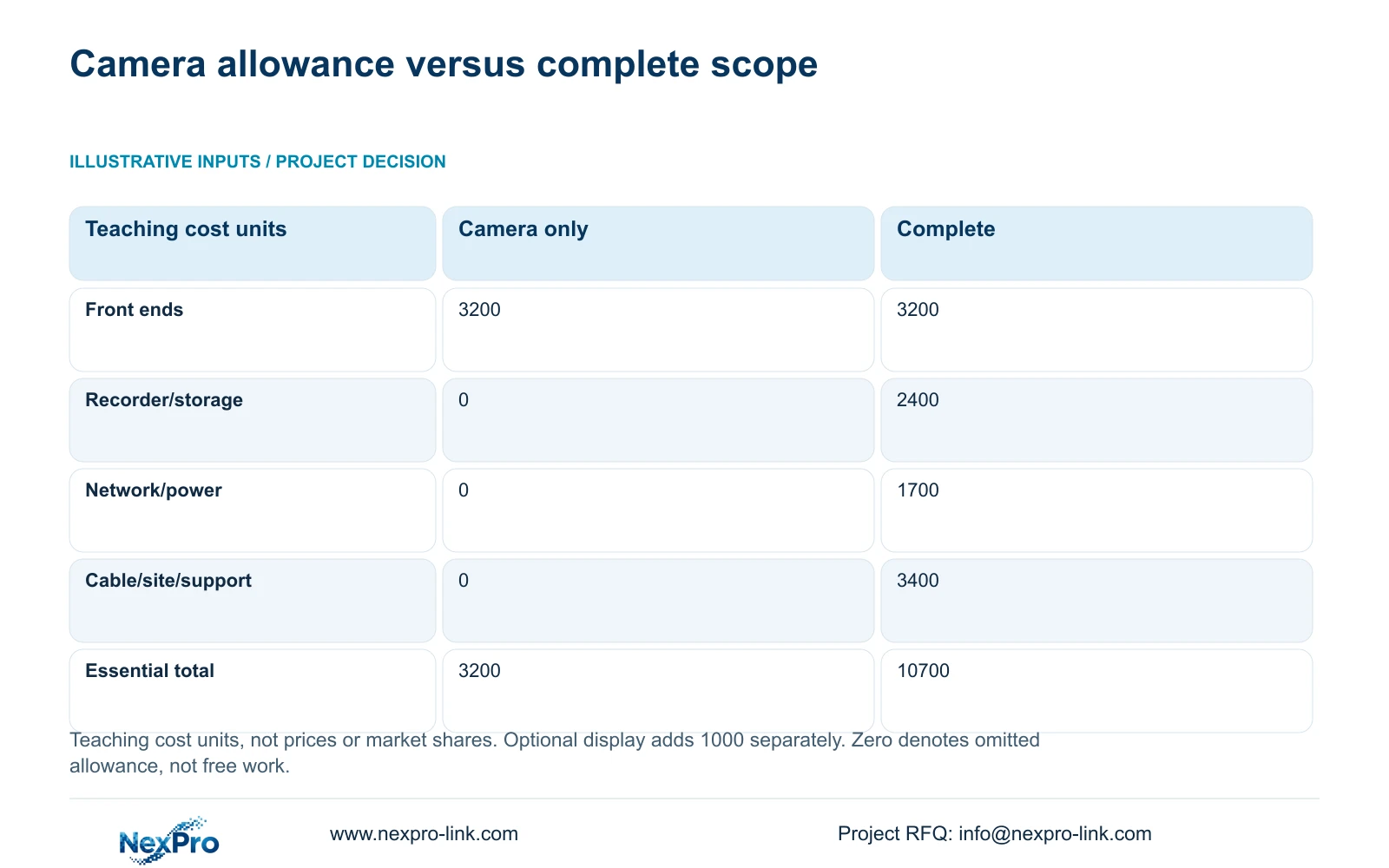
The teaching allowance assigns 3200 cost units to front ends, 2400 to recorder/storage, 800 to networking, 900 to power, 1600 to cabling and 1800 to installation/support. These units are neither a currency quotation nor typical hotel cost proportions. Essential evaluated allowance equals the sum of required scope rows; optional display remains separate.
The incomplete camera-only allowance totals 3200 units. Adding the stated recording, network, power, cable and site/support layers produces 10700 units. In the table, zero means absent from that allowance, not available free of charge. The optional display adds 1000 units separately. This example is independent of CASE01's equipment quantities and does not price its 32-camera system.
Compare supplier totals only after restoring omitted requirements and removing duplicated inclusions. Use the same destination, quantity baseline and installation boundary, with logistics, taxes and any software or service scope clearly stated. A quantity revision and a specification revision should be explained separately. RICS NRM distinguishes cost-planning and measurement uses; this teaching table is not its prescribed contract template.
| Metric / condition | Camera-only allowance | Complete allowance |
|---|---|---|
| Front ends | 3200 | 3200 |
| Recorder and storage | 0 | 2400 |
| Network and protected power | 0 | 1700 |
| Cabling and site/support work | 0 | 3400 |
| Essential total | 3200 | 10700 |
| Optional display | Not included | +1000 separately |
Section 05
Separate recurring cleaning work
Keep routine cleaning and access duties outside the initial equipment total unless the quotation expressly includes a defined service. Record who can safely reach each camera, what operating restrictions apply and who checks that the required image remains usable afterward. The cleaning schedule should follow the actual environment and hotel responsibilities; the supplied evidence establishes no universal interval.
Compare a more accessible mounting arrangement with one that requires recurring specialist access. Preserve the required view in both options. The additional initial scope is worth assessing when it changes a documented maintenance burden, but an annual saving needs actual service rates and agreed frequencies. No cost reduction can be assigned from this teaching allowance.
The supplied warranty policy records a 24-month limited hardware baseline for applicable main equipment from receipt, subject to controlling written order terms. Batteries, disks, cables and OEM scope have separate boundaries. Routine cleaning, local labor, travel and return transport should be stated independently. Historical longer terms must not be carried into a new BOQ, and continuing technical support is not unlimited free onsite maintenance.
Section 06
Prepare a position-linked RFQ
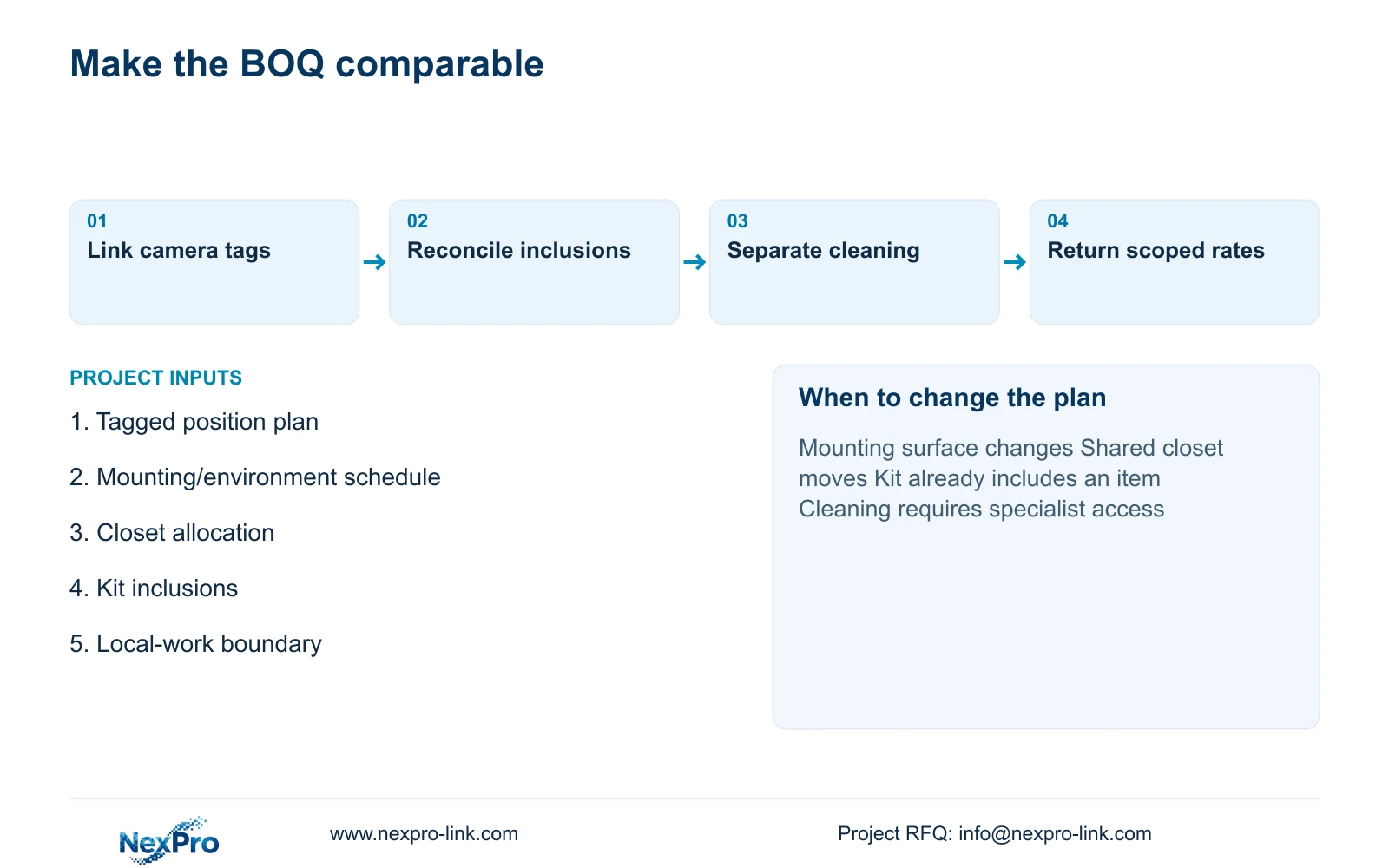
Issue a camera-tag schedule with environment, mounting method, connection boundary and serving closet references. Add separate shared-resource rows and a short inclusion register. Give every unresolved quantity an identifiable assumption so suppliers can return a comparable response. The cost manager can then replace allowances with quotations without losing the relationship between the item and the hotel function.
Recommend a complete itemized scope once position and route information are sufficiently defined. Use bounded provisional items while the installation design remains open, then revise them when the mounting surface, closet location or maintenance method changes. Retain required recording and protected network functions in every alternative. A cheaper proposal that removes those functions is a different scope.
Email info@nexpro-link.com with the tagged back-of-house plan, mounting/environment schedule, serving-closet information and current inclusions. State the delivery destination and split between equipment supply and local installation. NexPro-Link can discuss model matching, BOM/BOQ support and coordinated supply. Its CCTV manufacturing core and companion-category coordination should remain distinguishable, with any approval or order decision retained by the buyer.
Section 07
Buyer questions
Can accessories remain a percentage during concept budgeting? An explicitly provisional allowance can remain while quantities are unresolved. Identify what it covers and the missing design inputs. Replace it with position-linked items before treating the amount as a complete installation quotation.
How can a supplier avoid charging twice for kit contents? Return an inclusion register against the BOQ line references. Show which disks, mounts, adapters or services are inside the package, and reconcile the separate infrastructure and installation rows before totaling.
What should change when a shared closet moves? Review serving-camera routes, cable quantities, uplinks, local power, backup and access work together. Confirm which existing materials can be retained and which new work is required; do not assume the change is limited to the cabinet item.
Engineering references
These sources support the general planning principles. Always use the selected product's current datasheet and applicable project standards for final design.