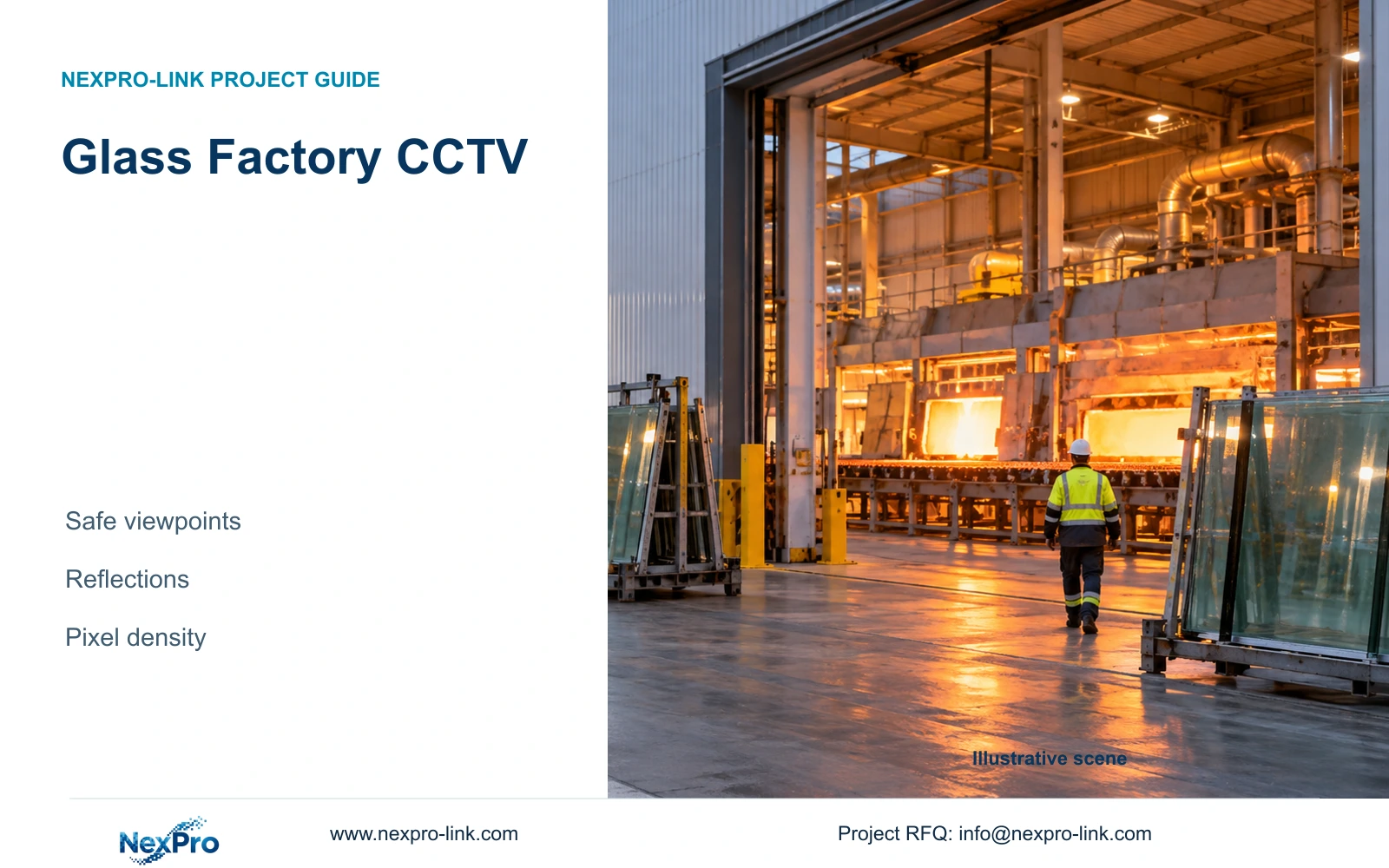
Glass factory CCTV should capture loading and access from suitable positions. Reflection geometry, radiant heat and recorded-image acceptance come before a resolution upgrade.
Section 01
Separate security evidence from hot-process inspection
Choose glass factory CCTV viewpoints and environmental suitability before resolution. Define loading, access and material-transfer views separately from any furnace-facing inspection task. An ordinary surveillance camera should not be specified as a furnace-inspection sensor or assumed to withstand radiant heat simply because its ambient temperature field appears acceptable.
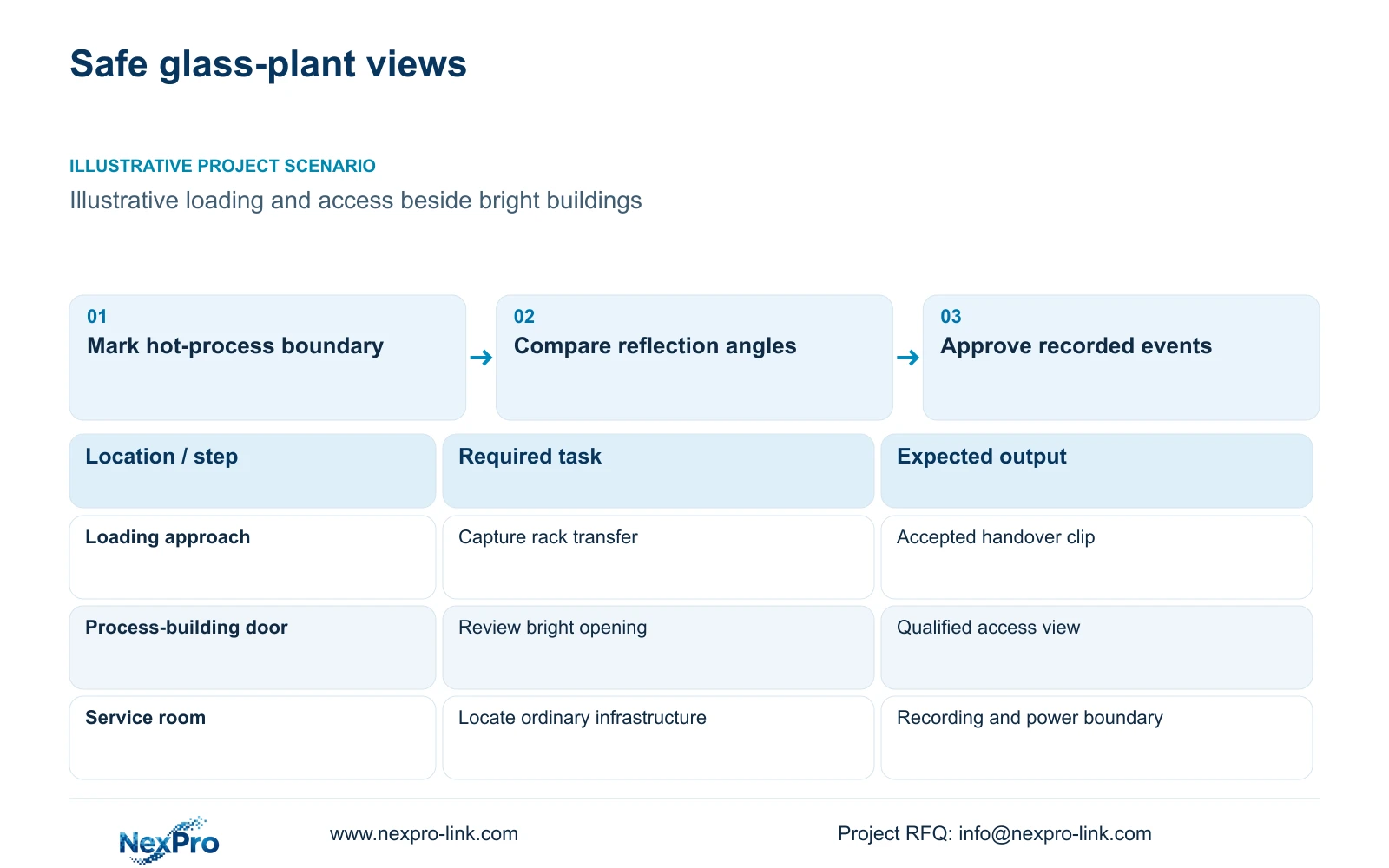
Illustrative project scenario: The glass plant wants loading and access evidence near bright process buildings. Assume the design review includes a loading approach, a doorway beside a process building and a protected service room. The proposed objective is to reconstruct who entered and how material moved. No furnace-inspection capability or installed client result is assumed.
Mark the hot-process boundary and the allowed observation positions on the drawing. Ask the plant team to identify door-open conditions, heat sources and cleaning exposure. If the desired event can be seen from a qualified normal-area position, develop that view first. If it requires a process-facing position, keep that requirement in a separate specialist schedule.
Section 02
Test reflection geometry before buying more pixels
Record the positions of glass racks, bright openings, luminaires and the target path. Review the camera direction against changing rack positions and typical vehicle orientation. A view that looks clear before stock arrives may become dominated by reflective surfaces or lose the transfer behind a loaded rack.
Compare candidate angles using representative recorded clips, including bright process openings and the darker access route in the same scene. Keep the target width and event visible during this exercise. Adjusting the angle or selecting a separate detail view should be considered before widening the scene and relying on a resolution increase.
Where a protected window is proposed, include its reflections, cleanliness and any lighting behind the camera in the trial. Do not assume a window makes the equipment environmentally suitable or preserves image quality. Document the final mounting geometry so procurement samples and commissioning tests use the same observation task.
Section 03
Define the evidence the owner must retrieve
The owner should state whether review needs a person crossing a door, the sequence of a rack transfer or a close view of a handover. These tasks demand different framing. Avoid describing acceptance only as a clear picture, because that leaves the supplier free to demonstrate an attractive overview that does not resolve the disputed event.
Create an acceptance record with the point identifier, target plane, operating light state and required playback action. The installer owns final alignment and the owner approves the event result. Retained access records may provide a time reference, but any automatic connection to them needs a separately agreed interface.
For suitable ordinary positions, the supplied NexPro-BL2812M55-5MP-DIC-AI reference lists 2880×1620 output and 25fps; the BL2812M88-8MP reference lists 3840×2160 at 25fps. Both list a 2.8 to 12mm motorized lens. Their catalogue fields help define candidate configurations, while exposure, reflection and playback acceptance remain project checks.
Section 04
Compare output widths at the same six-metre plane
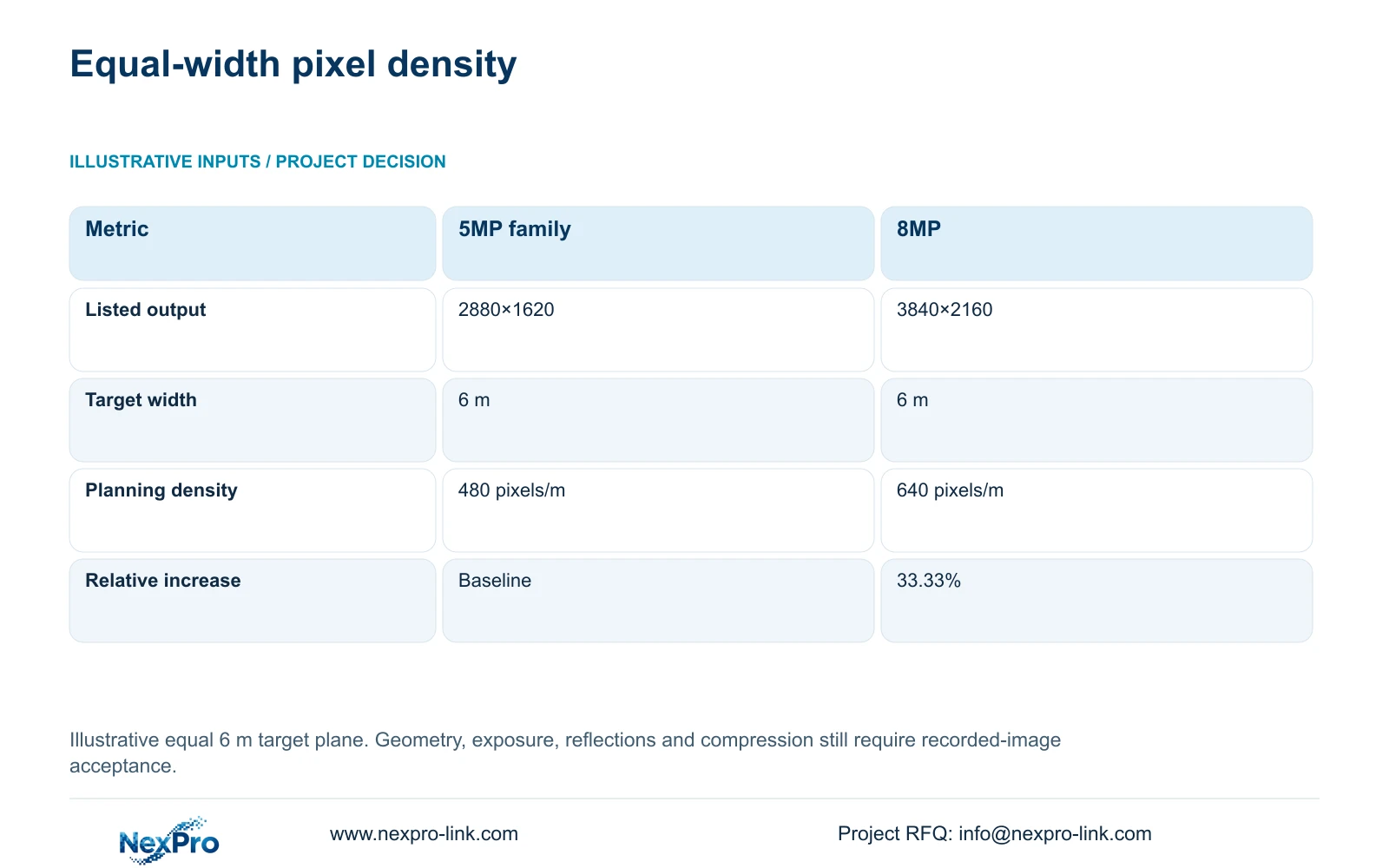
The supplied illustrative comparison holds the target width at 6 m. Planning pixels per metre equal horizontal output pixels divided by target width: 2880 / 6 = 480 pixels/m and 3840 / 6 = 640 pixels/m. The relative increase is (3840 / 2880 - 1) × 100 = 33.33%. Preserve the source's 5MP-family output of 2880×1620 when making this calculation.
The decisive difference is the horizontal sampling available at identical example geometry. The 5MP and 8MP names do not establish a 60% improvement in usable detail. Neither calculation proves label readability, comparative night performance or an ability to recover information lost to reflection, motion or occlusion.
Use the comparison to decide which candidate deserves a representative trial at the loading point. If both meet the accepted event, compare their complete system implications. If neither does, revise viewpoint, target width or lighting before treating another resolution increase as the solution.
| Metric | 5MP-family reference | 8MP reference |
|---|---|---|
| Listed output | 2880×1620 | 3840×2160 |
| Horizontal pixels | 2,880 | 3,840 |
| Target width | 6 m | 6 m |
| Planning density | 480 pixels/m | 640 pixels/m |
| Horizontal-density increase | Baseline | 33.33% |
Section 05
Keep resolution changes within the recording and power design
Recommend qualified normal-area cameras with task-specific framing, while pricing any necessary hot-process observation separately. CASE01 supplies a useful recording discipline: its 32 cameras assume supported 5MP-class streams at an illustrative average 4 Mbps each, giving 128 Mbps total input. That example cannot establish support for an all-8MP glass-plant configuration.
When a detail camera changes to 8MP, update its actual stream mode, representative bitrate, retention budget and simultaneous viewing requirement. The NexPro-NVR4449-4K reference has 320 Mbps input and four SATA bays, but its published summary distinguishes 49×5MP from 9×4K. Input bandwidth and channel count alone do not approve every proposed stream combination.
Keep switches, recorder and batteries in suitable serviceable rooms. Calculate PoE from actual device demand and protect the complete required power path. A retrieval monitor can serve a small operating team; any display wall remains a separate client branch with its own decoding and electrical demand. The security system should not become a dependency of furnace operation.
Section 06
Procure the tested view and its documented exceptions
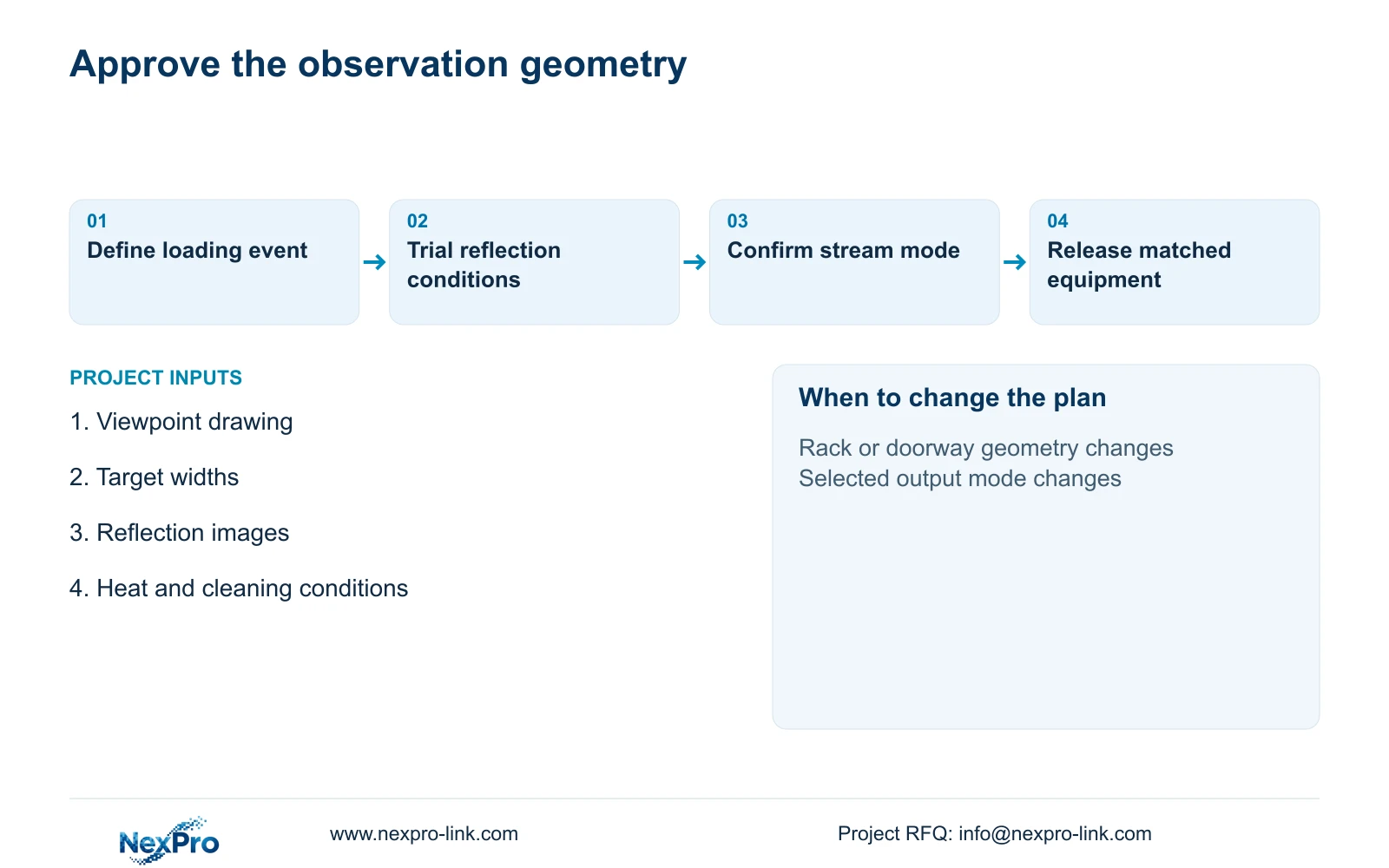
Give bidders the same viewpoint drawing, reflection conditions and event acceptance record. Separate mounts, protected connections, specialist observation equipment and local installation from the ordinary camera goods. Compare equivalent recorded results and service boundaries before drawing a price conclusion.
NexPro-Link can discuss model matching and a coordinated equipment schedule through its factory project supply and BOQ support scope. Group project packing by loading view, access view and service node. Preserve the accepted output mode and model identity in the submittal so a substitution does not leave the original density calculation attached to different hardware.
Release ordinary-area quantities only after the observation boundary is understood. Leave unresolved process-facing points clearly identified. Changes to rack layout, bright openings or the target plane should trigger a view review; changes to environmental exposure should trigger product qualification as well.
Section 07
Buyer questions
Is a higher pixel-density result enough to approve a camera? No. It identifies a candidate for testing. Approval should depend on recorded evidence at the required light state, motion and reflection conditions, using the agreed target plane.
Can one view show the loading route and a small identifying detail? Possibly, but prove both tasks in recorded playback. If widening the scene makes the identifying detail unusable, keep a separate detail view and preserve the overview.
Can a normal-area camera observe a furnace building? It may observe an access or loading event from a suitable position. That does not qualify it for direct furnace inspection, radiant-heat exposure or a process-control function.
Section 08
Request a viewpoint-based camera package
Send your proposed camera positions and target widths, representative reflection images, heat and cleaning conditions, and required loading or access events to info@nexpro-link.com for model and system-scope matching.
Engineering references
These sources support the general planning principles. Always use the selected product's current datasheet and applicable project standards for final design.