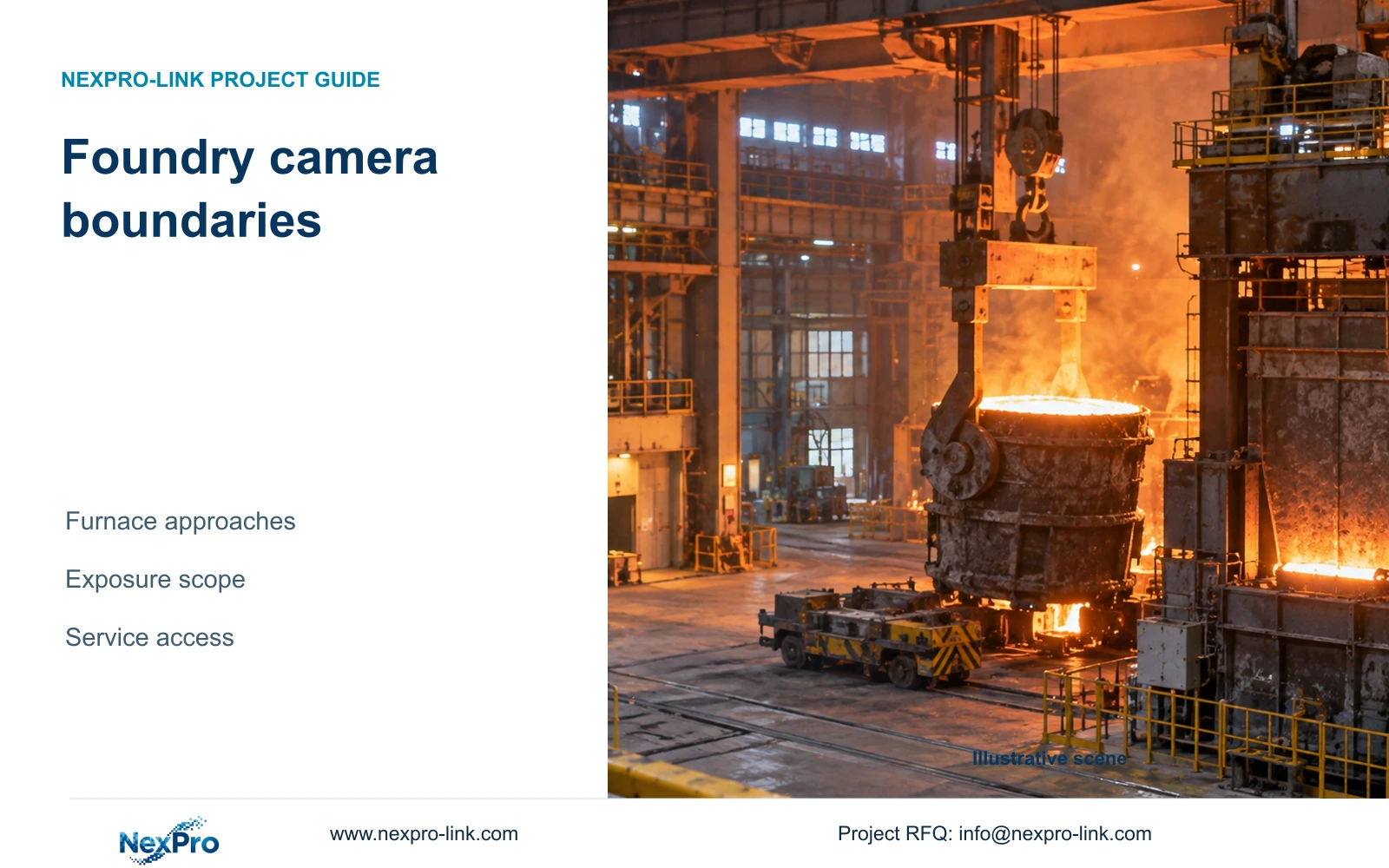
Foundry security cameras should preserve access and ladle-route context from suitable positions. Temperature, radiant exposure and service access determine where ordinary equipment can be considered.
Section 01
Separate suitable access positions from extreme zones
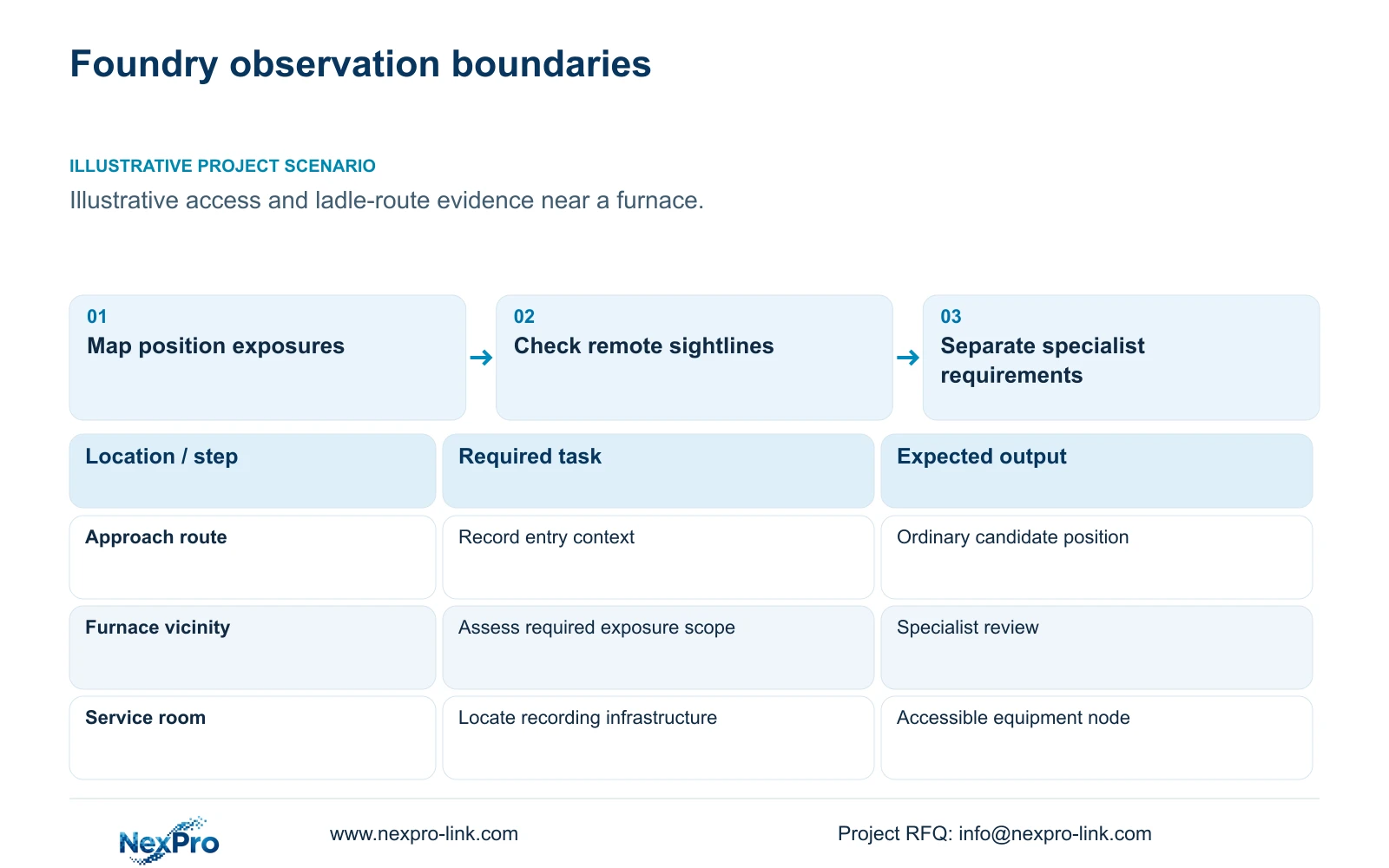
Foundry security cameras should record access and transfer context from locations that fit the complete equipment and installation scope. Keep ordinary CCTV in suitable positions and specify specialist equipment for the actual extreme zone. An IP rating alone does not establish heat or molten-metal suitability. Draw the environmental boundary before comparing equipment prices.
Illustrative project scenario: A foundry needs access and ladle-route context, but ordinary camera temperature limits may not fit the furnace vicinity. Assume the owner is considering a remote approach view and a closer process-facing position. The former could serve security if qualified; the latter needs separate environmental assessment. No measured site temperatures or approved camera positions are supplied.
Ask the responsible site team to document ambient conditions, radiant exposure, dust, splash possibilities and any classified-area information at each proposed position. Include conditions during transfer and servicing, not only steady operation. Distance from the furnace is an input to the assessment, not a universal qualification rule. Keep uncertain positions marked as unresolved.
Section 02
Qualify the service route alongside the viewing angle
Assess how the camera, connection and bracket can be reached for inspection or replacement. A remote position may provide adequate route context but still require access through an unsuitable area. The local team should identify the approved approach, service window and any necessary operational coordination. Keep these conditions in the camera schedule rather than assuming they will be arranged after delivery.
Compare an accessible ordinary-area position with the closer candidate using the same transfer task. If the remote angle loses the decisive route segment, examine another suitable angle or a separately qualified specialist front end. Do not move ordinary infrastructure toward the process merely to reduce cable length or increase apparent detail.
Service requirements extend to viewing surfaces and connections. Identify expected deposits, proposed cleaning methods and material compatibility information. An ingress field does not approve a cleaning chemical or an accessory assembly. Have the supplier document the offered configuration and the project team confirm whether it fits the actual operating and maintenance conditions.
Section 03
Preserve the transfer sequence across the boundary
Break the required ladle-route context into observable stages, such as entering the approach, passing the agreed transfer boundary and leaving the area. These are illustrative evidence roles, not instructions for ladle operation. Mark where structures, vehicles or temporary stacks may hide the route. Assign a view to each essential stage without requiring ordinary cameras to observe inside an unsuitable zone.
Where two views are necessary, test whether their recorded coverage supports reconstruction of the sequence. Use consistent location IDs and an agreed time reference. The owner should define what must be distinguishable in the footage. Surveillance remains separate from temperature measurement, molten-metal inspection and process-safety control, each of which needs its own engineered scope.
CASE01 is useful for the ordinary supporting architecture: it assumes cameras connected through local PoE access groups to a recorder and authorized clients. Its 32-camera CNC schedule contains no specialist cameras. It therefore provides no qualification for a furnace position and should not be relabelled as a complete foundry installation.
Section 04
Require every relevant suitability condition to pass
The BL2812M55 and DM2812M55 ordinary 5MP-family sources list IP66 and -20 to +60°C. Their listed 2880×1620 output and motorized lens fields can inform image planning in suitable locations. Preserve those documented fields without extending them into radiant-heat, chemical-resistance or explosion-protection claims.
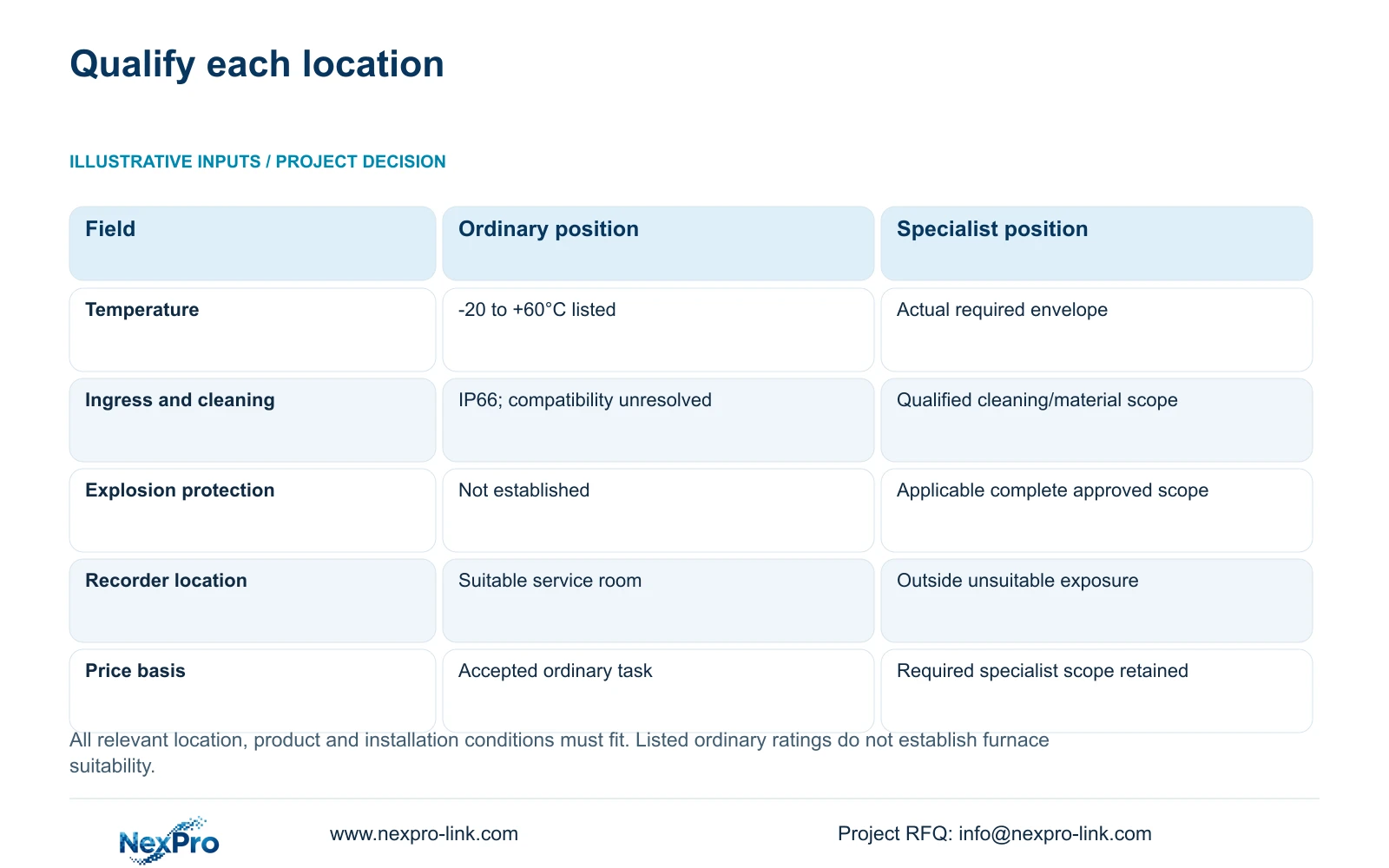
Use the decision rule: location conditions AND complete product scope AND approved installation requirements must fit. One passing field cannot override a failed or unresolved condition. A proposed position within the listed temperature field can still require information about radiant exposure, cleaning, corrosion or area classification. The table separates ordinary-area selection from specialist qualification rather than awarding either option a score.
The decisive difference is documented suitability for the actual position. Specialist equipment and its connections need their complete applicable scope reviewed; adding a housing does not automatically qualify an ordinary camera assembly. Responsible designers must verify current local requirements where applicable. This article defines procurement boundaries and does not provide hazardous-area installation instructions.
| Qualification field | Ordinary approach position | Extreme-zone position |
|---|---|---|
| Temperature and exposure | -20 to +60°C source field; assess radiation | Document required operating and radiant exposure |
| Ingress and cleaning | IP66 listed; cleaning compatibility unresolved | Specify cleaning and material compatibility |
| Explosion protection | Not established by ordinary source | Applicable complete product and installation scope |
| Recording infrastructure | Suitable accessible service room | Keep ordinary infrastructure outside unsuitable locations |
| Commercial scope | Price accepted ordinary-area task | Retain required specialist equipment and services |
Section 05
Buy the ordinary and specialist scopes separately
Recommend remote ordinary security views where they retain the agreed access and transfer evidence and satisfy the location assessment. Keep specialist scope only where the actual task or environment requires it. If the ordinary view cannot show an essential route segment, preserve that unmet requirement in the tender instead of removing it to fit a standard product.
Compare alternative suppliers on identical observation tasks and location boundaries. A specialist camera package may include protection, accessories or local engineering absent from an ordinary camera price. Keep those differences visible. Neither a metal enclosure nor PoE connectivity establishes equivalent protective scope, and no matched quotations are supplied here.
Place recorders, switches and batteries in suitable accessible rooms wherever the architecture permits. Show how specialist video reaches the recording system and confirm exact stream, event and export support. Keep the viewing display as a client branch. A larger monitor or recorder does not qualify a process-facing camera or establish specialist measurement capability.
Section 06
Release a position-specific qualification schedule
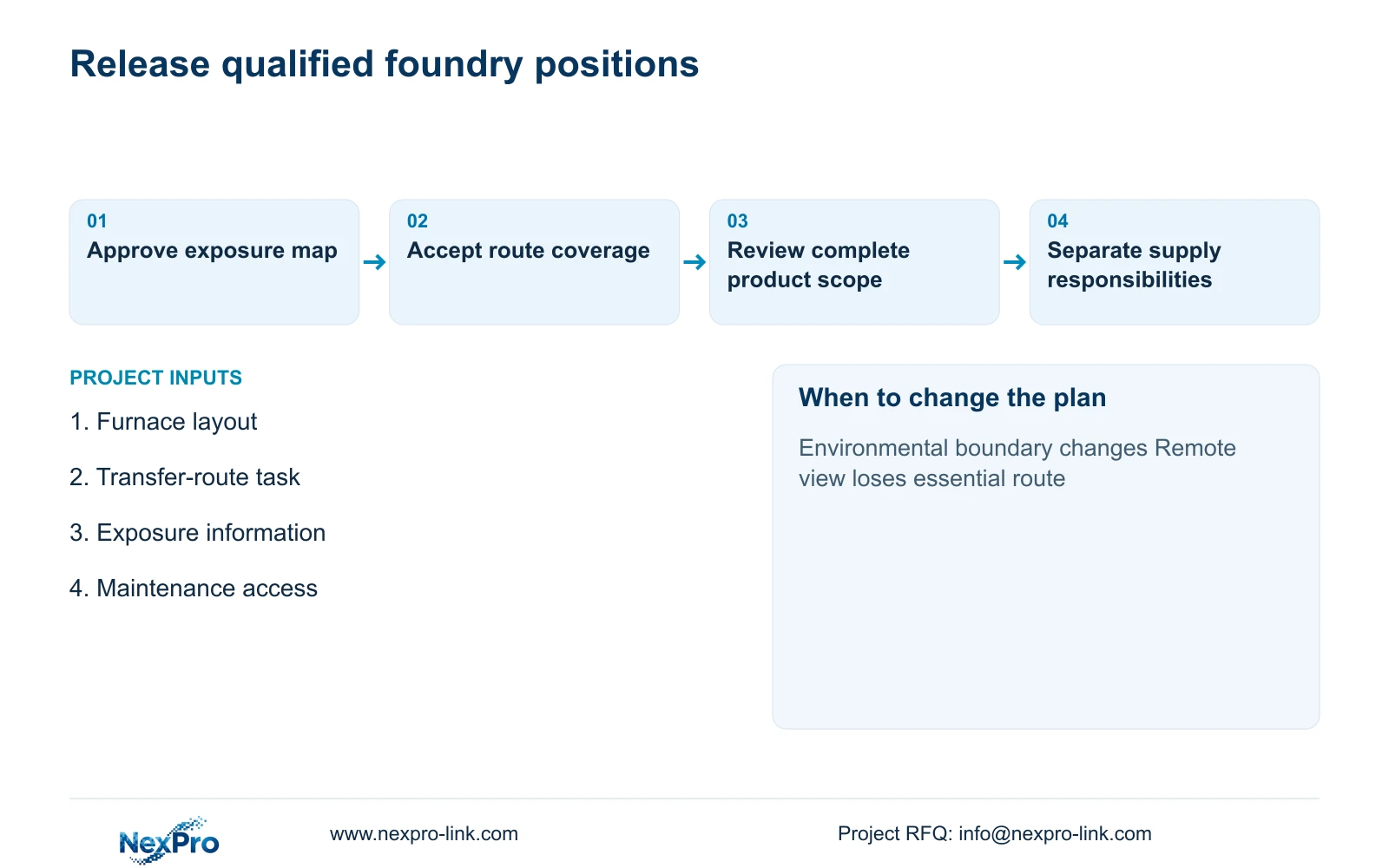
Prepare a schedule with observation task, proposed location, environmental inputs, maintenance access, ordinary/specialist status and responsible approval party. Mark supplied, retained and optional items. The environmental designer owns the location assessment; the equipment supplier supplies applicable product evidence; the installer confirms the approved arrangement. Unresolved suitability should remain a visible procurement hold.
Measure actual routes to the service room, including any boundary crossings and locally specified cable construction. CASE01's assumed 41 to 76 m links illustrate a point-by-point schedule only. Its lengths and ordinary equipment cannot be copied into foundry hot-zone connections. Verify terminations, local power and maintenance access as part of the selected complete arrangement.
NexPro-Link can support the ordinary security package, BOQ matching and associated technical documents within its published project scope. Packing and location labels can preserve the division between standard equipment and separately qualified items. Keep specialist design and final installation approval with the appointed parties, and revise the schedule when the transfer route or environmental boundary changes.
Section 07
Buyer questions
Does a camera rated to +60°C automatically suit a furnace approach? No. Assess the actual position, including radiant exposure and other environmental conditions. The listed temperature field alone does not establish suitability near molten metal.
Can a protective enclosure make an ordinary camera acceptable? Only where the complete offered arrangement is documented and accepted for the actual conditions. Do not infer assembly suitability from separate camera and enclosure descriptions.
Should all foundry cameras be specialist models? Classify locations individually. Suitable access routes and service rooms may support ordinary equipment, while specific extreme positions retain specialist requirements. The evidence task must remain covered in either case.
Section 08
Divide the foundry camera scope
Send the furnace/approach layout, required transfer-route evidence, position-specific exposure information and approved maintenance access to info@nexpro-link.com for an ordinary-area package discussion with specialist boundaries retained.
Engineering references
These sources support the general planning principles. Always use the selected product's current datasheet and applicable project standards for final design.