Review the affected footwear CCTV positions when an adhesive or its application changes. Keep stock and packing work separate from the site specialist's reassessment of the process boundary.
Section 01
Start with the assessed adhesive-area boundary
When a footwear plant changes an adhesive or its application, refer the change to the responsible site specialists before carrying forward CCTV approval around that process. Trace affected camera bodies, connections, installation routes and service access against the revised assessment. Keep unchanged stock and packing tasks in their own accepted scope. The industry name and a previous ordinary-camera decision cannot determine the new boundary; this guide provides an affected-position change record, not a substance classification or protective-system design.
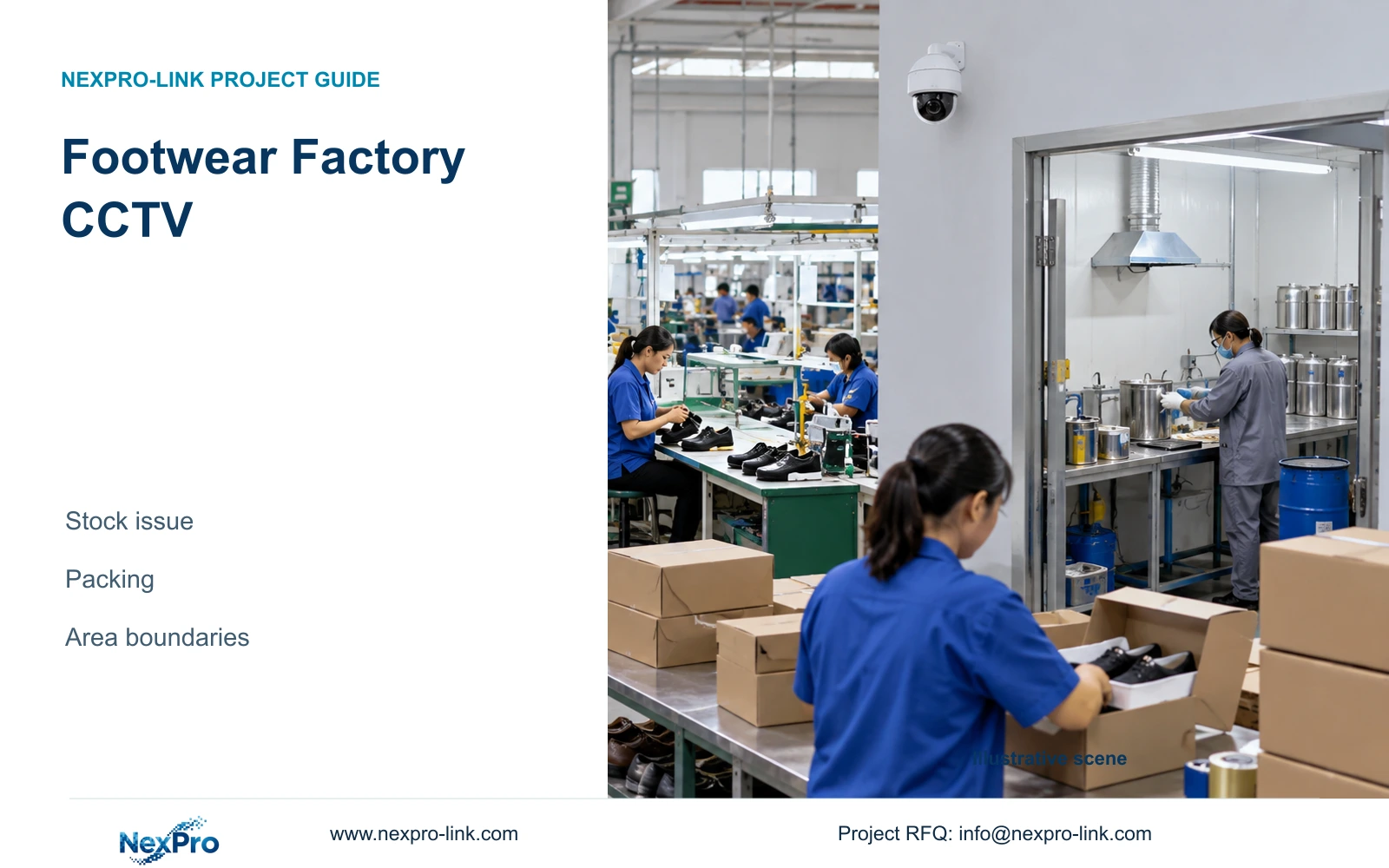
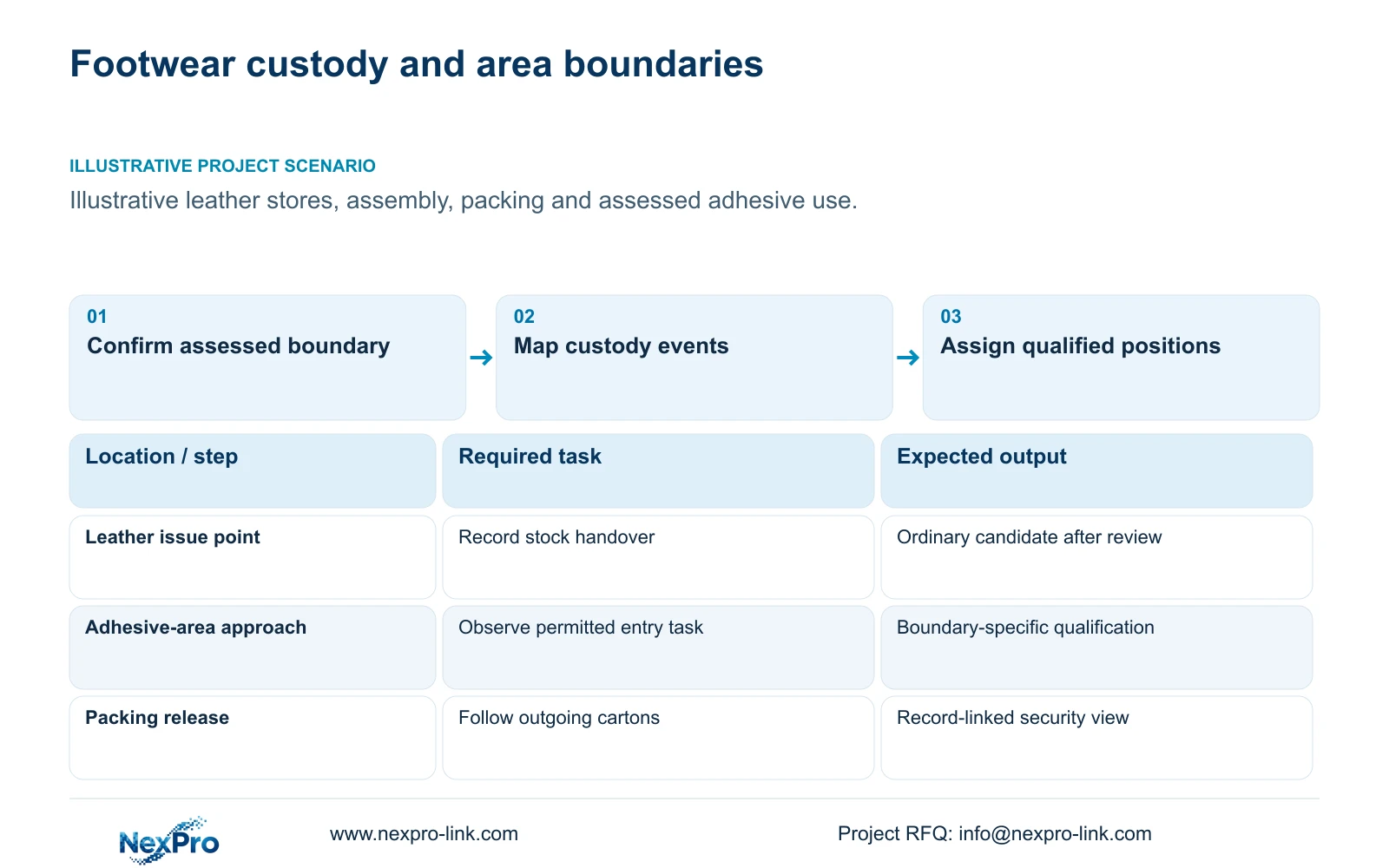
Illustrative project scenario: A shoe factory has leather storage, assembly, packing and an independently assessed adhesive-use area. Assume the security brief concerns material issue, movement into assembly and packed-carton release. The design separates these evidence tasks from any requirement inside the assessed adhesive area. This hypothetical scenario does not identify substances, establish a hazard classification or claim an approved installation.
Map each material route against the assessed boundary, including the location of the camera body and its cable connections. An adjacent approach may offer useful entry evidence, but it cannot automatically replace an interior task. Request lint or deposits, humidity, cleaning methods and night-shift lighting by position. Verify applicable local requirements with the project specialists before releasing any boundary-sensitive installation.
Section 02
Place detail at stock issue and carton release
Use leather-store access views to explain entry and movement, with a closer issue-point view where the owner needs handover evidence. Record what must be visible when material is presented: an agreed label field, the item group or the sequence of issue. Keep inventory identity in the stock record. Do not infer automatic counting, barcode reading or material authentication from general security-camera features.
At packing, distinguish the task of seeing cartons leave from the task of reading a release field. Carton stacks, trolleys and changing assembly layouts can hide the critical action. Review representative loads and the normal release position, then retain an overview if the close view excludes the wider route. This produces a clearer camera schedule than placing the same model uniformly over every bench.
Keep views tied to permitted material and security purposes. The owner should define review access and retention before detailed bench footage is included. Night lighting needs its own test at stock doors and packing exits, particularly when the transfer crosses differently lit spaces. An accepted daytime live image does not settle the recording requirement for a later shift.
Section 03
Use ordinary candidates only at qualified positions
The NexPro-BL2812M55-5MP-DIC-AI and NexPro-DM2812M55-5MP-DIC-AI provide ordinary bullet and source Dome-family references. Their supplied fields include a 5MP family, listed 2880x1620 output, a 2.8 to 12mm motorized lens, PoE and IP66. The relevant source temperature envelope is minus 20 to plus 60°C. These are model fields, not confirmation that every leather-store or assembly position is suitable.
Use the lens range to develop candidate framing at approved ordinary positions, then verify the required recorded evidence. Neither the Dome naming nor a metal-looking housing establishes an impact rating or resistance to the site's substances. Document maximum device demand separately because no camera peak watts are supplied. That missing input should remain visible in the PoE schedule.
Create a role-based camera map with supplied stock and packing views, retained suitable devices and separately identified specialist positions. Pair it with a service-access arrangement showing how lenses and connections can be reached. The designer owns task matching, the local installer verifies the physical arrangement and the site's specialists approve any environmental boundary. Keep those responsibilities attached to the position IDs.
Section 04
Compare complete qualification requirements
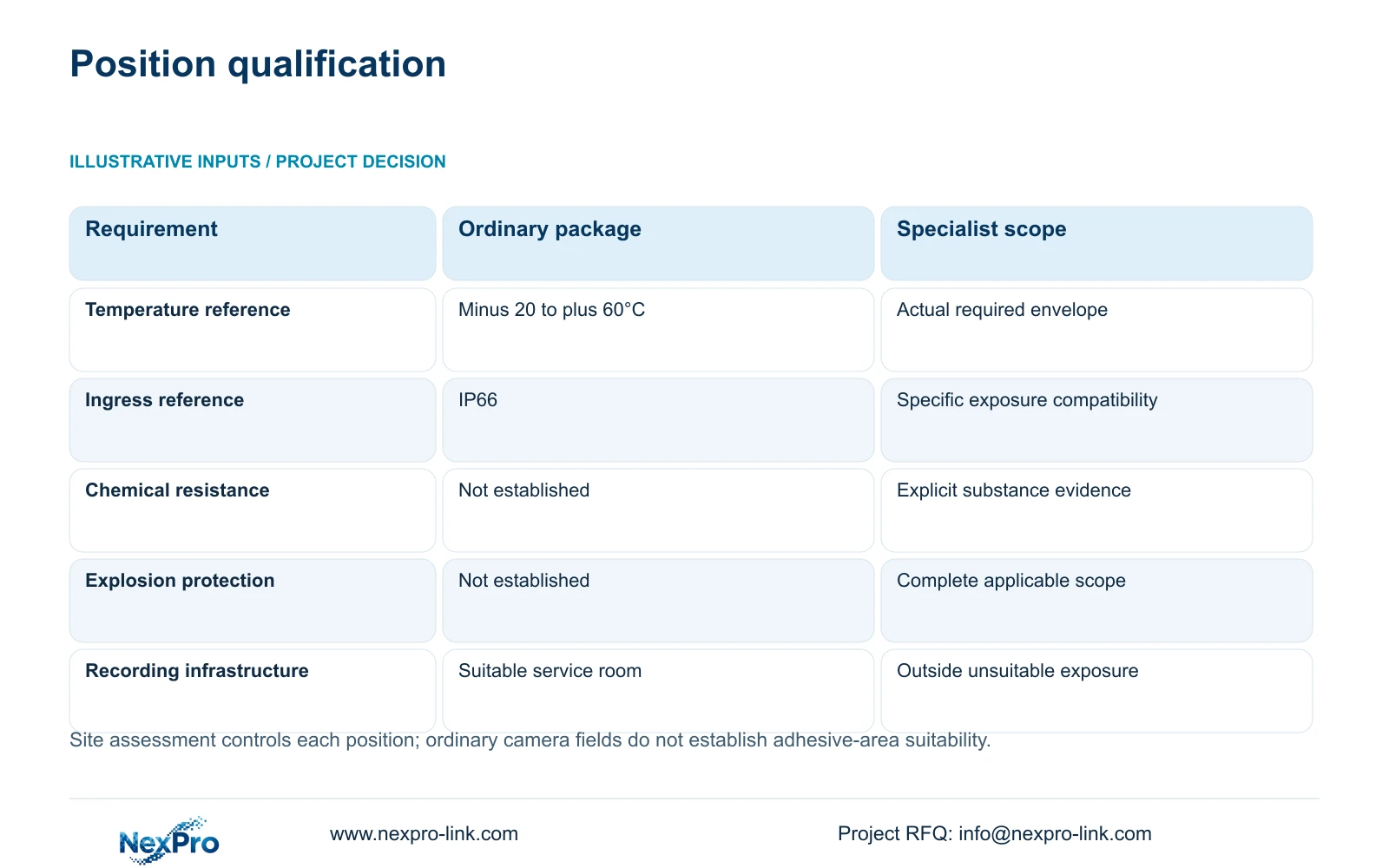
Apply the same selection rule to every location: conditions AND complete product scope AND approved installation requirements must fit. The table distinguishes the ordinary stock-and-packing basis from a position that requires specialist qualification. These are scope choices, without invented scores or costs. A camera that meets the temperature requirement still needs evidence for every other relevant exposure.
The decisive difference is whether the actual position can be accepted against the ordinary specification or needs additional documented protection. IP66 does not establish explosion protection, chemical resistance or compatibility with an unspecified cleaning method. A general PoE label describes a power interface; it does not qualify equipment for an adhesive-area installation.
If the assessed area requires specialist equipment, retain its complete protective and installation scope in the quotation. The AXIS P1468-XLE source is an example of a specialist camera with stated Zone2/22 and Division2 applications, subject to its complete applicable scope. It is not an automatic selection for this hypothetical shoe factory and does not establish suitability for every adhesive or cleaning substance.
| Requirement | Suitable ordinary position | Specialist position |
|---|---|---|
| Temperature | Check actual ambient against minus 20 to plus 60°C | Match the specified operating envelope |
| Ingress and cleaning | IP66 field plus actual exposure review | Document cleaning and material compatibility |
| Substance exposure | No chemical resistance established | Require explicit compatibility evidence |
| Assessed protection | Ordinary PDF establishes no explosion protection | Retain complete applicable protective scope |
| Infrastructure | Accessible suitable recording room | Ordinary racks outside unsuitable positions |
Section 05
Keep shared infrastructure outside unsuitable exposure
Recommend a selective ordinary-area package for qualified stores, routes and packing positions, connected to suitable local infrastructure. Preserve specialist coverage where the required event lies within a location that cannot use ordinary equipment. Relocation to an approved approach can be considered when it retains the task, but any lost interior visibility must be an explicit owner decision.
CASE04 provides a separate four-building garment-campus reference, with 80 cameras divided into four local 20-camera recording nodes. Its value here is the separation of local recording and authorized cross-building retrieval. It has no specialist cameras in its stated baseline and therefore supplies no evidence for an adhesive-area position. Choose the footwear plant's node quantities from its approved task map.
Keep camera data paths and electrical protection distinct. Specify actual streams, recorder modes and retention, then check each switch group and local UPS load. Recorders, batteries and network equipment need their own suitable rooms and service access. Cable routes through a boundary need the appropriate project review. Start with a normal retrieval screen; a display wall is optional operating scope rather than a prerequisite for recording.
Section 06
Review only positions affected by an adhesive change
Separate ordinary cameras, specialist equipment, environmental interfaces and local construction in the BOQ. Compare suppliers on the same stock, transfer and packing evidence, with identical boundary requirements. If the tender mandates a brand or platform for specialist positions, retain it unless an approved alternative satisfies the complete scope. A lower ordinary-camera total cannot establish a lower cost for an equivalent qualified system.
NexPro-Link's Factory & Warehouse project supply and BOQ & Tender Support scopes can support the ordinary equipment package, model matching and explicit deviations. Location-labelled packing should follow the approved camera map and keep unresolved specialist positions separate. Release documentation with the revision of the assessment used for selection, then require the local team to verify framing, service access and retrieval before handover.
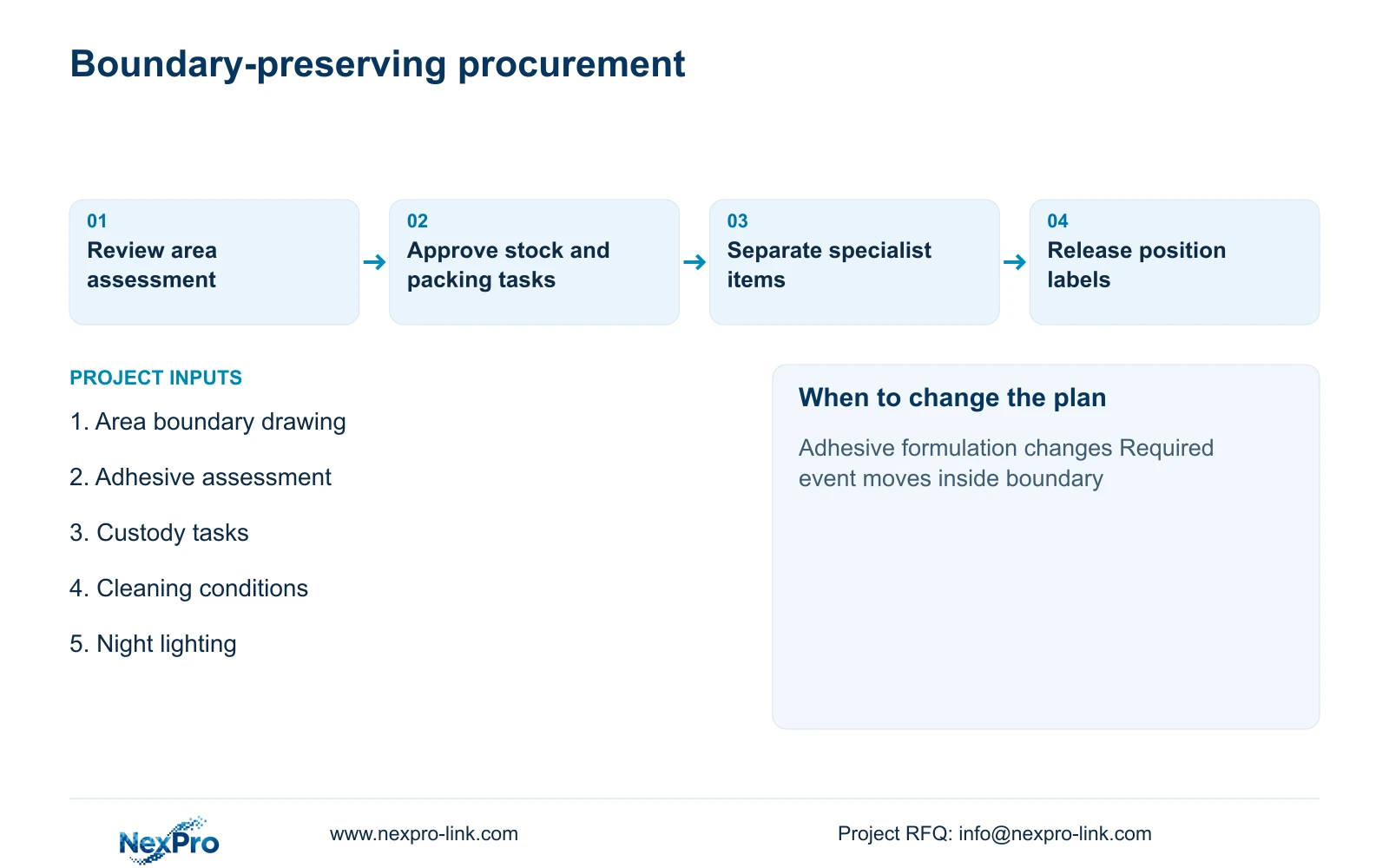
Give the assessor the actual change and the previous position schedule, then ask which location and installation conditions remain valid. Distinguish an unchanged camera view from an unchanged equipment exposure: the same stock handover may still be visible while its mount or cable route is affected. Where an outside approach loses an interior event, obtain an explicit owner decision rather than recording that loss as an equivalent substitute. Unaffected ordinary work should not inherit an undocumented new specialist requirement or blanket approval.
| Condition / stage | Required input | Decision and evidence |
|---|---|---|
| Substance or application changes | Site specialist's revised assessment | Hold affected positions until their new scope is established |
| Outside approach retained | Actual mount, connections and visible transfer | Retain only the accepted view and suitable installation |
| Stock/packing scope unchanged | Position-level confirmation against the revision | Release independently; do not extend its approval to process positions |
Section 07
Buyer questions
Must every camera in a shoe factory be specialist equipment? Selection is position-specific. Ordinary equipment can be considered where the complete conditions fit. The site's assessment determines where specialist requirements apply; neither the factory name nor another room's classification settles the choice.
Can an ordinary camera observe the adhesive-area entrance from outside? Possibly, if its actual mounting and connections are suitable and the required entry task is visible. The responsible specialists must confirm the boundary, and the owner must accept any interior events that remain outside that view.
How should a later adhesive change be handled? Refer it back to the site assessment and affected-position schedule. Review substance exposure, protection and installation suitability before retaining the previous selection. Preserve unaffected ordinary-area scope where its conditions remain unchanged.
Section 08
Define the footwear CCTV supply boundary
Send the stock-to-packing route drawing, adhesive-area assessment and boundary, position-specific cleaning and lighting conditions, and required handover evidence to info@nexpro-link.com for a selective ordinary-area equipment discussion.
Engineering references
These sources support the general planning principles. Always use the selected product's current datasheet and applicable project standards for final design.