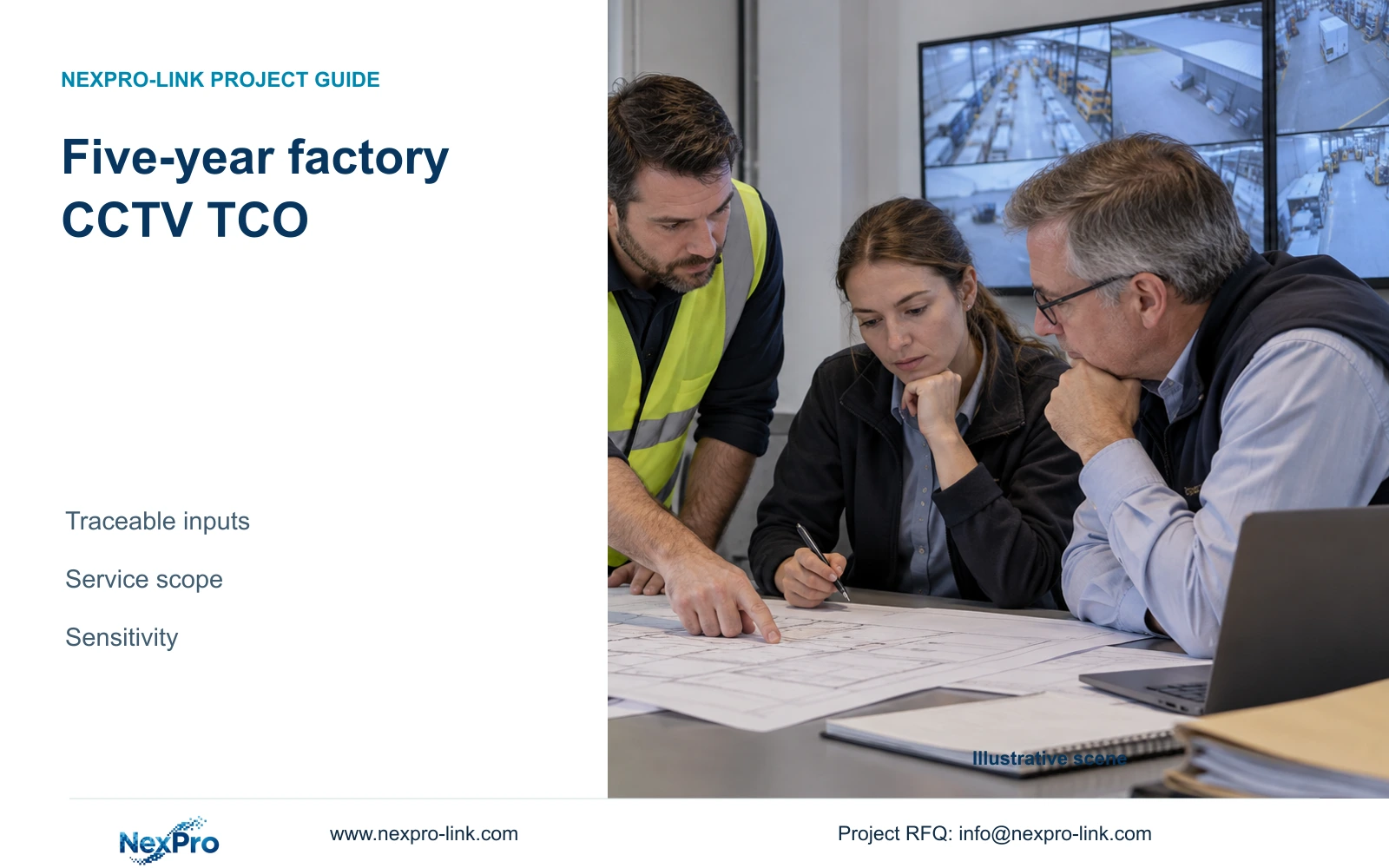
Give each lifecycle line a source date, scope and status: contracted, measured or assumed. When an assumption changes, show which ranking changes and which costs remain supported.
Section 01
Establish a matched acquisition and support baseline
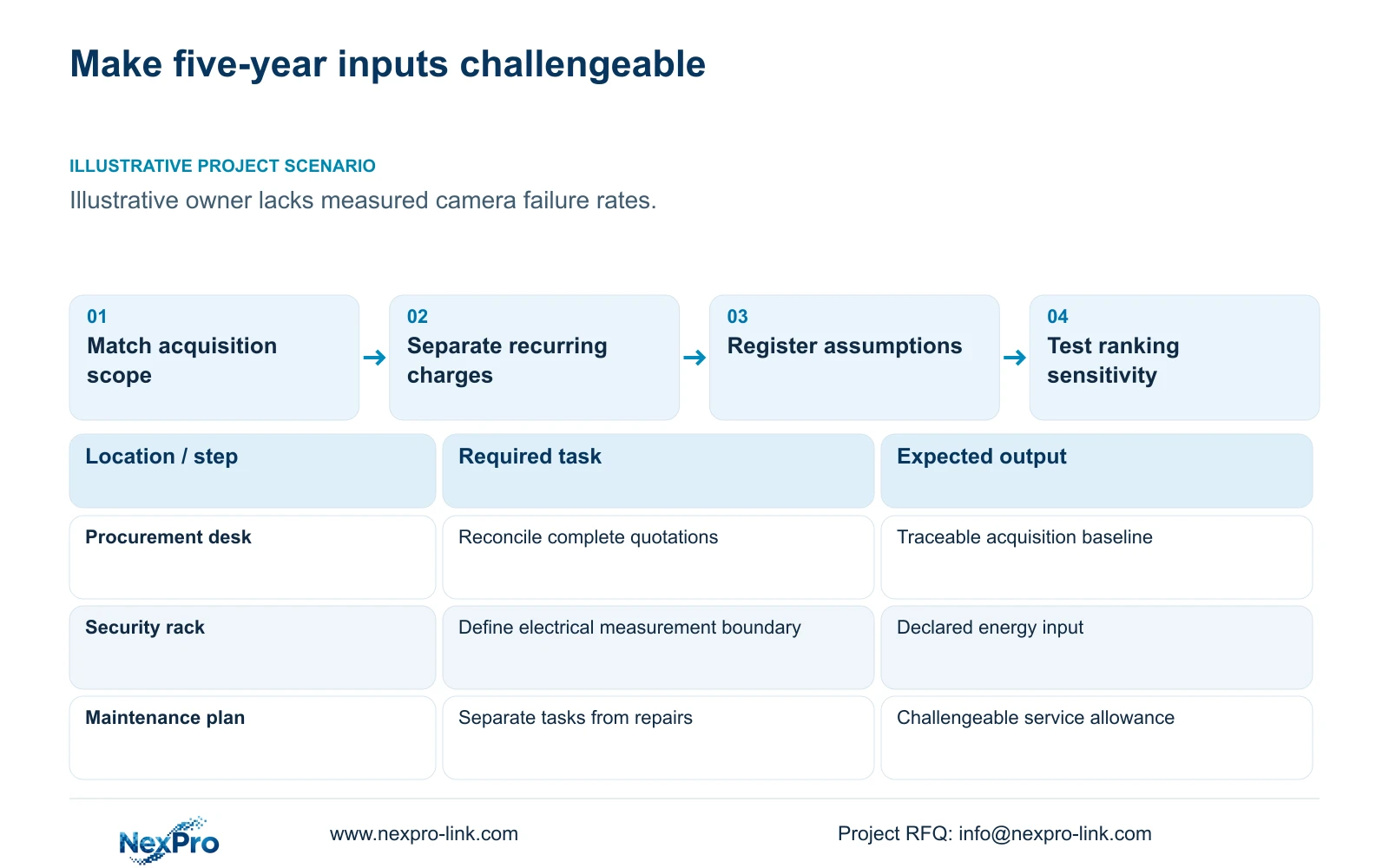
Give each lifecycle line a source date, scope and status: contracted, measured or assumed. When an assumption changes, show which ranking changes and which costs remain supported. Leave unavailable future repairs as a scenario, not a forecast. The register lets an owner challenge the comparison without accepting invented reliability figures.
Build five-year factory CCTV TCO from matched acquisition scope, documented recurring charges and explicit operating assumptions. Show uncertain future work as scenarios rather than treating invented failure rates as forecasts. The owner should be able to trace each material cost to a quotation, contract, measured input or clearly labeled planning assumption.
Illustrative project scenario: The owner needs a long-term comparison but lacks measured failure rates. Use CASE01's hypothetical 32-camera CNC factory to define the system boundary: ordinary security views, recording equipment, PoE infrastructure, protected power and an operator retrieval path. Assume two candidate packages must deliver these same services before their five-year expenditure is compared.
Start with equipment, installation, required omissions and commissioning. Then identify which support services are included in acquisition and which recur. Set the five-year start point, currency basis and treatment of optional enhancements. This avoids comparing one offer's complete installed service with another's goods invoice and then carrying the mismatch through every later year.
Section 02
Model energy and planned maintenance independently
Calculate operating energy from the declared electrical boundary: annual_kWh = average_input_W/1000 × operating_hours. Use measured or appropriately supported average input where available, with the applicable tariff supplied by the owner. If the measurement is downstream of a UPS, add its input-side consumption only through a justified calculation or measurement; do not present the load-side figure as the complete utility draw.
CASE01 gives a recording-priority load assumption of 682.7407 W and an optional display-inclusive load of 1,262.7407 W. These describe different operating scopes. The larger figure includes four assumed 120 W LCD panels and an assumed 100 W decoder while retaining the original operator equipment. Neither total is a measured billable input, and the display option should not be used to claim a brand's energy disadvantage.
Build planned maintenance from the approved tasks, access arrangements and quoted rates. Separate routine inspection from optional upgrades and uncertain repairs. Disks and batteries need configuration-specific service planning, but no universal replacement age is established by the supplied sources. A budget allowance should name its purpose and source rather than appearing as a guaranteed failure event in a chosen year.
Section 03
Expose the assumptions capable of changing the ranking
Use a transparent structure: five_year_TCO = normalized_acquisition + sum(yearly_energy + contractual_support + planned_maintenance + approved_replacement_allowances) minus agreed_residual_value. If residual value has no accepted basis, omit it from the main comparison and identify that choice. Use nominal totals unless the owner requests a separate discounted calculation with its own approved assumptions.
Run sensitivity cases around inputs that are both uncertain and material. Energy tariff, service access and selected battery scope may change the result; mandatory contractual charges may be more certain. Keep each alternative's technical outcome fixed while varying the relevant assumption. Report what changes the decision rather than constructing an optimistic case for one supplier and a pessimistic case for the other.
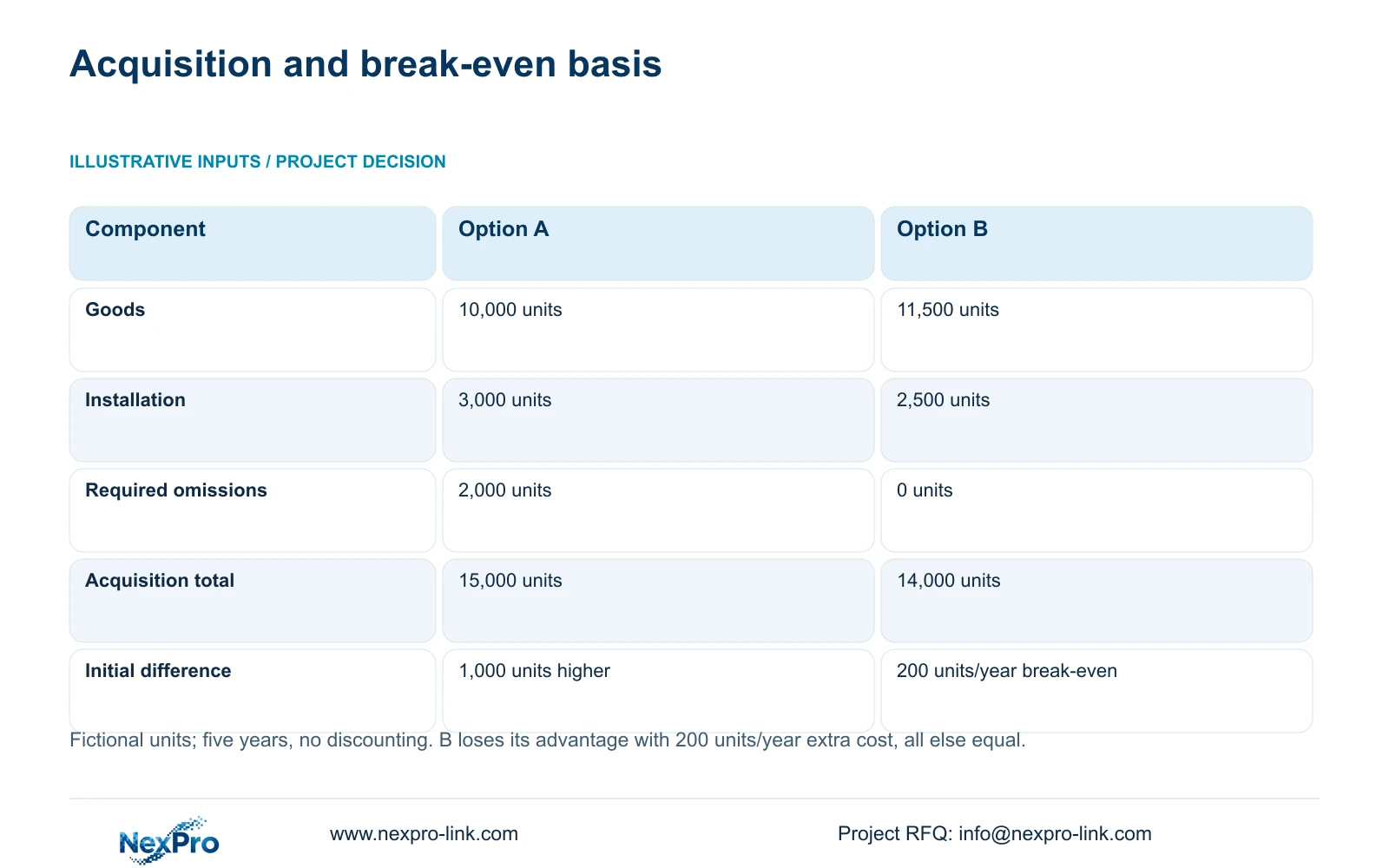
The supplied acquisition example creates a 1,000-unit difference after normalization. Over five years, an additional average 200 units per year in the initially cheaper option would equal that acquisition advantage, assuming all other costs match and no discounting. This is an illustrative break-even condition derived from fictional currency units, not a quoted service fee or a prediction of future expenditure.
Section 04
Correct the initial quotation before extending the model
The supplied fictional inputs are Option A goods at 10,000 units, installation at 3,000 units and required omitted scope at 2,000 units. Option B has goods at 11,500 units, installation at 2,500 units and no required omissions. Apply normalized_total = goods + installation + required_omitted_items. The complete acquisition totals are 15,000 and 14,000 units.
The difference is A_total minus B_total = 1,000 units. A's lower goods price therefore becomes the higher complete acquisition cost. This is the starting point for the TCO model, not its final five-year conclusion. Recurring charges or justified service differences can alter the ranking, but none has been supplied as a monetary input here.
Replace every fictional price with same-date, same-quantity, same-currency and same-delivery-scope quotations. Retain required integration, environmental protection and installation services when comparing NexPro-Link with another brand package. The cost model cannot make an unqualified offer equivalent by assuming missing services will be inexpensive or unnecessary.
| Acquisition component | Option A | Option B |
|---|---|---|
| Goods | 10,000 units | 11,500 units |
| Installation | 3,000 units | 2,500 units |
| Required omissions | 2,000 units | 0 units |
| Normalized acquisition | 15,000 units | 14,000 units |
Section 05
Recommend the option whose cost case survives review
For the fictional acquisition inputs, Option B has the lower complete starting cost. Recommend it provisionally only if technical acceptance is equivalent and the recurring-cost comparison does not reverse that advantage. Present the 200-unit annual break-even condition beside the recommendation so the owner can assess how much unresolved future expenditure matters.
Distinguish warranty coverage from an operating-service contract. NexPro-Link's supplied public policy describes an eligible main-equipment baseline of 24 months from receipt, while the UPS page uses a 1 to 2-year product term. Confirm controlling quotation and order terms, including battery, storage and accessory scope. A headline warranty period does not by itself price site labour, freight or replacement access.
Choose another option when required platform functions, local service arrangements or documented recurring terms justify its complete cost. Avoid assigning unsupported reliability advantages to any brand. If the ranking depends on uncertain repair allowances, show the dependency and decide whether a pilot, clearer service quotation or revised contract is needed before the owner commits.
Section 06
Keep a source register beside the five-year schedule
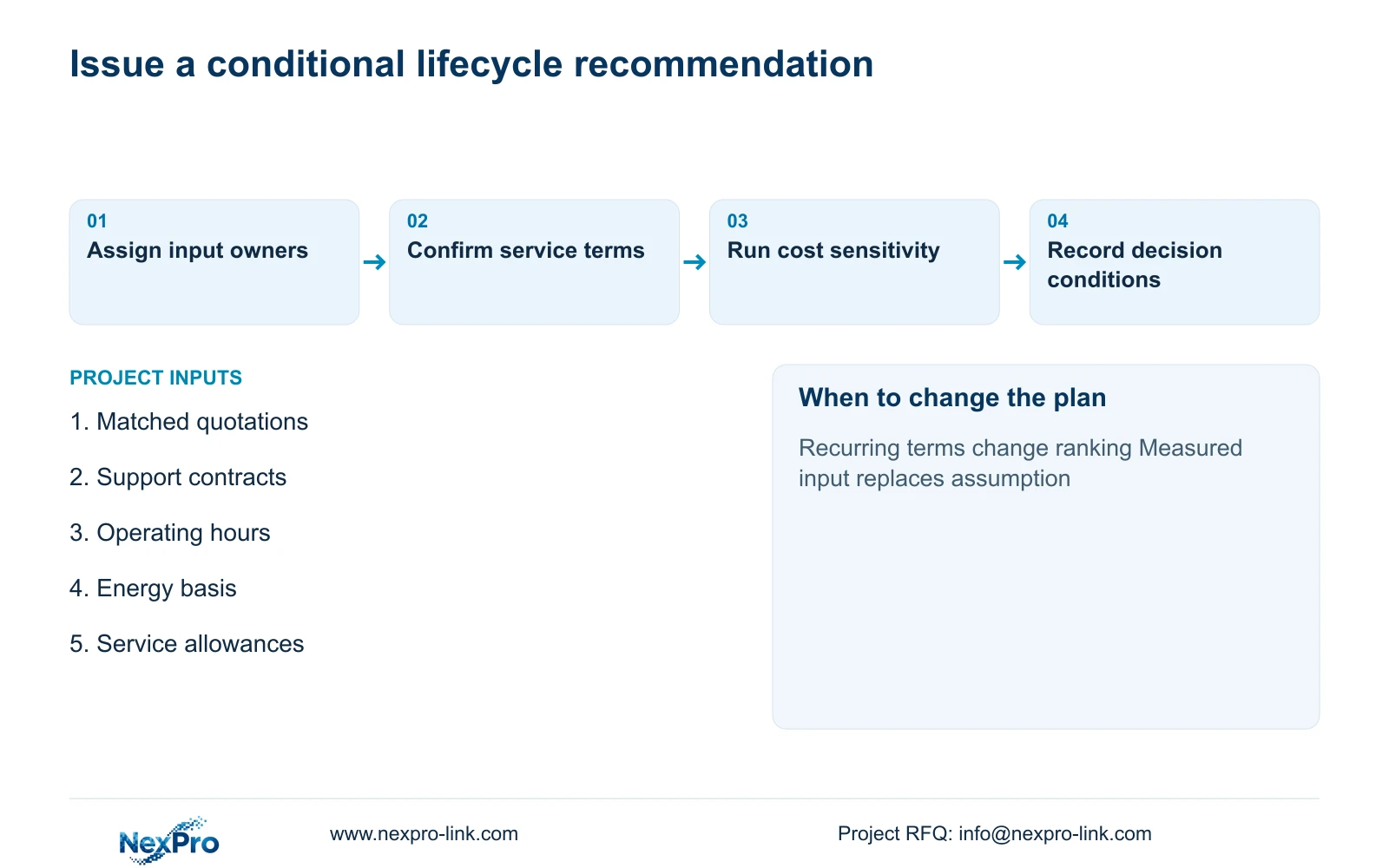
For every material TCO line, record the input owner, source date, quantity basis and whether it is contractual or assumed. Procurement owns matching supplier prices; the operator supplies hours and service needs; the local installer provides access and labour inputs. This division lets the owner challenge a number without losing the entire model's structure.
NexPro-Link's BOQ and tender-support scope can help clarify equipment matching, quotation deviations and preparation scope. Request written commercial boundaries for the selected package rather than extrapolating from a general product page. Keep optional OEM packing or future expansions separate unless they belong to the approved five-year service plan.
Update the model when actual configuration or measured operating inputs become available. Preserve the original baseline and show revisions by cost category. The useful output is a conditional procurement recommendation with traceable assumptions, rather than a precise-looking five-year total whose largest components cannot be explained.
Section 07
Buyer questions
How should repairs be modeled without measured failure rates? Use separately labeled allowances or scenarios supported by service quotations and the owner's planning policy. Do not turn an allowance into a forecast. Show whether changing it would reverse the preferred option.
Should optional future expansion be included in the main TCO? Include it only when the owner has approved the future scope and its timing basis. Otherwise show it as a separate scenario so committed operating costs remain distinguishable from discretionary future work.
Can a longer warranty be counted as lower annual maintenance cost? Only after checking what work it covers and what remains chargeable. Product repair coverage may leave site access, labour, freight or other services outside the terms. Price those boundaries rather than assuming a direct annual saving.
Section 08
Build a challengeable five-year comparison
Send your matched acquisition quotations, recurring support terms, operating-hours/energy basis and planned service allowances to info@nexpro-link.com for clarification of the equipment and commercial scope.
Engineering references
These sources support the general planning principles. Always use the selected product's current datasheet and applicable project standards for final design.