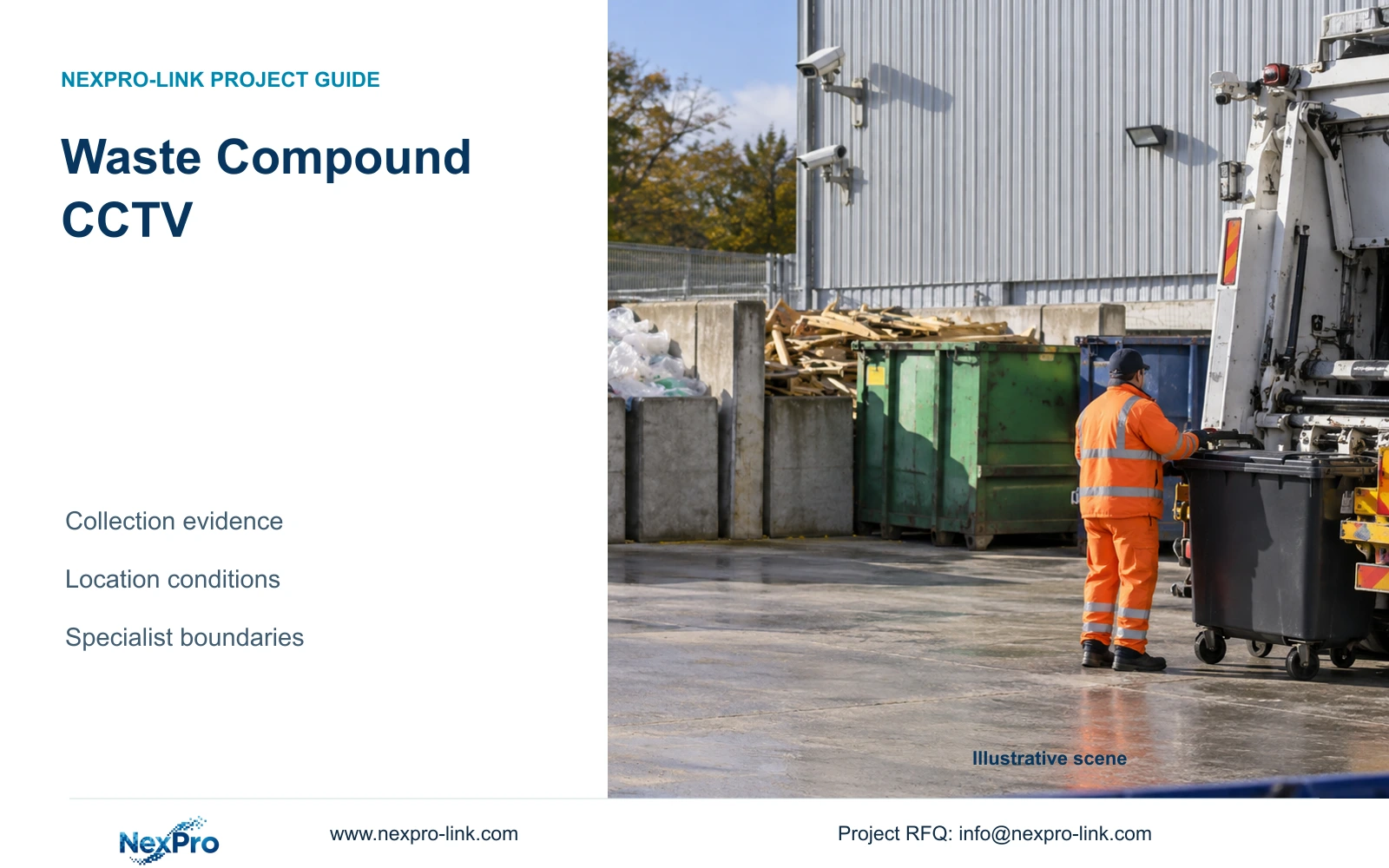
For a container exchange, retain the incoming collection reference, bay position and outgoing container association separately. Review arrival, exchange and departure, noting any obscured transfer.
Section 01
Match each collection event to its actual storage location
For a container exchange, retain the incoming collection reference, bay position and outgoing container association separately. Review arrival, exchange and departure, noting any obscured transfer. Ask the records owner to reconcile a changed container identifier. A visible collector visit does not establish sealed contents or resolve a missing disposal record.
Factory waste compound CCTV should be specified by custody events and actual location conditions. Identify what enters each bay, who may access it and how external collectors take material away. Do not assume that packaging waste, metal scrap and other stored materials share environmental, cleaning or fire-system requirements. The material inventory and site assessment must lead equipment selection.
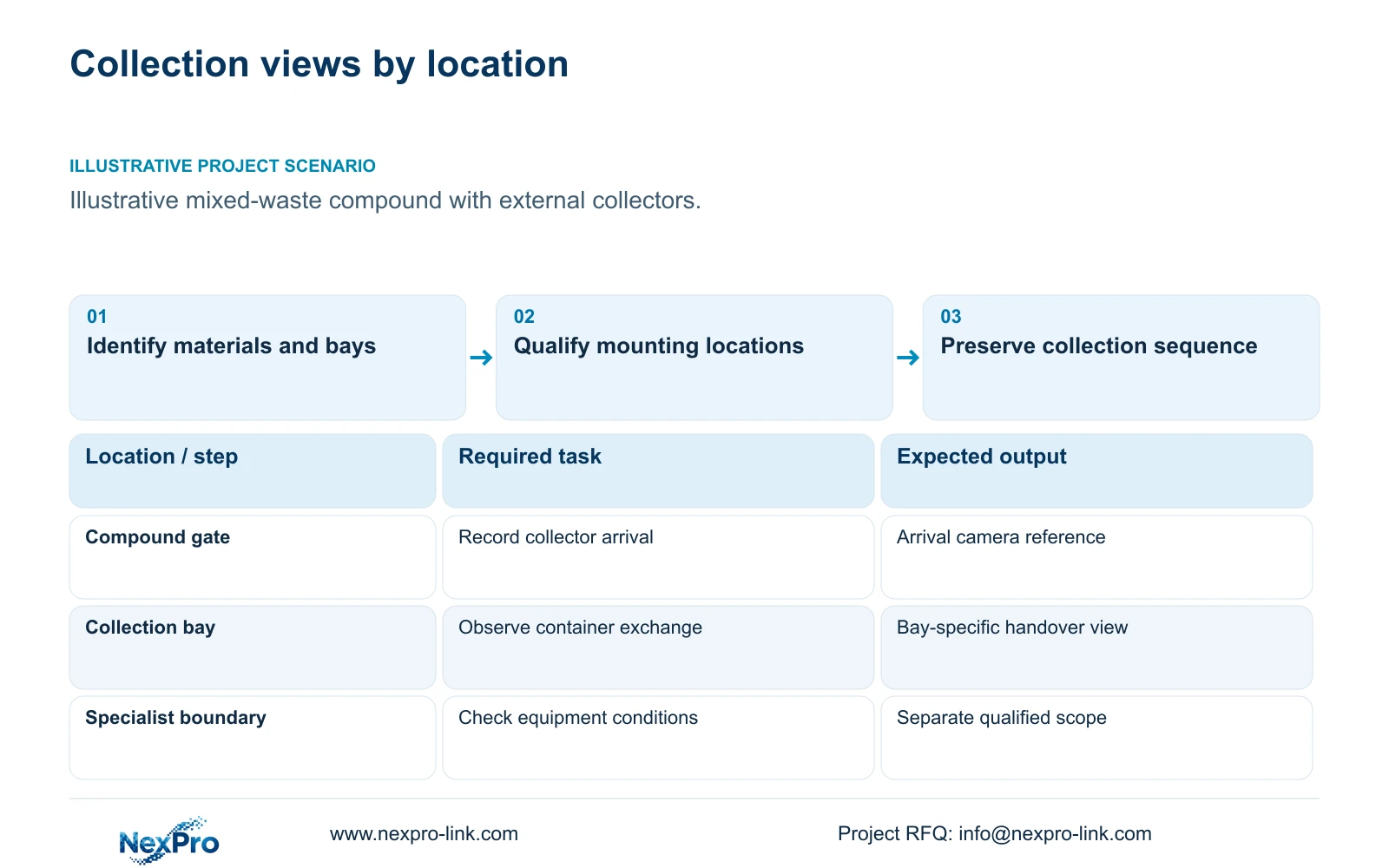
Illustrative project scenario: The compound contains several waste types and is served by external collectors. Assume separate bays for general packaging waste and metal scrap, with another area whose material conditions require specialist review. The security task is to document approved entry, the selected collection bay and departure. These assumed categories do not establish the site’s hazard classification.
Create a location schedule with bay identifier, material description, collection route and required visible event. A gate view provides arrival context; a bay view may document which container was exchanged. Record the relevant collector or collection-ticket reference outside the video system. A camera image cannot establish the contents of a closed container or verify a material classification.
Section 02
Use the hazard assessment to qualify the mounting position
Obtain the site’s location and environmental assessment before approving camera positions. It should identify any constraints affecting equipment, cable routes, cleaning, corrosion, condensation and maintenance access. A position outside a specialist storage area may permit an ordinary camera to observe its approach, provided the view answers the task and the actual mounting location is suitable.
When a required view lies within a specialist location, retain the specialist product and installation scope. Do not turn an ordinary camera into an approved assembly by adding an unspecified housing. The responsible designers should verify the applicable local requirements and the complete equipment configuration. This article provides a procurement boundary, not instructions for hazardous-area installation.
Check the supporting infrastructure as well as the camera. Switches, recorders and batteries should be placed in suitable accessible service locations where possible. Cable entries and local connection equipment may also fall within the specialist scope. A central service room cannot erase the conditions at an exposed camera termination or a cabinet beside a storage bay.
Section 03
Preserve the arrival-to-departure collection sequence
Map gate and bay camera identifiers to collection records so an approved reviewer can follow the relevant sequence. Check whether a truck blocks the container exchange, whether the bay label remains visible and whether night lighting changes the scene. Choose separate overview and handover views where one position cannot retain the required context.
Use collection-ticket times as search inputs while checking their relationship to recorder time. If the ticket is completed after loading, the video window must cover the actual exchange rather than only the administrative timestamp. Export the complete required sequence and record selected cameras, time range and handling responsibility. Video adds visible context but does not replace weighbridge, material or collection records.
Allocate permissions by footage ownership. CASE08 illustrates four independent 32-camera nodes sharing approved fibre without unrestricted tenant access. A shared waste compound may therefore require an owner-approved common-area review role distinct from each building’s cameras. The collector’s involvement in an event does not automatically grant access to unrelated footage.
Section 04
Keep ordinary and specialist choices separate in the comparison
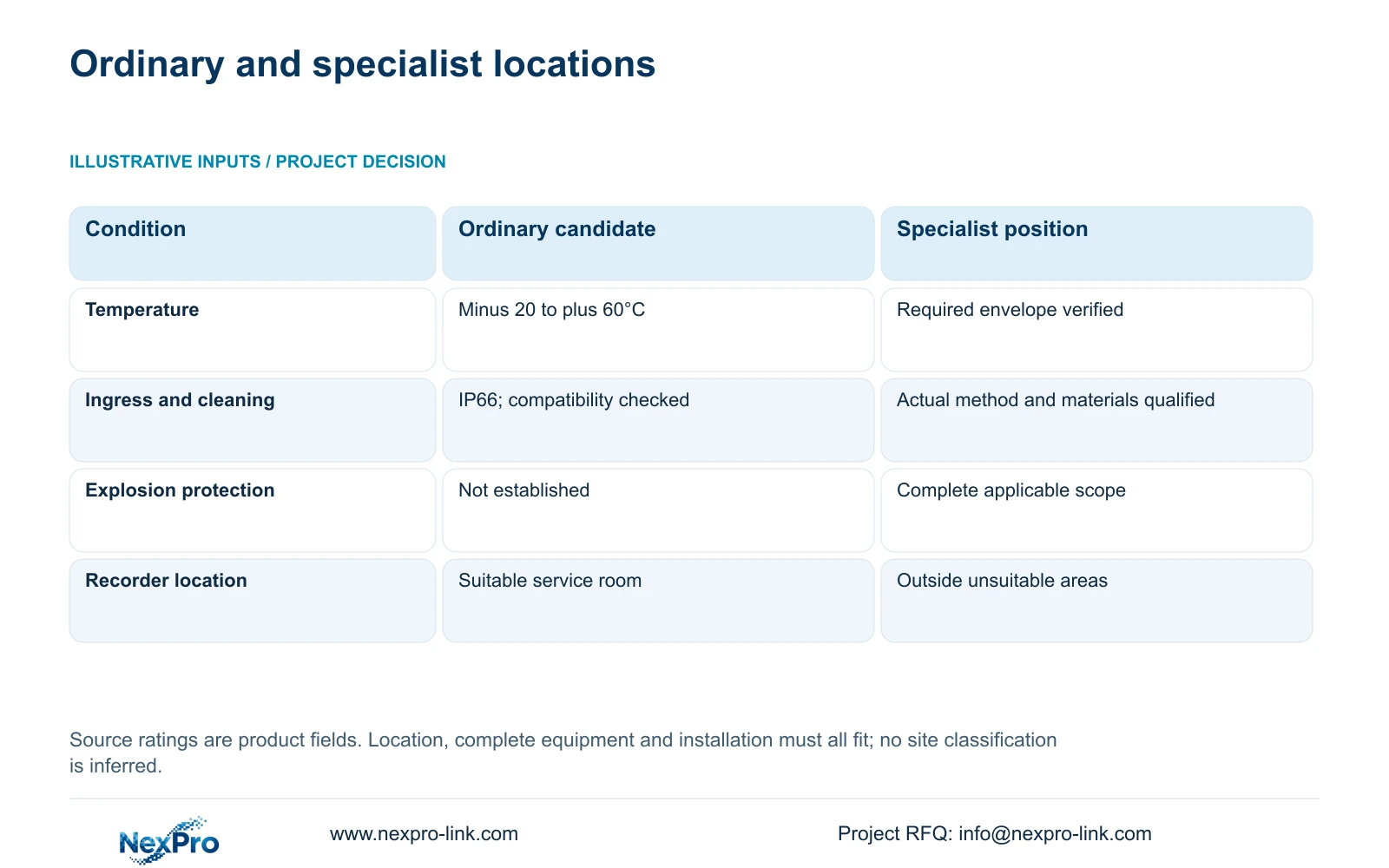
Qualification requires location conditions, complete product scope and approved installation requirements to fit together. The supplied ordinary BL2812M and DM2812M references list IP66 and an operating range of minus 20 to plus 60°C. These are source fields, not a finding that any waste-compound position is suitable. The matrix below turns them into location-specific procurement choices.
The decisive difference is the mounting and connection environment. An ordinary gate or bay-approach candidate can be priced only after its complete conditions are accepted. A position requiring specialist protection keeps that requirement through the camera, accessories and installation. One satisfactory temperature or ingress field cannot override an unresolved chemical, cleaning or hazard condition.
The NexPro-BL2812M55-5MP-DIC-AI has listed 2880×1620 output and a 2.8–12mm motorized lens for ordinary security view planning. Its IP66 field, metal appearance or PoE capability does not establish explosion protection, chemical resistance or specialist washdown suitability. The same caution applies to Dome-family candidates; housing form does not prove a protective scope.
| Location or condition | Ordinary-location choice | Specialist-location choice |
|---|---|---|
| Gate approach | Candidate after environment and view checks | Specialist assessment if conditions demand |
| Temperature | Source envelope: minus 20 to plus 60°C | Required envelope separately documented |
| Cleaning and exposure | IP66 field; compatibility still checked | Actual cleaning and material compatibility |
| Hazardous position | No approval established by ordinary PDF | Complete applicable product and installation |
| Recording infrastructure | Suitable accessible service room | Keep ordinary infrastructure outside unsuitable areas |
Section 05
Recommend an ordinary-area package around retained specialist scope
Recommend ordinary cameras for accepted gate, approach and suitable bay views, while keeping specialist positions as separate qualified items. This preserves the collection task without imposing one equipment category on the entire compound. Change the recommendation when materials, cleaning methods, mounting exposure or the site assessment change; a new waste stream can alter more than the camera view.
Use CASE08’s local-node method for recording and power allocation, without importing its zero-specialist-camera assumption into this compound. Its ordinary node storage example uses 41.472 TB of 30-day video against a 48.64 TB budget already containing formatting and reserve. Specialist streams, power supplies or additional cameras need their own inputs and compatibility checks before joining that budget.
The complete quotation should distinguish camera equipment, approved specialist connections, PoE or separate supply, local recording, backbone and installation work. Keep fire detection and protective systems in their own scope. Ordinary visual observation is not certified fire detection. Compare competing proposals with the same specialist requirements retained, rather than claiming savings by removing required protection.
Section 06
Issue a bay-to-camera schedule with explicit exclusions
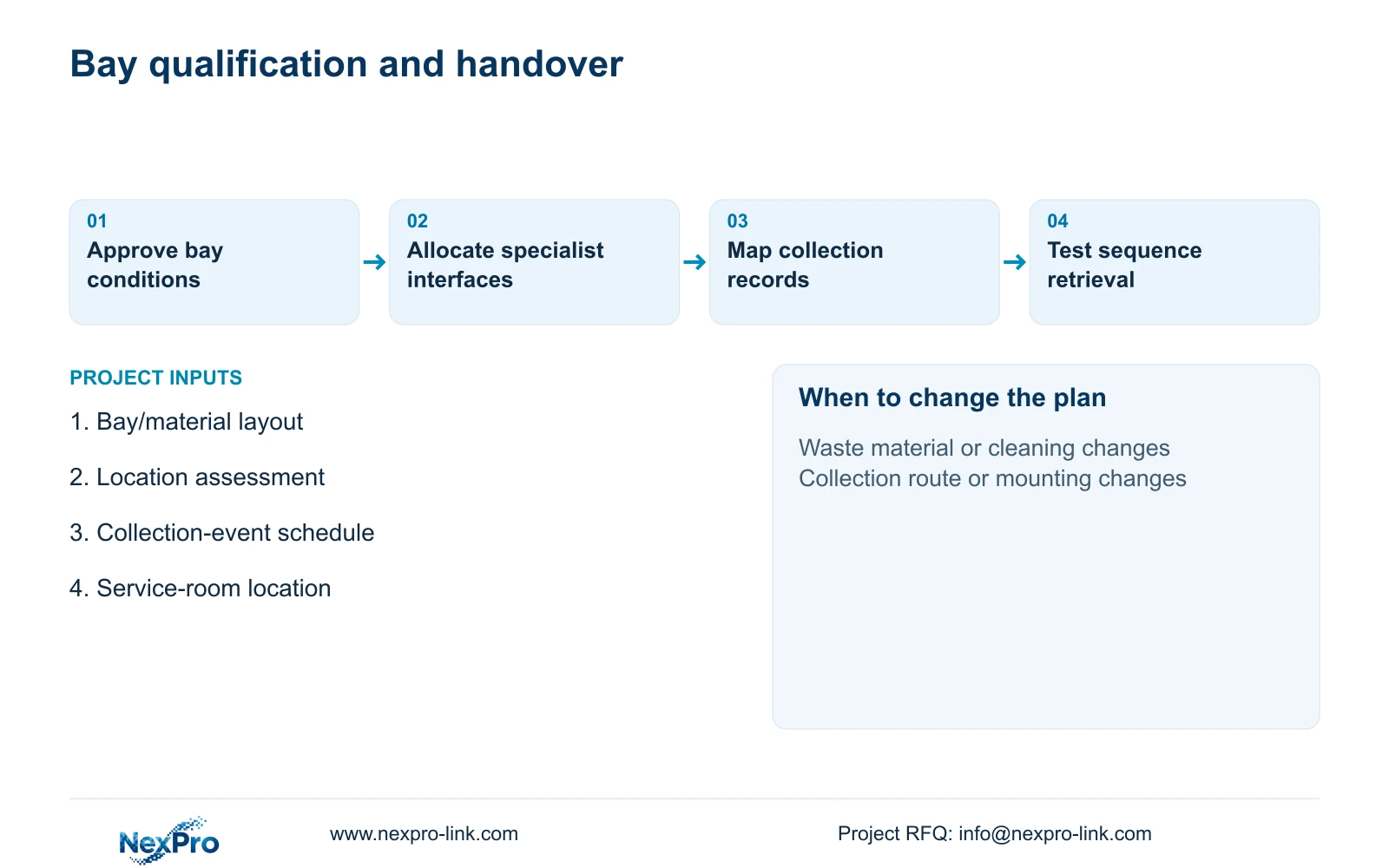
The final interface schedule and shared-equipment allocation should identify bay and gate views, footage ownership, recorder assignment and every location qualification. Mark ordinary equipment as supplied where accepted, specialist equipment as separately qualified, existing collection systems as retained, and site installation as assigned contractor work. Include an owner for each unresolved connection.
NexPro-Link can discuss ordinary CCTV model matching, recording infrastructure, technical documents and coordinated BOQ preparation. Project packing can group accepted gate and bay devices by location tag. Specialist selection, protective-system design and local approval remain with the responsible project teams, even when related equipment is discussed through one supply contact.
Acceptance should follow a representative collection sequence from entry through bay exchange to departure, using the actual agreed lighting and loading arrangement. Check access permissions and recorded timestamps alongside image usefulness. Update the location schedule after a bay change or new waste category so repeat orders preserve the qualified scope instead of copying an obsolete camera assignment.
Section 07
Buyer questions
Can a camera confirm what is inside a sealed waste container? The proposed CCTV task documents visible custody events and container context. Material identity and contents remain dependent on the appropriate records and inspection process.
Can we place ordinary cameras outside a specialist bay? Potentially, if the actual mounting location and connections are suitable and the external view answers the approved task. The boundary and sightline must be reviewed by the responsible designers.
What should trigger a review of repeat-order cameras? Changes to stored materials, cleaning, mounting exposure, collection routes or the site assessment should reopen qualification. An unchanged camera model does not guarantee an unchanged environment.
Section 08
Scope the waste-compound recording package
Send the bay/material layout, relevant location assessment, collection-event requirements and service-room/network location to info@nexpro-link.com for an ordinary-area CCTV and separately identified specialist scope.
Engineering references
These sources support the general planning principles. Always use the selected product's current datasheet and applicable project standards for final design.