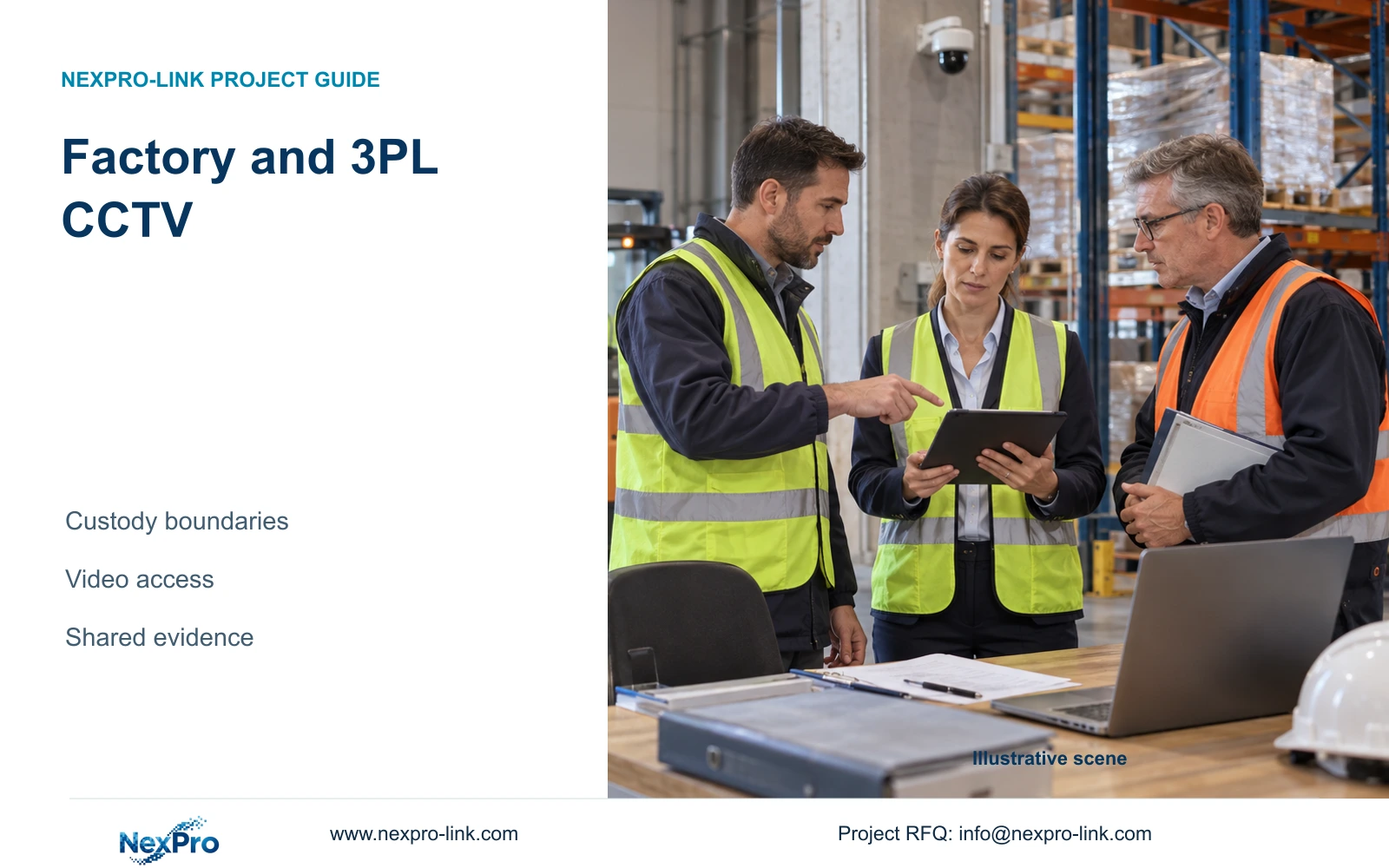
A manufacturer and its logistics contractor can share a warehouse without sharing unrestricted footage access. Define custody, retrieval and infrastructure responsibilities before combining systems.
Section 01
Agree the handover boundary before combining video systems
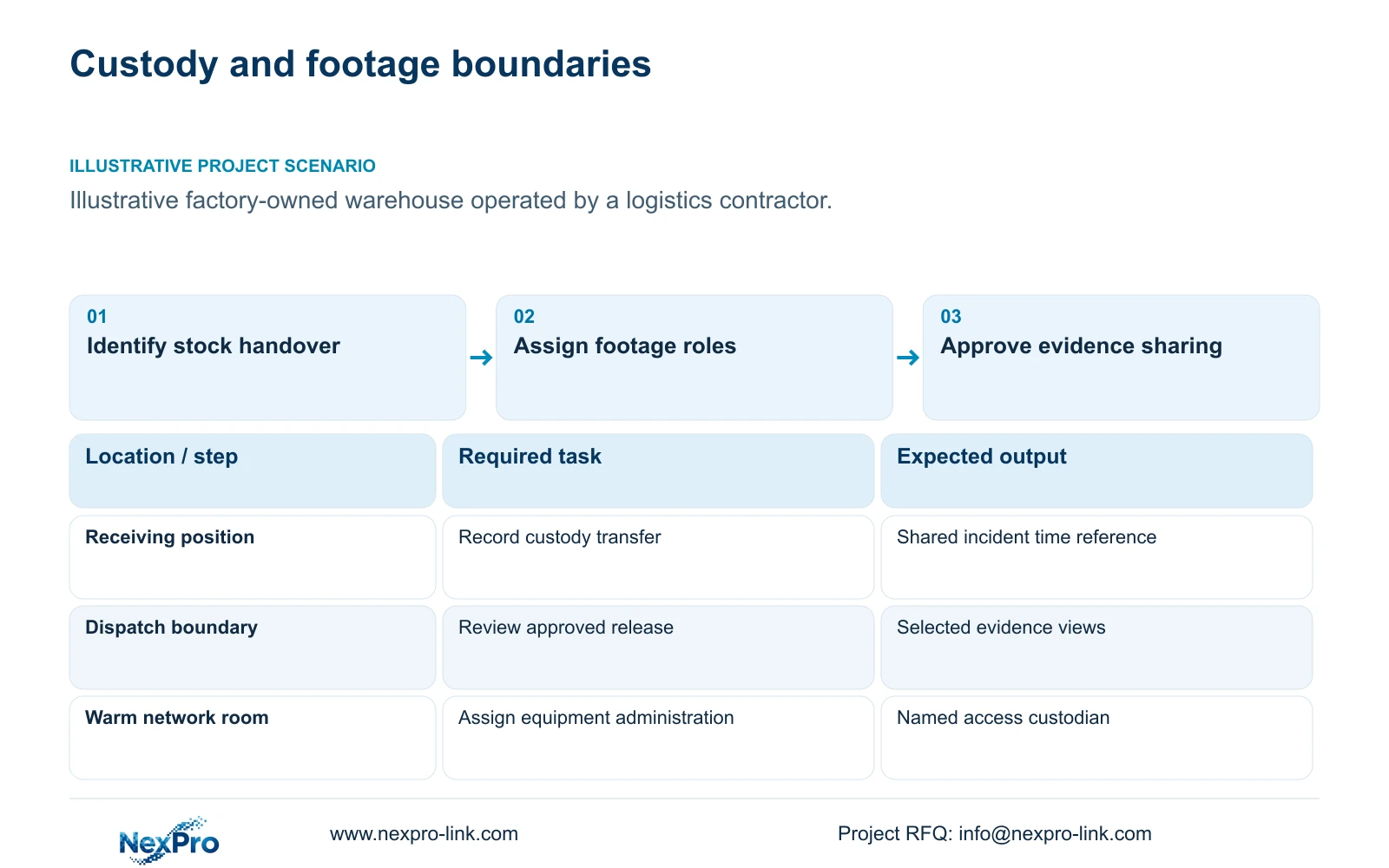
For a factory warehouse and third party logistics arrangement, define the stock handover boundary and footage responsibilities before procuring shared CCTV. Equipment ownership, operational custody and permission to view recordings are separate decisions. A manufacturer can own the site while the logistics contractor needs limited views for receiving and dispatch, without either party needing unrestricted access to every production or storage camera.
Illustrative project scenario: A logistics contractor manages a factory warehouse while the manufacturer owns the site. Assume that goods enter through an agreed receiving position and leave through dispatch after an operational release. Those are planning assumptions. The project team must identify the actual transfer event, responsible personnel and supporting warehouse records before deciding where cameras or shared access are needed.
Map receiving, packing, storage and dispatch as individual tasks on the loaded-rack layout. For each handover, record the physical position and time reference used by both parties. CCTV can help explain a disputed sequence, but a camera timestamp does not itself define the commercial transfer of responsibility. Keep that decision in the agreed operating documents and use video to support its review.
Section 02
Set viewing rights independently from retention periods
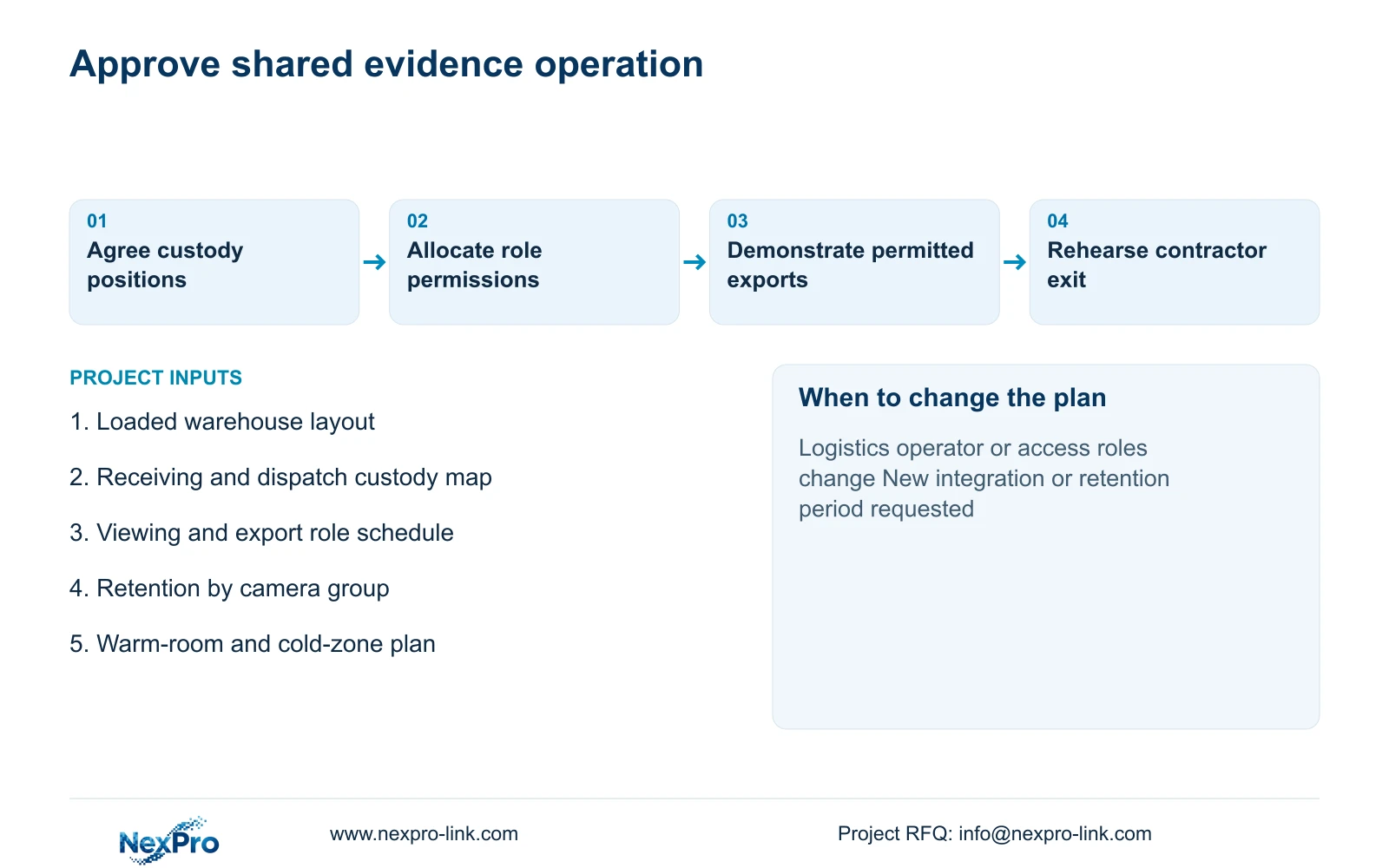
Build a role schedule before choosing shared accounts or a management platform. Separate live viewing, playback, export, administration and configuration changes. A dispatch supervisor may need current dock views and limited playback; a nominated reviewer may handle exports; technical administration should have its own controlled responsibility. These are proposed roles to verify against the selected equipment, not assumed features of every recorder.
Decide retention by camera group and agreed review needs. The logistics operator's access period need not equal the storage period, and ending an operating contract should not automatically erase footage the owner has approved for preservation. Identify who authorizes exceptional exports and how retained material is handed over. Ask the relevant project adviser to verify local privacy, retention and disclosure requirements.
Check whether the proposed recorder and client can enforce the required separation in practice. If a user can reach excluded cameras through another client or direct device login, a restricted screen layout is insufficient. Where verified permissions cannot meet the boundary, price an appropriately separated recording or management architecture. Shared network infrastructure does not require shared credentials.
Section 03
Make evidence sharing a defined operating workflow
Use a specific retrieval request containing the incident reference, location, time window and requesting party. Assign approval to the agreed footage custodian and record which cameras were included. For a dispatch dispute, the approved set might include release-position detail and dock context while excluding unrelated production views. Confirm this selection through a representative retrieval exercise before accepting the system.
Name the person or role responsible for preparing the export, checking playback on the recipient's agreed device and recording its delivery. Keep the original recording and the shared copy distinguishable. If the chosen system cannot perform a proposed export control or logging function, document the procedural alternative or required additional platform rather than leaving the requirement as an unpriced software promise.
Give each physical interface an equally clear owner. The local installer can provide cold-transition connections; the owner's facilities team can retain responsibility for a warm network room; the supplier can identify camera models and project tags. Record these as supplied, retained, installer-provided or optional items. Serviceable cabinets and accessible terminations matter when a failed view must be restored during an active warehouse contract.
Section 04
Compare the complete recording baseline with added integration
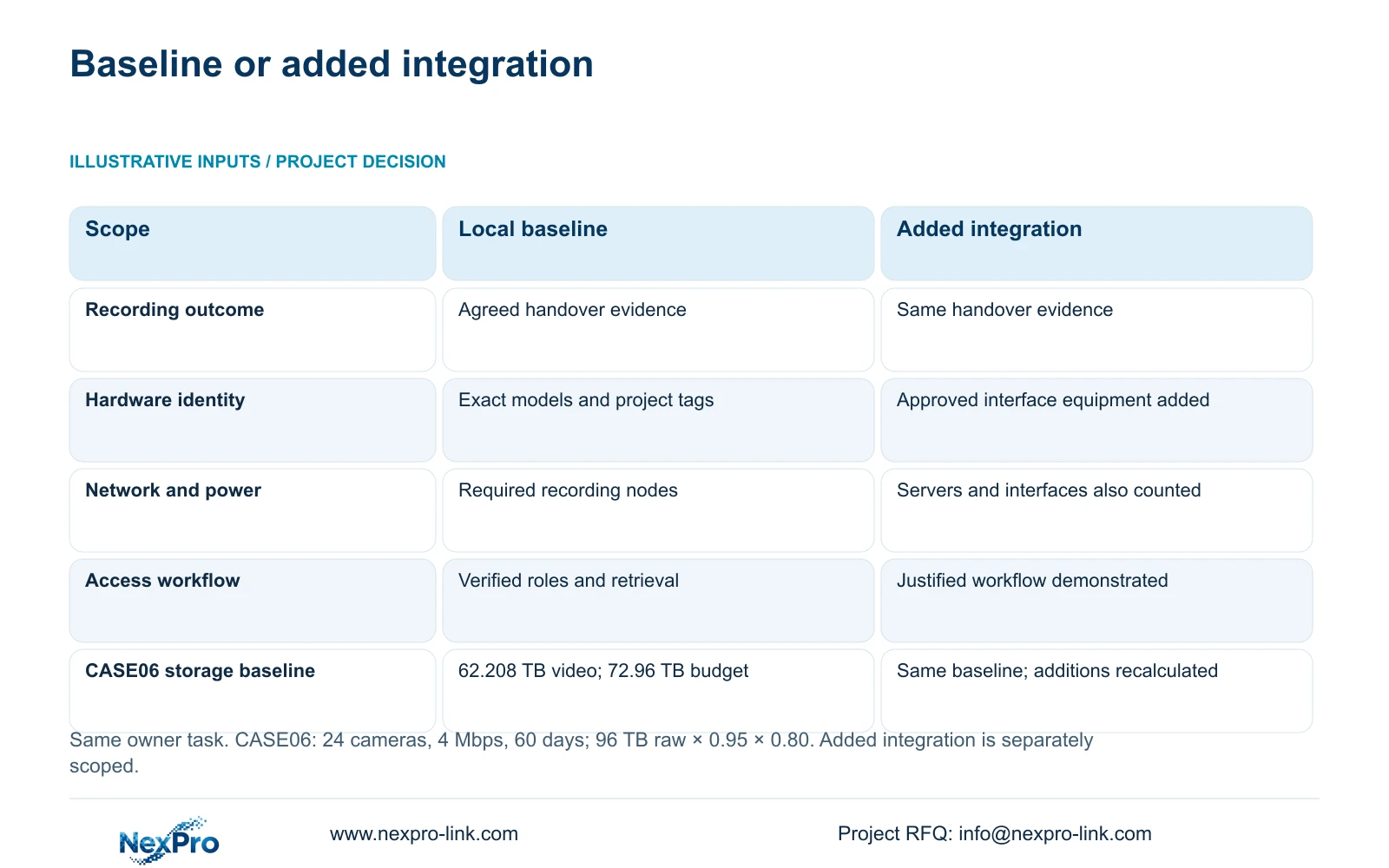
Start with a complete camera-to-recording package that delivers the agreed handover evidence. Option A uses verified local roles and an approved retrieval procedure. Option B retains those outcomes and adds management or integration for a defined need, such as linking a warehouse incident reference to selected footage. Keep the operating task constant when comparing quotations.
The decisive difference is the added workflow and its dependencies. Option B may require another server, software scope, supported interface, configuration work and ongoing administration. It does not automatically improve image quality or establish better custody evidence. Assign one owner to each interface and identify who demonstrates the workflow across the warehouse record, video client and export destination.
The matrix gives the quantity surveyor a scope-normalization basis without arbitrary scores or invented costs. An empty field means clarification is required, not that the item is free or incompatible. Ask each bidder to identify exact models, retained resources and excluded installation work. Separate mandatory recording items from optional automation so procurement can compare both the baseline and the complete enhanced option.
| Decision | Option A: local baseline | Option B: added integration |
|---|---|---|
| Recording outcome | Agreed receiving and dispatch evidence | Same agreed evidence |
| Hardware identity | Exact models and location tags | Same plus approved interface equipment |
| Network and power | Required recording nodes accounted for | Additional servers and interfaces counted |
| Software and access | Verified roles and approved retrieval | Defined additional workflow, separately demonstrated |
| Procurement responsibility | Complete baseline BOM and named owners | Added scope, exclusions and interface owners |
Section 05
Keep shared infrastructure measurable and environmentally suitable
CASE06 provides an illustrative background with four cameras each at ambient receiving, packing, warm corridors and dispatch, plus eight specialist cold-area views. Its 24 streams average 4 Mbps each, giving 24 × 4 = 96 Mbps recording input. This is an assumed design load. Specialist streams, firmware and client functions still require confirmation before the two organizations rely on shared retrieval.
For 60 days of continuous recording, video_TB = 24 × 4 × 10^6 × 86400 × 60 / 8 / 10^12 = 62.208 TB. The case's eight 12 TB disks total 96 TB raw, with recording_budget = 96 × 0.95 × 0.80 = 72.96 TB. Compare 62.208 TB directly with 72.96 TB; the latter already includes the illustrative formatting allowance and 20% reserve. The 60-day period is a project assumption, not a universal obligation.
NexPro-NVR8864-4K provides an eight-bay, 320 Mbps input reference for this supported-mode assumption. It does not establish RAID or all-4K concurrent decoding. Keep ordinary cameras and separately qualified cold-area equipment distinct, with the recorder, switches and batteries in suitable warm accommodation. Count the actual protected electrical nodes and added integration loads. A display wall remains an optional client branch; it should not become a hidden requirement for recording or evidence export.
Section 06
Price responsibilities and test the contract handover
Recommend the local recording baseline where verified roles and an approved export process satisfy both parties. Select additional management scope when frequent joint investigations, several sites or a required warehouse interface create a defined operational need. If an existing platform is mandatory, preserve it in the comparison. Require the alternative supplier to show what remains equivalent and what changes.
Split the BOQ into equipment supply, local installation, configuration, acceptance and ongoing service. Include cable routes and testing, cabinet access, specialist connections and account administration under named parties. NexPro-Link's BOQ support can coordinate model matching, submittals and quotation differences; its project-supply scope can include preparation and packing. Neither scope alone proves software interoperability or includes all local construction work.
Acceptance should include a cross-boundary incident search, a permitted export and a denied request for an excluded camera. Also rehearse contractor replacement: identify accounts to revoke, credentials to transfer, asset tags to reconcile and recordings to preserve under the agreed policy. Record any unsupported controls before purchase. This makes the commercial handover testable and reduces the chance that shared hardware becomes dependent on an outgoing operator's account.
Section 07
Buyer questions
Should the factory and logistics contractor buy separate recorders? Separate recorders are appropriate when the required administration or access boundaries cannot be enforced on a shared system, or when contracts require independent operation. First test the shared architecture against the role schedule; hardware separation adds its own storage, power and maintenance scope.
Does ONVIF support prove the warehouse integration will work? No. ONVIF Profiles concern defined device and client functions with applicable firmware. An accepted video connection does not establish warehouse-reference search, event handling or the complete sharing workflow. Demonstrate the specific interface required by the project.
Who should pay for extra retention requested by one party? Treat it as an identifiable scope change under the operating agreement. Establish the affected camera groups, storage and service requirements, then allocate the quoted change. A request for a longer period should not silently alter every camera's retention.
Section 08
Request a custody-based scope comparison
Send the receiving and dispatch custody map, required viewing and export roles, retention periods by camera group, and network-room plan with cold-zone temperatures to info@nexpro-link.com. NexPro-Link can discuss a baseline BOQ and separately priced integration scope.
Engineering references
These sources support the general planning principles. Always use the selected product's current datasheet and applicable project standards for final design.