A managed warehouse contains customer-controlled cages, shared loading routes and a facility operator's security room. Identify the operator for shared areas and each customer-controlled space.
Section 01
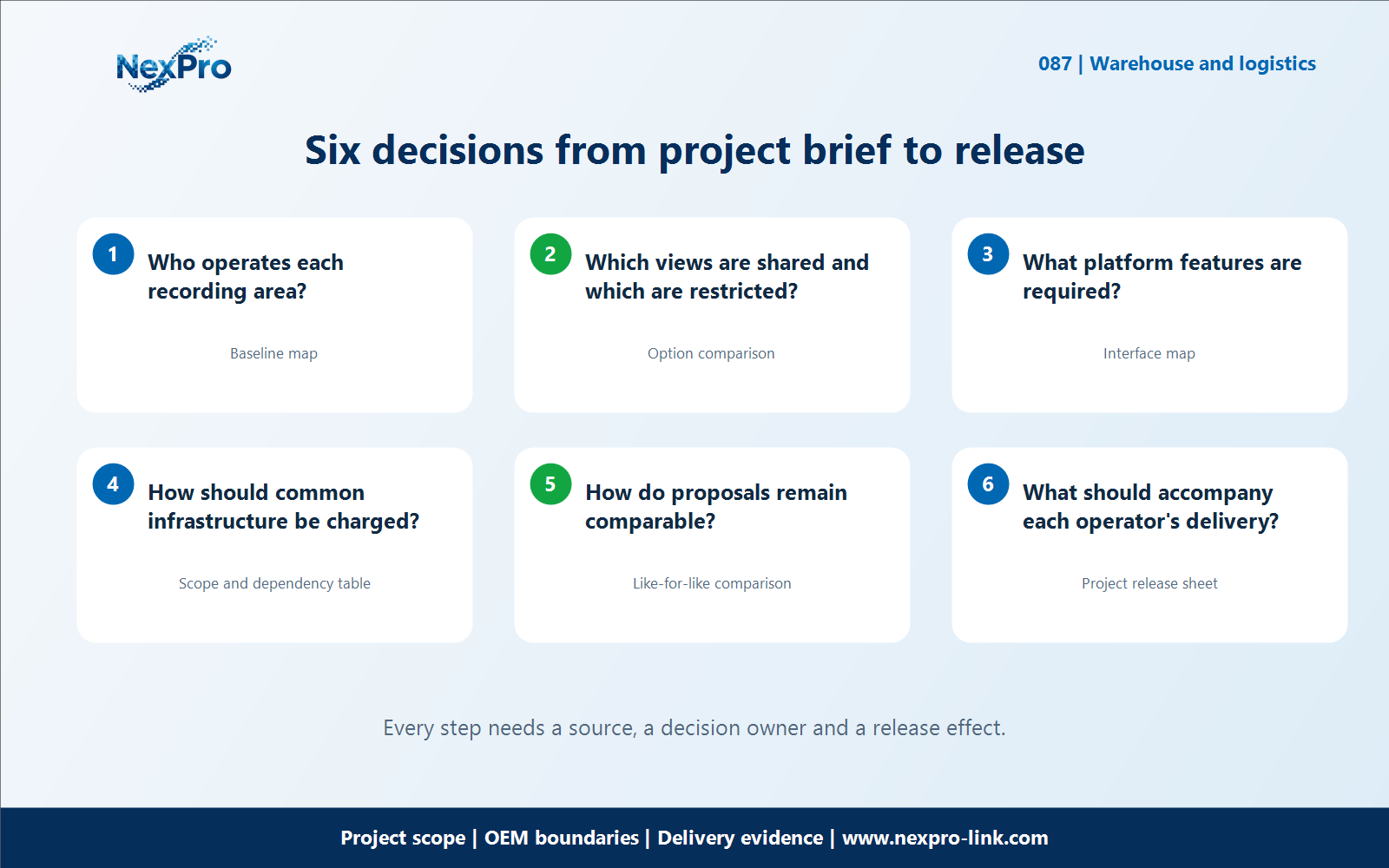
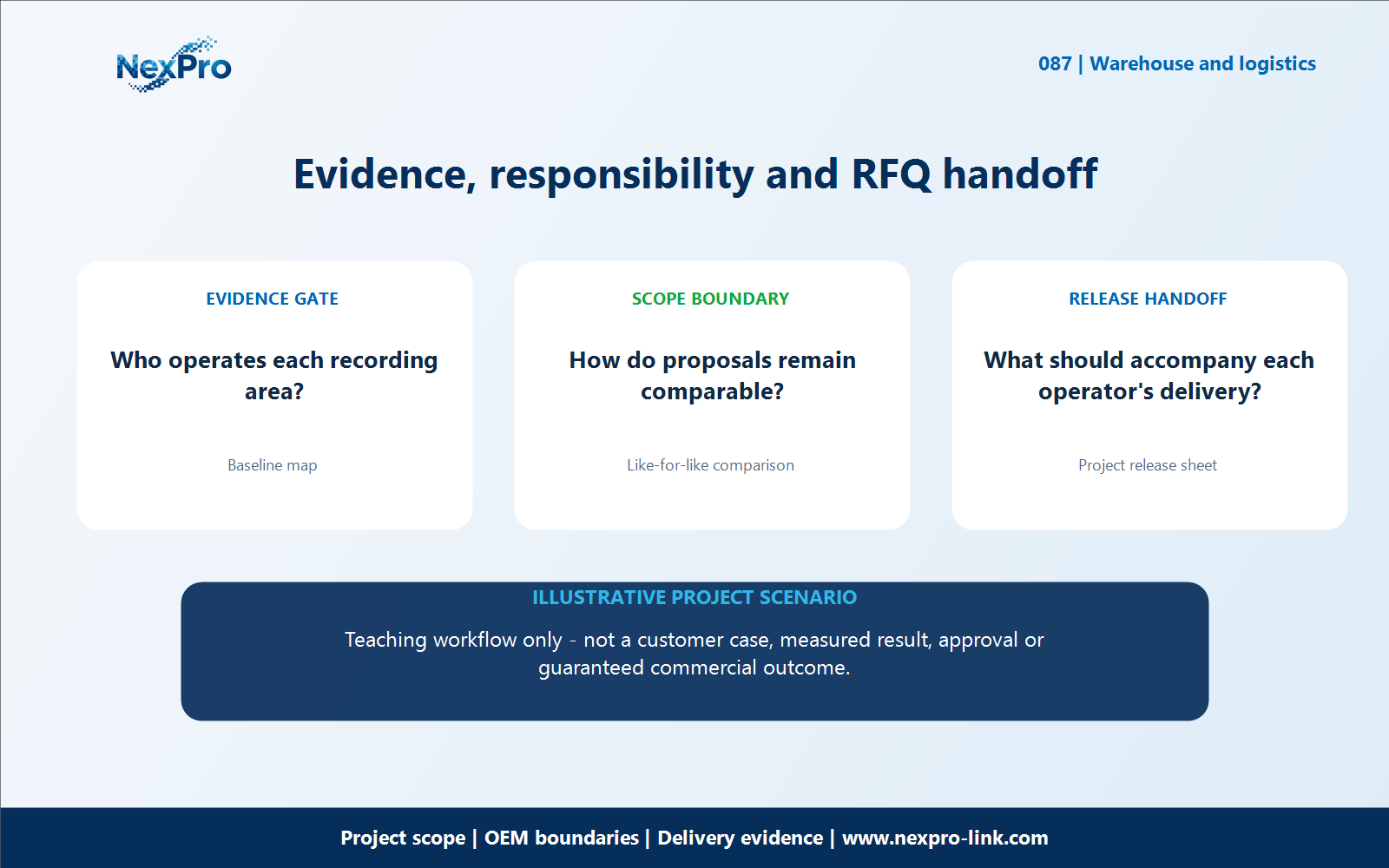
Who operates each recording area?
A managed warehouse contains customer-controlled cages, shared loading routes and a facility operator's security room. Identify the operator for shared areas and each customer-controlled space. Do not infer data access from physical proximity. The equipment design should reflect the agreed responsibility and viewing boundaries rather than treating the whole building as one account.
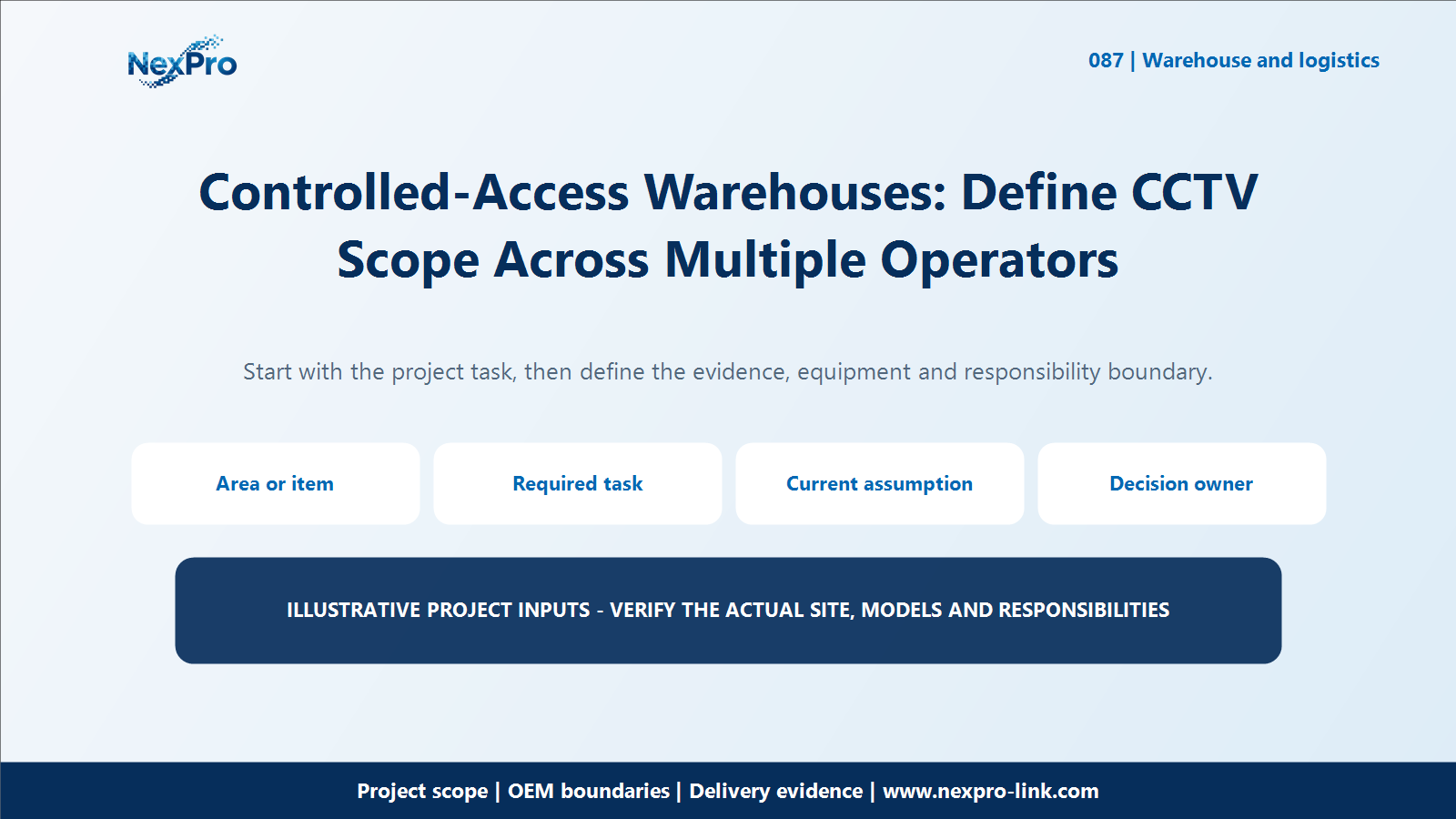
For the "Who operates each recording area" decision, use the baseline map fields Area or item, Required task, Current assumption, Decision owner. Apply it to controlled warehouse CCTV scope so the buyer, supplier and local integrator can see which input is confirmed, who owns it and which evidence remains open.
Evaluate who operates each recording area against the stated site task and the surrounding equipment, documentation, packing and handover dependencies for controlled warehouse CCTV scope. For who operates each recording area in controlled warehouse CCTV scope, record the confirmed condition, chosen option and remaining evidence separately; an open value is not a price, test, approval or customer-result claim.
Carry the who operates each recording area decision into the RFQ, BOQ, configuration or release record for controlled warehouse CCTV scope. For who operates each recording area in controlled warehouse CCTV scope, name the equipment, artwork, network, installation and acceptance owner; site-specific work remains with the buyer or integrator unless the signed scope says otherwise.
Section 03
What platform features are required?
What platform features are required? Describe the required roles, export controls and review workflow explicitly. Evaluate the intended software against those tasks. A multi-view screen or familiar brand name is not sufficient evidence of the access model the project requires. For Controlled-Access Warehouses: Define CCTV Scope Across Multiple Operators, keep this decision tied to the same project brief rather than opening a separate generic specification exercise.
For the "What platform features are required" decision, use the interface map fields Device or record, Input, Output, Responsible party. Apply it to controlled warehouse CCTV scope so the buyer, supplier and local integrator can see which input is confirmed, who owns it and which evidence remains open.
Evaluate what platform features are required against the stated site task and the surrounding equipment, documentation, packing and handover dependencies for controlled warehouse CCTV scope. For what platform features are required in controlled warehouse CCTV scope, record the confirmed condition, chosen option and remaining evidence separately; an open value is not a price, test, approval or customer-result claim.
Carry the what platform features are required decision into the RFQ, BOQ, configuration or release record for controlled warehouse CCTV scope. For what platform features are required in controlled warehouse CCTV scope, name the equipment, artwork, network, installation and acceptance owner; site-specific work remains with the buyer or integrator unless the signed scope says otherwise.
| Project question | Project-oriented treatment | Keep equal when comparing offers |
|---|---|---|
| Who operates each recording area? | Identify the operator for shared areas and each customer-controlled space. | Rack or handling-area geometry |
| Which views are shared and which are restricted? | Separate shared-route views from restricted-area views at the design stage. | Recording and retrieval objective |
| What platform features are required? | Describe the required roles, export controls and review workflow explicitly. | Remote network and environmental scope |
| How should common infrastructure be charged? | Keep shared backbone, cabinet and recording resources distinct from customer-specific equipment. | Area-labelled equipment and support |
Section 04
How should common infrastructure be charged?
How should common infrastructure be charged? Keep shared backbone, cabinet and recording resources distinct from customer-specific equipment. State the allocation method used in the cost model. This avoids double-counting common infrastructure or hiding necessary shared costs inside a low tenant-camera price. For Controlled-Access Warehouses: Define CCTV Scope Across Multiple Operators, keep this decision tied to the same project brief rather than opening a separate generic specification exercise.
For the "How should common infrastructure be charged" decision, use the scope and dependency table fields Item, Included, Dependency, Separate option. Apply it to controlled warehouse CCTV scope so the buyer, supplier and local integrator can see which input is confirmed, who owns it and which evidence remains open.
Evaluate how should common infrastructure be charged against the stated site task and the surrounding equipment, documentation, packing and handover dependencies for controlled warehouse CCTV scope. For how should common infrastructure be charged in controlled warehouse CCTV scope, record the confirmed condition, chosen option and remaining evidence separately; an open value is not a price, test, approval or customer-result claim.
Carry the how should common infrastructure be charged decision into the RFQ, BOQ, configuration or release record for controlled warehouse CCTV scope. For how should common infrastructure be charged in controlled warehouse CCTV scope, name the equipment, artwork, network, installation and acceptance owner; site-specific work remains with the buyer or integrator unless the signed scope says otherwise.
Section 05
How do proposals remain comparable?
How do proposals remain comparable? Hold access boundaries, retention and operator tasks constant across proposals. Where an enterprise platform is necessary, keep it in the required scope. An economical equipment package should not silently remove the governance functions that define the project. For Controlled-Access Warehouses: Define CCTV Scope Across Multiple Operators, keep this decision tied to the same project brief rather than opening a separate generic specification exercise.
For the "How do proposals remain comparable" decision, use the like-for-like comparison fields Requirement, Baseline, Proposed treatment, Remaining difference. Apply it to controlled warehouse CCTV scope so the buyer, supplier and local integrator can see which input is confirmed, who owns it and which evidence remains open.
Evaluate how do proposals remain comparable against the stated site task and the surrounding equipment, documentation, packing and handover dependencies for controlled warehouse CCTV scope. For how do proposals remain comparable in controlled warehouse CCTV scope, record the confirmed condition, chosen option and remaining evidence separately; an open value is not a price, test, approval or customer-result claim.
Carry the how do proposals remain comparable decision into the RFQ, BOQ, configuration or release record for controlled warehouse CCTV scope. For how do proposals remain comparable in controlled warehouse CCTV scope, name the equipment, artwork, network, installation and acceptance owner; site-specific work remains with the buyer or integrator unless the signed scope says otherwise.
Section 06
What should accompany each operator's delivery?
What should accompany each operator's delivery? Separate equipment allocations in the packing register and hand over access through the approved process. A carton label is not an authorization to view another operator's footage. Keep physical delivery and software permissions as linked but distinct tasks. For Controlled-Access Warehouses: Define CCTV Scope Across Multiple Operators, keep this decision tied to the same project brief rather than opening a separate generic specification exercise.
For the "What should accompany each operator's delivery" decision, use the project release sheet fields Configuration, Artwork, Quantity, Location, Release stage. Apply it to controlled warehouse CCTV scope so the buyer, supplier and local integrator can see which input is confirmed, who owns it and which evidence remains open.
Evaluate what should accompany each operator's delivery against the stated site task and the surrounding equipment, documentation, packing and handover dependencies for controlled warehouse CCTV scope. For what should accompany each operator's delivery in controlled warehouse CCTV scope, record the confirmed condition, chosen option and remaining evidence separately; an open value is not a price, test, approval or customer-result claim.
Carry the what should accompany each operator's delivery decision into the RFQ, BOQ, configuration or release record for controlled warehouse CCTV scope. For what should accompany each operator's delivery in controlled warehouse CCTV scope, name the equipment, artwork, network, installation and acceptance owner; site-specific work remains with the buyer or integrator unless the signed scope says otherwise.
Engineering references
These sources support the general planning principles. Always use the selected product's current datasheet and applicable project standards for final design.