A warehouse operator opens four facilities with similar receiving processes but different rack heights and building sizes. Standardize recurring operating tasks, naming and supported workflows first.
Section 01
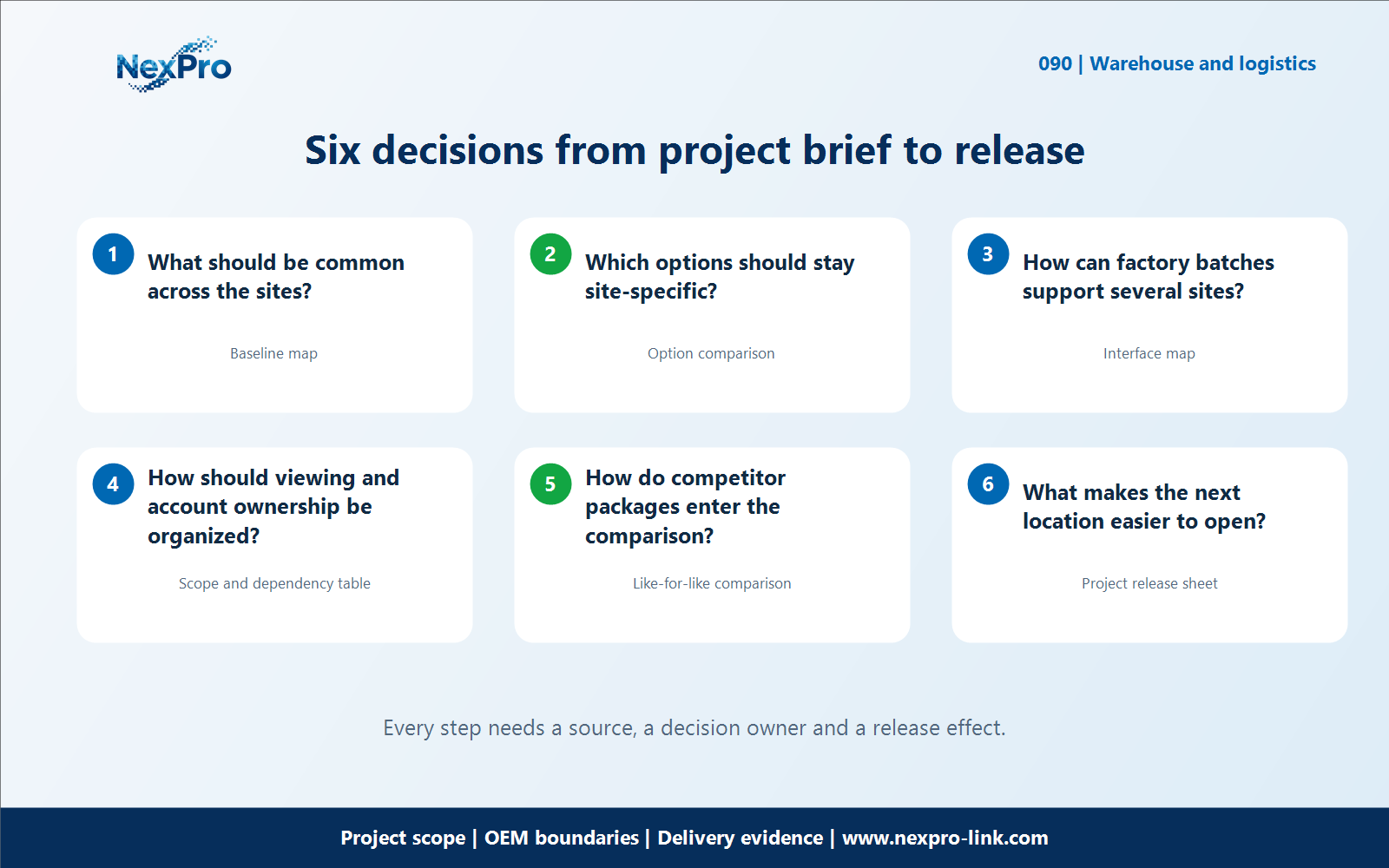
What should be common across the sites?
A warehouse operator opens four facilities with similar receiving processes but different rack heights and building sizes. Standardize recurring operating tasks, naming and supported workflows first. Hardware can then be grouped by role. A common core should simplify procurement without pretending that every building has the same geometry or environmental conditions.
For the "What should be common across the sites" decision, use the baseline map fields Area or item, Required task, Current assumption, Decision owner. Apply it to multi warehouse opening CCTV so the buyer, supplier and local integrator can see which input is confirmed, who owns it and which evidence remains open.
Evaluate what should be common across the sites against the stated site task and the surrounding equipment, documentation, packing and handover dependencies for multi warehouse opening CCTV. For what should be common across the sites in multi warehouse opening CCTV, record the confirmed condition, chosen option and remaining evidence separately; an open value is not a price, test, approval or customer-result claim.
Carry the what should be common across the sites decision into the RFQ, BOQ, configuration or release record for multi warehouse opening CCTV. For what should be common across the sites in multi warehouse opening CCTV, name the equipment, artwork, network, installation and acceptance owner; site-specific work remains with the buyer or integrator unless the signed scope says otherwise.
Section 02
Which options should stay site-specific?
Which options should stay site-specific? Keep lens choice, exposed-area equipment and infrastructure layout specific to each location. Record these as permitted options rather than uncontrolled exceptions. This preserves the benefit of standardization while maintaining the view each site actually needs. For Opening Multiple Warehouses: A Common CCTV Core with Site-Specific Options, keep this decision tied to the same project brief rather than opening a separate generic specification exercise.
For the "Which options should stay site-specific" decision, use the option comparison fields Position or option, Suitable condition, Trade-off, Next choice. Apply it to multi warehouse opening CCTV so the buyer, supplier and local integrator can see which input is confirmed, who owns it and which evidence remains open.
Evaluate which options should stay site-specific against the stated site task and the surrounding equipment, documentation, packing and handover dependencies for multi warehouse opening CCTV. For which options should stay site-specific in multi warehouse opening CCTV, record the confirmed condition, chosen option and remaining evidence separately; an open value is not a price, test, approval or customer-result claim.
Carry the which options should stay site-specific decision into the RFQ, BOQ, configuration or release record for multi warehouse opening CCTV. For which options should stay site-specific in multi warehouse opening CCTV, name the equipment, artwork, network, installation and acceptance owner; site-specific work remains with the buyer or integrator unless the signed scope says otherwise.
Section 03
How can factory batches support several sites?
How can factory batches support several sites? Aggregate identical approved configurations for production planning, then allocate them to individual site releases. Keep forecasts separate from orders. A shared batch can simplify preparation, but each facility still needs an accurate packing and configuration record. For Opening Multiple Warehouses: A Common CCTV Core with Site-Specific Options, keep this decision tied to the same project brief rather than opening a separate generic specification exercise.
For the "How can factory batches support several sites" decision, use the interface map fields Device or record, Input, Output, Responsible party. Apply it to multi warehouse opening CCTV so the buyer, supplier and local integrator can see which input is confirmed, who owns it and which evidence remains open.
Evaluate how can factory batches support several sites against the stated site task and the surrounding equipment, documentation, packing and handover dependencies for multi warehouse opening CCTV. For how can factory batches support several sites in multi warehouse opening CCTV, record the confirmed condition, chosen option and remaining evidence separately; an open value is not a price, test, approval or customer-result claim.
Carry the how can factory batches support several sites decision into the RFQ, BOQ, configuration or release record for multi warehouse opening CCTV. For how can factory batches support several sites in multi warehouse opening CCTV, name the equipment, artwork, network, installation and acceptance owner; site-specific work remains with the buyer or integrator unless the signed scope says otherwise.
| Project question | Project-oriented treatment | Keep equal when comparing offers |
|---|---|---|
| What should be common across the sites? | Standardize recurring operating tasks, naming and supported workflows first. | Rack or handling-area geometry |
| Which options should stay site-specific? | Keep lens choice, exposed-area equipment and infrastructure layout specific to each location. | Recording and retrieval objective |
| How can factory batches support several sites? | Aggregate identical approved configurations for production planning, then allocate them to individual site releases. | Remote network and environmental scope |
| How should viewing and account ownership be organized? | Define local and central operator tasks before selecting the management arrangement. | Area-labelled equipment and support |
Section 04
How should viewing and account ownership be organized?
How should viewing and account ownership be organized? Define local and central operator tasks before selecting the management arrangement. Using one application name does not prove the required multi-site permissions or administration. Compare the actual workflow and account ownership needed across the facilities. For Opening Multiple Warehouses: A Common CCTV Core with Site-Specific Options, keep this decision tied to the same project brief rather than opening a separate generic specification exercise.
For the "How should viewing and account ownership be organized" decision, use the scope and dependency table fields Item, Included, Dependency, Separate option. Apply it to multi warehouse opening CCTV so the buyer, supplier and local integrator can see which input is confirmed, who owns it and which evidence remains open.
Evaluate how should viewing and account ownership be organized against the stated site task and the surrounding equipment, documentation, packing and handover dependencies for multi warehouse opening CCTV. For how should viewing and account ownership be organized in multi warehouse opening CCTV, record the confirmed condition, chosen option and remaining evidence separately; an open value is not a price, test, approval or customer-result claim.
Carry the how should viewing and account ownership be organized decision into the RFQ, BOQ, configuration or release record for multi warehouse opening CCTV. For how should viewing and account ownership be organized in multi warehouse opening CCTV, name the equipment, artwork, network, installation and acceptance owner; site-specific work remains with the buyer or integrator unless the signed scope says otherwise.
Section 05
How do competitor packages enter the comparison?
How do competitor packages enter the comparison? Compare each site against the same operational requirements, then add the shared management scope. Do not multiply one small-site price across unlike buildings. A useful portfolio comparison preserves the differences that drive equipment and service cost. For Opening Multiple Warehouses: A Common CCTV Core with Site-Specific Options, keep this decision tied to the same project brief rather than opening a separate generic specification exercise.
For the "How do competitor packages enter the comparison" decision, use the like-for-like comparison fields Requirement, Baseline, Proposed treatment, Remaining difference. Apply it to multi warehouse opening CCTV so the buyer, supplier and local integrator can see which input is confirmed, who owns it and which evidence remains open.
Evaluate how do competitor packages enter the comparison against the stated site task and the surrounding equipment, documentation, packing and handover dependencies for multi warehouse opening CCTV. For how do competitor packages enter the comparison in multi warehouse opening CCTV, record the confirmed condition, chosen option and remaining evidence separately; an open value is not a price, test, approval or customer-result claim.
Carry the how do competitor packages enter the comparison decision into the RFQ, BOQ, configuration or release record for multi warehouse opening CCTV. For how do competitor packages enter the comparison in multi warehouse opening CCTV, name the equipment, artwork, network, installation and acceptance owner; site-specific work remains with the buyer or integrator unless the signed scope says otherwise.
Section 06
What makes the next location easier to open?
What makes the next location easier to open? Maintain the core configuration and a concise site-options register. Reuse those decisions while reviewing the new layout. Branded kits and repeatable documentation help the next opening when they carry accurate configuration information rather than a generic package name. For Opening Multiple Warehouses: A Common CCTV Core with Site-Specific Options, keep this decision tied to the same project brief rather than opening a separate generic specification exercise.
For the "What makes the next location easier to open" decision, use the project release sheet fields Configuration, Artwork, Quantity, Location, Release stage. Apply it to multi warehouse opening CCTV so the buyer, supplier and local integrator can see which input is confirmed, who owns it and which evidence remains open.
Evaluate what makes the next location easier to open against the stated site task and the surrounding equipment, documentation, packing and handover dependencies for multi warehouse opening CCTV. For what makes the next location easier to open in multi warehouse opening CCTV, record the confirmed condition, chosen option and remaining evidence separately; an open value is not a price, test, approval or customer-result claim.
Carry the what makes the next location easier to open decision into the RFQ, BOQ, configuration or release record for multi warehouse opening CCTV. For what makes the next location easier to open in multi warehouse opening CCTV, name the equipment, artwork, network, installation and acceptance owner; site-specific work remains with the buyer or integrator unless the signed scope says otherwise.
Engineering references
These sources support the general planning principles. Always use the selected product's current datasheet and applicable project standards for final design.