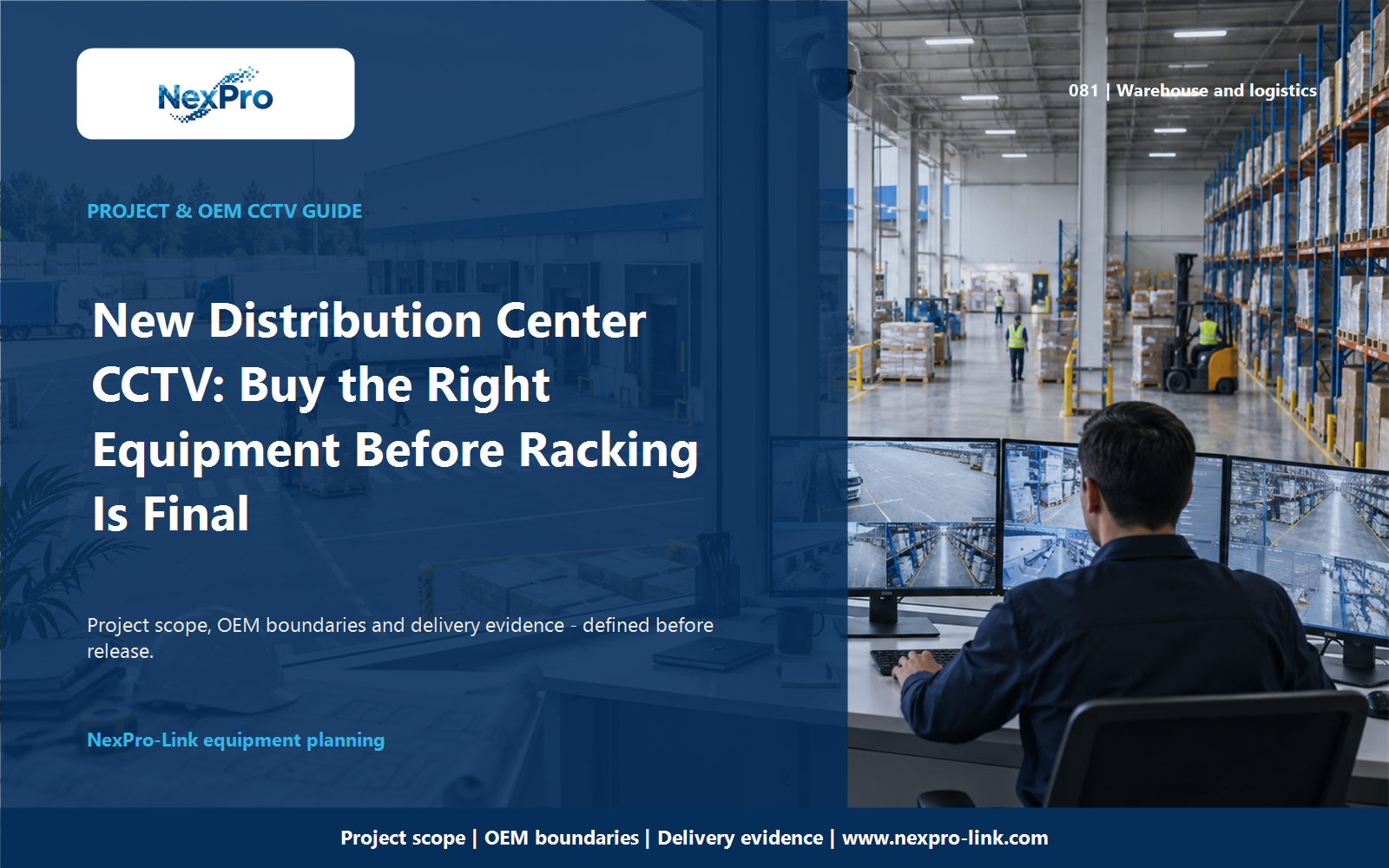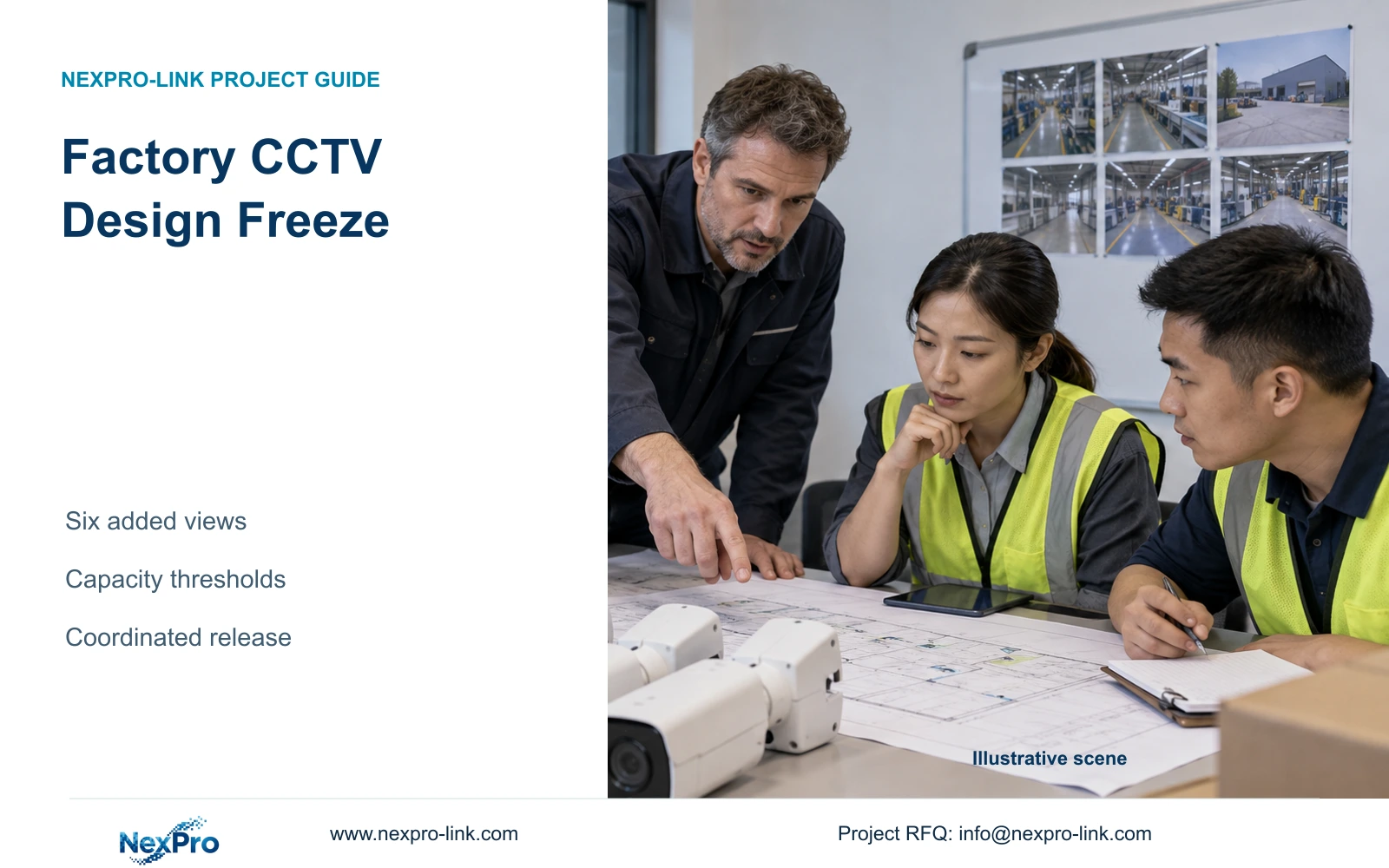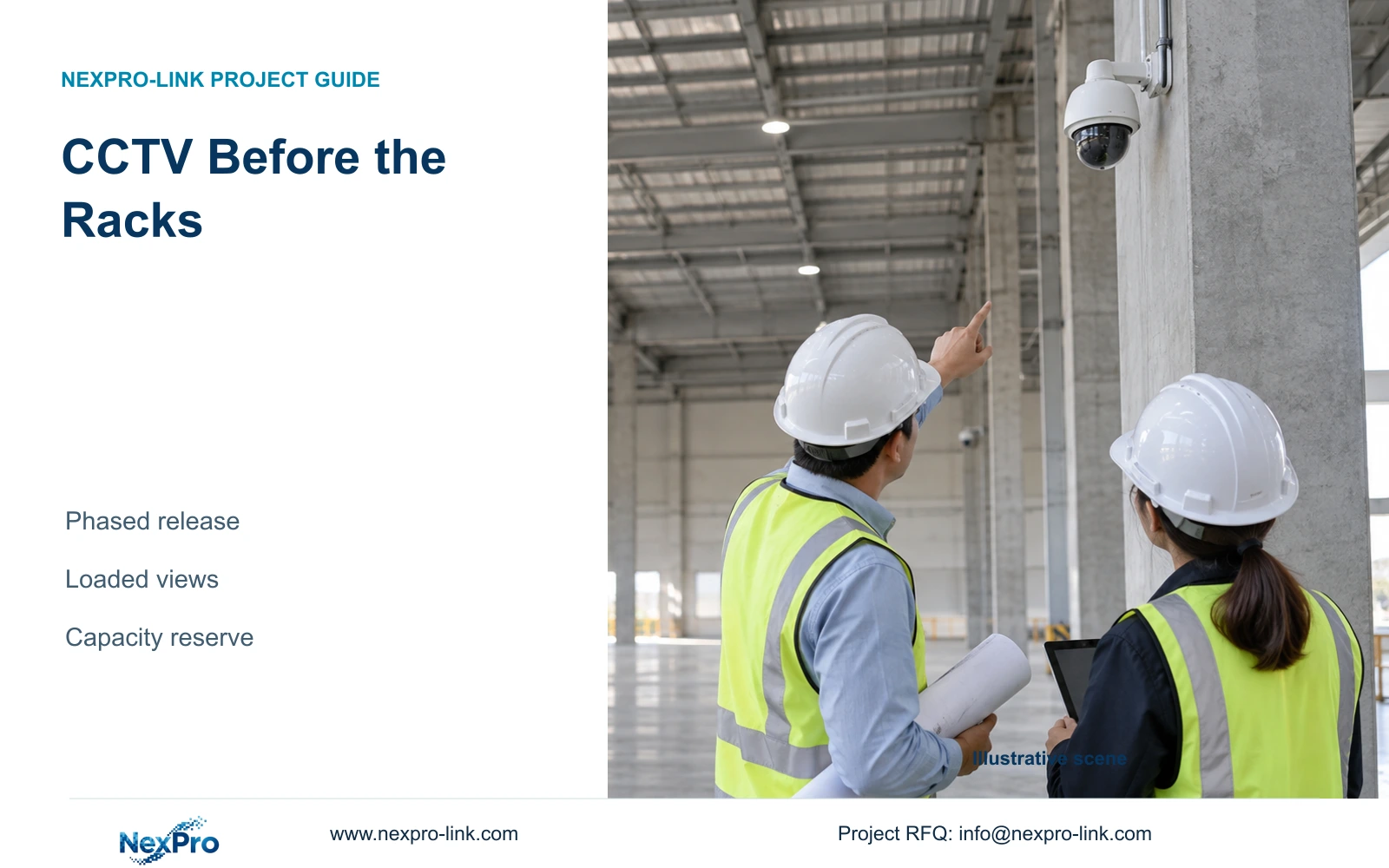
Order stable warehouse CCTV infrastructure early while keeping rack-dependent views adjustable. Compare opening and final recording capacity before freezing the BOQ.
Section 01
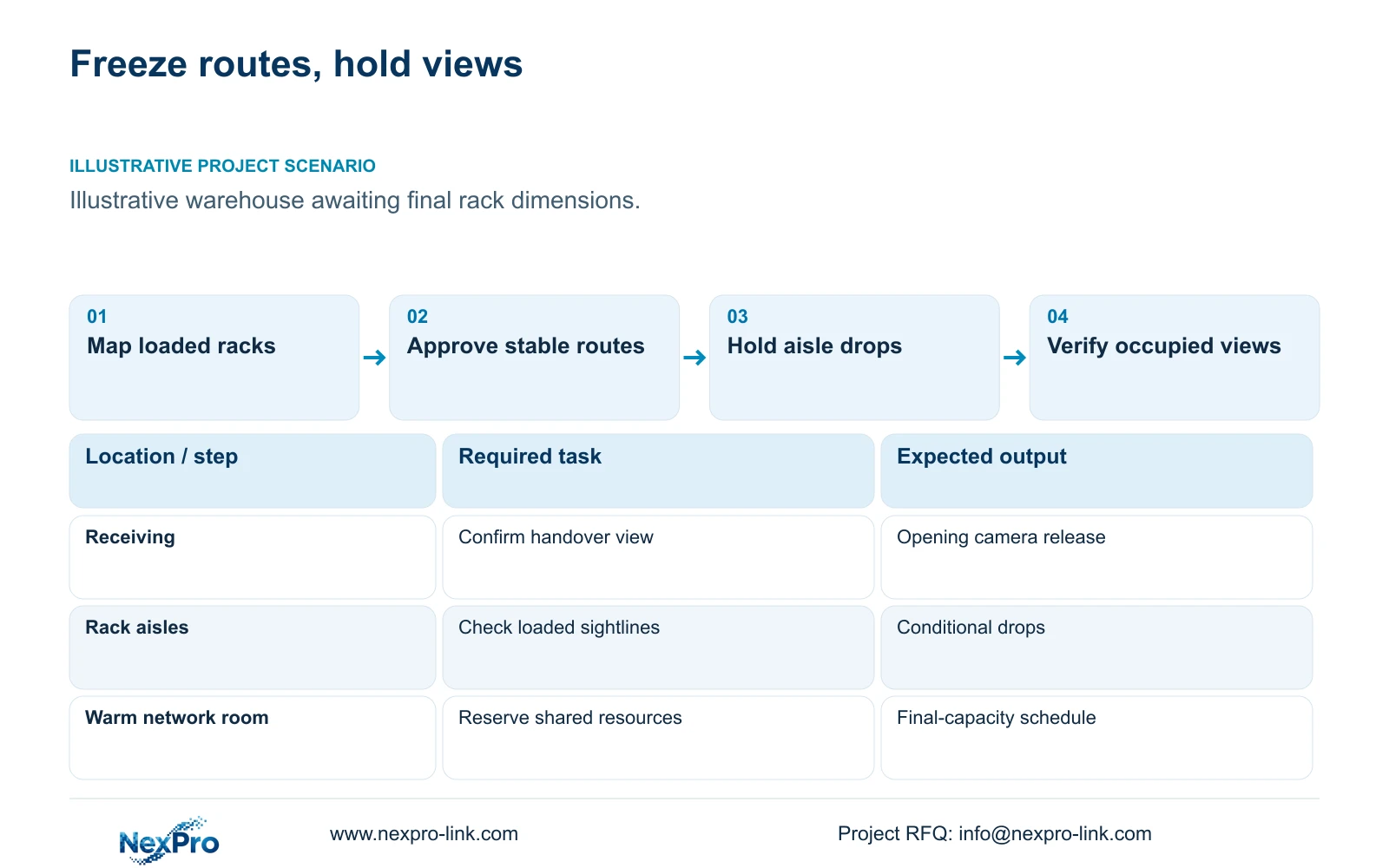
Approve the loaded layout before fixing camera positions
For factory warehouse CCTV before racks are installed, commit to service rooms, approved main routes and opening-phase recording dependencies first. Keep final camera positions, mounting accessories and view widths conditional on the loaded-rack arrangement. An empty-building view cannot demonstrate what an operator will see after pallets, trucks and storage equipment occupy the space.
Illustrative project scenario: A new factory warehouse must order infrastructure before final rack dimensions are released. Assume receiving and dispatch positions are reasonably stable, while aisle widths and upper storage levels remain provisional. The quantity surveyor needs a purchasable opening package without treating every proposed camera location as an approved final position.
Ask warehouse operations to mark maximum loaded heights, cross-aisles, temporary staging and normal forklift routes on the proposed plan. Identify the event required at each position: a receiving handover, movement through a cross-aisle or release at dispatch. Add cold-zone temperatures and proposed network rooms where these affect equipment placement. Give each assumption an owner and a release date so procurement can distinguish an unresolved view from a missing shared dependency.
Section 02
Release stable cable routes and hold uncertain drops
Divide cabling into approved infrastructure routes and view-dependent final drops. A confirmed route to an accessible network room can proceed while an aisle camera drop remains provisional. The drawing should show where this distinction occurs; otherwise a contractor may price the entire route as fixed and later classify a small positioning change as replacement work.
For each uncertain drop, identify the permitted mounting area, expected route alternatives and the work needed after rack installation. Do not leave loose cable lengths unspecified or assume spare cable can be stored anywhere. The installer should establish a suitable handling and protection method, with final termination and testing included in the scope.
CASE06 provides a separate illustrative cold-chain baseline: 24 new links total 1,404 m, using continuous lengths from 41 to 76 m and a feasible five-reel cut plan for 305 m reels. Those quantities cannot be copied into this 16-to-32-camera phase example. They demonstrate why individual routes matter. A shifted aisle endpoint changes a continuous cut, potentially its reel assignment, termination position and test record, even when the aggregate camera count stays unchanged.
Section 03
Keep lens and mounting changes commercially defined
A motorized varifocal lens gives the commissioning team an adjustment range, but it cannot restore a sightline blocked by a loaded rack. Specify the target plane and an acceptable mounting zone before choosing the lens. Require the engineer to revisit a position if the final rack arrangement moves the handover outside that zone or places a permanent obstruction between camera and target.
The NexPro-BL2812M55-5MP-DIC-AI is a relevant ordinary-area candidate with a listed 2.8–12 mm motorized lens and 2880×1620 main output in its 5MP-family specification. The NexPro-DM2812M55-5MP-DIC-AI provides a Dome-family alternative with the same listed output dimensions and lens range. Housing choice still needs a mounting and maintenance decision; neither source establishes an impact rating or a guaranteed identification distance.
Make the handover schedule explicit. The supplier provides approved camera models and agreed accessories; the designer approves view geometry; the local installer provides mounts, cable completion and alignment; operations confirms the occupied scene. Where a cold chamber requires specialist equipment, retain that separate selection. CASE06 assigns 16 cameras to ordinary areas and eight to specialist cold-area views, with recorder, switches and batteries in a suitable warm room.
Section 04
Reserve final recording resources without buying every camera
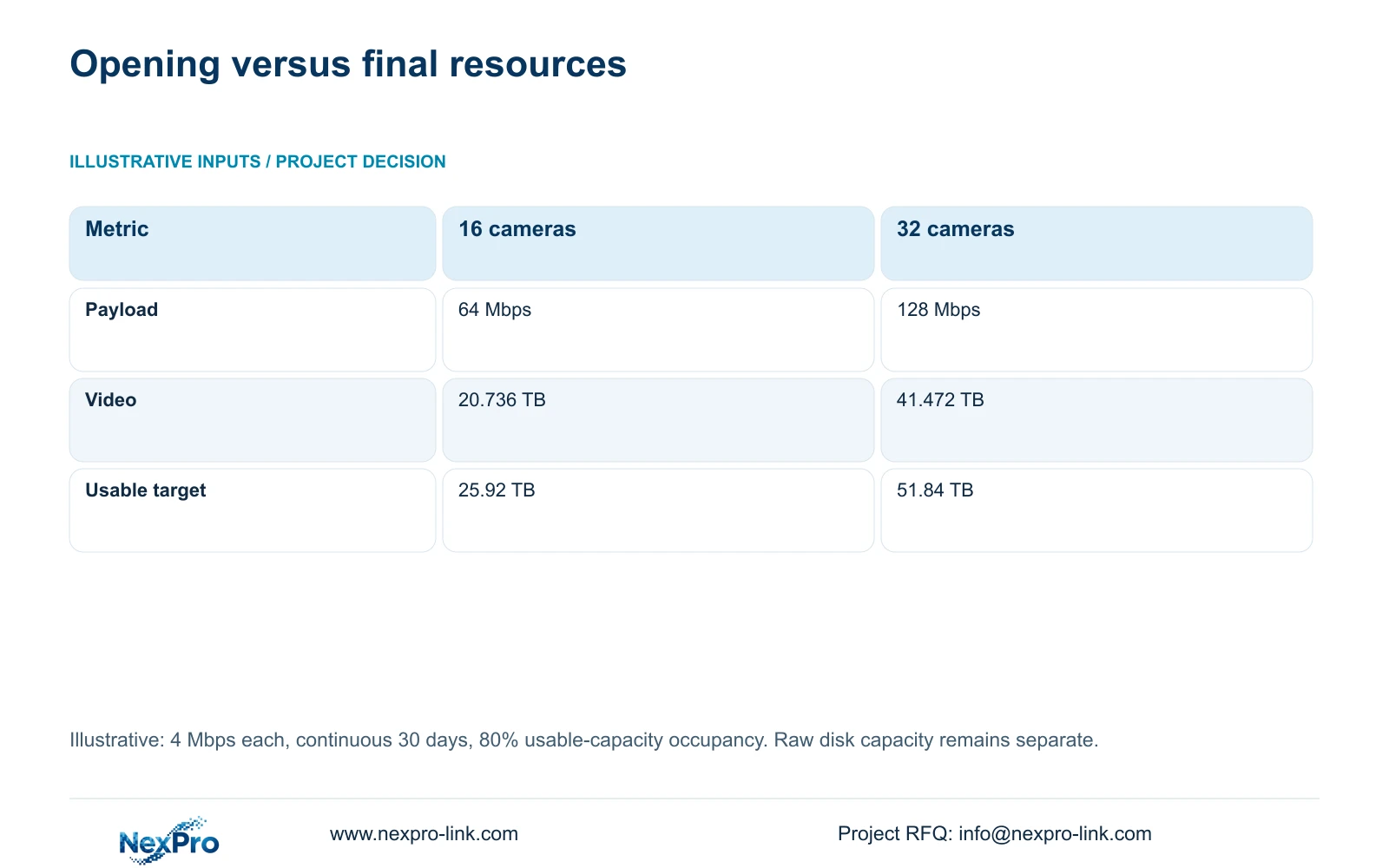
The illustrative phase calculation uses 16 opening cameras and 32 final cameras, each averaging 4 Mbps, with continuous recording for 30 days. Required recorder payload is required_Mbps = 4 × n. Decimal video capacity is video_TB = 0.0108 × 4 × n × 30; the coefficient converts one Mbps recorded continuously for one day into TB.
This gives 64 Mbps and 20.736 TB of video at opening, rising to 128 Mbps and 41.472 TB at full operation. With video occupying at most 80% of usable capacity, usable_required = video_TB / 0.80 gives 25.92 TB and 51.84 TB. These are usable-capacity targets, not raw disk labels. Formatting overhead and any supported storage-protection arrangement require separate treatment.
The decisive difference is the doubled shared recording demand. Later camera purchases can wait for confirmed sightlines, while recorder expansion capability, cabinet space and usable storage must follow the agreed growth strategy. NexPro-NVR4449-4K lists 320 Mbps input and four SATA bays up to 18 TB each, but input bandwidth alone does not approve the installed disk combination, stream modes or simultaneous playback workload. Its published 5MP and 4K summary modes remain distinct.
| Metric | Opening phase | Final phase |
|---|---|---|
| Cameras | 16 | 32 |
| Recorder payload | 64 Mbps | 128 Mbps |
| Video capacity | 20.736 TB | 41.472 TB |
| Usable capacity at 80% occupancy | 25.92 TB | 51.84 TB |
Section 05
Choose staged release with defined adjustment allowances
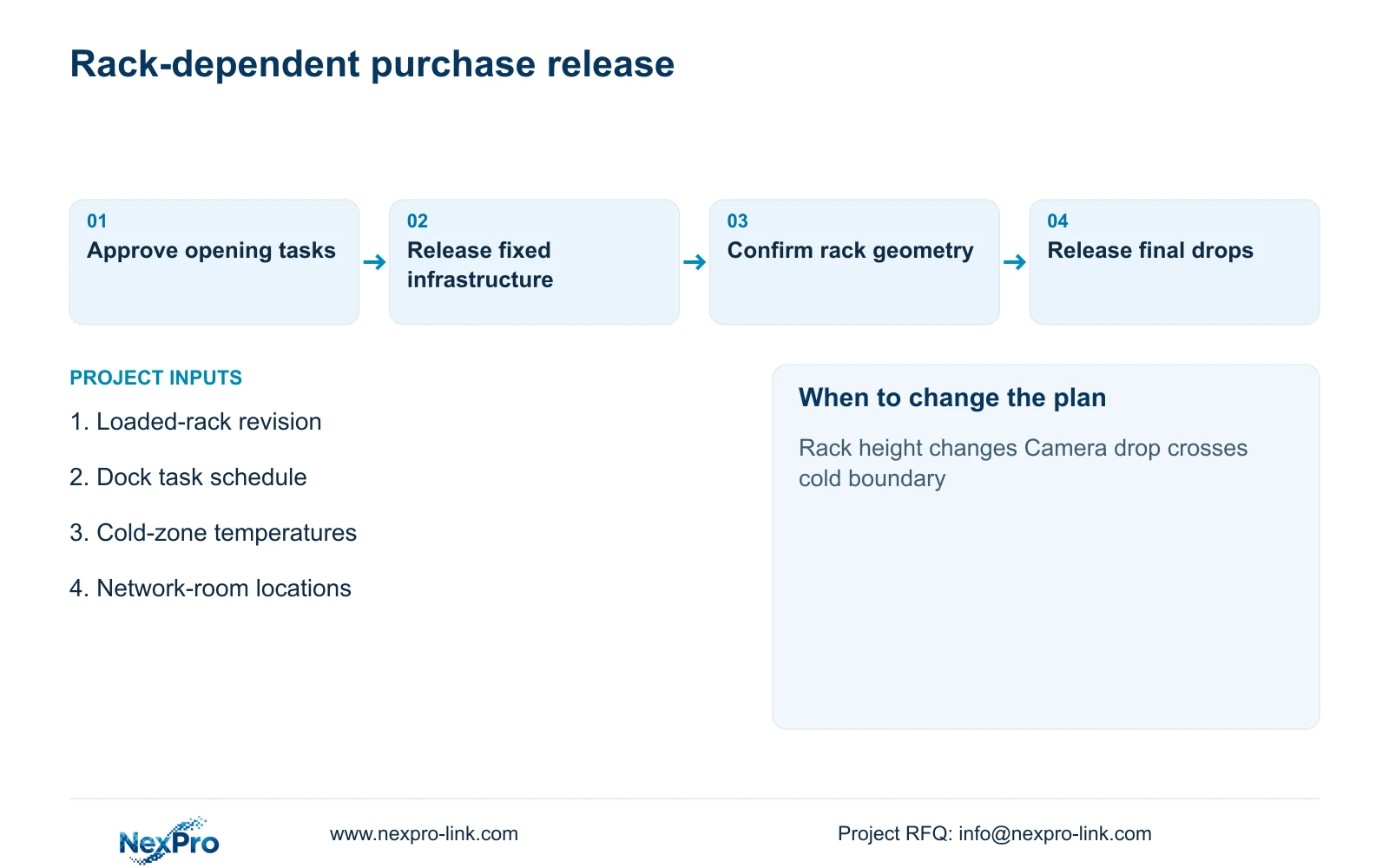
Use a staged release when the rack geometry remains unsettled. Approve the opening tasks, stable service nodes and routes, then release aisle-dependent equipment after the loaded layout is accepted. Price the later survey, final drops, mounts and commissioning as identifiable work. An undefined allowance makes competing bids difficult to compare and leaves the owner exposed to scope arguments.
A single complete purchase becomes reasonable when rack dimensions, loaded heights and operational routes are genuinely frozen, or when a required platform imposes a coordinated equipment release. Compare the same evidence tasks and installation boundaries across offers. A cheaper camera schedule is not equivalent if it excludes final alignment, specialist cold-zone connections or the return visit needed after racks arrive.
Power must follow the same release logic. Every opening camera needs a working supply path, switch and recorder, plus the approved backup objective. Protect only the circuits actually connected to the selected UPS. Replace assumed camera demand with selected-model maximum inputs, and do not count camera watts again when they are already included in complete switch AC demand.
Section 06
Tie the BOQ release to drawings and responsibilities
Issue one schedule with location ID, observation task, drawing revision, equipment status and responsible party. Use statuses such as approved for purchase, provisional position and later-phase supply. Attach the conditions that release each provisional item. This lets the quantity surveyor track a position change separately from a new camera, longer route or altered environmental requirement.
NexPro-Link's BOQ and Tender Support scope covers model matching, technical submittals, deviations and quotation coordination. For this project, the useful supplier output is a phase-labelled equipment list with stated stream and storage assumptions, accessory boundaries and unresolved views. Project packing can follow those same location IDs so a later rack revision does not silently change carton assignments.
Before opening, demonstrate recording, authorised playback and export for every released task, then inspect representative views with the expected obstructions in place. Final acceptance should repeat the view checks after racks are loaded. Preserve both drawing revisions and the resulting changes; the opening approval should not be mistaken for approval of the eventual full warehouse layout.
Section 07
Buyer questions
Can we order cameras while rack dimensions remain provisional? Yes, for stable receiving, dispatch or other confirmed tasks. Keep aisle-dependent quantities and accessories conditional, and agree how substitutions or additional mounts will be priced before releasing them.
Does reserving 32 channels require installing final storage immediately? Not necessarily. A staged disk plan is possible if the opening retention target is met and the supported expansion procedure is documented. Include any later installation, recording interruption and recommissioning work.
Who should approve a rack-driven camera move? The designer should approve the revised view and technical effects, operations should confirm the task remains covered, and the quantity surveyor should record the commercial change against the accepted baseline.
Section 08
Request a rack-dependent release schedule
Send your proposed loaded-rack layout, receiving and dispatch tasks, cold-zone temperatures, and network-room locations to info@nexpro-link.com. NexPro-Link can discuss an opening package and the specific equipment held for final layout approval.
Engineering references
These sources support the general planning principles. Always use the selected product's current datasheet and applicable project standards for final design.