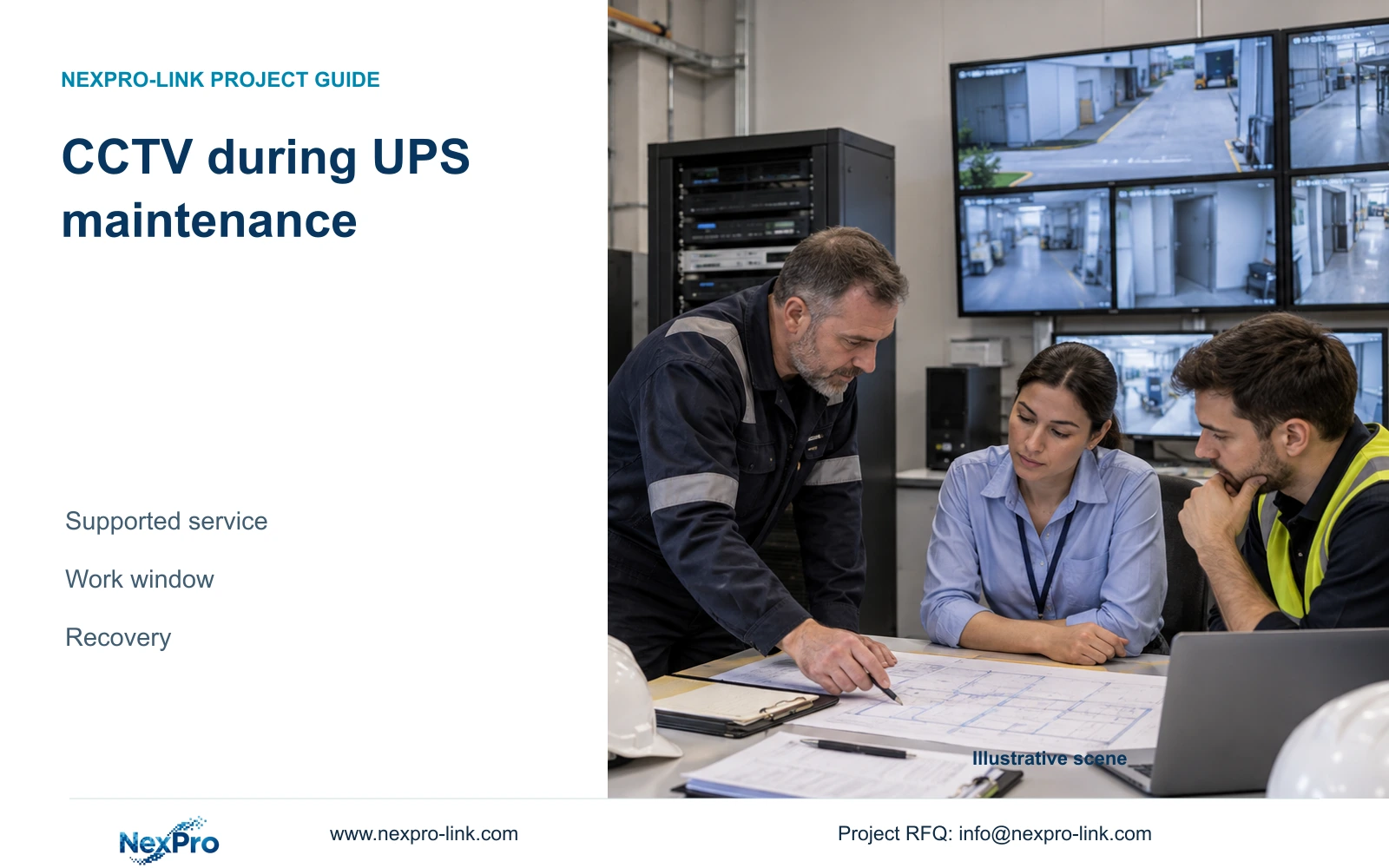
Factory UPS maintenance needs an approved service arrangement, a defined interruption boundary and post-service recording checks. Duplicate equipment labels are insufficient.
Section 01
Select an authorised service arrangement before setting continuity promises
Plan factory UPS maintenance around the exact manufacturer's supported service arrangement and qualified site personnel. Determine which surveillance loads the work affects, then decide whether an agreed interruption or a verified alternative service path meets the owner's task. Do not infer live battery replacement, bypass capability or uninterrupted operation from the UPS category.
Illustrative project scenario: A factory cannot easily remove the security-rack supply for battery service. CASE01 supplies the hypothetical baseline: four PoE groups, one recorder with four drives and operator equipment serving 32 ordinary security views. Assume the project manager needs a maintenance plan that protects essential evidence without improvising electrical connections.
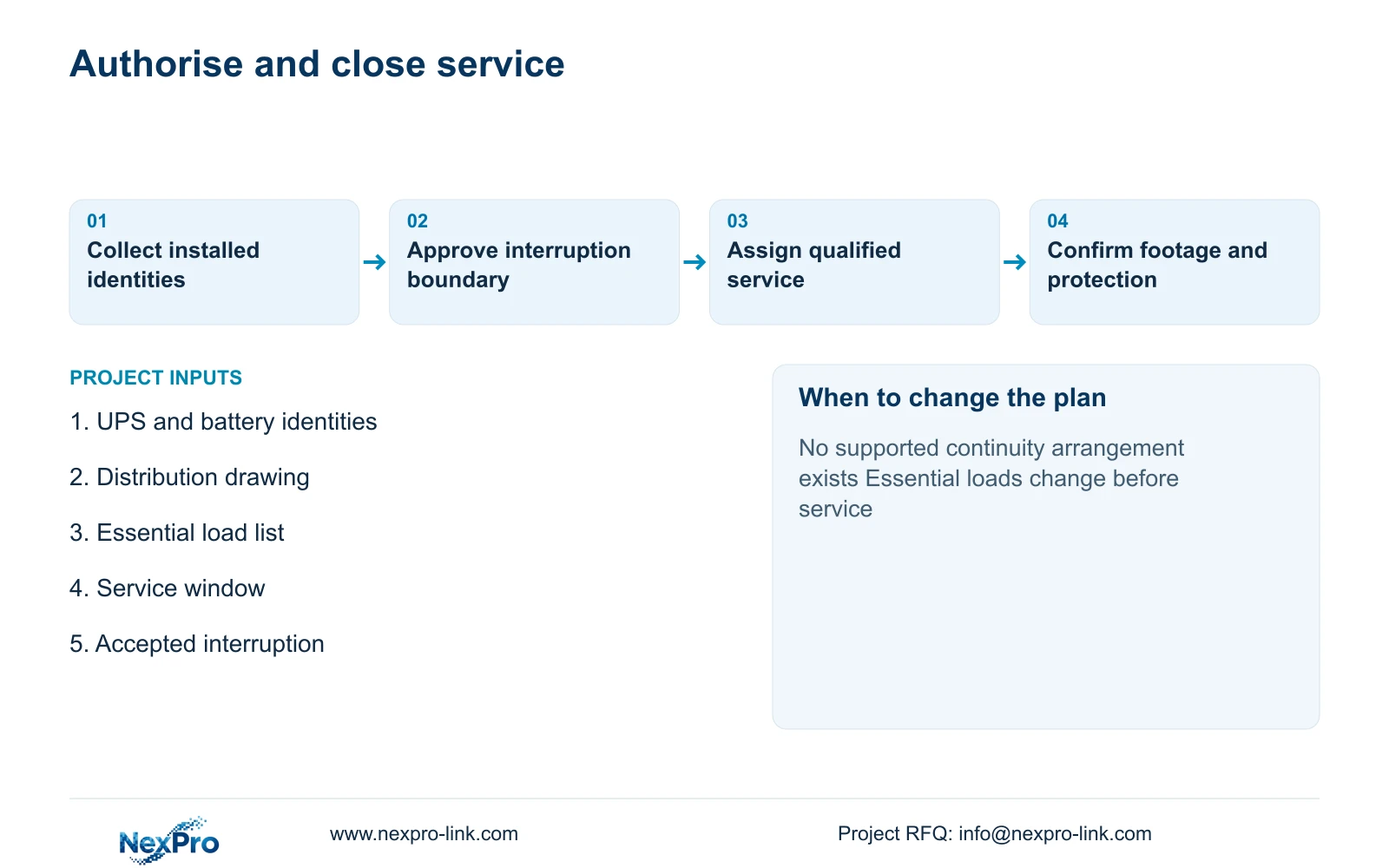
Obtain the installed UPS and battery identities, service documentation, distribution drawing and current load schedule. Ask the appointed service provider to identify supported options and restrictions. Until those facts are available, the plan should state the accepted interruption and unresolved continuity requirement rather than promise a maintenance function the equipment evidence does not establish.
Section 02
Choose the maintenance window from the affected recording tasks
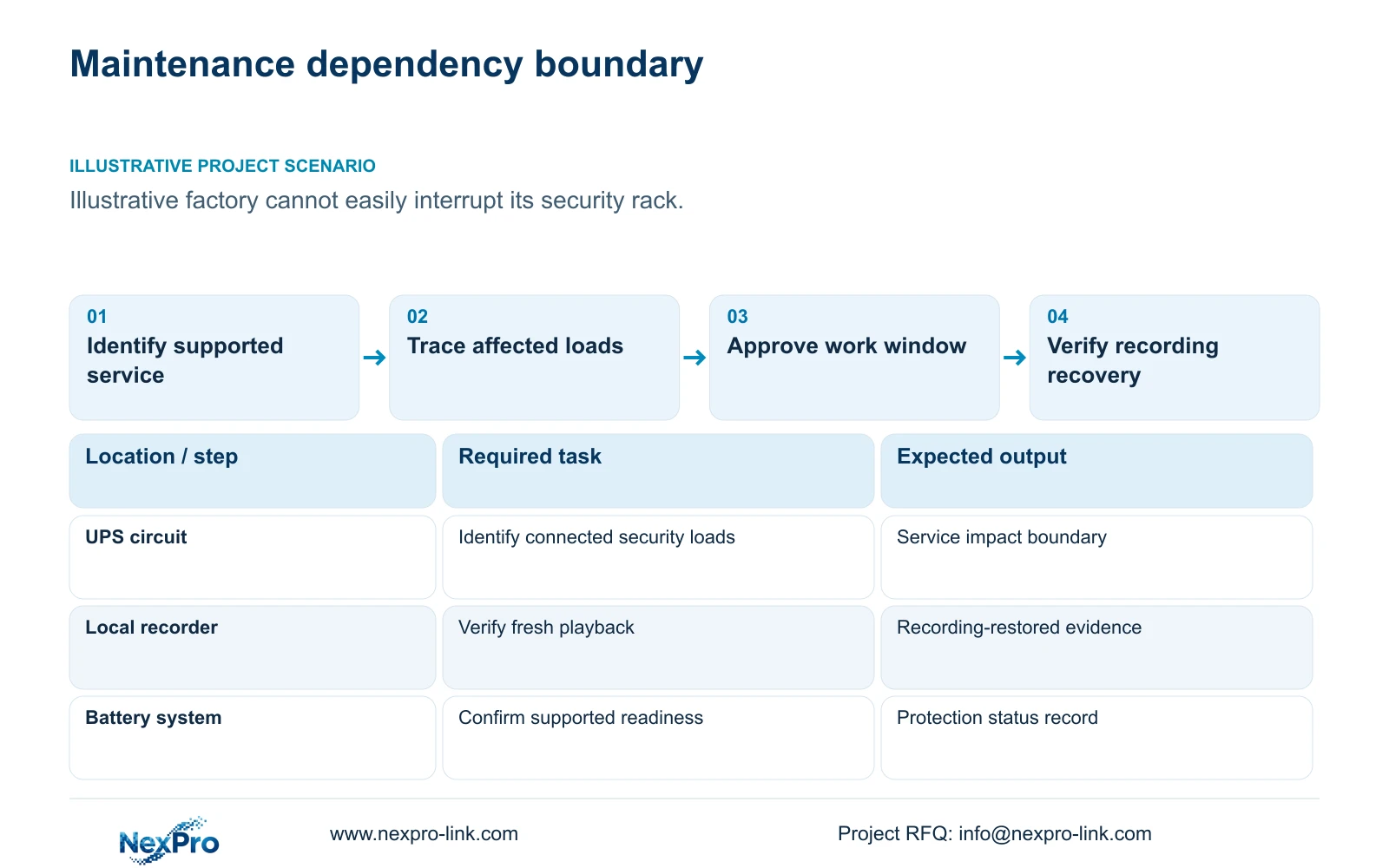
Trace every load on the serviced circuit. If it supplies PoE switches as well as the recorder, removing that supply can affect both image capture and storage. If only a display component is serviced and the recording chain is independent, footage may continue while the guardroom loses that display. These are different maintenance consequences.
Use the owner-approved task schedule to select the window. Gate arrivals, valuable material transfers and dispatch may still occur outside normal production hours, so a low-production period should not automatically be treated as a low-security period. Confirm the activities expected during service and identify any temporary operational restrictions the owner accepts.
The work plan should name the service lead, electrical authority, CCTV verification lead and operational contact. State the planned interruption, rollback decision and escalation route without inventing a standard service duration. If temporary equipment is proposed, its power, network and recording dependencies must be qualified before the maintenance date.
Section 03
Verify recording and protection as separate completion conditions
After authorised service, reconcile every required camera against the accepted channel inventory. Verify fresh playback, timestamps and disk status, then test the agreed export workflow for essential views. Keep any observed gap in the service record. Restored live images alone do not establish that every recording schedule returned correctly.
The service provider should separately confirm the UPS condition and battery readiness using supported documentation. Equipment may be powered while the battery remains in a recovery or charging state. The CCTV team should therefore distinguish recording restored from backup protection confirmed in the handover status.
Preserve the accepted recorder and network configuration before service so changes can be identified afterward. If support work alters firmware, interface roles or recording settings, repeat the affected checks. Close the work order only when the named parties have supplied their respective evidence, with any outstanding limitation explicitly accepted by the owner.
Section 04
Compare an agreed interruption with a verified service path
Option A accepts a defined recording interruption where the serviced UPS remains a shared dependency. Option B seeks continuity through a separately supported service arrangement. Both begin with the same essential recording task. The method is to trace the serviced component through its power and data dependencies and determine the affected task before authorising work.
The decisive difference is evidence that the required path remains available during service. An independent display-service task can preserve recording, but UPS work may reach every connected switch and recorder. A second unit or a bypass label does not establish that the installed arrangement can carry the load safely.
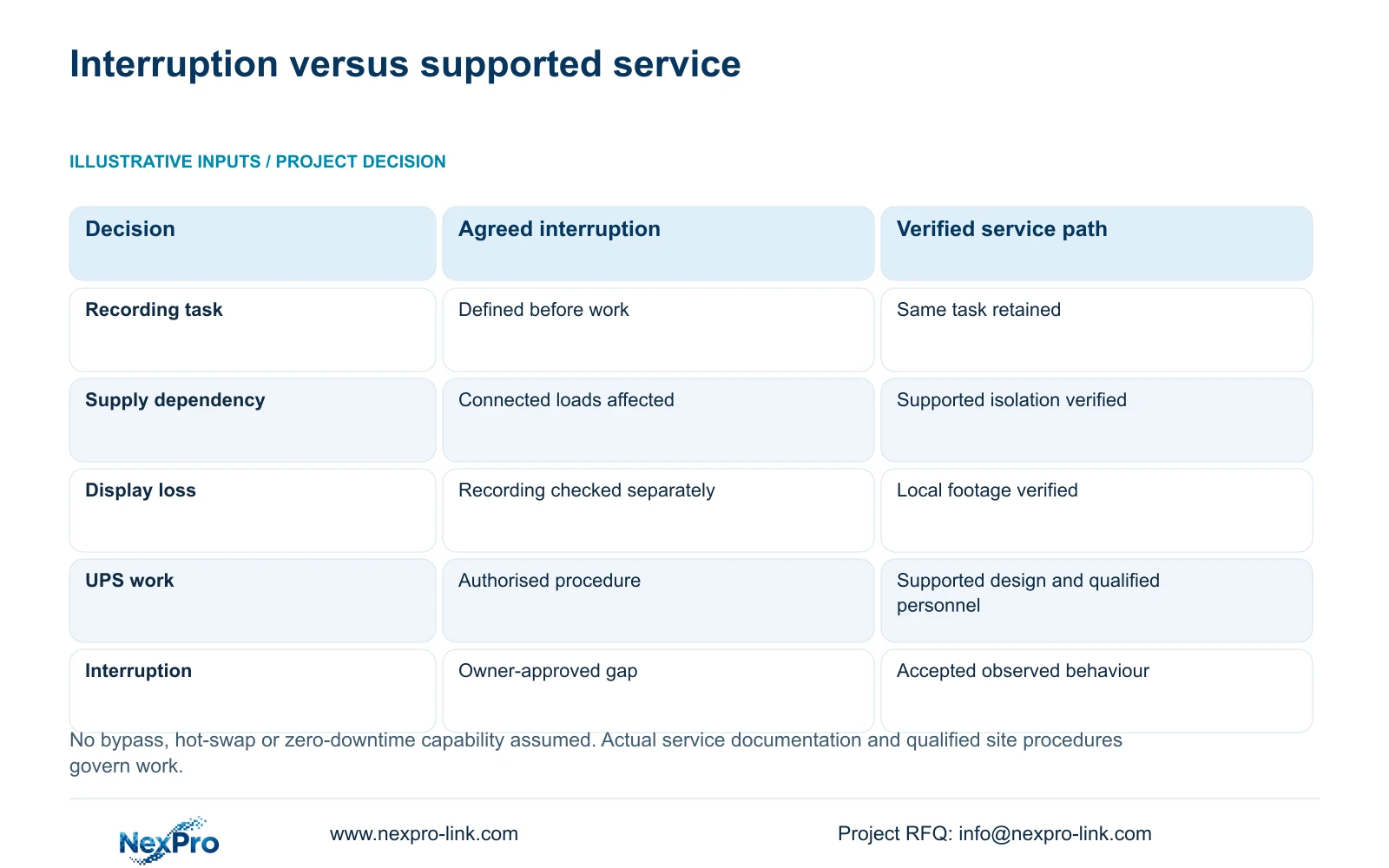
Use this filled matrix to frame the service quotation and work plan. No automatic bypass, hot-swap capability or zero-downtime performance is assumed. The actual manufacturer documentation and qualified local service method control the electrical work; this comparison provides procurement decisions, not wiring or switching instructions.
| Decision | Option A: agreed interruption | Option B: verified service path |
|---|---|---|
| Required recording | Defined before service | Same essential recording task |
| Serviced dependency | Shared supply interrupts connected loads | Supported isolation verified before work |
| Display unavailable | Check recording separately | Prove local recording continues |
| UPS service method | Authorised model-specific procedure | Supported arrangement and qualified personnel |
| Accepted interruption | Owner approves defined gap | Observed behaviour meets agreed target |
Section 05
Use a controlled interruption when continuity cannot be supported
For the stated scenario, first ask whether the installed equipment supports an acceptable service arrangement. If it does not, recommend an owner-approved interruption with a prepared recovery sequence, or a separately engineered temporary solution. Unsupported live improvisation should not become the means of meeting an aggressive continuity promise.
CASE01's illustrative recording-first load is 682.7407 W; adding its optional LCD wall and decoder raises it to 1,262.7407 W. A proposed alternative service path must account for the actual loads it would carry, including retained operator equipment. Those figures are planning demands, not measurements, and they do not establish maintenance ratings or transfer capabilities.
The rack series lists SP1KR(S) at 1 kVA / 900 W and SP2KR(S) at 2 kVA / 1800 W. These are capacity references only. Request exact service support, battery compatibility and operating limits for the installed variant. Change the maintenance proposal when essential-load scope, distribution, site activity or supported service evidence changes.
Section 06
Procure the service evidence alongside replacement equipment
The maintenance enquiry should distinguish supplied parts, retained infrastructure, installer-provided electrical work and optional continuity equipment. Include the approved service window, documentation required before attendance and post-service evidence required before completion. This avoids buying a replacement battery while leaving the actual interruption strategy unpriced.
NexPro-Link's BOQ support can help identify equipment references and organise technical questions for a coordinated offer. The installed UPS service provider and qualified local team should confirm procedures and supported accessories. A general project supply relationship should not be interpreted as authorisation for live electrical work.
Compare offers using the same required recording task and service boundary. Include recovery verification, battery-readiness evidence and responsibility for unresolved faults. A quotation that excludes on-site service or continuity equipment can still be useful, provided the exclusion is visible and another named party owns it. Unknown work remains an open scope item rather than a zero-cost assumption.
Section 07
Buyer questions
Does an online UPS automatically allow battery replacement without stopping loads? No such capability is established by the supplied series information. Obtain the installed variant's service documentation and have the authorised provider confirm the permitted arrangement.
Can display maintenance proceed while recording continues? Potentially, if the serviced display path is independent of required camera power, networking and storage. Verify local recording during the planned service state rather than assuming independence from the device name.
What if no acceptable maintenance window exists? Treat continuity as a design requirement requiring a supported service path or separately engineered temporary arrangement. Resolve that requirement before authorising work; do not compensate with an improvised live procedure.
Section 08
Prepare an authorised security-rack service enquiry
Send your installed UPS and battery identities, circuit and load schedule, acceptable recording interruption and proposed service window to info@nexpro-link.com. NexPro-Link can discuss equipment documentation and supply scope for coordination with your qualified service team.
Engineering references
These sources support the general planning principles. Always use the selected product's current datasheet and applicable project standards for final design.