Record load, battery configuration and declared curve conditions beside each offered duration. Compare only common conditions or obtain a supplier clarification; do not interpolate a missing competitor configuration into a winner.
Section 01
Fix the protected load and battery configuration before comparing brands
Record load, battery configuration and declared curve conditions beside each offered duration. Compare only common conditions or obtain a supplier clarification; do not interpolate a missing competitor configuration into a winner. Keep recharge and installation exclusions visible. The output is a comparable evidence request, not a brand reliability or runtime ranking.
Compare NexPro-Link, APC and Eaton factory UPS offers using exact regional models, the same protected AC load and supported runtime evidence. Check W and VA ratings independently, then identify the battery configuration that supports the required duration. A larger kVA label or an illustrative energy calculation cannot establish a runtime winner.
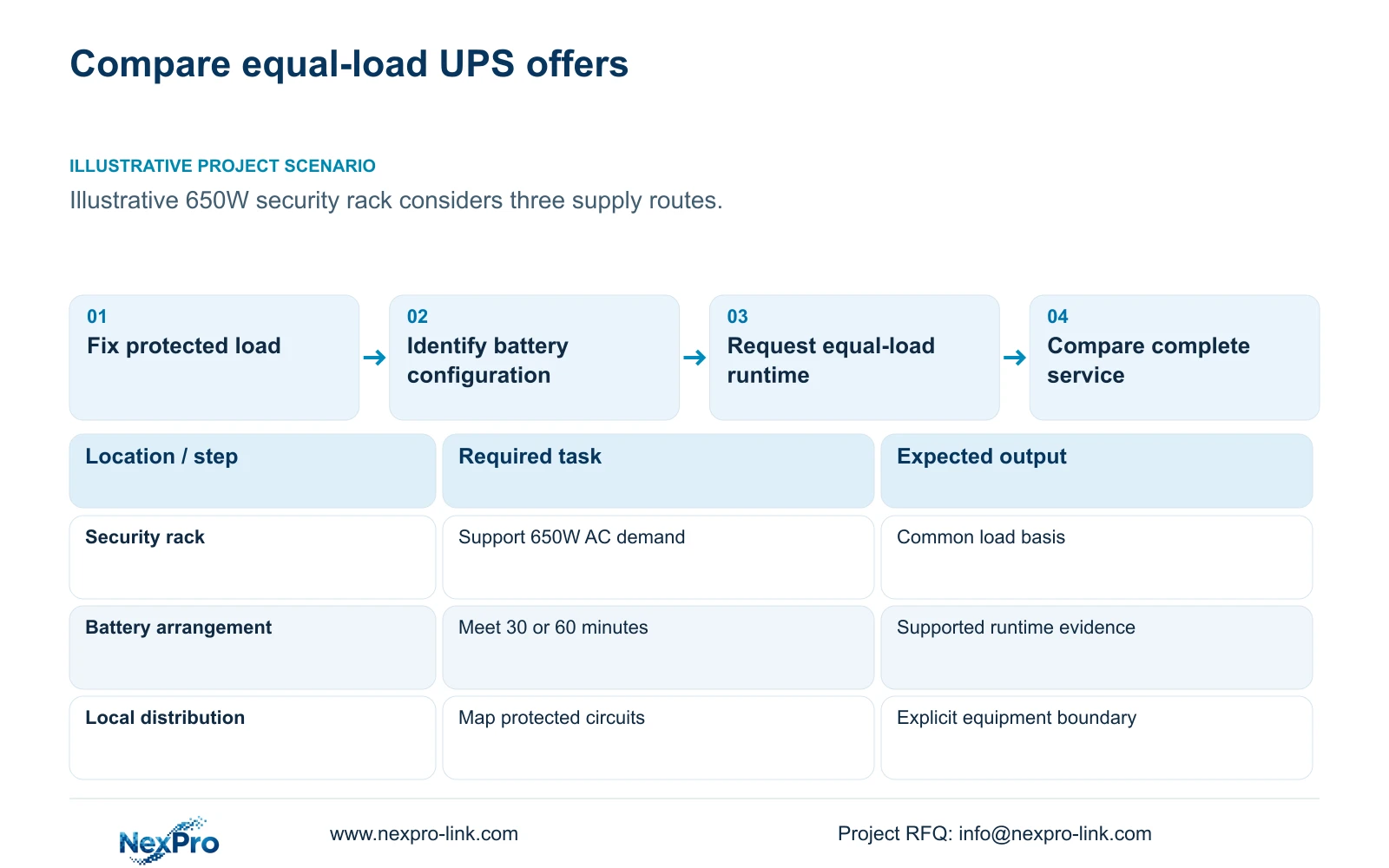
Illustrative project scenario: A buyer has different kVA and battery offers from three supply routes. Assume the immediate service is a factory security rack with 650W protected AC demand, and the owner is choosing between 30 and 60 minutes. This teaching load is separate from CASE01's complete 32-camera load calculation.
Ask each supplier to identify input/output voltage, rated W and VA, battery model and quantity, and the evidence supporting runtime at 650W. No exact APC or Eaton product specification is supplied here, so neither brand receives inferred ratings or minutes. Their offers need the same model-level documentation as the NexPro-Link candidate.
Section 02
Request runtime evidence at the same operating demand
The APC/Schneider buying-guide reference distinguishes capacity from runtime: W and VA are separate constraints, while duration depends on load and the selected UPS/battery arrangement. Require each bidder's curve or supported selection evidence at the agreed demand. A runtime entry at a different load should not be copied into the comparison as if conditions were equal.
Record temperature, battery age basis, initial state of charge and the operating endpoint behind the supplied evidence. Also identify self-consumption, discharge-rate and BMS constraints where they affect the supported configuration. These inputs explain why nominal Wh alone is insufficient to prove the required minutes.
Decide whether the owner needs uninterrupted operation for the entire period or time to complete a controlled action. A generator bridge needs an agreed transition task; continued recording needs the complete camera-to-recorder power path. Do not shorten the actual service target simply because a quoted battery arrangement is easier to fit.
Section 03
Include distribution, accessories and service in every offer
Trace the protected load to its electrical circuit. In CASE01, the cameras are counted through complete switch AC demand, with recorder, disks and operator equipment added separately. Counting camera watts again after including powered switch demand would duplicate load. A remote device outside the UPS-fed circuit remains outside that UPS's protection.
Request the installation package around each proposed UPS: compatible battery connections, rack supports, outlet distribution and any specified management or service accessories. Identify which are supplied, retained or installer-provided. A low equipment price can leave essential electrical or maintenance dependencies unpriced.
Separate equipment warranty from battery and local service terms. NexPro-Link's public general policy gives an eligible main-equipment baseline of 24 months from receipt, while its rack UPS page also uses a 1–2-year product term. Preserve that distinction and obtain the applicable written order terms rather than assuming the longest wording governs every component.
| Item | Required task | Scope status | Responsible party |
|---|---|---|---|
| UPS and supported battery | Serve accepted load and duration | Supplied matched configuration | UPS supplier |
| Rack supports and distribution | Fit and connect protected devices | Supplied or installer-provided | Supplier and local electrician |
| Protected-circuit mapping | Identify equipment receiving backup | Installation scope | Local electrical contractor |
| Runtime evidence | Support the selected operating target | Required submittal | UPS supplier |
| Maintenance response | Restore service after a fault | Separate agreed support scope | Owner and service provider |
Section 04
Convert two duration targets into an illustrative energy request
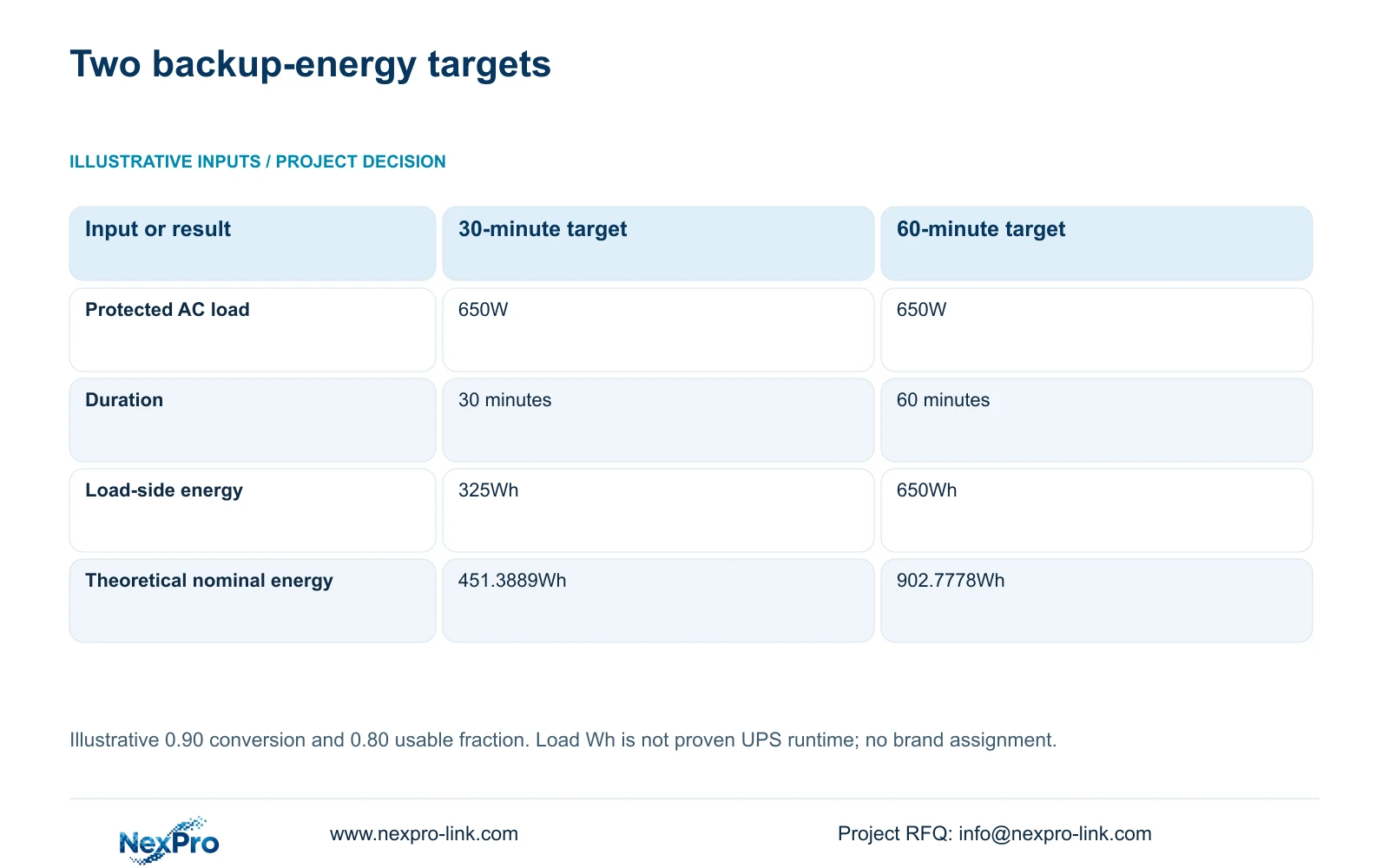
For the assumed 650W load, load_Wh = P_W × minutes / 60. The 30-minute target requires 650 × 30 / 60 = 325Wh delivered to the loads; the 60-minute target requires 650 × 60 / 60 = 650Wh. These are load-side requirements, not published battery capacities or demonstrated UPS runtimes.
For this illustration only, use a battery-to-load conversion factor of 0.90 and usable stored-energy fraction of 0.80. nominal_battery_Wh = load_Wh / (0.90 × 0.80). The theoretical nominal requirements are 451.3889Wh for 30 minutes and 902.7778Wh for 60 minutes. Neither number is assigned to NexPro-Link, APC or Eaton.
The decisive difference is duration: at unchanged load and assumed factors, the one-hour energy request is twice the half-hour request. It does not require twice the inverter rating. Request a manufacturer-supported battery configuration and actual runtime evidence, including recharge suitability for the site's outage pattern, before accepting either target.
| Input or result | 30-minute target | 60-minute target |
|---|---|---|
| Protected AC load | 650W | 650W |
| Target duration | 30 minutes | 60 minutes |
| Energy delivered to loads | 325Wh | 650Wh |
| Theoretical nominal battery energy | 451.3889Wh | 902.7778Wh |
Section 05
Separate capacity qualification from the duration decision
The NexPro-Link rack online LiFePO4 references are SP1KR(S) at 1kVA/900W, SP2KR(S) at 2kVA/1800W and SP3KR(S) at 3kVA/2700W. These are quoted model capacities. They do not assign a common battery Wh value across the range or establish minutes at the illustrative 650W demand.
Using CASE01's planning assumptions of load power factor 0.9 and maximum rated utilization 80%, the separate 650W example requires rated_W ≥ 650/0.80 = 812.5W and rated_VA ≥ 650/(0.9 × 0.80) = 902.7778VA. SP1KR(S) passes that provisional capacity screen, subject to actual load characteristics and electrical compatibility; its battery duration remains unresolved.
CASE01 itself assumes 682.7407W for recording priority and 1,262.7407W with the additional LCD wall and decoder. Its capacity candidates are SP1KR(S) and SP2KR(S), respectively. Do not replace those loads with 650W or combine their energy results with this teaching example. Changed display scope can require a capacity review as well as a runtime review.
Section 06
Select a supported configuration and document the change triggers
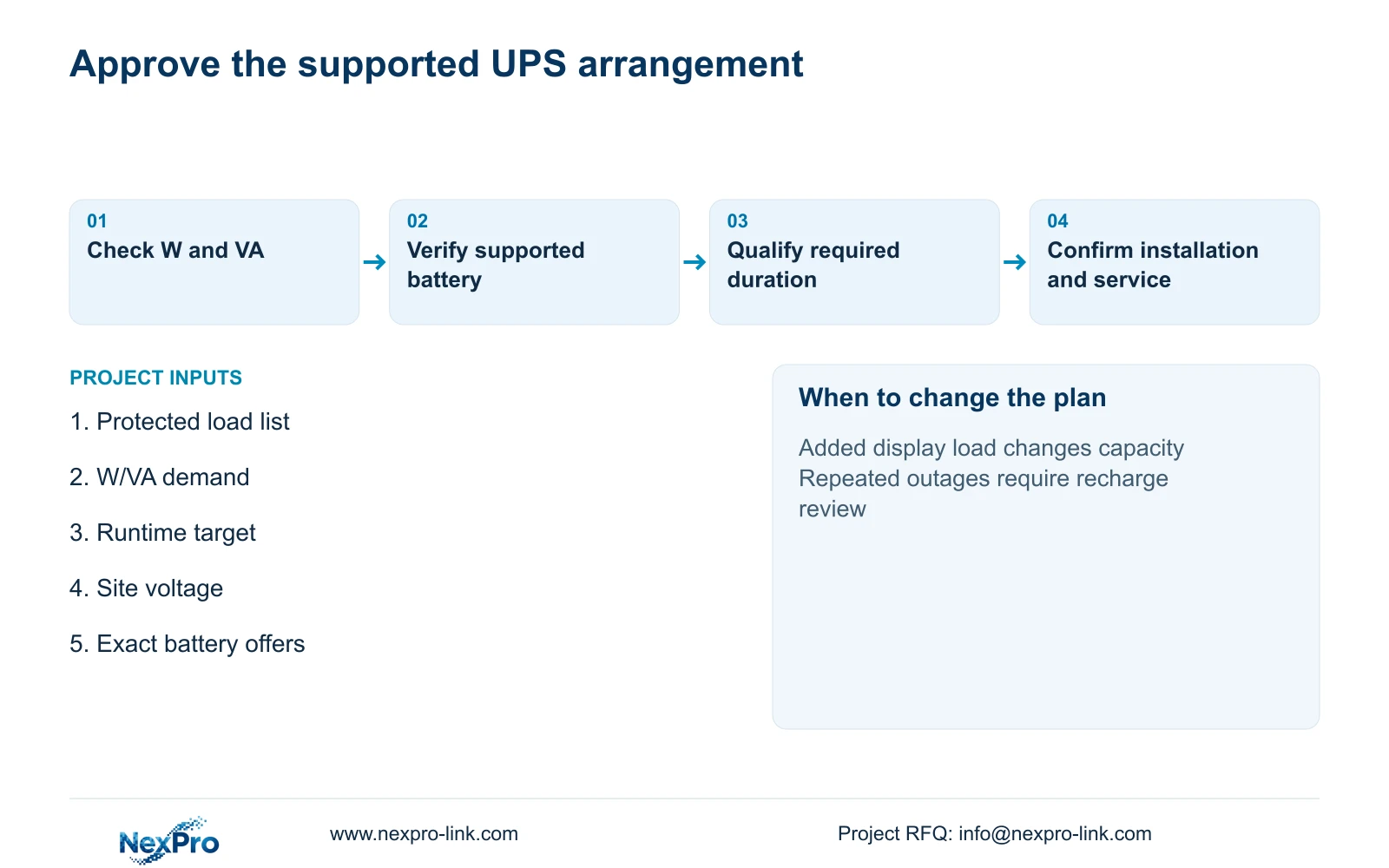
Recommend the smallest configuration that passes the actual W and VA screen, matches the electrical installation and supplies supported evidence for the owner's duration. Compare all three supply routes on that basis. If an APC or Eaton proposal provides a required service or supported battery arrangement absent from another offer, retain that difference in the decision record.
The project-ready delta table should show the UPS variant, supported battery, accessories, protected circuits and service boundary. NexPro-Link can discuss the related equipment and submittal scope, while the local electrical team confirms installation requirements. A complete supply package does not establish local construction responsibility by itself.
Reopen selection when load, power factor, runtime target or battery configuration changes. Include a second-outage and recharge review when repeated interruptions are part of the operating brief. The final comparison should state which claims come from model documentation, which are assumptions and which require site verification.
Section 07
Buyer questions
Can a higher-kVA offer have a shorter runtime? Yes. Capacity and stored energy are different selection dimensions. Compare supported runtime at the same load and exact battery configuration rather than assuming the larger inverter lasts longer.
Can the theoretical Wh result be used to choose an unrelated battery? No. It is an energy-request illustration. Battery voltage, compatibility, charging, BMS behavior and the manufacturer's supported arrangement must be verified for the exact UPS.
Should recharge appear in a factory UPS bid comparison? Yes when another outage may occur before the battery recovers. Request the supported recharge conditions and assess them against the owner's expected operating pattern.
Section 08
Request a common-basis UPS comparison
Send the protected AC load list with W/VA data, required operating duration, site voltage and circuit arrangement, and exact UPS/battery offers to info@nexpro-link.com for a matched capacity, runtime and supply-scope review.
Engineering references
These sources support the general planning principles. Always use the selected product's current datasheet and applicable project standards for final design.