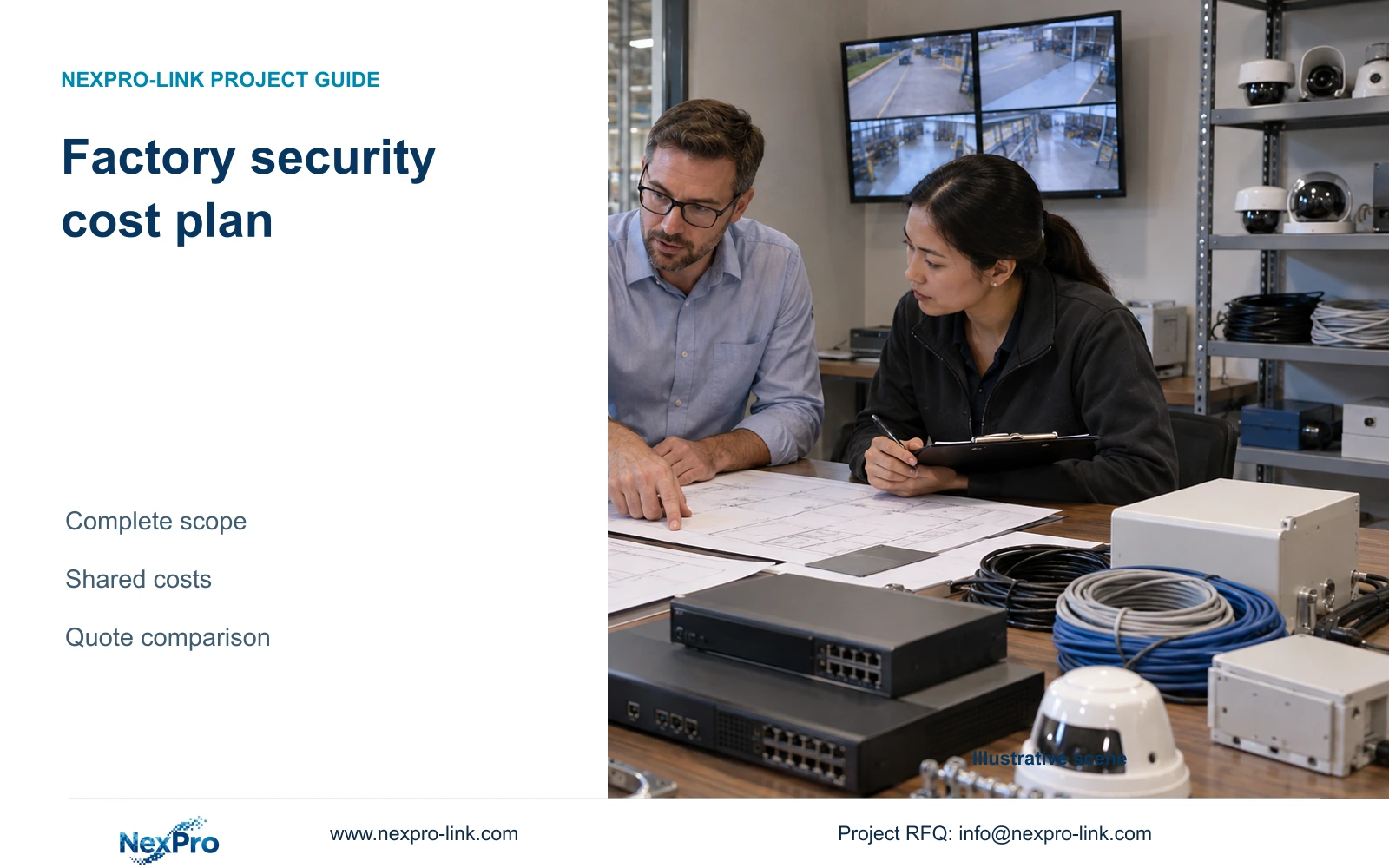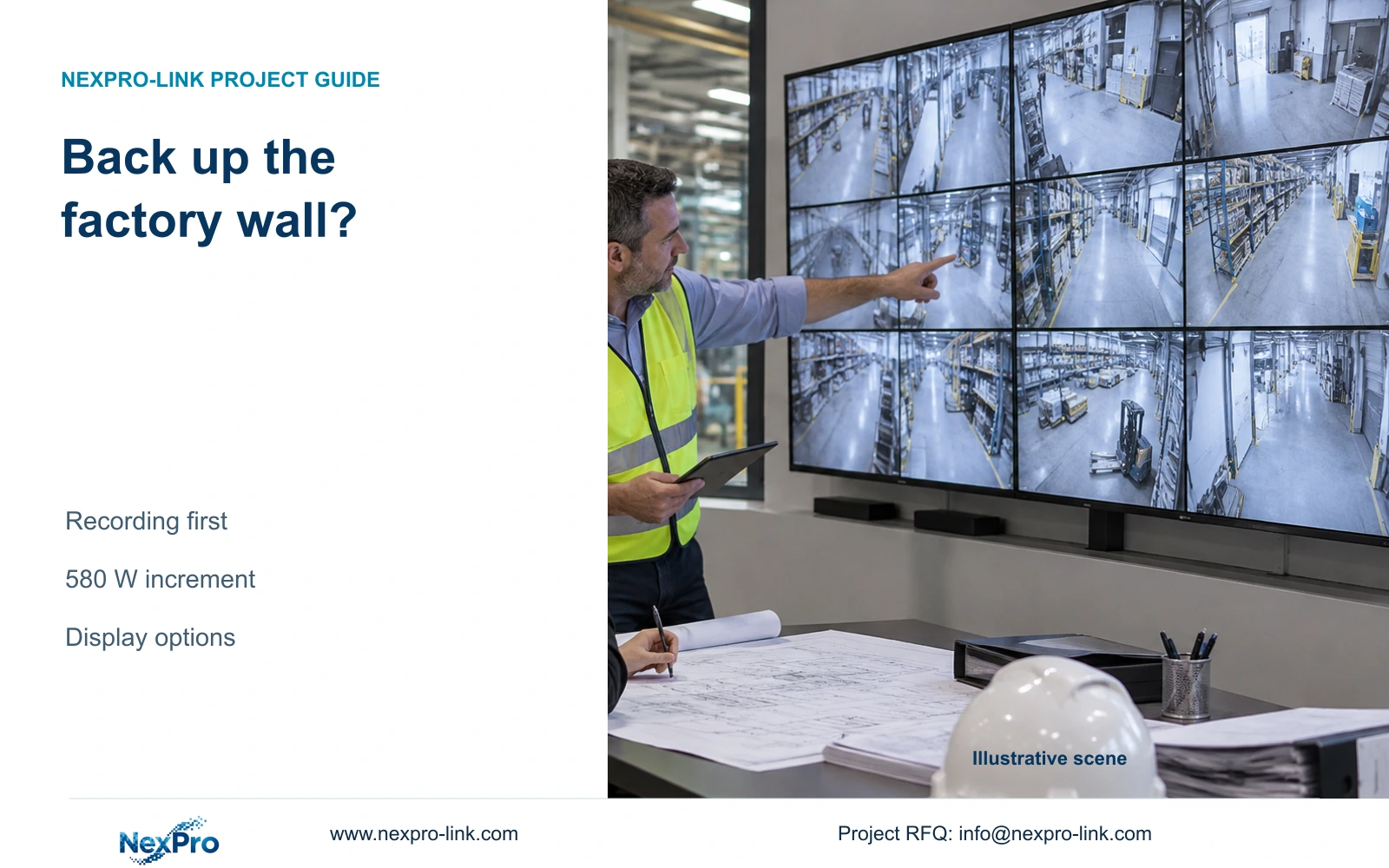
An over-budget factory security tender needs traceable alternatives. Preserve required views, retention and outage tasks, then price substitutions and optional scope transparently.
Section 01
Freeze required outcomes before changing the tender
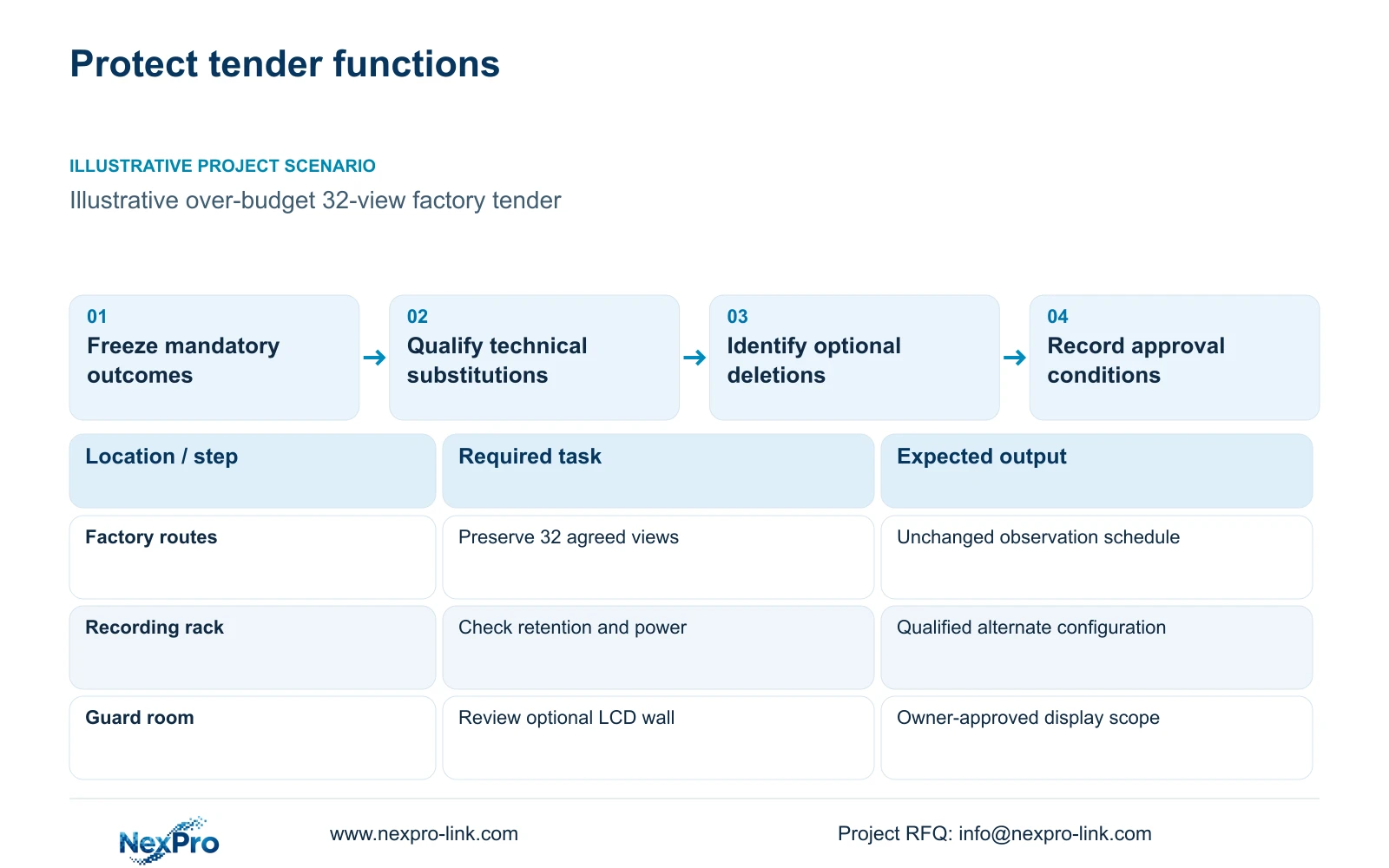
Factory tender value engineering should reduce optional or inefficient scope while preserving the functions the owner has agreed to accept. Start with a protected requirement schedule, then compare qualified substitutions against it. A lower price obtained by removing required retention, usable views or installation work is a scope reduction that needs explicit approval. It should not appear as an equivalent alternative.
Illustrative project scenario: The bid exceeds budget and the contractor needs a defensible alternate for the CASE01 new CNC factory. Assume the owner requires 32 ordinary security views, continuous recording for 30 days and a 30-minute backup objective for essential CCTV equipment. A four-panel LCD wall is being considered separately. These are hypothetical planning conditions, not a completed installation or a confirmed tender award.
The designer should mark each requirement as mandatory, discretionary or unresolved. Specify the observation task at each location, recording hours, retrieval workflow and protected equipment boundary. The quantity surveyor then uses those classifications to test proposed reductions. If the owner changes an outcome, issue a revised brief before repricing. Keeping the original and revised requirements visible makes the cost decision reviewable.
Section 02
Check alternatives against linked technical constraints
A recorder substitution must pass channel, stream-mode, bandwidth and disk-capacity checks together. CASE01 assumes 32 supported 5MP-class streams averaging 4 Mbps each, giving 32 × 4 = 128 Mbps input. NexPro-NVR4449-4K lists 49 channels, 320 Mbps input and four SATA bays supporting up to 18 TB per drive. Its summary distinguishes 49 × 5MP from 9 × 4K; the channel count does not justify an all-8MP substitution or prove decoding capacity.
Preserve the illustrative storage calculation: video_TB = cameras × average_Mbps × 10^6 × 86,400 × days / 8 / 10^12. With 32 cameras, 4 Mbps and 30 days, video demand is 41.472 TB. Four 16 TB drives provide 64 TB raw. The planning video budget is 64 × 0.95 × 0.80 = 48.64 TB, which exceeds 41.472 TB. Formatting allowance and the 20% reserve are already included in that budget.
A cheaper disk combination is acceptable only if its recalculated budget still meets the same demand and the exact drives are supported. Changes to bitrate need their own image-quality assessment because lower stored data can change useful evidence. Compare the entire affected configuration rather than treating disks, cameras and the recorder as independent discount lines. No RAID capability is assumed in this capacity example.
Section 03
Record the reason and consequence of every change
Build a deviation register linking each proposed change to the original BOQ line, retained function, technical evidence and approving party. Include the cost effect only after the engineer has identified downstream work. Moving a camera may reduce cable length but alter the view, bracket and maintenance access. Replacing one model can also require a new sample or configuration check.
For this scenario, separating the optional LCD wall from the recording package is a defensible candidate. Retain the original retrieval display, recorder, disks and camera network. The wall's removal is acceptable only if continuous multi-view monitoring is not mandatory. Conversely, deleting cable testing would remove an acceptance deliverable and should be rejected unless the owner formally changes that requirement.
NexPro-Link's BOQ & Tender Support scope includes model matching, technical submittals and deviations. Use that support to obtain an exact proposed configuration and a clear exceptions list. Supplier documentation supports review; the buyer's appointed authority still decides whether the alternate satisfies the tender. Keep supplied, retained and optional items distinguishable so an accepted change cannot silently transfer work to the local contractor.
| Item | Required task | Scope decision | Responsible party |
|---|---|---|---|
| 32 security views | Record agreed transfer and access tasks | Retained requirement | Designer verifies; owner accepts |
| Recorder and disks | Provide 30-day recording | Qualified supplied alternative | Supplier documents; engineer checks |
| Four-panel LCD wall | Provide simultaneous overview | Optional if brief permits | Owner approves deferral |
| Cable testing | Verify installed links | Retained site deliverable | Local installer completes |
Section 04
Price the equivalent scope before accepting savings
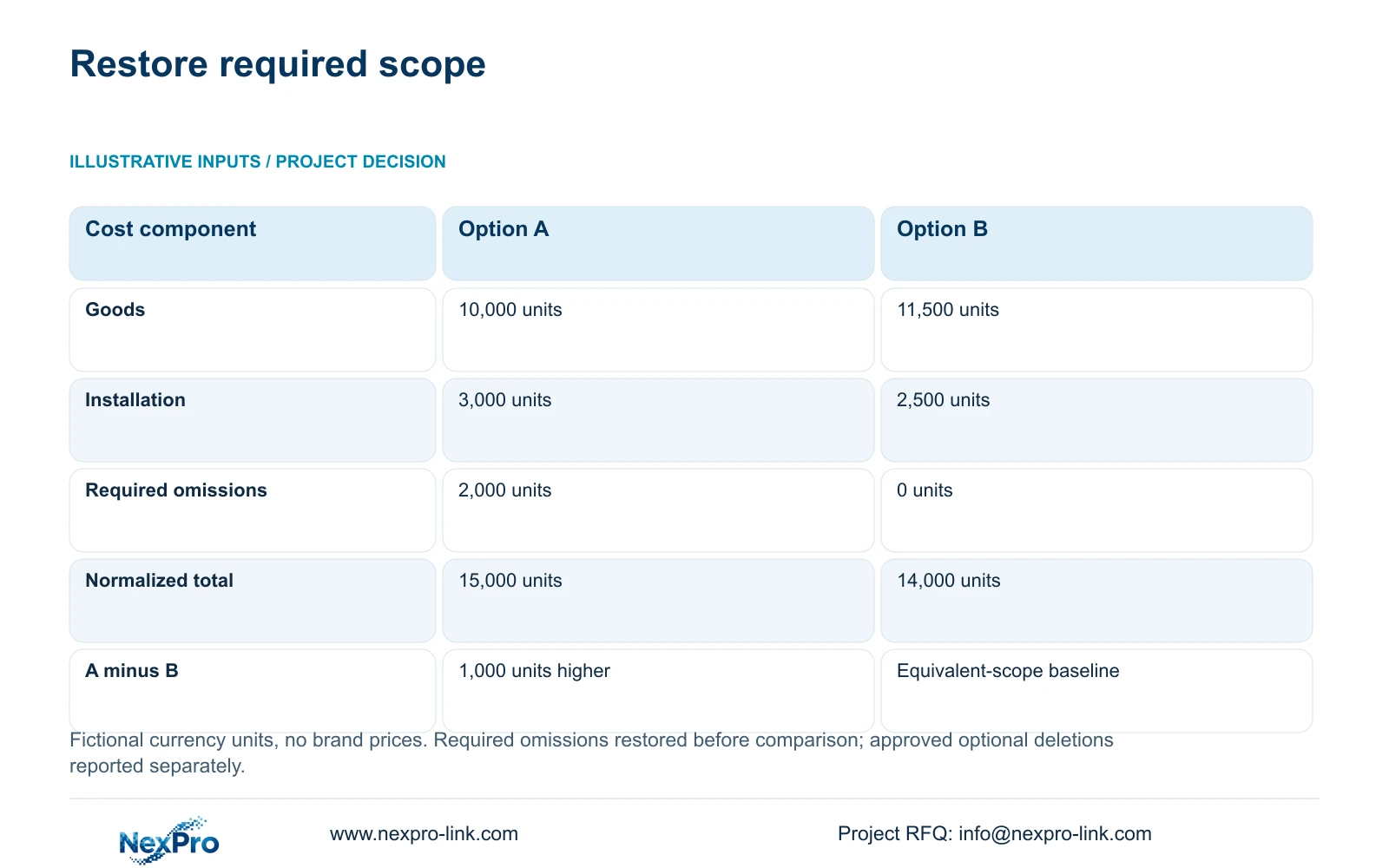
An alternate can look cheaper because its goods subtotal excludes work contained elsewhere in the original bid. Use the supplied fictional example to expose that risk. Option A contains 10,000 currency units of goods and 3,000 units of installation, with 2,000 units of required omitted scope. Option B contains 11,500 units of goods and 2,500 units of installation, with no required omission within the example.
Calculate normalized_total = goods + installation + required_omitted_items. A becomes 15,000 units and B becomes 14,000 units. Using difference = A_total - B_total gives 1,000 units. A's lower goods price does not survive the complete-scope comparison. The decisive difference is that required omissions must be restored before either offer can be presented as meeting the same task.
These units are not brand prices or realised savings. Obtain same-date quotations with matching quantities, currency and delivery scope before making a commercial recommendation. Show genuine optional deletions separately from the normalized equivalent total. For example, deferring an owner-approved wall changes the purchased scope; it should not be hidden inside an apparent saving from a technically equivalent recorder substitution.
| Cost component | Option A | Option B |
|---|---|---|
| Quoted goods | 10,000 units | 11,500 units |
| Installation | 3,000 units | 2,500 units |
| Required omitted scope | 2,000 units | 0 units |
| Normalized total | 15,000 units | 14,000 units |
Section 05
Separate justified deferrals from capacity reductions
Recommend preserving CASE01's recording-first package and pricing the optional wall separately, provided the owner accepts the smaller display arrangement. This protects the agreed recording task while exposing a discretionary addition. The illustrative essential load is 682.7407 W. Adding four assumed 120 W LCD panels and an assumed 100 W decoder increases it by 580 W to 1,262.7407 W, while retaining the original operator equipment.
That scope decision changes the power requirement. With an 80% rating-utilization target and assumed power factor of 0.9, required rated_W ≥ load_W / 0.8 and rated_VA ≥ load_W / (0.9 × 0.8). The two arrangements lead to capacity references SP1KR(S), rated 1 kVA/900 W, and SP2KR(S), rated 2 kVA/1,800 W, respectively. Panel and decoder demand are planning assumptions, not published measured consumption.
For 30 minutes, load-side energy equals load_W × 0.5 hours: 341.3704 Wh without the wall and 631.3704 Wh with it. These figures do not prove UPS runtime; the selected battery configuration and supplier runtime evidence remain necessary. If permanent wall monitoring is mandatory, retain its scope and seek other qualified changes. Do not remove backup capacity while leaving the larger protected load unchanged.
Section 06
Issue an alternate that can be approved and purchased
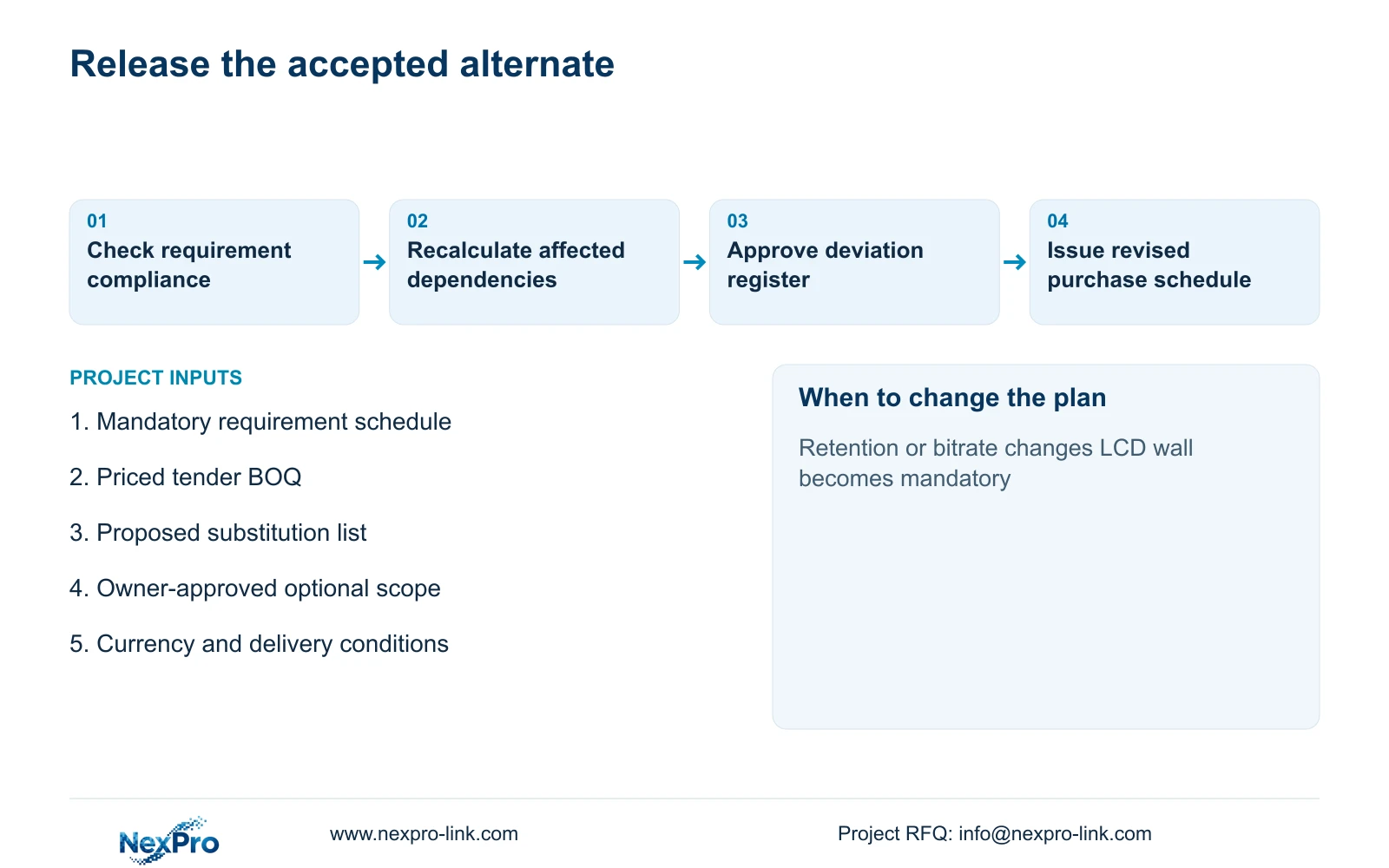
The alternate submission should contain the unchanged requirement schedule, exact substitutions, owner-approved deferrals and a complete cost bridge. Pair each technical change with its supporting document and any required sample check. The contractor should be able to trace the revised purchase schedule back to the accepted tender decision without reconstructing assumptions from correspondence.
Maintain mandatory brand, platform or specialist requirements where they apply. A NexPro-Link alternative needs explicit permission to enter the comparison if the tender restricts substitutions. Where mixed equipment is proposed, identify the exact workflow requiring verification, including playback and export. A lower equipment subtotal cannot resolve an untested integration requirement.
Release purchasing only after the approving party accepts the deviations and unresolved inputs have named owners. Record changes to quantities, delivery phases and installation boundaries separately from model substitutions. NexPro-Link can discuss the associated equipment list, technical documents and project packing within its published supply scope. Local installation and final project approval remain assigned to the relevant project parties.
Section 07
Buyer questions
Can an alternate be submitted before every model is approved? Yes, as a conditional proposal. Identify unapproved models and the evidence needed to close each item. Keep any provisional price distinguishable from an accepted equivalent offer so procurement does not release an unresolved substitution.
What if the tender makes the original brand mandatory? Seek permission before proposing a brand substitution. If no substitution is allowed, evaluate permitted optional equipment, preparation or packaging changes while keeping the required brand and operating scope intact.
Should later expansion equipment be included in the base alternate? Include only the capacity needed for the accepted current and committed future scope. Price discretionary expansion separately, with its dependencies identified. A deferred item may still require reserved space or infrastructure if the owner intends to add it later.
Section 08
Prepare a defensible tender alternate
Send the mandatory requirement schedule, priced BOQ, proposed change list and currency/delivery conditions to info@nexpro-link.com. NexPro-Link can discuss model matching and a documented alternate with explicit retained functions and exclusions.
Engineering references
These sources support the general planning principles. Always use the selected product's current datasheet and applicable project standards for final design.