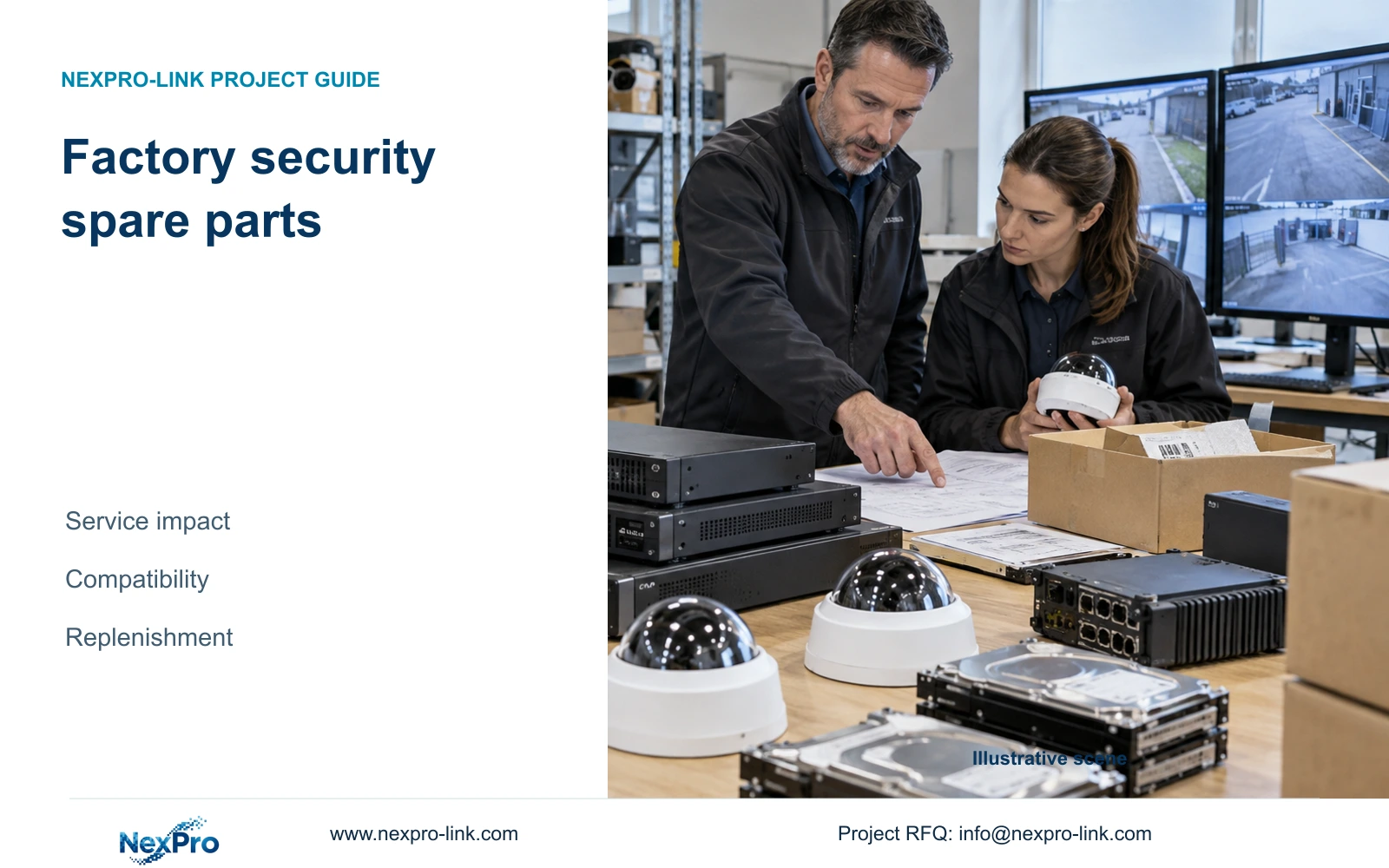
Factory security spares should cover defined service roles. Match compatibility and restoration needs before deciding which items to hold locally or replenish through a supplier.
Section 01
Rank the lost task before choosing spare quantities
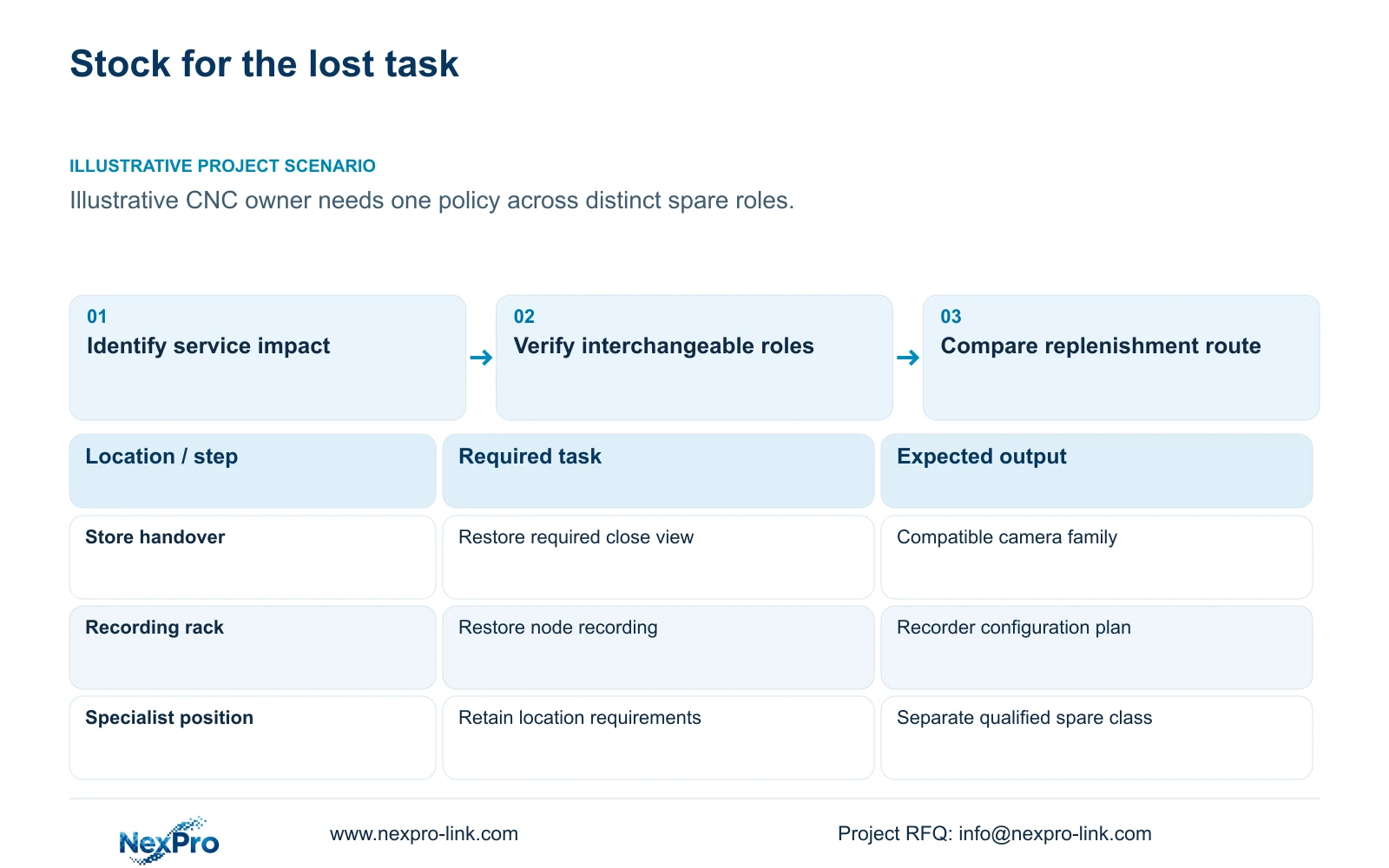
Size factory security spare stock by the function lost, accepted interruption and practical replenishment route. A universal percentage of camera quantity ignores the difference between one unavailable overview and a failed recorder serving an entire node. First identify which roles need a local replacement and which can wait for an agreed supply process.
Illustrative project scenario: The owner wants one spare policy for ordinary cameras, recorders, disks and specialist front ends. Use the supplied 32-camera CNC package as the ordinary-area baseline, with one recorder and four disks. Specialist front ends are a separate potential scope, not equipment present in CASE01. No failure frequency or delivery lead time is assumed.
For each role, describe the missing outcome: gate context, store handover detail, continuous recording or authorised retrieval. Ask the owner how long that outcome may be unavailable and whether another accepted view can provide useful temporary evidence. Assign the local service party and record the access conditions. Those answers determine the stocking decision more directly than the purchase price alone.
Section 02
Build spare families from verified interchangeability
Group ordinary cameras only where a spare can satisfy the actual lens, image, mounting, environmental and interface requirements. A camera family name or equal resolution is insufficient. Maintain a compatibility schedule linking each spare to approved installed roles and the firmware combination used with the recorder. Mark untested substitutions as pending rather than available coverage.
The supplied NexPro-Link 5MP bullet and Dome specifications list a 2.8–12 mm motorized lens and 2880×1620 output. Retain that output as listed when matching a replacement. A compatible stream still needs the required recording, retrieval and any audio or event behaviour checked. ONVIF profile guidance supports checking exact device, client and firmware applicability; basic video connectivity does not establish every workflow.
Keep specialist cameras in separate stock classes. An ordinary camera is not an assumed replacement for a special environment or approved assembly. If several sites share ordinary spares, check transport access and who can release the stock. A technically interchangeable device in another inaccessible store does not provide the same recovery route as one held beside the serviced installation.
Section 03
Compare complete replenishment routes with interruption tolerance
Map replenishment from fault recognition through diagnosis, approval, dispatch, arrival, installation and verification. Obtain the supplier's actual process and the local contractor's access arrangements. Do not enter an assumed delivery promise just because the item is listed in a catalogue. The owner should compare the complete route with the interruption it is prepared to accept.
Where the external route exceeds the accepted interruption, propose local stock, a service-held spare or another explicitly agreed continuity measure. If the owner permits a longer gap and the supply route is credible, replenishment without dedicated local stock may be acceptable. Record the decision by role, including any temporary loss of capability the owner accepts.
Quantities need a further decision about simultaneous demand and replenishment after a spare is consumed. Ask whether a shared spare may remain installed while the failed unit is assessed and who orders its replacement. Without operating history, do not invent a stock optimisation result. Approve a provisional quantity with a review trigger and make the uncertainty visible in the procurement schedule.
Section 04
Compare spare roles without a blanket percentage
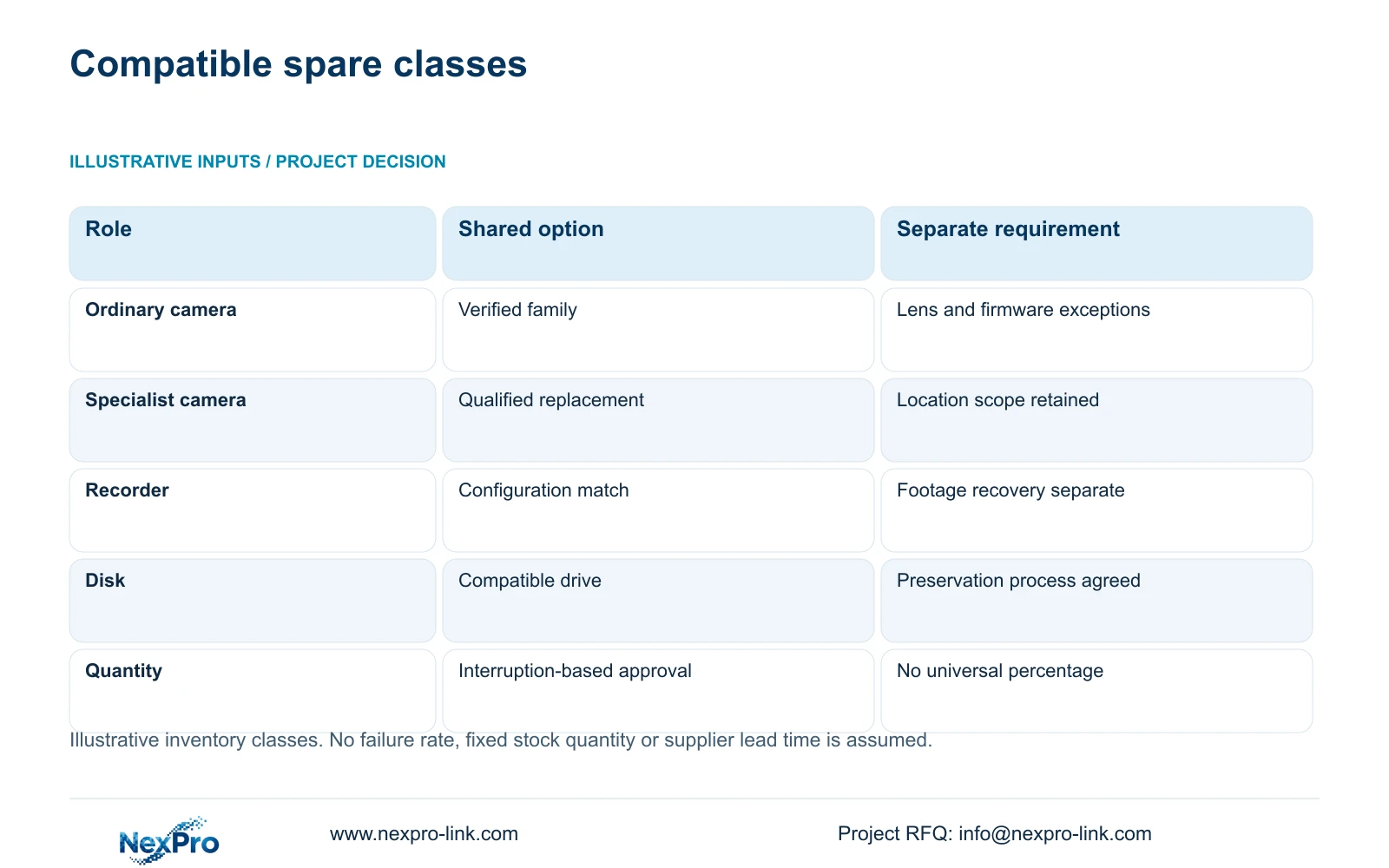
Use the matrix to turn the inventory classes into purchasing choices. Its method is to compare tolerated interruption, replenishment process and actual interchangeability for each role. The rows are filled decisions, not arbitrary scores. They also distinguish restoring new recording from recovering historical footage, which spare-hardware lists often leave unresolved.
The recorder row matters in the CNC baseline because one recorder serves the 32 planned camera streams. A spare must match the required recording modes, input demand, disk arrangement and configuration. NexPro-NVR4449-4K is the case reference, with four SATA bays; its channel count does not establish RAID or every decoding scenario. A replacement chassis does not contain a copy of the previous footage.
For disks, identify a compatible replacement model and the approved preservation and initialization procedure. A spare disk may support restoration of recording capacity, but it does not recreate overwritten or lost video. Decide evidence preservation separately. Stock quantities remain provisional until interruption, service access and real replenishment inputs have been agreed.
| Inventory role | Shared-spare option | When to separate or expand |
|---|---|---|
| Ordinary cameras | Verified compatible family | Different lens, mounting or firmware requirements |
| Specialist front ends | Qualified specialist replacement only | Location scope or interfaces differ |
| Recorder | Verified configuration and storage match | Recording modes or recovery process differ |
| Disks | Approved compatible drive stock | Preservation or capacity requirements differ |
| Stock quantity | Approved interruption-based quantity | Concurrent demand or replenishment changes |
Section 05
Keep usable stock and coverage records together
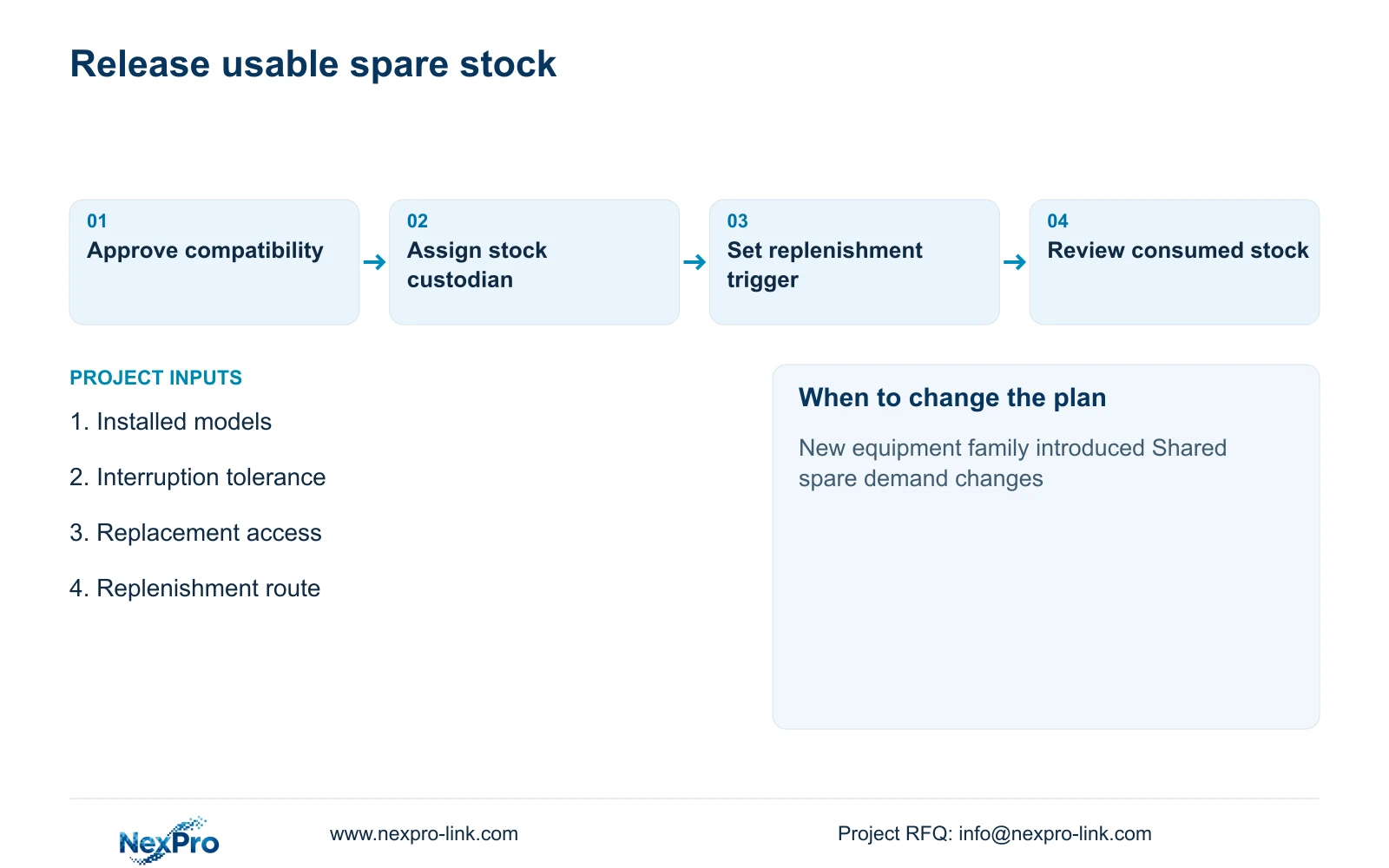
Recommend a role-based stock policy with a custodian, compatibility record and release procedure. Store the spare with the correct accessories and maintain its readiness according to the selected equipment's instructions. Label the installed roles it may cover, while keeping network credentials under the owner's controlled process rather than printed on cartons.
Separate warranty entitlement from stock availability. The supplied NexPro-Link policy gives eligible main equipment a receipt-based baseline, so an unused spare should not be assumed to begin coverage only when installed. Obtain the terms for disks, batteries and other accessories separately. A warranty claim can replenish stock through an agreed remedy, but it is not itself a continuity plan.
Change the policy when a new model family, specialist location or tighter interruption target is introduced. Recheck shared stock before expanding to another building. When comparing brands or supply partners, require the same supported roles and service boundary; an inexpensive spare that cannot be installed in the required position is not a useful equivalent.
Section 06
Release a controlled spare and repeat-order schedule
The procurement schedule should identify installed quantity, approved spare model, proposed stock quantity, covered roles, location and replenishment owner. Distinguish initial installed equipment from separately purchased service stock. Include mounting accessories or termination items where they are necessary for the replacement task, rather than assuming they can always be recovered from the failed installation.
Retain configuration references and acceptance evidence for the approved spare family. If a supplier proposes a substitution on a repeat order, compare the technical difference before changing the stock record. NexPro-Link's BOQ support can help organise model matches and deviations, with project approval remaining with the buyer. Project packing can keep replacement kits identifiable without concealing their actual model.
Review consumption and unresolved service cases once operating records exist. Increase, reduce or split stock only for a documented reason such as recurring demand, changed access or a different replenishment route. This produces a repeat-order standard that can be updated deliberately, rather than a permanent percentage carried forward from the first quotation.
Section 07
Buyer questions
Can a shared spare serve two factories? Yes, if compatibility, transport access, release authority and the possibility of competing demand are acceptable. Shared ownership alone does not establish that either site can restore its required task in time.
Does a spare recorder preserve old footage? No. It can support restoration of the recording function after configuration and storage checks. Historical footage preservation requires its own supported process.
Should unused spares be excluded from the warranty register? No. Record their receipt and applicable terms alongside installed equipment. Do not assume coverage waits until installation unless the accepted arrangement says so.
Section 08
Define a role-based spare package
Send your installed model schedule, accepted interruption by role, replenishment location and local replacement responsibilities to info@nexpro-link.com to discuss compatible factory security spare stock.
Engineering references
These sources support the general planning principles. Always use the selected product's current datasheet and applicable project standards for final design.