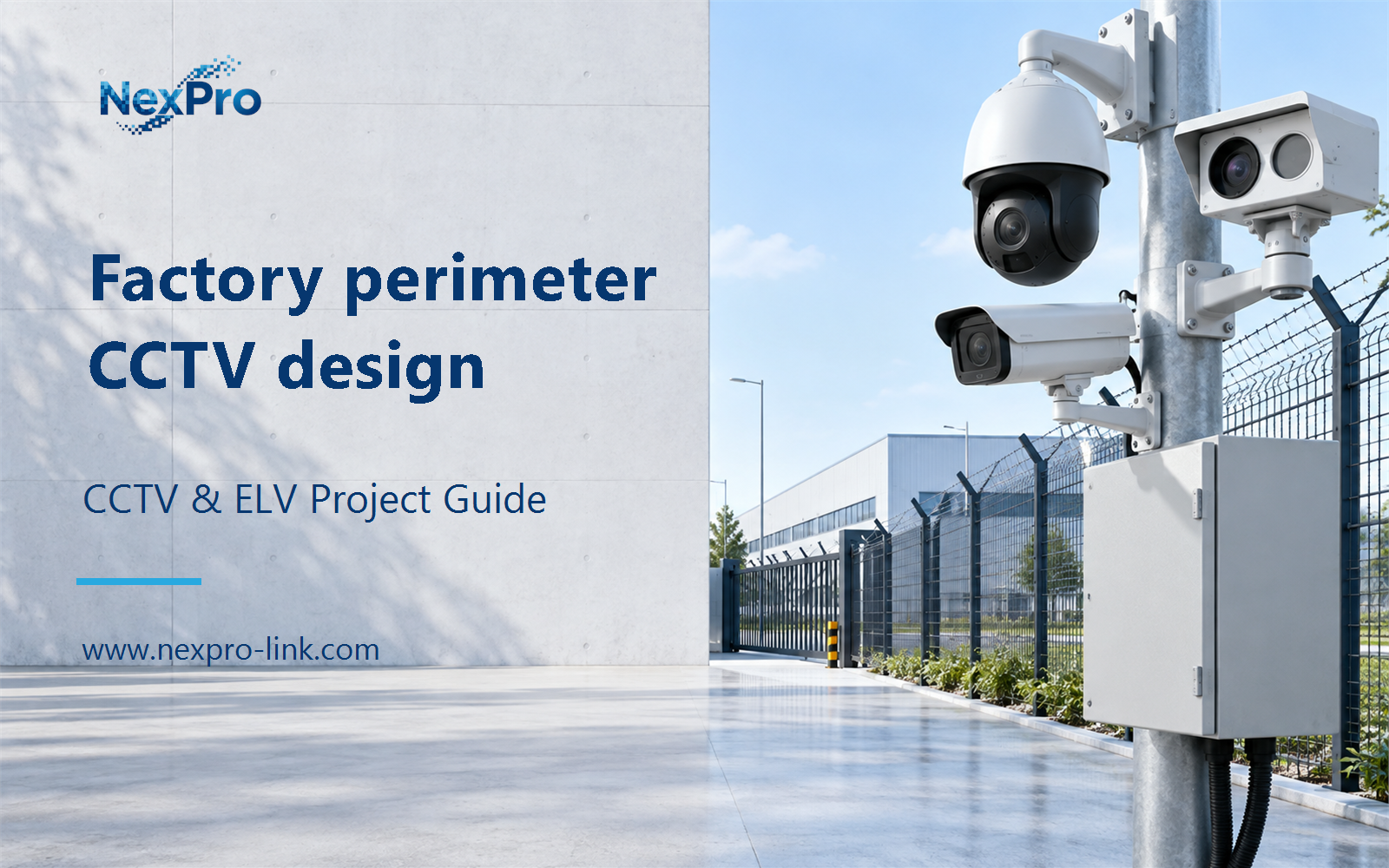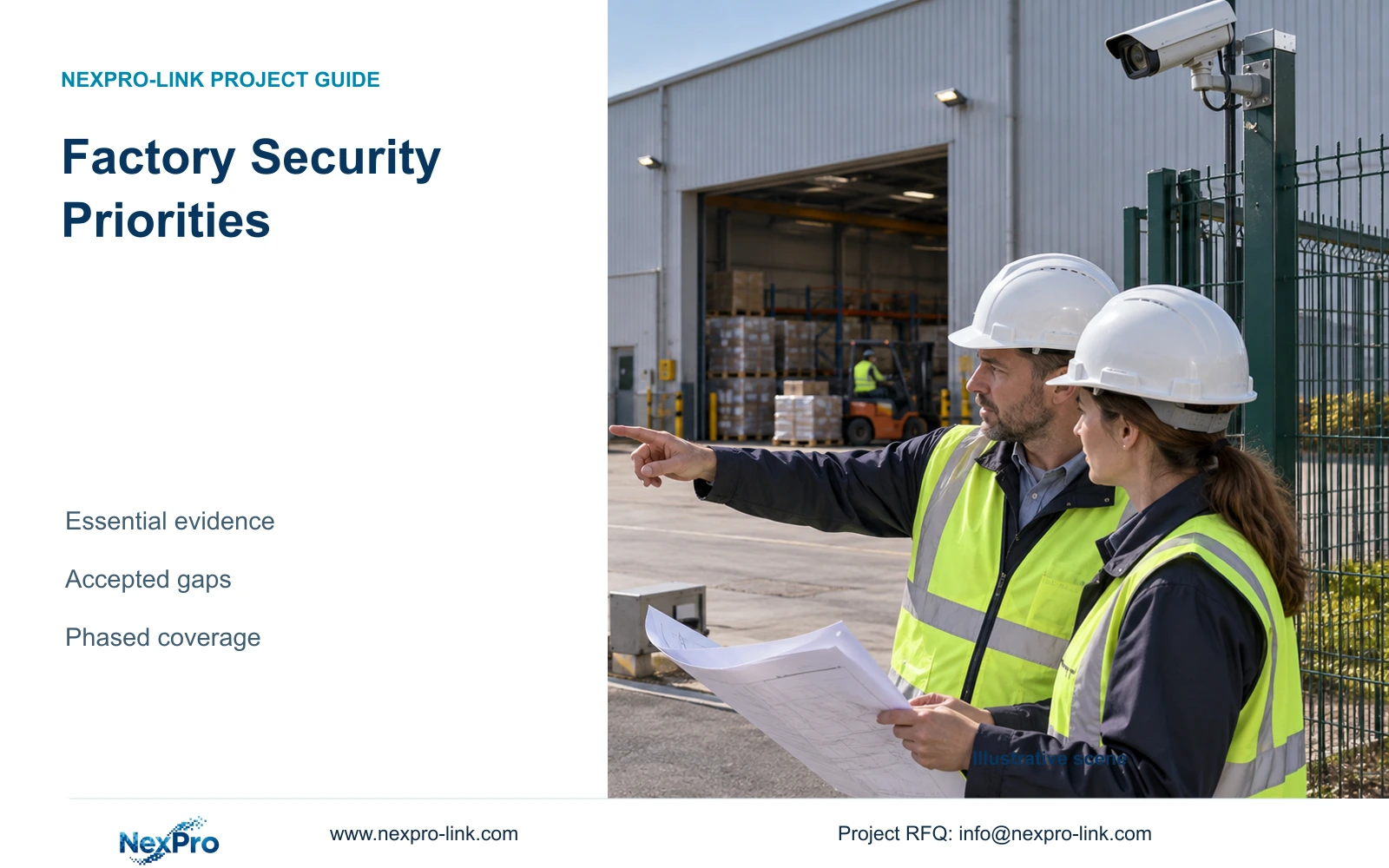
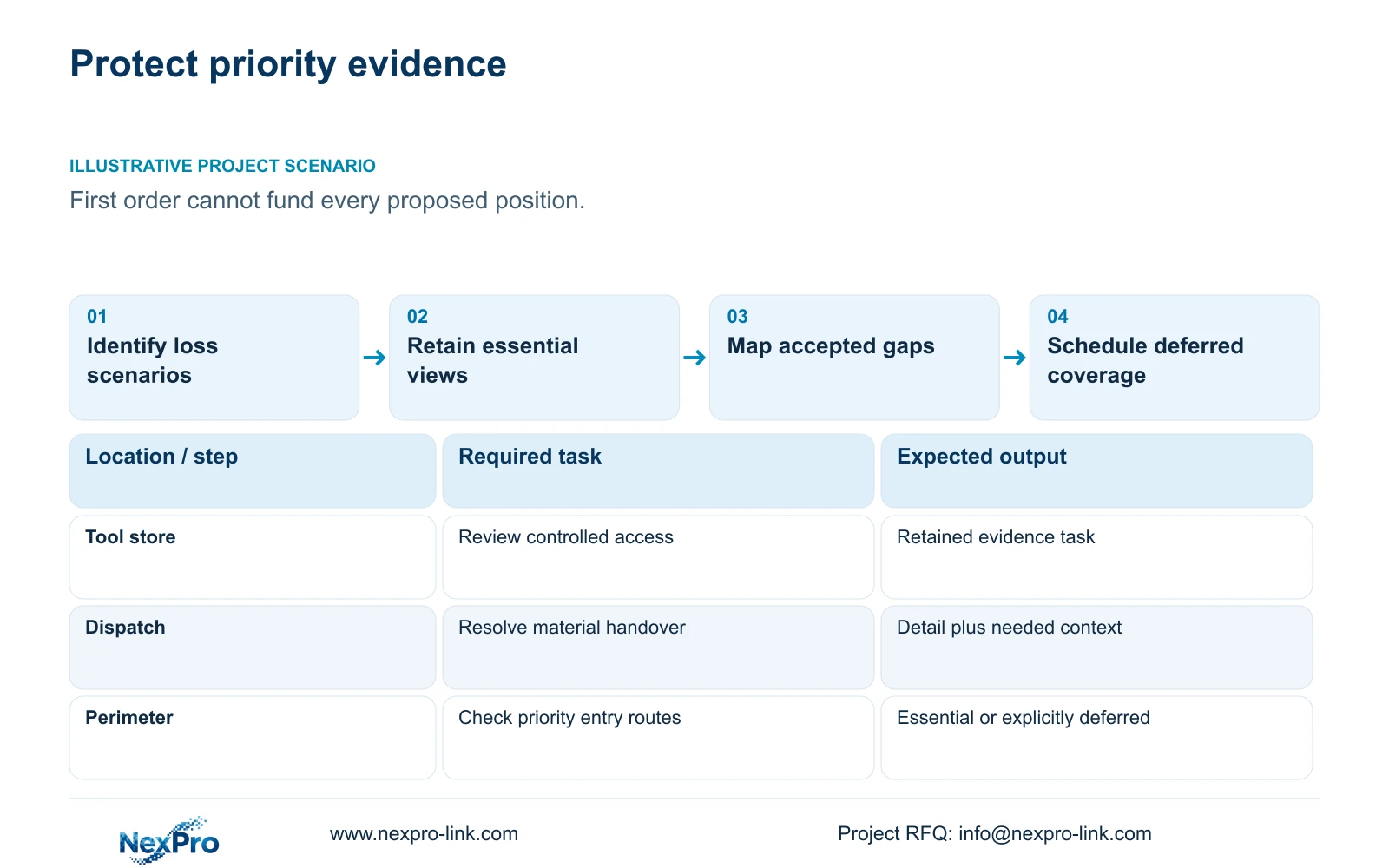
When the first order cannot fund every position, protect the views that answer agreed loss scenarios and make deferred coverage gaps explicit.
Section 01
Prioritise the unanswered loss scenario by zone
Fund the smallest complete security package that preserves evidence for the owner's agreed loss scenarios. Entrances, high-value stores and perimeter positions have different purposes, so none deserves automatic first priority. Identify the event each view must resolve and the consequence of leaving that event unrecorded before reducing the schedule.
Illustrative project scenario: A factory owner cannot fund every proposed camera position in the first order. Assume the immediate concerns are disputed material handovers, access to a tool store and movement through two gates. Additional perimeter overview is proposed, but the owner has not yet decided whether guards need continuous boundary observation or only later incident review.
Compare zones using explicit consequences rather than invented scores. A store view may preserve the only record of a controlled transfer; a gate overview may provide essential route context; a perimeter view may be necessary where another credible loss route exists. The owner should approve which events remain observable in phase one and which gaps are knowingly deferred.
Section 02
Protect the view that supplies necessary detail
Write an evidence task beside every retained position. At dispatch, distinguish following a pallet's movement from resolving the handover itself. At a store entrance, specify the target plane and obstruction conditions. Removing the only suitable detail view can leave the system unable to answer the priority question even when several broad views remain.
A practical retained position needs an achievable angle, adequate target width and suitable lighting during the relevant shift. Examine the loaded state as well as an empty floor plan: pallets, vehicles and temporary screens may block the target. Where a broad camera supplies essential approach context, identify it as part of the evidence task rather than classifying every overview as optional.
The NexPro-BL2812M55-5MP-DIC-AI and source Dome NexPro-DM2812M55-5MP-DIC-AI list a 5MP family output including 2880×1620 and a 2.8–12mm motorized lens. Those fields support view planning, not a guaranteed recognition distance. The lens range cannot establish a usable target width without the mounting geometry and accepted image task.
Section 03
Defer coverage without breaking the operating package
Separate deferred camera positions from infrastructure required by retained positions. Phase one still needs recording capacity, power, connections and authorised retrieval for every accepted view. A reduction that removes cameras but leaves their only access switch unfunded does not create a usable smaller system.
The illustrative CNC reference contains 32 positions: four gate overviews, six material or tool-store views, ten permitted machine-hall transfer views, four common-route views, six dispatch views and two equipment-room approaches. Use those groups to discuss priorities, not as a preapproved reduction list. The ten transfer views serve security observation and do not represent machine inspection or guarding.
For deferred positions, record the task, location assumption and trigger for release. Install shared containment early where later access would disrupt operations, but price that work separately from absent devices. The project manager owns the phase schedule; the engineer verifies shared capacity; the installer identifies access constraints. Future provision should correspond to defined additions rather than an unexplained oversizing allowance.
Section 04
Compare detail density with the coverage sacrificed
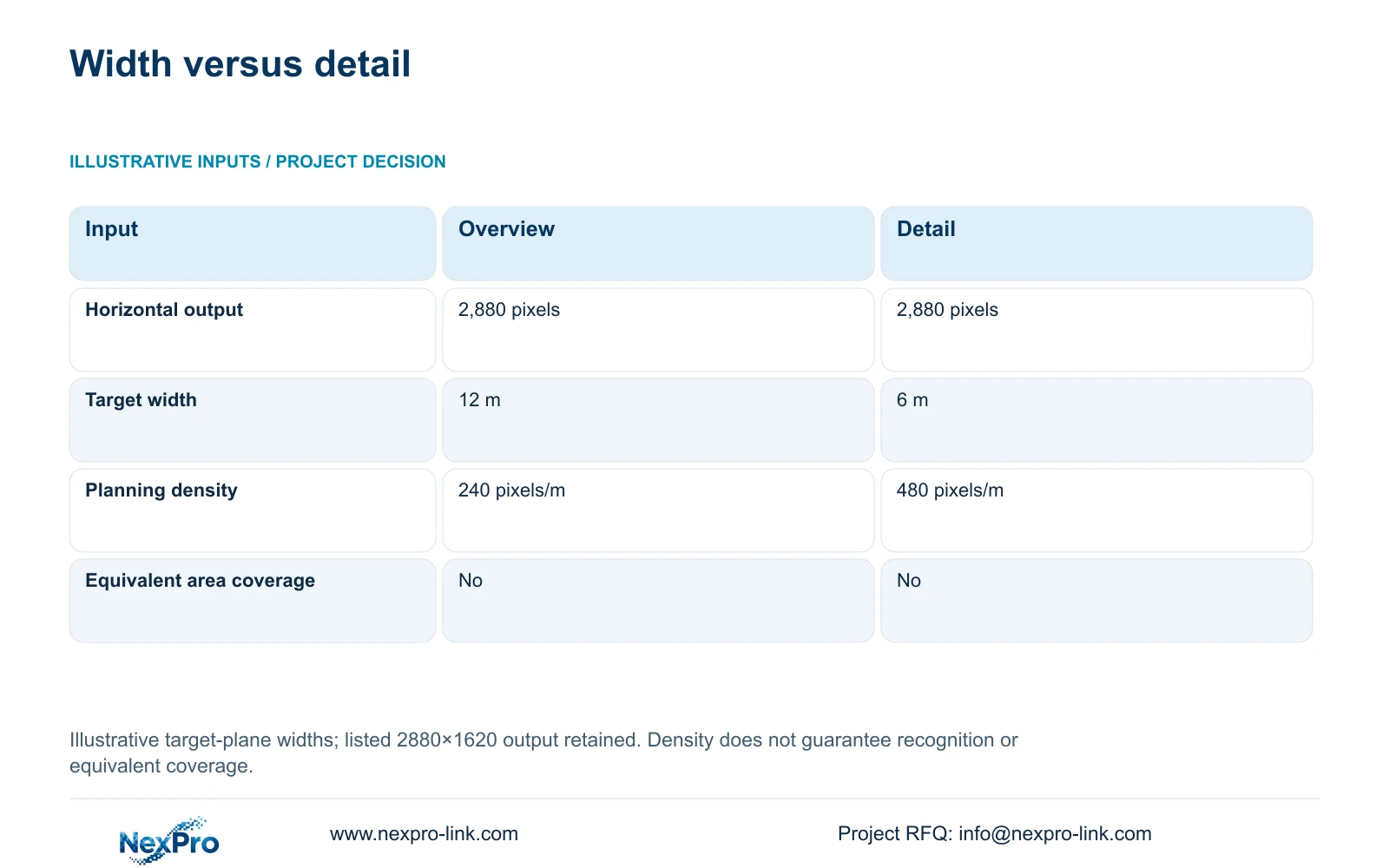
This illustrative comparison uses 2,880 horizontal output pixels and two assumed widths at the target plane. Option A covers 12 m; Option B covers 6 m. Calculate planning_pixels_per_metre = horizontal_output_pixels / target_width_m. The results are 2,880 / 12 = 240 pixels per metre and 2,880 / 6 = 480 pixels per metre.
The narrower view doubles planning density while removing half the horizontal span at that plane. It does not provide equivalent area coverage or prove that fewer cameras can meet both tasks. If the owner needs the movement context outside the 6 m view, retain a separate overview or revise the arrangement so the accepted context remains visible.
Use the comparison to protect the relevant detail task during budget cuts. These widths are planning geometry, not guaranteed fields of view from a particular lens setting. Motion, illumination, compression and obstruction still affect usable footage. There is no universal acceptance threshold attached to either density; review representative recorded footage against the owner's actual question.
| Planning input | Option A: overview | Option B: detail |
|---|---|---|
| Horizontal output | 2,880 pixels | 2,880 pixels |
| Target-plane width | 12 m | 6 m |
| Planning density | 240 pixels/m | 480 pixels/m |
| Equivalent area coverage | No | No |
Section 05
Spend first on accepted tasks and their dependencies
For the stated scenario, retain useful store-access and handover evidence, together with enough gate context to trace those movements. Defer additional perimeter overview only after confirming it is not the sole view of an agreed priority event. If the owner's main concern instead involves boundary entry, perimeter coverage moves into the first package and the retained list changes.
Keep display upgrades subordinate to the viewing task. A normal retrieval monitor may be sufficient where staff review incidents on demand. The case's optional wall adds an assumed 580 W through four 120 W LCD loads and a 100 W decoder load, so it also changes protected-power demand. That calculation is illustrative and gives no measured consumption or runtime guarantee.
Compare bids using the same priority events, shifts, retention and accepted blind spots. A proposal with fewer cameras may be appropriate if it preserves those results, but its quoted saving must come from matched complete quotations. Mandatory platforms or specialist environments may restrict the alternative; preserve those requirements rather than trading them away to meet a camera-only budget.
Section 06
Release phase one with an explicit coverage record
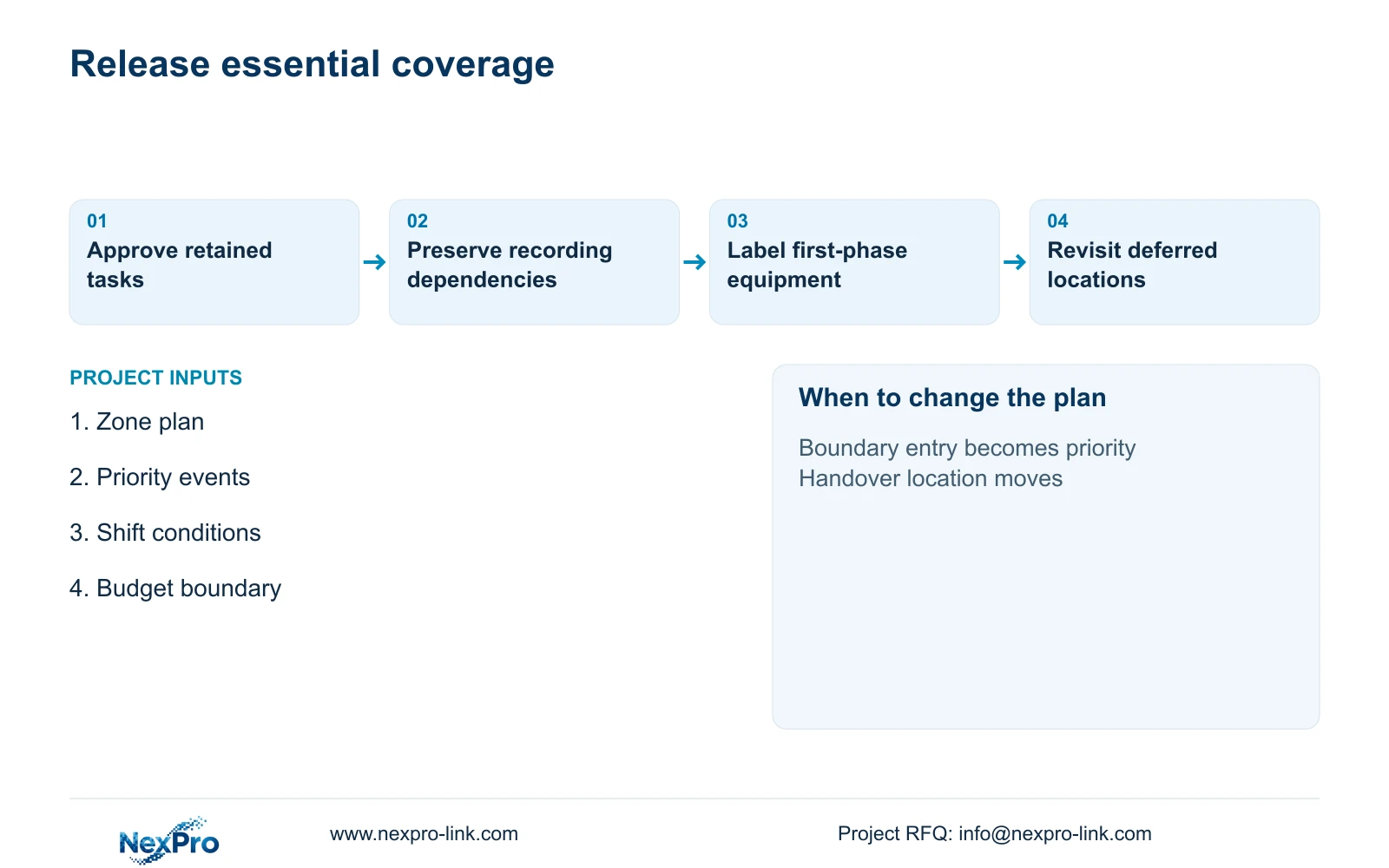
Prepare a phase-one schedule that labels each position essential, supporting or deferred and explains the task behind that status. Include an annotated plan showing the accepted viewing boundaries. The owner should see where evidence will be unavailable, rather than infer full-site protection from the existence of a recording system.
Keep each accepted view connected to its recorder, switch, power node and retrieval role. NexPro-Link's factory project supply and BOQ support can help translate this reduced schedule into equipment and technical documents. Label the initial shipment by the retained positions so the installer does not confuse deferred locations with missing equipment.
Before ordering the later phase, revisit operating routes and stored-material heights. Changes can alter camera angles and cable work even when the original position count remains unchanged. Record revised scope against the earlier accepted gap list, so additional expenditure closes a defined need and the owner can judge whether the intended coverage has been achieved.
Section 07
Buyer questions
Can event recording compensate for a smaller first-phase budget? It can change storage demand, but it does not restore an absent view. Use it only where the trigger and recording behaviour preserve the required event, including relevant lead-in and follow-up footage.
Should spare cameras be purchased before deferred positions? Decide from replacement consequences and supply arrangements. A spare may support continuity at an essential position, while a deferred camera addresses a separate coverage gap. Identify both purposes instead of treating them as interchangeable quantities.
Who accepts the blind spots left by phase one? The owner or designated operational decision-maker should accept the stated gaps, informed by the engineer's view plan. The installer confirms implementation; installation completion alone does not establish acceptance of the reduced coverage.
Section 08
Build a task-based first order
Email info@nexpro-link.com with your annotated zone plan, priority loss or handover scenarios, shift conditions and phase-one budget boundary. NexPro-Link can discuss essential views and separately scheduled additions.
Engineering references
These sources support the general planning principles. Always use the selected product's current datasheet and applicable project standards for final design.