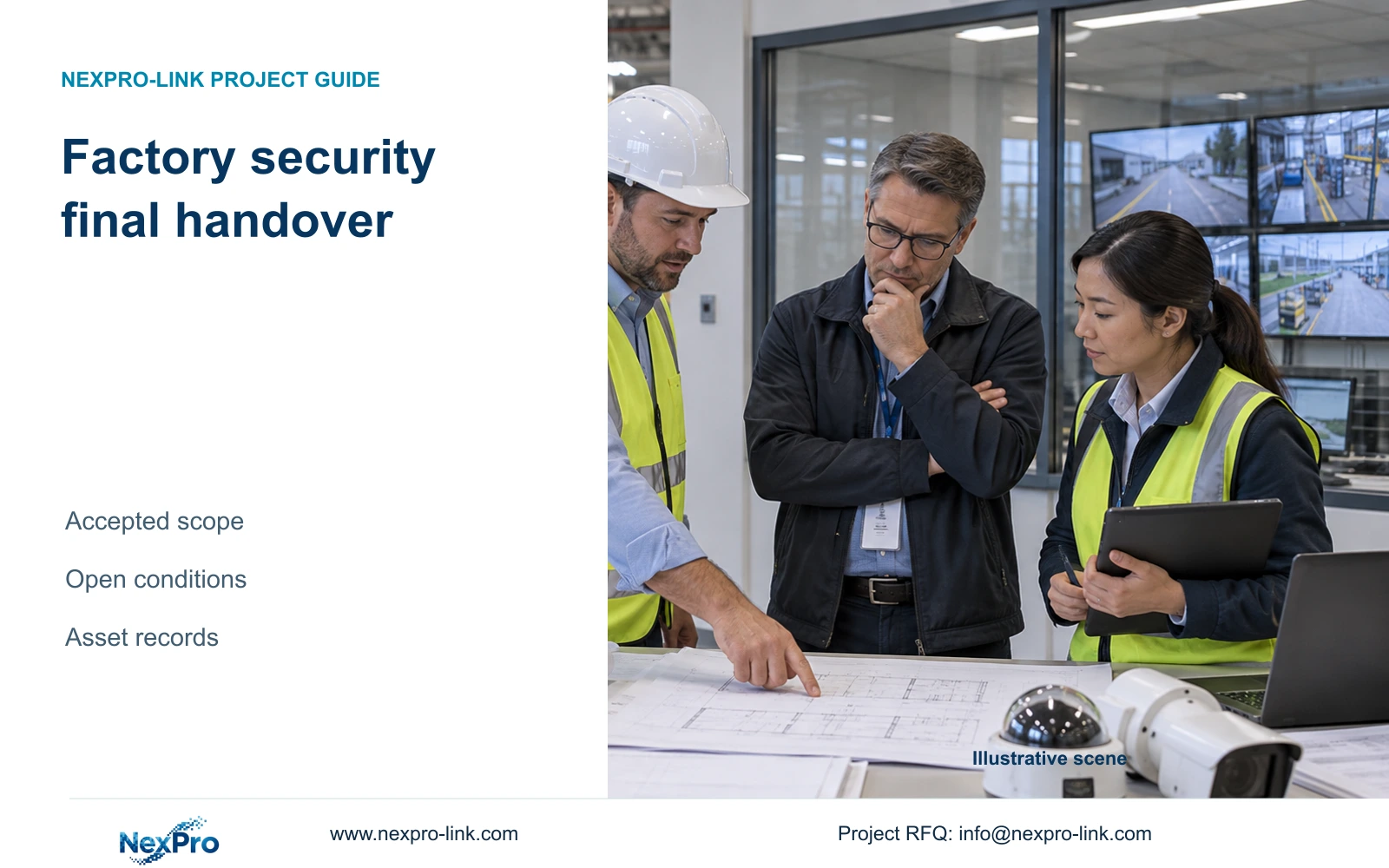
Factory security final handover should identify which installed tasks are accepted, which conditions remain open and who owns each correction before operations take over.
Section 01
Tie acceptance to installed tasks and identified assets
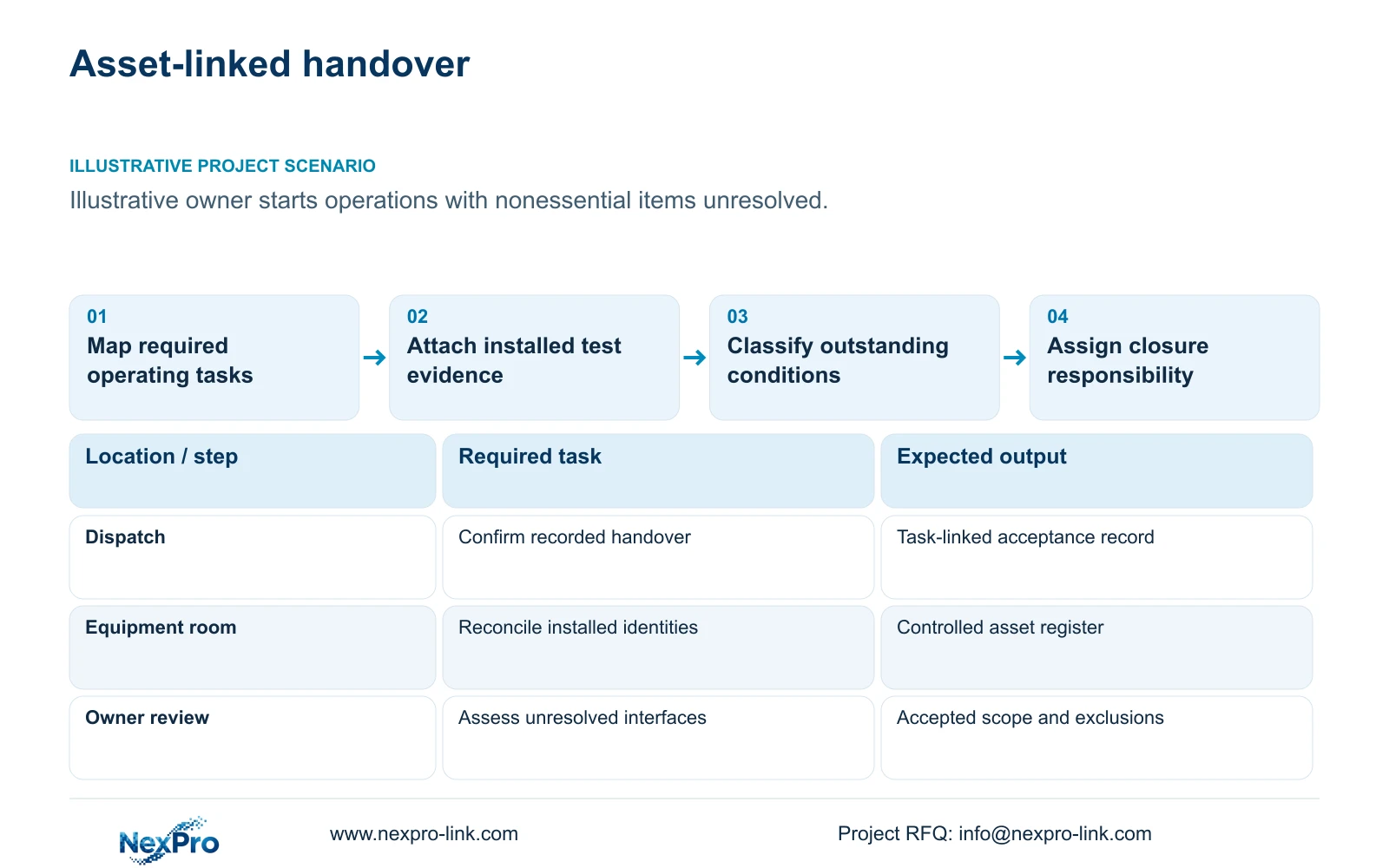
Factory security final handover should state the accepted operational scope and list every outstanding condition with its responsible party. Map each required task to the installed assets and supporting test record. Shipment confirms delivery; power-on confirms a limited equipment state; operational acceptance requires evidence of the agreed task. Any contractual completion status should be recorded separately using the project's agreed procedure.
Illustrative project scenario: The owner wants to occupy the plant while a small set of nonessential items remains unresolved. Use CASE01's proposed 32-camera CNC factory package as the planning background. Assume the unresolved work includes a correction to a document label and an optional management interface. Their nonessential status must be confirmed by the owner against the required operating tasks; these hypothetical examples are not completed customer works.
Start the handover schedule with gate access review, store transfers, permitted machine-hall movement and dispatch retrieval. For each task, identify camera tags, recorder, network connection, protected-power dependency and authorised viewing route. An installed camera can have a working picture while the relevant recorded sequence remains unusable. Linking acceptance to the task prevents that device-level success from masking a missing operating function.
Section 02
Separate deferred work from missing operational evidence
Classify outstanding entries by their effect on the accepted service. A spelling correction on a drawing may be deferred if the physical asset can still be identified reliably. A missing dispatch recording, inaccessible export account or unverified required backup duration affects an operating task and needs a different decision. The project manager should record the owner's reasoning for any conditional acceptance instead of marking every open item as a minor snag.
Each entry needs a specific symptom or missing record, affected assets, interim arrangement, named responsible person, target closure date and retest condition. For the hypothetical optional interface, state whether it is excluded from the current operating boundary or remains an uncompleted contractual deliverable. That distinction preserves the commercial record without suggesting the owner has waived work simply by starting operations.
Record unavailable test conditions as untested. If night loading has not occurred, a daytime image cannot close night acceptance. If an outage test was not permitted, retain the approved load schedule and the missing installed-test record separately. Factory preparation can support the equipment baseline, but it cannot resolve site views, installed power paths or operating conditions that were never demonstrated.
Section 03
Give the maintenance team a usable operating record
The operating package should connect model, serial number and project tag to camera location, switch port, recorder assignment and applicable test evidence. Include approved drawings, installed firmware records, configuration backups and restricted account-recovery instructions. Record who controls each document after handover. A folder of unmatched manuals leaves maintenance staff reconstructing the system during a fault.
For CASE01, distinguish the planning schedule from verified installed assets: 32 new ordinary-area cameras, four access-switch load groups and one recorder are proposed. The NexPro-NVR4449-4K public reference lists 49 channels, 320 Mbps input and four SATA bays with up to 18 TB per drive. Those catalogue fields help identify the intended recorder, but they do not prove the installed stream mode, disk health, simultaneous playback performance or RAID.
Attach operator instructions for retrieval, export and escalation, plus the actual training result. Keep supplied equipment, owner-retained resources, installer-provided services and optional additions distinguishable in the asset register. NexPro-Link's project-supply scope can coordinate equipment and documentation, while the local installer records final connections and the owner appoints document custodians. The final package should let each party find its responsibilities without interpreting an undifferentiated equipment list.
Section 04
Keep optional integration outside the accepted recording boundary
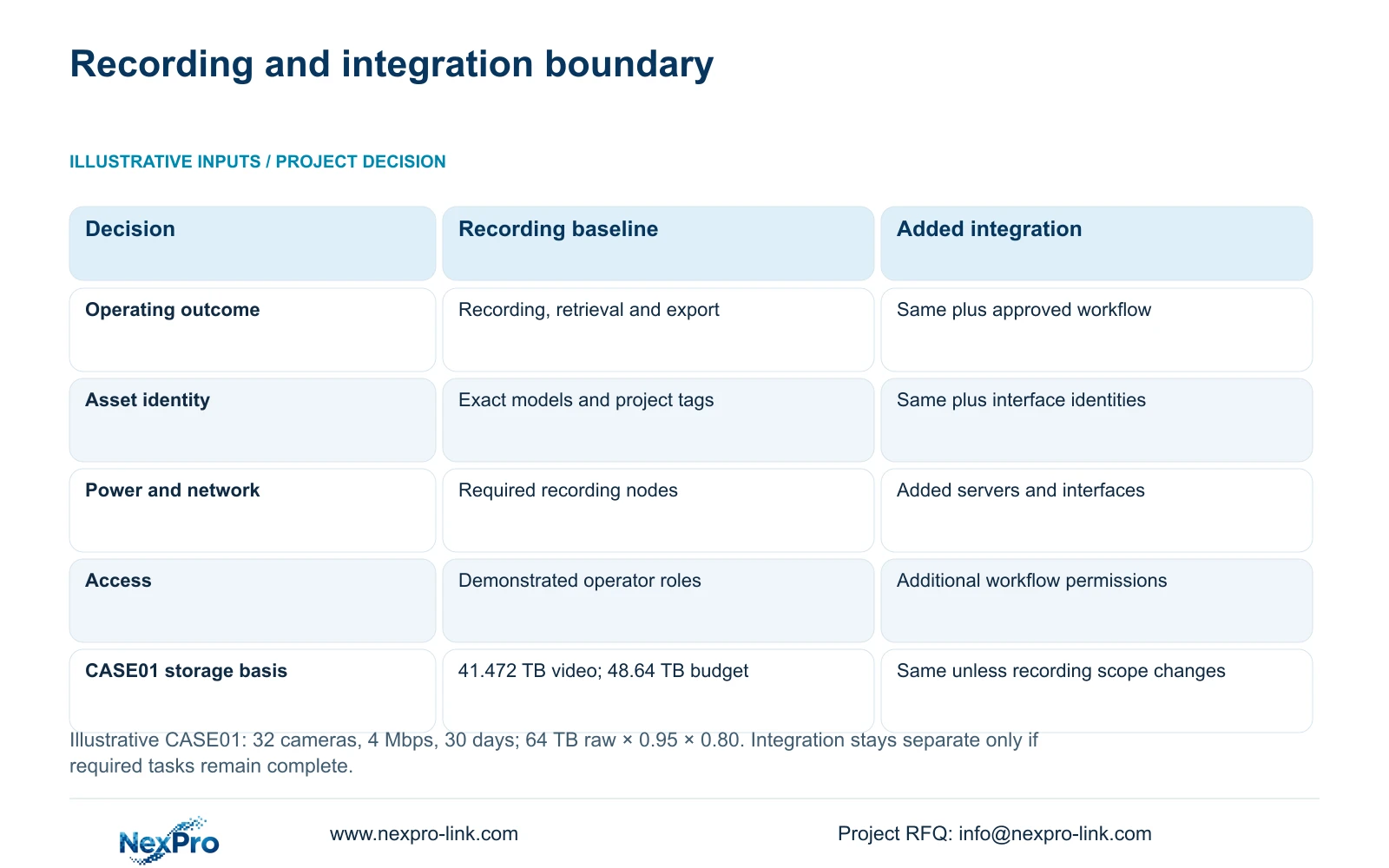
Use a complete local recording package as the baseline when it meets the owner's agreed tasks. Compare an additional management interface against that same outcome, with its extra dependencies shown explicitly. Assign each line to supplied, retained, installer-provided or optional, and name one interface owner. A blank field represents unresolved scope; it should not be treated as a free item or evidence that an interface is impossible.
The decisive difference in the comparison is the additional operating chain. An optional server or interface brings its own network access, power, configuration, permissions and support responsibilities. It can remain outside the accepted baseline only when no required task depends on it. If the owner's required alarm or retrieval workflow passes through that interface, its unfinished state belongs within the operational acceptance decision.
CASE01 provides a useful capacity cross-check without establishing a site result. At 32 cameras, 4 Mbps average and 30 continuous days, video_TB = 32 × 4 × 10^6 × 86400 × 30 / 8 / 10^12 = 41.472 TB. Four 16 TB drives give 64 TB raw; the illustrative recording budget is 64 × 0.95 × 0.80 = 48.64 TB. Compare 41.472 TB directly with 48.64 TB because formatting allowance and reserve are already included. Installed retention still needs its own recording evidence.
| Handover decision | Option A: recording baseline | Option B: added integration |
|---|---|---|
| Required outcome | Local recording, retrieval and export | Same outcome plus approved workflow |
| Asset identity | Camera, recorder and project tags | Same plus interface asset identities |
| Network and power | Required recording nodes documented | Additional server and interface dependencies documented |
| Software and access | Required operator roles demonstrated | Additional permissions and workflow tested |
| Procurement boundary | Complete supplied and installer scope | Added scope with named interface owner |
Section 05
Release only the operating scope the evidence supports
Recommend an asset-linked handover record that identifies accepted functions, exclusions and open conditions before responsibility transfers to operations. The owner should review whether the documented baseline supports the intended use of the plant. The engineer checks the evidence and dependency boundaries; the quantity surveyor reconciles outstanding work with the order. This recommendation concerns the security package and does not itself authorise building occupancy.
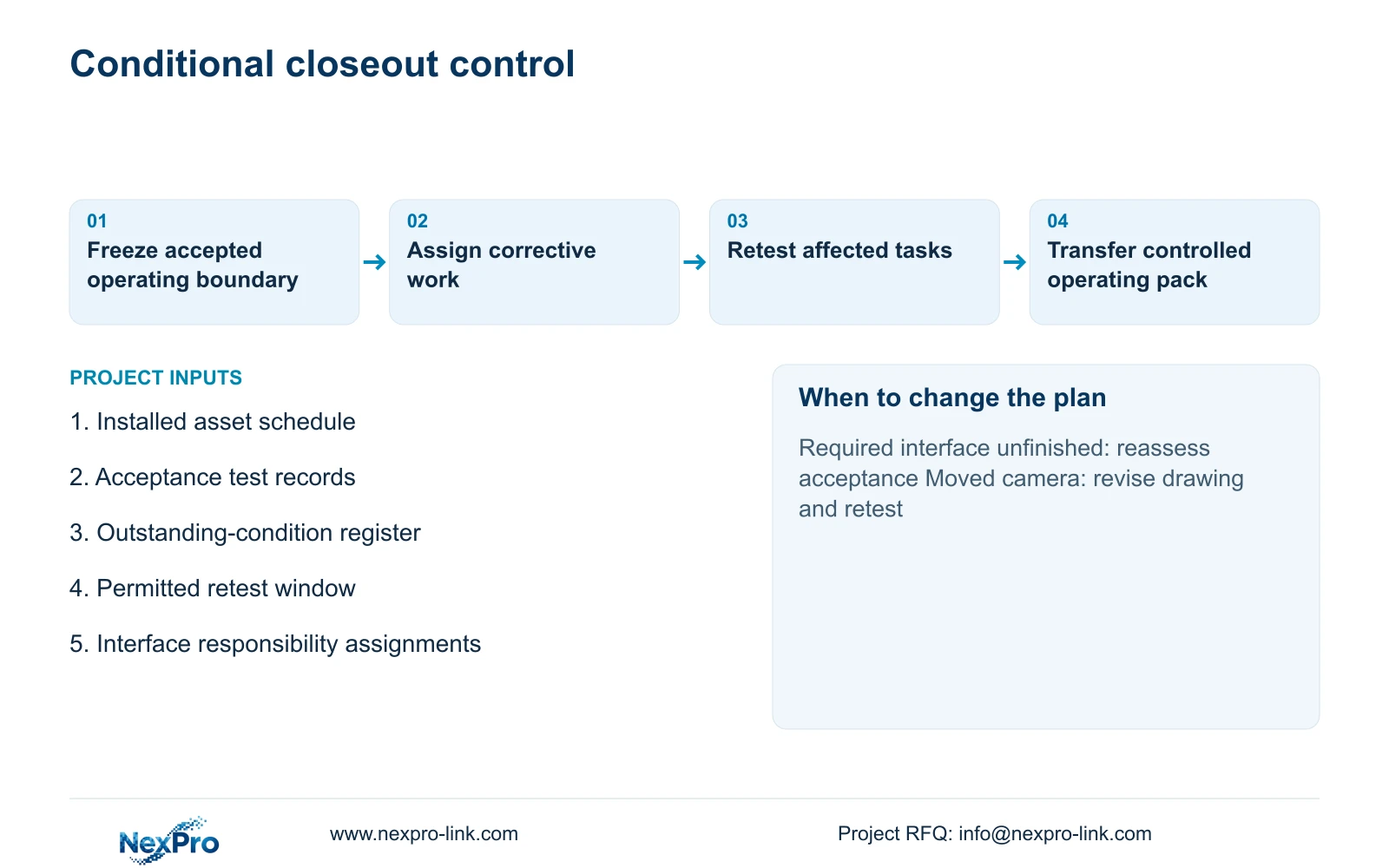
Keep the recommendation conditional where a required function remains untested or defective. A working recorder cannot compensate for an unpowered camera group, and successful local export cannot establish a required remote-management route. For multi-brand interfaces, ONVIF profile and exact firmware applicability need checking against the requested feature. Basic video connectivity alone does not demonstrate every event, search or audio workflow.
Closure should include the corrected asset or document, retest result and updated revision reference. If a camera is moved to resolve a blind spot, revisit its name, route drawing and affected acceptance record. Compare alternative supplier closeout proposals using the same task and responsibility boundary. Additional local service or required integration may justify a different package, but no unsupported brand ranking or invented completion cost belongs in the decision.
Section 06
Price corrective work against the remaining responsibility gaps
Turn the open register into a limited closeout request. Separate replacement equipment from configuration correction, document revision, site attendance and repeat testing. Ask for the technical basis before ordering another recorder or camera. A fault in the installed network path requires different work from a missing product function, even when both appear to the operator as lost footage.
Use the approved sample or batch schedule to reconcile delivered units with installed identities. Specify permitted retest conditions, including any production-access restrictions, and the task that will close each entry. NexPro-Link's BOQ and tender support can help match models, technical submissions and quotation scope. Local installation and final approval remain assigned to the relevant project parties rather than being implied by coordinated equipment supply.
At closure, issue a controlled operating baseline with the outstanding register either closed or explicitly carried forward. Preserve earlier records so an accepted limitation is not mistaken for a later fault. Transfer support contacts and applicable order terms with the assets, and identify who updates the pack after future changes. The next maintenance visit should begin from a known configuration and service boundary.
Section 07
Buyer questions
Does accepting the recording baseline remove the supplier's obligation to finish optional integration? Not automatically. Record the accepted operating boundary separately from the remaining order scope, exclusions and any agreed variation. The project parties should confirm the contractual effect through their agreed procedure rather than infer it from an operational handover signature.
Must the owner wait 30 days before accepting the entire package? Separate tasks that can be demonstrated immediately from the full retention observation. Record storage configuration and planning capacity at initial handover, then keep any required retention verification open until sufficient recording history exists. Do not describe the calculation alone as a completed 30-day test.
How should a drawing error be handled when the system works? Assess whether the error could misdirect maintenance or incident retrieval. A wrong camera or switch-port identity may affect operation even with working video. Record the correction owner and verify the revised drawing against the installed asset before closing it.
Section 08
Define the remaining handover scope
Send your installed asset schedule, task-linked acceptance records, outstanding-condition register and permitted retest window to info@nexpro-link.com to discuss equipment, document and closeout-support requirements.
Engineering references
These sources support the general planning principles. Always use the selected product's current datasheet and applicable project standards for final design.