A factory security snag list should connect each symptom to its time, affected path and next authorised check, with closure based on the original task.
Section 01
Describe the failed task before requesting a replacement
A factory security snag list should separate image, network, power and recording symptoms before proposing device replacement. Record what failed, when it failed and which operational task was lost. Use that evidence to direct the next authorised check, then close the issue by repeating the original task.
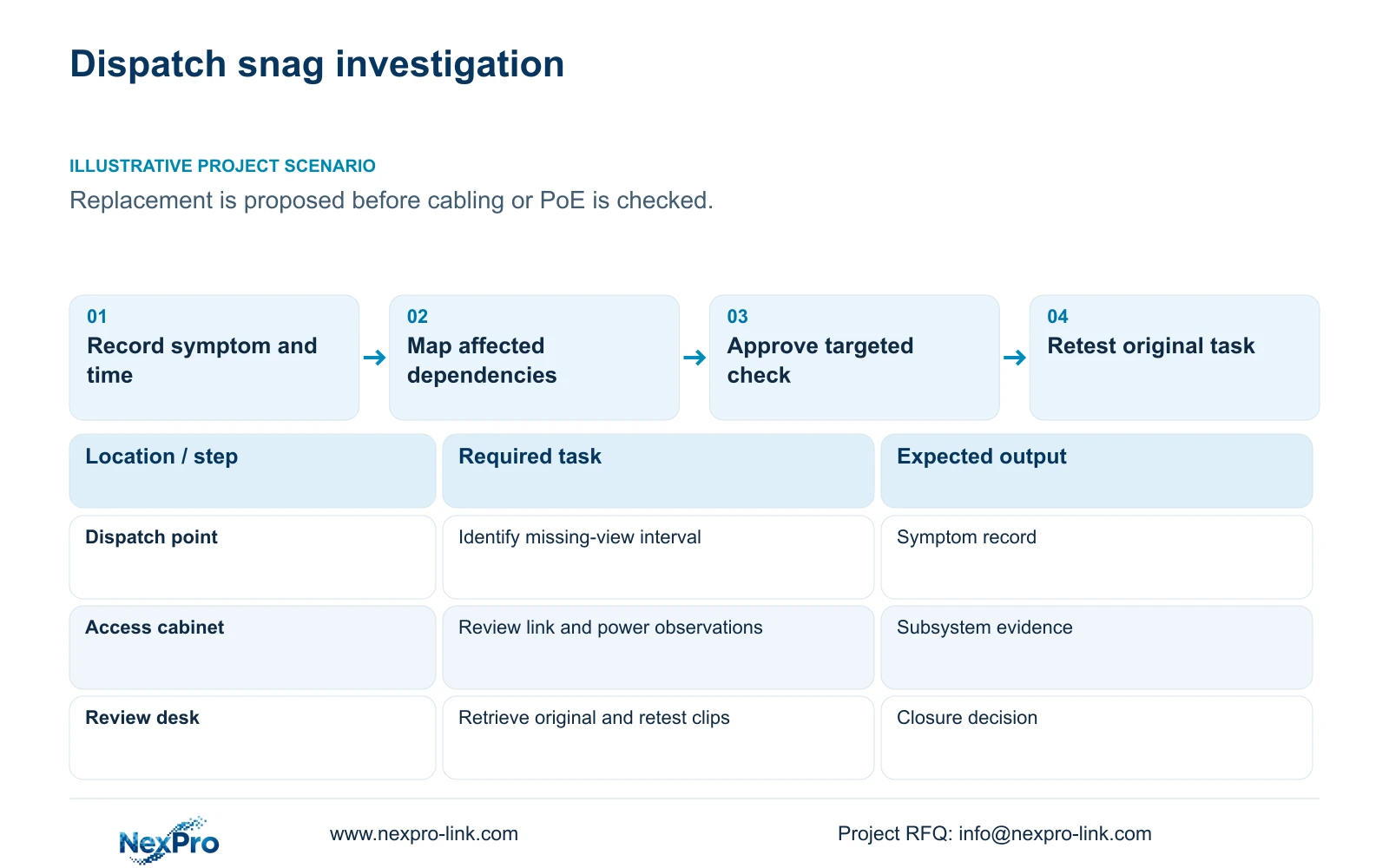
Illustrative project scenario: A camera replacement is proposed for a fault that may be caused by cabling or PoE. In the hypothetical CASE01 CNC package, one dispatch point loses its visible picture at night while other points appear available. Assume no cause has been established and the project manager needs a coordinated investigation.
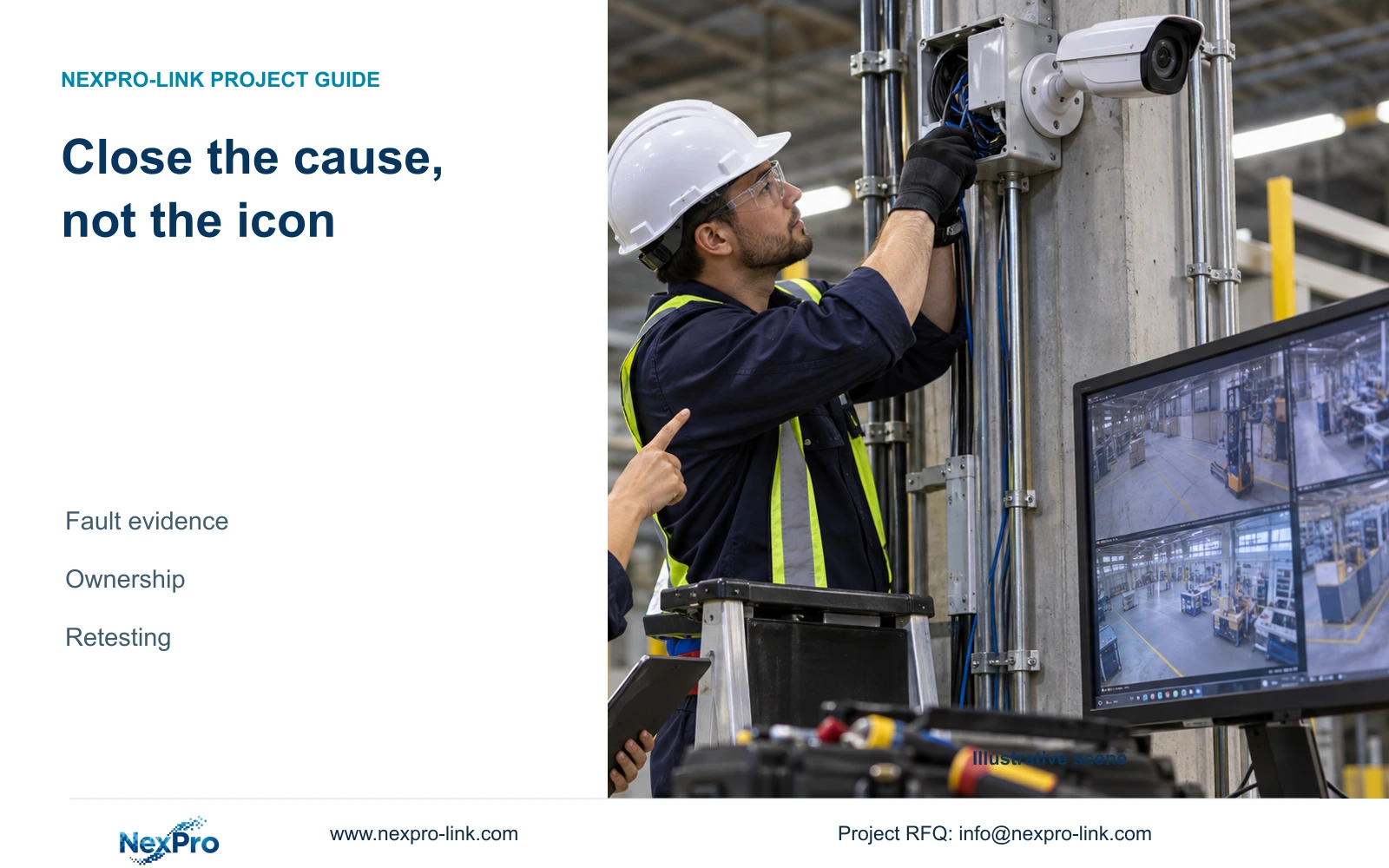
Write the entry as an observation: the named dispatch point was unavailable through a specified client during a recorded time window. State whether footage is missing, whether the camera restarted and whether neighbouring channels were affected only after checking those facts. A dashboard icon or verbal report alone cannot establish which component failed.
Section 02
Give each issue one coordinator and explicit subsystem owners
Assign one person to coordinate the snag even when several parties investigate it. The installer can provide the point-to-port map and physical-link evidence; the network owner can review authorised switch observations; the equipment supplier can advise on model-specific functions. The owner defines the operational consequence and the evidence needed for acceptance.
Responsibility should follow the agreed supply and service boundaries. Mark the camera, cabling, PSE, recorder and client as supplied, retained or installer-provided. Optional items need their own scope. This prevents an equipment supplier from being asked to certify owner networking or a local installer from being assigned an unpurchased software service.
Keep the investigation owner distinct from the party ultimately responsible for the remedy. Initial coordination is not an admission of liability. The quantity surveyor should track diagnostic work, equipment, removal, reinstatement and shipping separately where applicable. An unresolved cost remains unresolved; it should not be entered as zero merely because no quotation exists yet.
Section 03
Preserve evidence and make controlled comparisons
Save relevant clips and status records before altering the affected arrangement. Identify exact model, serial, firmware, settings revision and connected port. Obtain the applicable cable test record and any available power or link event observations. Keep credentials and sensitive footage within the authorised project channel rather than attaching them to a public snag report.
Use a supported, controlled comparison to narrow the cause when the responsible personnel approve it. Document the original and comparison conditions so the team can tell what changed. Avoid replacing several components and altering settings simultaneously, because an apparent recovery then provides little evidence about the actual remedy.
CASE01 groups its 32 cameras into four local PoE groups. That grouping helps the investigator identify shared dependencies without proving that any group has failed. A simultaneous symptom across one group suggests a different investigation boundary from a single blurred view. Preserve the distinction and do not convert a topology observation into a diagnosis.
Section 04
Choose the next action from the observed symptom
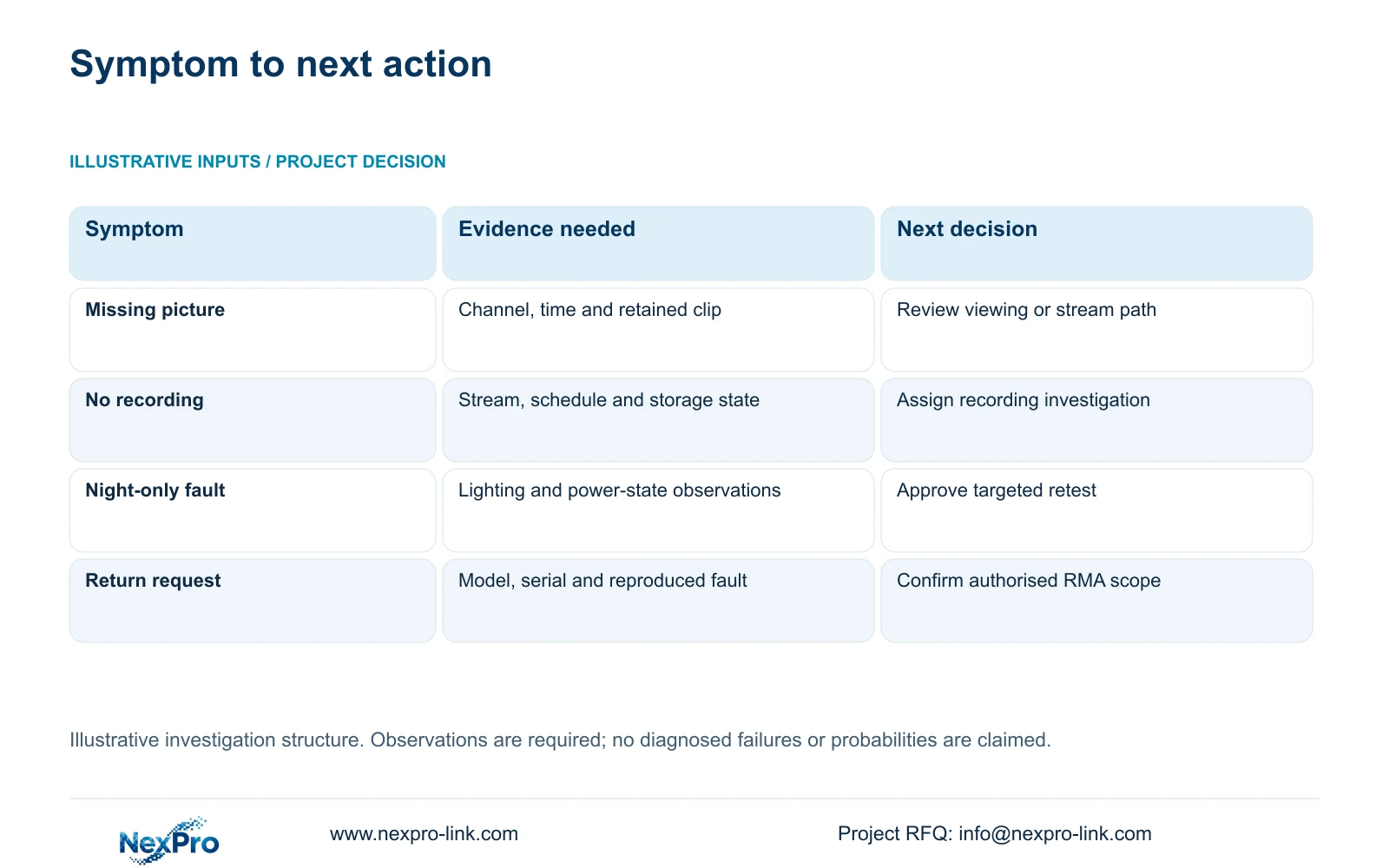
The filled matrix below develops the supplied fault-isolation structure into specific next checks and service boundaries. It is an investigation aid, not a record of actual failures or their probabilities. Each row needs observations before a cause or return decision can be established.
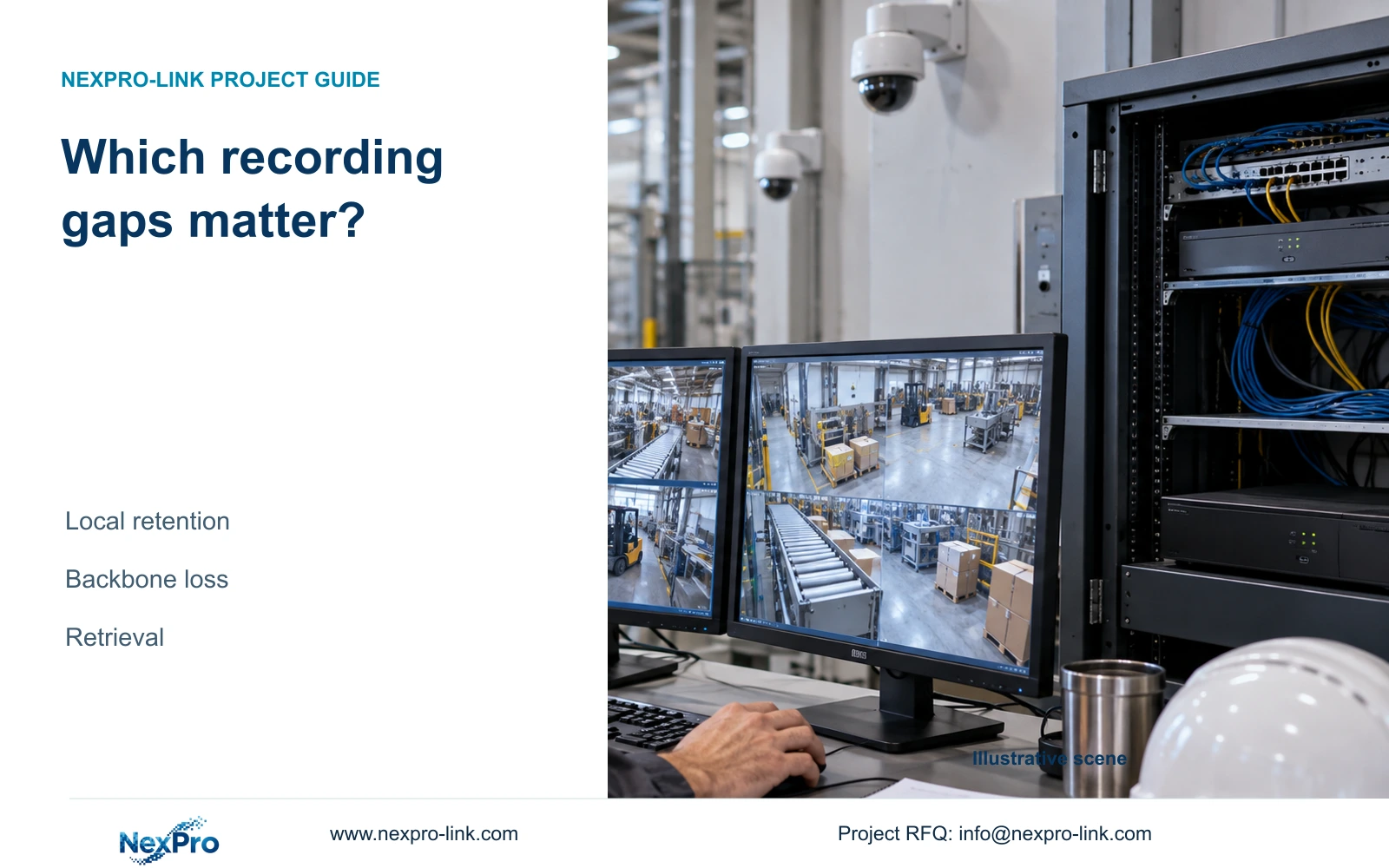
The decisive distinction is between a missing live picture and missing retained video. Continuous recording with a failed client view directs attention toward the viewing path. Missing footage despite an available stream requires investigation of recording conditions as well. Replacing the camera solely from the same screen icon ignores that difference.
For a night-only issue, compare the required illumination and power state with the failed interval. For a return request, establish identity, reproduced symptoms and authorised RMA scope. Local removal, temporary coverage, shipping and reinstallation remain separate service decisions. Do not use destructive storage actions or unauthorised resets to clear a symptom before preserving evidence.
| Observed symptom | Next supported check | Decision boundary |
|---|---|---|
| Missing picture | Compare exact channel, time and recording | Do not infer camera failure from icon |
| No recent recording | Review stream, schedule and storage observations | Separate recorder and camera responsibilities |
| Night-only problem | Compare required lighting and PoE state | Cause remains open until evidenced |
| Return proposed | Confirm model, serial and authorised RMA scope | Removal and shipping quoted separately |
Section 05
Retest the failed task and affected shared functions
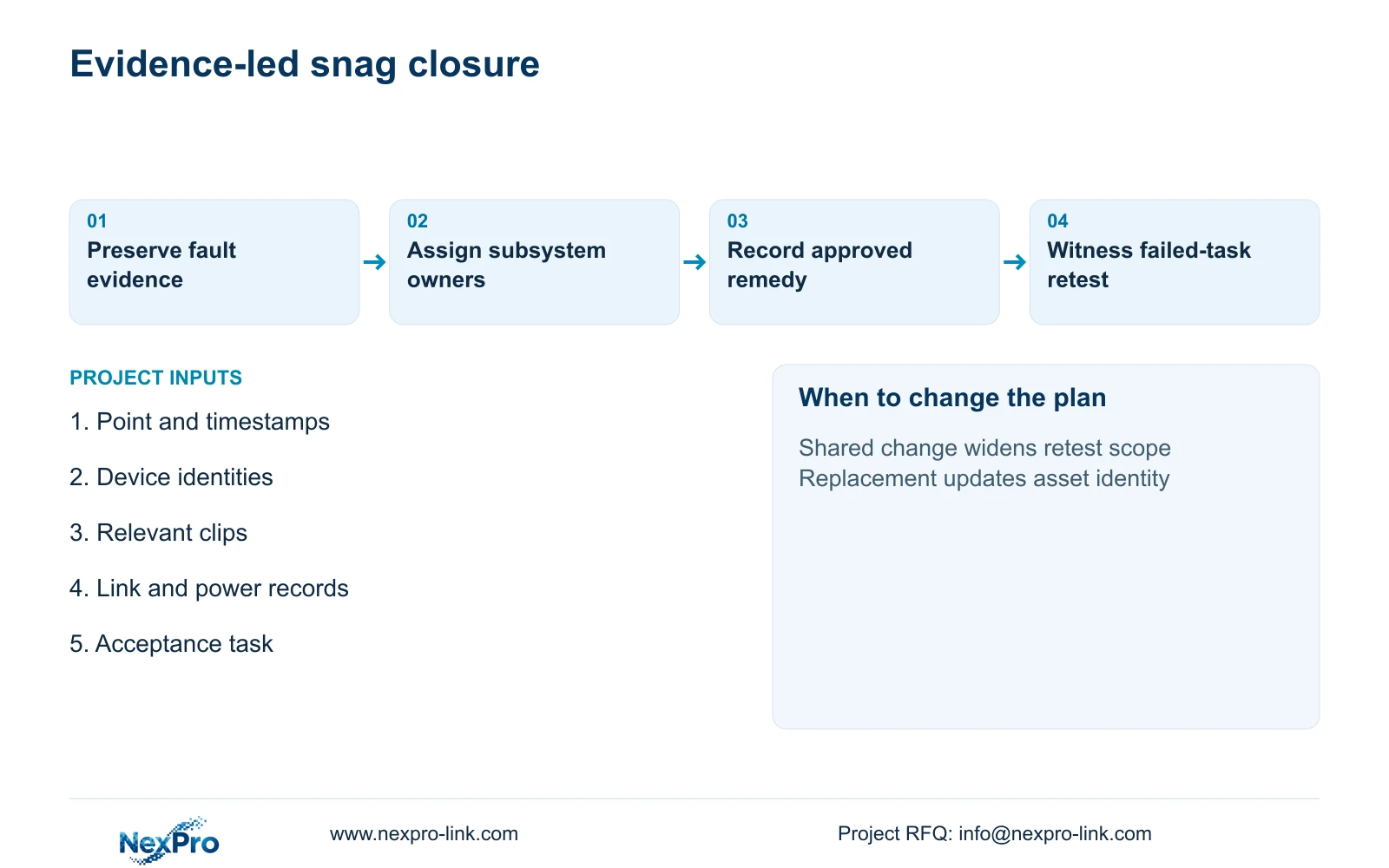
A corrective action is not closure until the original acceptance task has been repeated under relevant conditions. For the illustrative dispatch issue, test the same required night state and retrieve the resulting recording. A working daytime preview after a replacement does not resolve the original complaint.
Record the remedy, changed identity or settings, retest conditions and result. If the action affects a shared switch, recorder or configuration, include other affected functions in the retest boundary. This is especially important when the remedy restores one point by moving a problem or reducing required functions elsewhere.
Recommend evidence-led correction before repeated hardware swaps. Change that approach when observations establish a supported device fault requiring repair or replacement, or when the agreed service process calls for an authorised temporary substitute. Even then, confirm that the replacement matches the required role and complete the installed task check. A bench result alone cannot close the final view.
Section 06
Turn the closed snag into a maintenance record
The final record should preserve the original symptom, cause where established, approved remedy, replacement identity and witnessed retest. Update the point register and configuration revision. If the cause remains unresolved but a temporary measure is accepted, state the restriction, monitoring requirement and party responsible for further action.
For a warranty or RMA discussion, use the applicable written terms and exact equipment scope. NexPro-Link's public warranty policy distinguishes eligible main equipment from other scopes, while controlling quotation and order terms remain important. Do not describe local access equipment, labour, freight or every accessory as included without confirming the agreement.
NexPro-Link's BOQ support can help record model deviations and supply boundaries, and its factory project supply scope provides the equipment-planning context. A useful service request contains the observed failure and completed checks, allowing the supplier and local contractor to discuss the next supported action. Operator handover should retain the point identity and escalation route so recurrence can be reported consistently.
Section 07
Buyer questions
Can a temporary camera swap be useful? Yes, when authorised and documented as a controlled comparison or continuity measure. Record what changed and preserve the original evidence; a recovery alone does not prove the removed camera caused the fault.
Should a snag remain open after the picture returns? Keep it open until the required task and relevant conditions have been verified. An intermittent issue may need an agreed observation period or repeat test rather than immediate closure.
Who approves closure when several contractors are involved? Use the project's agreed acceptance authority. The coordinating person collects subsystem evidence, but final closure should follow the owner or engineer's defined approval process.
Section 08
Send an evidence-led defect request
Send the snag entry with point and timestamps, exact device identity, relevant link or power observations, and permitted retest conditions to info@nexpro-link.com. NexPro-Link can discuss the supplied-equipment boundary and next supported action.
Engineering references
These sources support the general planning principles. Always use the selected product's current datasheet and applicable project standards for final design.