Factory preparation can confirm specified equipment functions, while industrial site acceptance must establish useful recorded views and working dependencies.
Section 01
Decide what the factory record actually demonstrates
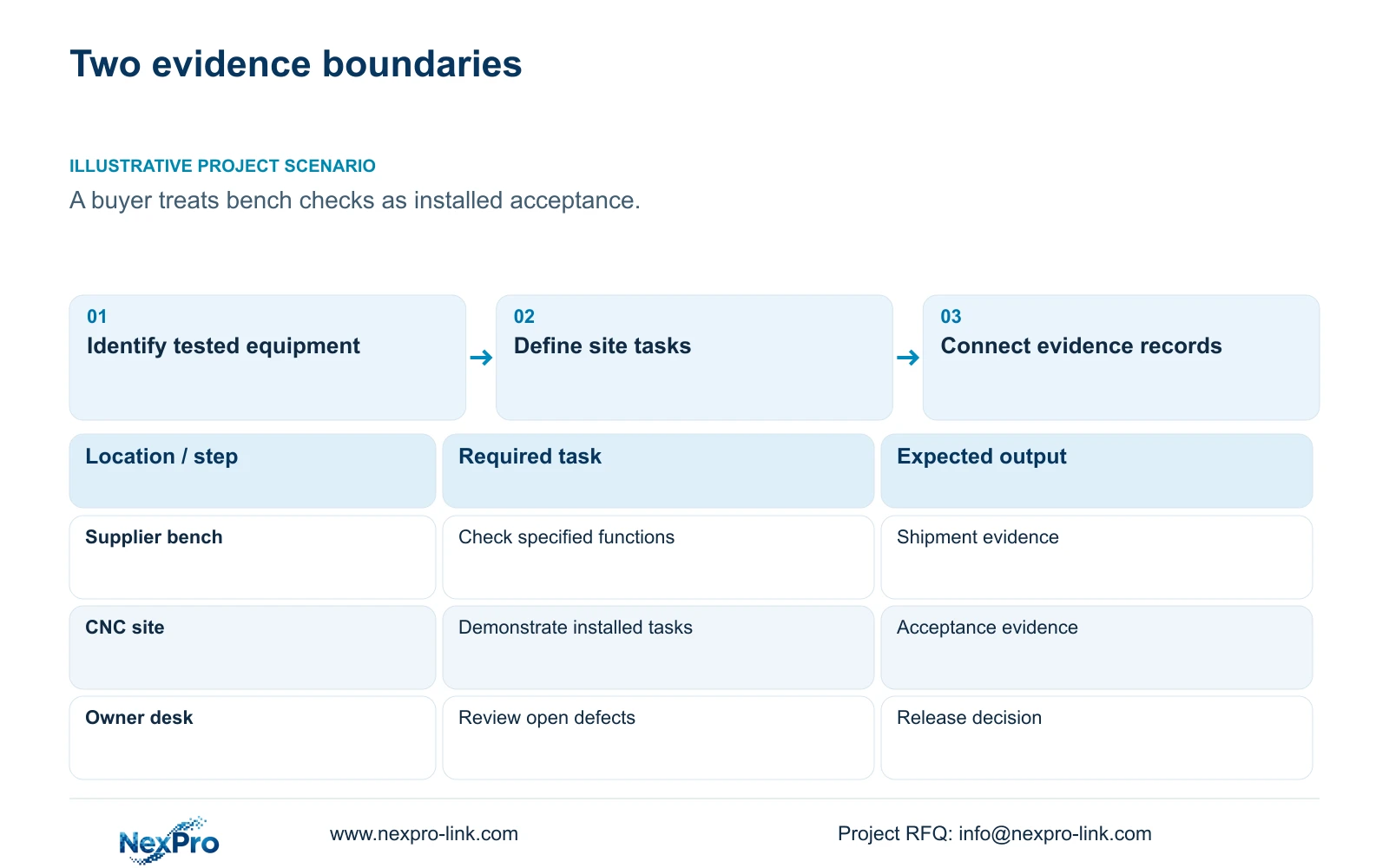
CCTV factory quality and industrial site acceptance answer different questions. A factory record should identify the equipment, configuration and functions checked before shipment. Site acceptance should establish whether the installed system produces the agreed evidence under actual operating conditions. Approve these as separate deliverables, with a traceable connection between them.
Illustrative project scenario: A buyer treats a pre-shipment functional check as proof that cameras will provide useful images in a new CNC factory. Using CASE01 as a planning reference, the project contains 32 ordinary security views covering gates, stores, permitted transfers, common routes, dispatch and equipment-room approaches. No installed performance or completed customer project is assumed.
Before approving shipment, ask what was connected, which functions were exercised and whether the record covers samples or the actual batch. A successful recording check on one camera establishes only that documented test outcome. It does not establish every unit's condition, the final gate view or the performance of the site cable route. Keep untested items visible rather than describing the package as fully accepted.
Section 02
Define acceptance through observable site tasks
Write acceptance tasks as actions the owner can witness. At a material store, the reviewer might need to distinguish the handover sequence and identify which doorway was used. At dispatch, the task could be to retrieve the loading event using its recorded time. Specify the view, operating state, reviewer and evidence required for each task.
The installer needs the mounting position, expected obstructions, lighting state and actual network path before arranging the demonstration. An empty production hall cannot represent the view after equipment, pallets and personnel occupy it. If a critical transfer disappears behind a machine enclosure, revise the view or position and repeat the task; a bench image does not resolve that obstruction.
Include recording, retrieval and export in the acceptance boundary. A clear live picture may coexist with an incorrect recording schedule or unusable export workflow. Agree which checks require representative production and which can proceed before opening. This gives the project manager a realistic sequence without treating unfinished site conditions as either product defects or accepted performance.
Section 03
Connect both evidence sets to one approved configuration
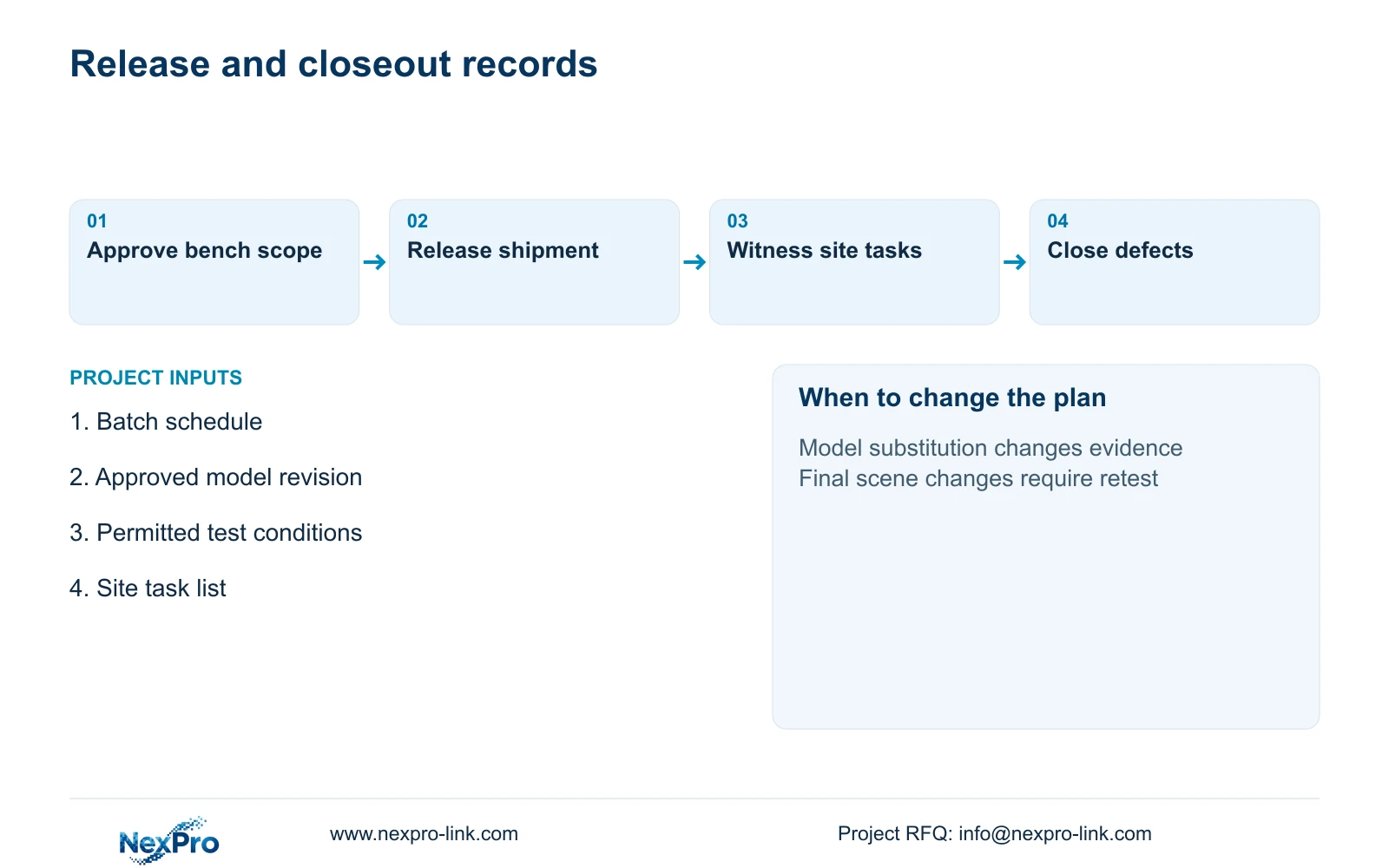
Use the approved equipment schedule as the connection between factory and site records. Each test entry should carry the project point, exact model, serial number where available, firmware identity and relevant settings. Retain the revision that was tested. If a substitute arrives, the engineer must decide which checks remain applicable and which must be repeated.
For the illustrative CNC package, assign the supplier the supplied camera and recorder identity records, the local installer the point-to-port mapping and installed view checks, and the owner the operational acceptance decision. Mark equipment as supplied, retained, installer-provided or optional. One party should coordinate each interface even when several parties contribute evidence.
A practical handover record links a factory recording check to the same installed camera point and its site export demonstration. Store the approved configuration separately from operator instructions, and keep access credentials out of public inspection records. This allows a later defect to be investigated against the delivered state instead of an unrelated demonstration unit.
Section 04
Keep core acceptance complete before adding integration
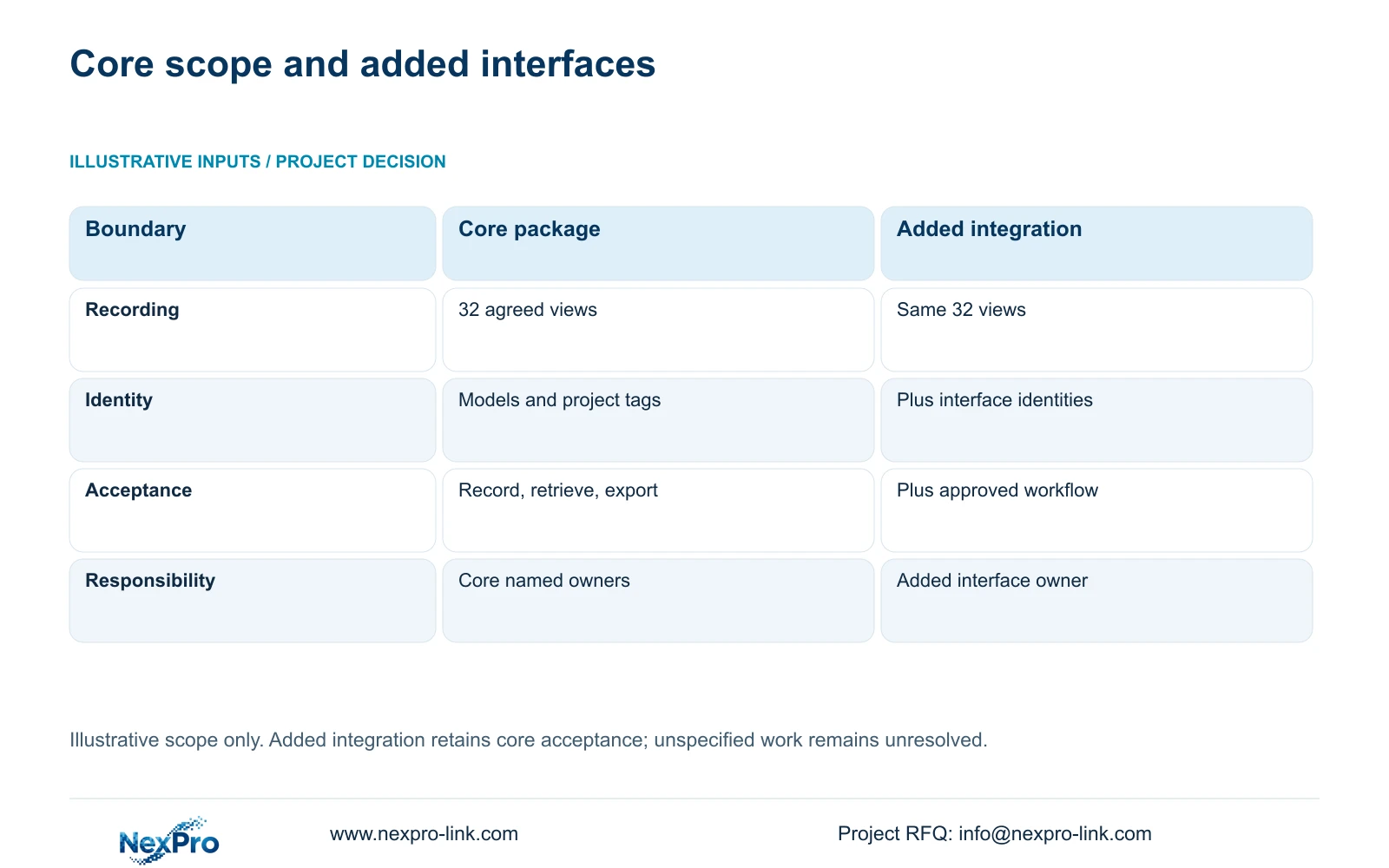
The minimum package must support the owner's agreed recording and retrieval task. Additional management or integration creates another acceptance boundary, even when the original camera count remains unchanged. The filled comparison below applies the supplied scope matrix to the illustrative 32-view project without inventing prices or ranking scores.
The decisive difference is the evidence required for the added workflow. Option B retains every core check and adds interface ownership, access testing and any supporting equipment. It cannot replace camera-to-recorder acceptance with a software demonstration. Equally, an unspecified interface in Option A is an unresolved scope item, not proof of incompatibility or a zero-cost inclusion.
NexPro-Link's Factory & Warehouse project supply scope covers coordinated security equipment inputs, while its BOQ & Tender Support scope addresses model matching, submittals and deviations. Those services can help keep the schedule consistent. The purchase documents still need to state who provides installation, existing-network access and final site approval.
| Decision | Option A: core recording | Option B: added integration |
|---|---|---|
| Recording outcome | 32 agreed views and usable retrieval | Same views and retrieval retained |
| Hardware identity | Camera, recorder and project tags | Same records plus interface identities |
| Network and power | Every required recording node checked | Added servers and interfaces included |
| Software access | Approved viewing and export roles | Additional workflow and permissions tested |
| Procurement responsibility | Complete core scope with named owners | Added scope, dependencies and owners |
Section 05
Use separate release decisions and a shared defect log
Recommend shipment release against agreed factory evidence, followed by installed acceptance against site tasks. This preserves useful preparation while avoiding an unsupported promise about the final scene. The project manager should record outstanding items, their operational impact, the responsible party and the evidence needed to close them.
Classify a failed task before deciding the remedy. An incorrect model is a supply discrepancy; a wrong camera aim is an installation issue; an unavailable owner network interface may be a coordination issue. These categories guide investigation, but responsibility should follow the contract and observations. Do not assign blame solely because the symptom appears in a camera window.
Change the acceptance plan when the owner adds a required integration, changes a critical view or revises the operating conditions. Compare alternative suppliers against the same tasks and evidence requirements, including local services where required. A cheaper equipment-only offer and an installed, witnessed package are different scopes until their missing work is priced.
Section 06
Make the handover package usable after approval
The completed handover should contain the delivered identity schedule, factory check records, site task evidence and the closed or accepted outstanding-item list. An operator guide should explain how to find a point, retrieve an event, export a clip and report a failure. Organise these records by project identity so maintenance staff can follow them without knowing the shipment history.
If acceptance is phased, state which zones and functions are released. For example, gate and store recording may be available while a dispatch view awaits its final mounting position. Keep the incomplete task open and define its retest condition. A partial release should never be presented as acceptance of all 32 views.
The RFQ should distinguish preparation work from installed commissioning and operator handover. NexPro-Link can discuss equipment matching, technical documents and project packing within that split. The local contractor should confirm site attendance and installation responsibilities, while the owner's representative retains the final decision on whether the agreed evidence is useful.
Section 07
Buyer questions
Can a sample inspection release the whole shipment? Only if the buyer has agreed that sampling basis. Record the inspected quantities, selection method and untested scope. A sample result should not be described as an individual functional record for every shipped unit.
What if the factory record passes but a site task fails? Investigate the failed task using the delivered identity and installed conditions. The cause may involve configuration, placement, lighting, cabling or equipment. Keep the site issue open until the remedy is demonstrated under the relevant conditions.
Should acceptance include an optional management platform? Include it when the owner requires its workflow. Give that workflow its own interface owner, test evidence and commercial scope while preserving the core recording checks.
Section 08
Define the two acceptance boundaries
Send your sample or batch schedule, permitted factory test conditions and site acceptance tasks to info@nexpro-link.com. NexPro-Link can discuss the preparation records, unresolved interfaces and handover scope needed for your procurement.
Engineering references
These sources support the general planning principles. Always use the selected product's current datasheet and applicable project standards for final design.