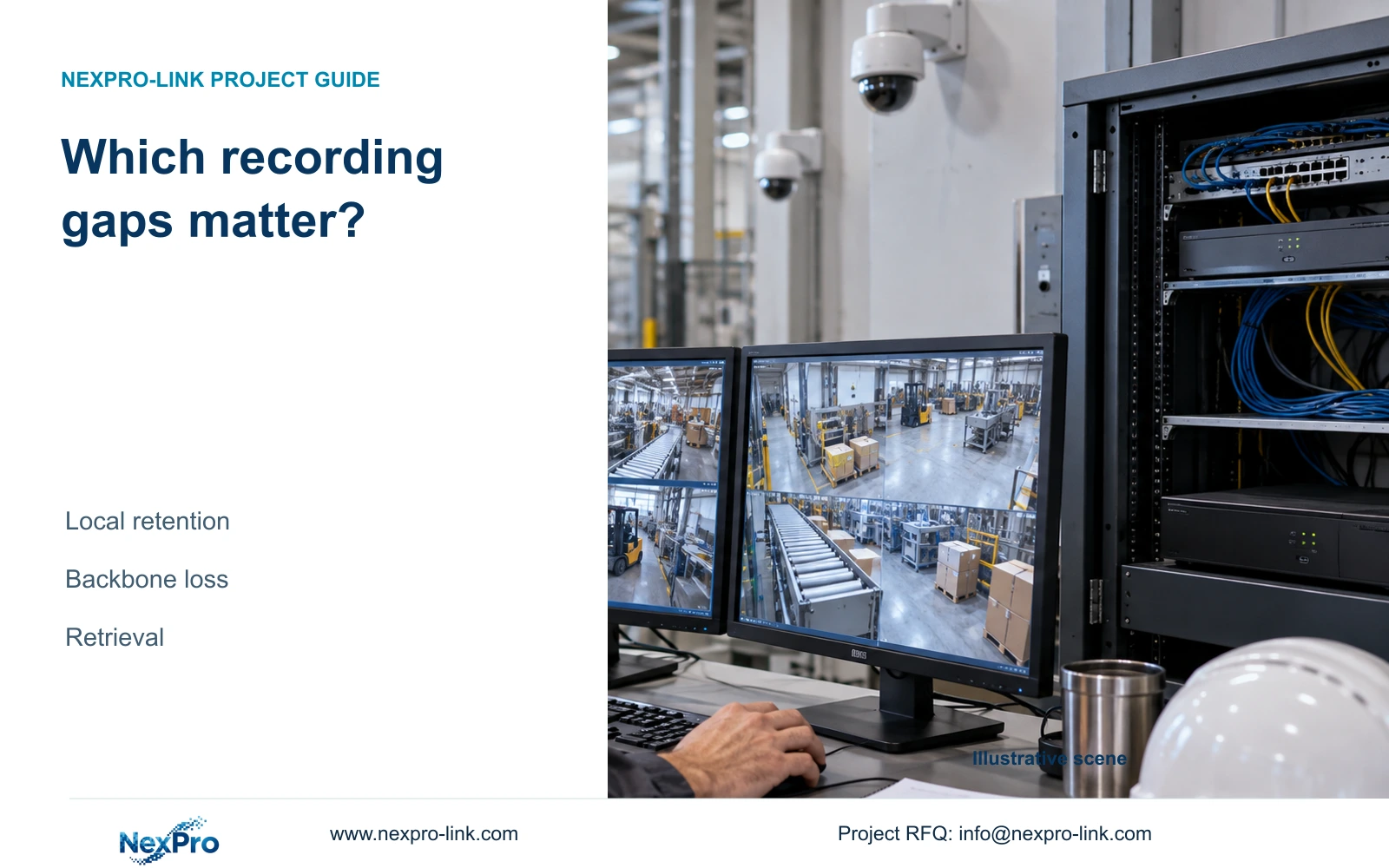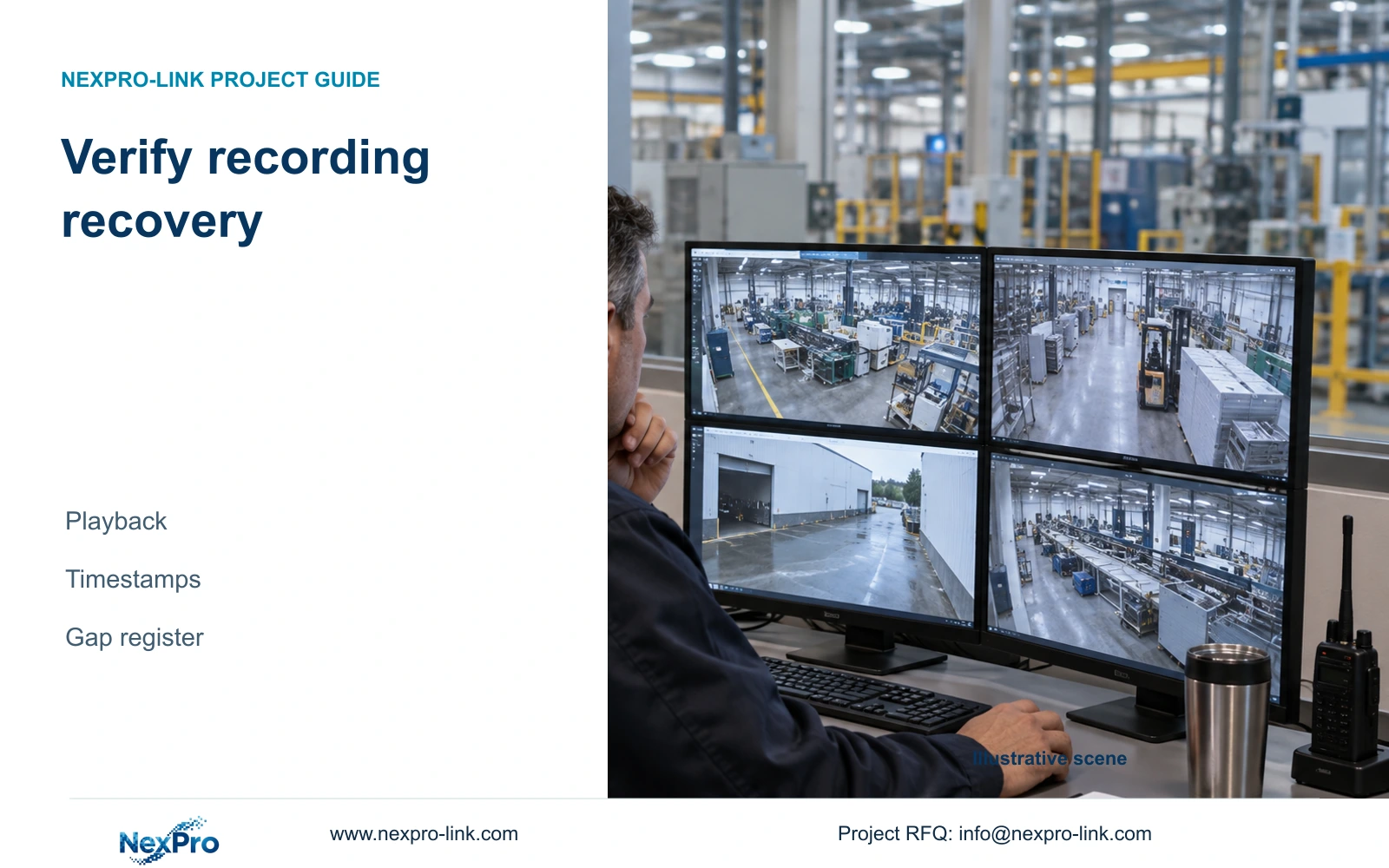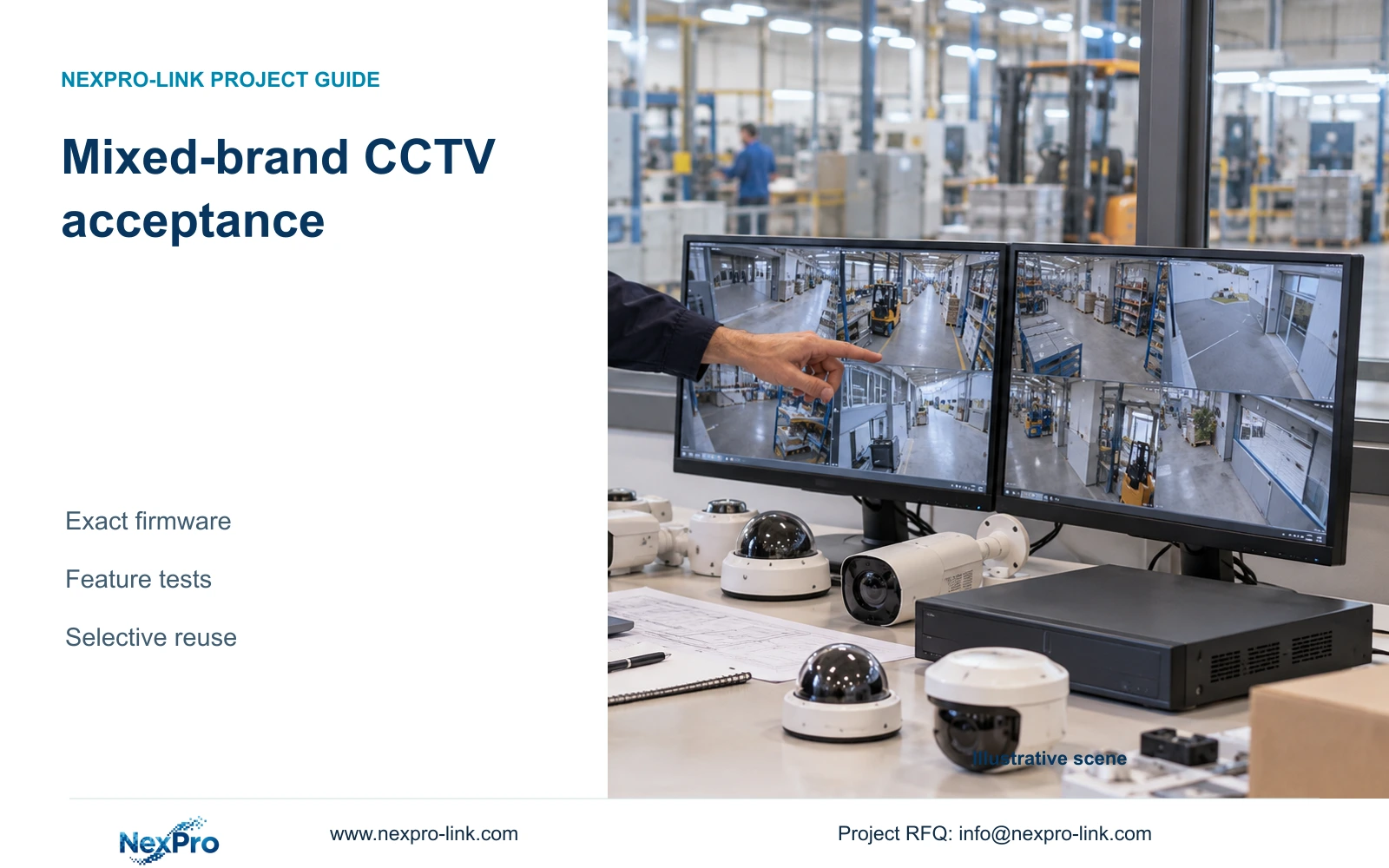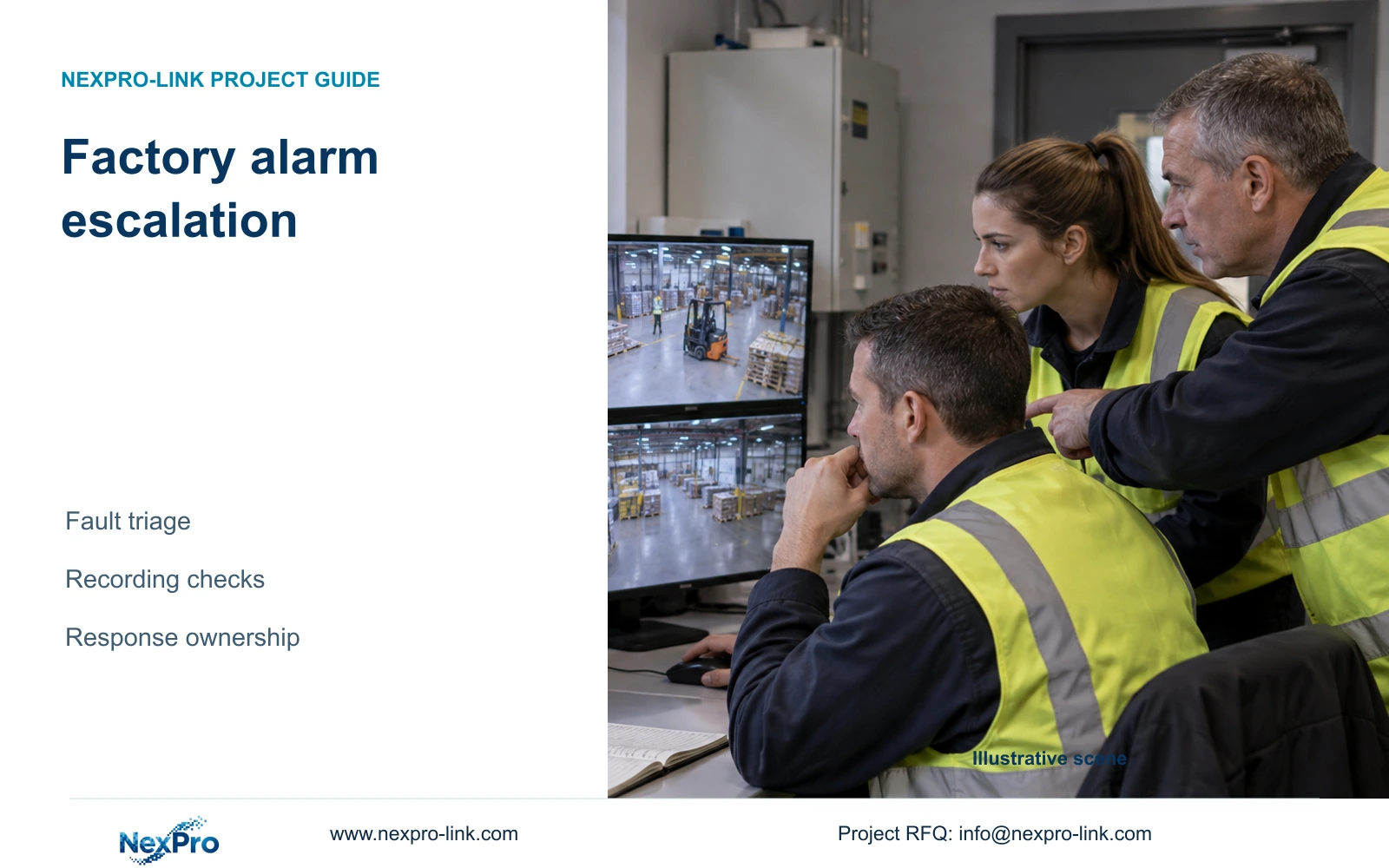
An offline camera warning and a recording failure require different responses. Build a factory alarm schedule around the affected task, verified equipment states and a named escalation owner.
Section 01
Separate viewing faults from recording loss
Factory security alarm escalation should distinguish unavailable viewing, missing camera streams and stopped recording before assigning a response. Start with a small set of states that the selected equipment can actually report or that an operator can verify. Each state needs an affected location, a recording consequence and a named responder. A generic offline message leaves the guard unsure whether footage is still being stored.
Illustrative project scenario: Operators at a new CNC factory receive alerts but cannot tell whether the issue is viewing access or recording continuity. Use CASE01 as the planning baseline: 32 ordinary security cameras, four PoE access groups and one local recorder. Assume a guard checks the system during each shift and an appointed integrator handles technical faults. These are hypothetical operating arrangements, not a completed client installation.
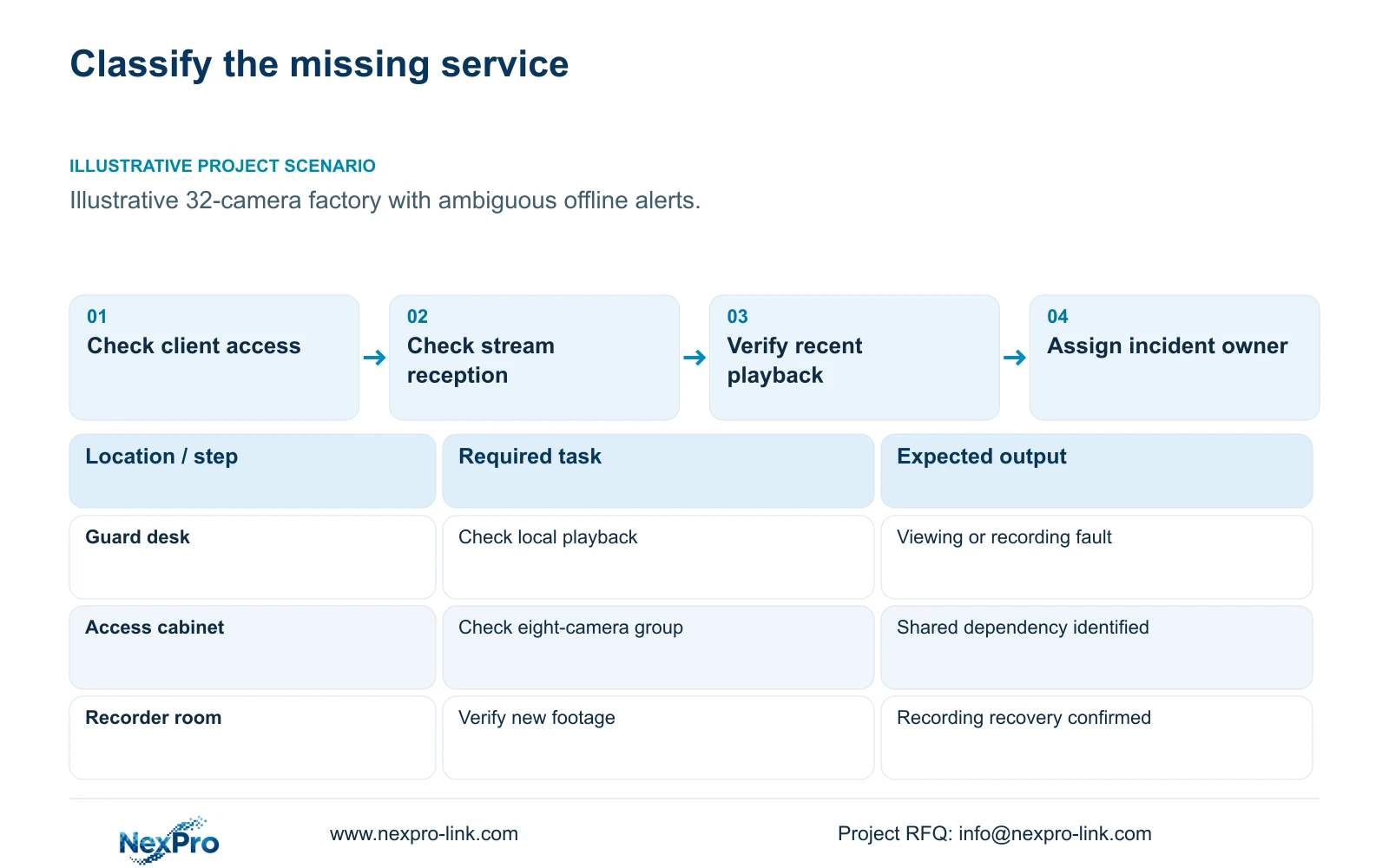
Define three initial checks: can the authorised client connect, is the recorder receiving the required stream, and can recent recorded footage be played back? A client connection failure may leave local recording intact. A missing stream removes new footage from the affected camera. A storage failure may affect several views even while live pictures remain visible. Record these outcomes separately, including an unknown state when the operator cannot verify recording.
Section 02
Assign escalation according to the affected task
Assign the guard to confirm location and impact, the integrator to investigate the camera-to-recorder path, and the owner's security lead to decide temporary operating measures. The owner's IT team should own faults within its retained network or account infrastructure. Write the handoff explicitly so an alert does not circulate between teams while a dispatch view remains unavailable.
Treat confirmed loss of required recording as a higher priority than a remote client failure with verified local recording. A single gate camera may nevertheless deserve urgent attention if it is the only accepted view of a transfer point. Escalation should follow the importance and extent of lost coverage, rather than the number of devices listed in a notification. Set acknowledgement and investigation targets with the actual staffing arrangement; this example does not prescribe universal response times.
Correlate related symptoms into one incident while retaining the affected camera list. If all eight cameras on an access group disappear together, investigate their shared switch, supply and uplink before opening eight unrelated repair jobs. Include the generator arrangement and protected circuits in the incident record where power is implicated. A generator-running indication alone does not confirm that the recorder, switches and necessary network path have recovered.
| Observed condition | Recording consequence | Initial owner and action |
|---|---|---|
| Remote client unavailable; local playback verified | Local footage remains available | IT checks access; guard retains local review |
| One required stream absent | New footage missing for that view | Integrator checks camera, port and link |
| Eight streams absent together | Shared access group loses recording | Integrator checks switch, power and uplink |
| Live pictures present; recent playback missing | Recording continuity unconfirmed | Integrator checks storage and recording state |
Section 03
Verify each alarm path on the selected equipment
Build an alarm capability schedule before promising automatic notifications. For every required state, identify its source, exact model and firmware, available interface, recipient and fallback check. Mark an unsupported or unverified state clearly. The NexPro-NVR4449-4K public specification lists 49 channels, 320 Mbps input and four SATA bays supporting up to 18 TB per drive. Those fields do not establish a particular alarm interface or notification workflow.
ONVIF Profiles provide a framework for checking device and client applicability, but successful live video does not demonstrate every event function. Ask the supplier to show the required fault condition reaching the intended recipient on the proposed combination. If automatic recording-health reporting is unavailable, quote a documented operator playback check or a separately qualified monitoring service instead of silently treating the requirement as satisfied.
Test the notification route as well as the monitored device. An alert dependent on the same failed network connection may never reach the responder. Identify what remains visible locally and who checks it when remote delivery is unavailable. Where monitoring touches factory infrastructure, keep security access within the approved network boundary; NIST SP 800-82 Rev.3 is a relevant OT-security reference for coordinating operational constraints and separation.
Section 04
Keep detection quality separate from system-health alarms
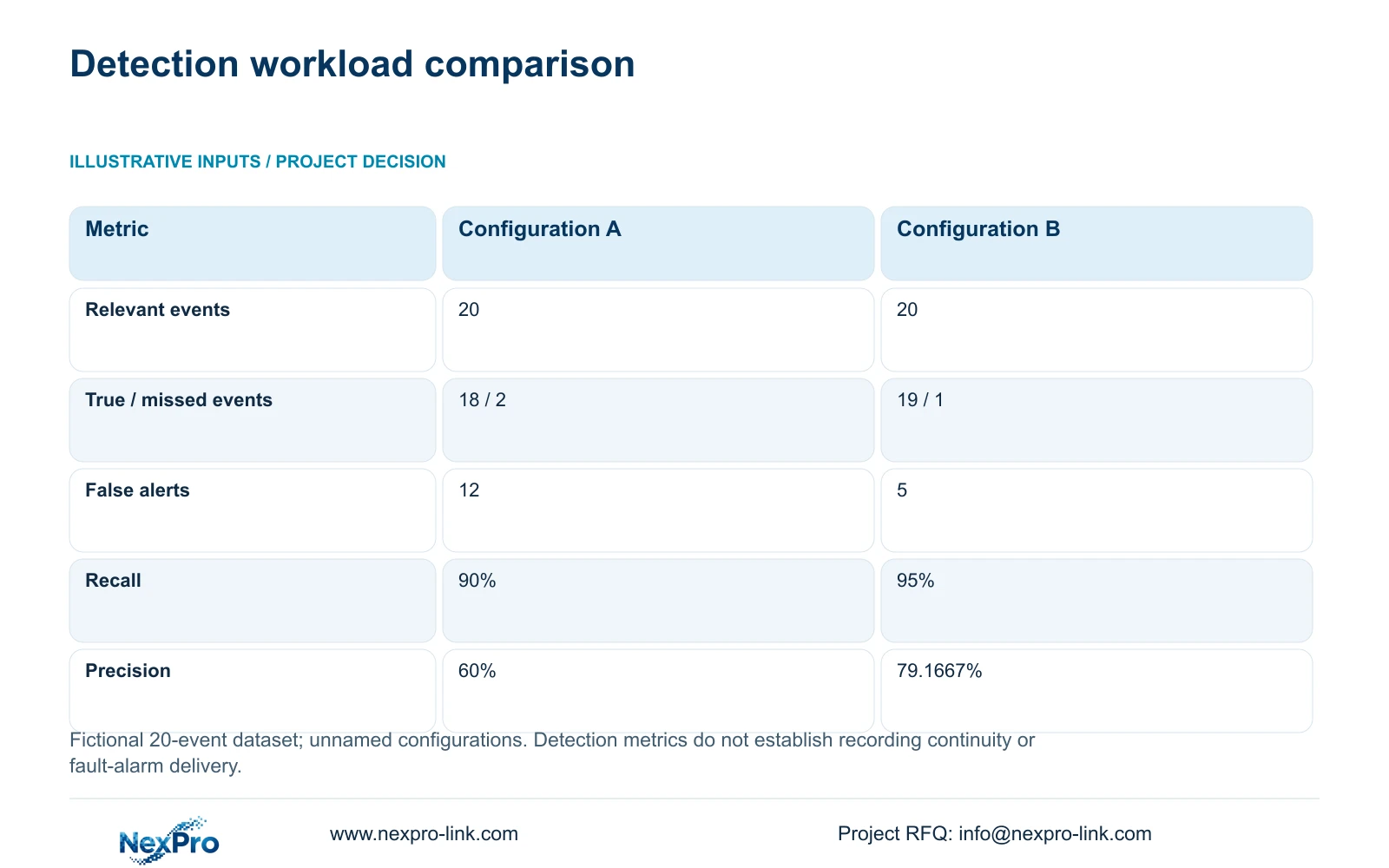
Operational detection alerts can compete for attention with equipment faults. Evaluate that workload separately so nuisance detections do not obscure a recording-loss incident. The supplied fictional trial contains 20 relevant events: unnamed configuration A detects 18 and adds 12 false alerts; B detects 19 and adds five false alerts. These figures describe teaching inputs, not NexPro-Link or competitor performance.
Use recall = TP / (TP + FN) and precision = TP / (TP + FP). For A, recall is 18 / 20 = 90% and precision is 18 / 30 = 60%. For B, recall is 19 / 20 = 95% and precision is 19 / 24 = 79.1667%, approximately 79.17%. B both misses fewer relevant events and produces fewer false alerts in this dataset.
The decisive difference is that reduced false-alert volume accompanies improved recall here. A configuration that suppresses alerts by missing more events would require a different decision. Run an authorised site trial with agreed event definitions and review missed events alongside delivered alerts. These analytics figures do not measure fault-alarm delivery, recording availability or response time, and surveillance analytics are not certified machine protection, fire detection or a worker-scoring system.
| Metric | Configuration A | Configuration B |
|---|---|---|
| Relevant events | 20 | 20 |
| True positives | 18 | 19 |
| False negatives | 2 | 1 |
| False positives | 12 | 5 |
| Recall | 90% | 95% |
| Precision | 60% | 79.1667% |
Section 05
Close incidents only after recording is verified
For CASE01, map each access group to its eight cameras and the common recorder. A switch fault affects its group; a recorder fault can interrupt the shared recording task. The case assumes 32 streams averaging 4 Mbps, giving 128 Mbps aggregate recording input. This demand is illustrative, and being below the recorder's published 320 Mbps input figure does not prove alarm support, simultaneous decoding or automatic failover.
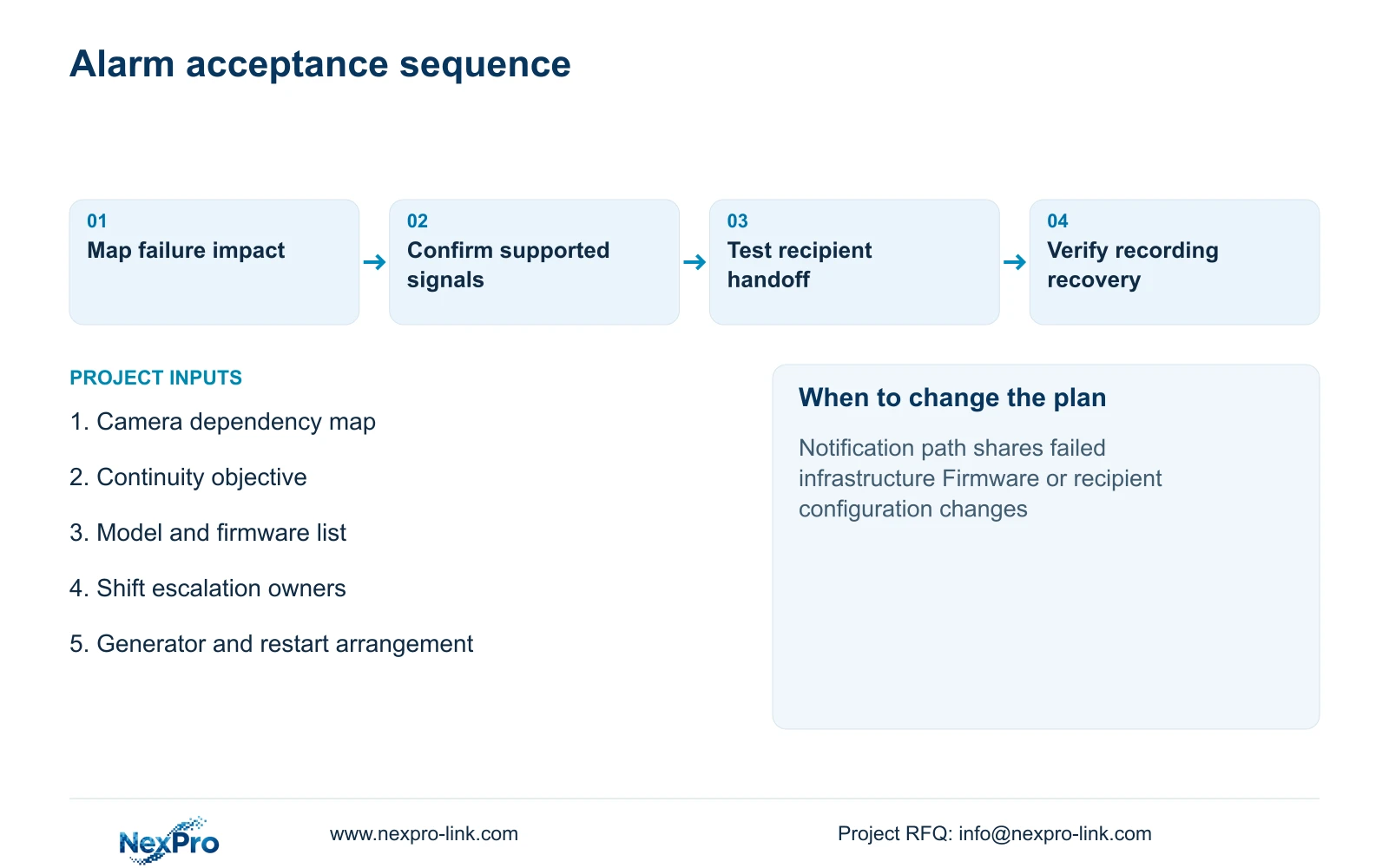
Recommend a recording-first response with separate client-access and detection queues. After the responsible technician restores the affected power or network dependency, verify stream reception, recording status and playback of a newly recorded interval. Note the last available footage before failure and the first verified footage after recovery. Restored live video alone is insufficient to close a recording-loss incident.
Change this approach when the owner requires unattended monitoring, an independent notification path or continued recording during recorder failure. Those requirements may need additional software, power protection or a different recording architecture. Two devices sharing the same cabinet supply do not establish independent resilience. Quote the added interfaces and recovery tests separately, rather than labelling a spare unit as automatic redundancy.
Section 06
Purchase an alarm workflow with clear acceptance checks
Attach the failure-impact map to the equipment schedule. Specify which alarms must be automatic, which states require operator verification, who receives each notification and what evidence closes the incident. Separate supplied equipment from retained owner networks and optional monitoring services. This gives procurement a comparable scope without inventing prices for unresolved integrations.
NexPro-Link's BOQ and Tender Support scope can support model matching, technical submittals, deviations and quotation coordination. For this topic, request an explicit response against the alarm schedule, including unverified functions and demonstration requirements. A competing proposal should preserve the same monitored states, notification destinations and local support responsibilities before price differences are assessed.
Plan acceptance checks during an approved maintenance window: interrupt one camera path, simulate loss of client access, and demonstrate a supported recording-fault condition without risking required footage. Record notification delivery, acknowledgement, investigation and post-recovery playback separately. Retest affected checks after firmware, network, recipient or power changes. The resulting handover should let the next shift distinguish a viewing problem from an unresolved recording gap.
Section 07
Buyer questions
Can alerts be grouped without hiding individual camera failures? Yes. Use one incident for a suspected shared cause, but retain every affected camera ID and its recovery status. Close the group only after the required views have passed their individual recording checks.
What if the recipient does not acknowledge an alarm? Specify a backup recipient and an owner-approved escalation interval. Include shift changes and unavailable personnel in the workflow, then test the handoff using the proposed notification method.
Does a camera becoming online resolve the recording incident? It resolves only the connectivity symptom. Confirm a new recorded interval can be played back, and document any remaining gap or unavailable footage before closing the incident.
Section 08
Define your factory alarm response scope
Send your required recording-continuity objective, camera-to-switch-and-recorder map, notification owners, and generator/restart arrangement to info@nexpro-link.com to discuss equipment matching and an actionable escalation schedule.
Engineering references
These sources support the general planning principles. Always use the selected product's current datasheet and applicable project standards for final design.