A 20-camera reuse decision needs more than working live images. This illustrative retrofit connects compatibility tests, 30-day storage, protected power and a reversible cutover.
Section 01
Approve retained cameras by their recording tasks
Retain the twenty existing cameras only after their required recording, retrieval and recovery functions work with the proposed system. Inventory each model, firmware version, stream setting, power source, location and cable identity before approving reuse. A live picture leaves important questions unanswered: whether scheduled recording continues, an event can be found, an export plays correctly and the camera reconnects after interruption. Assign each unresolved function an owner and a test.
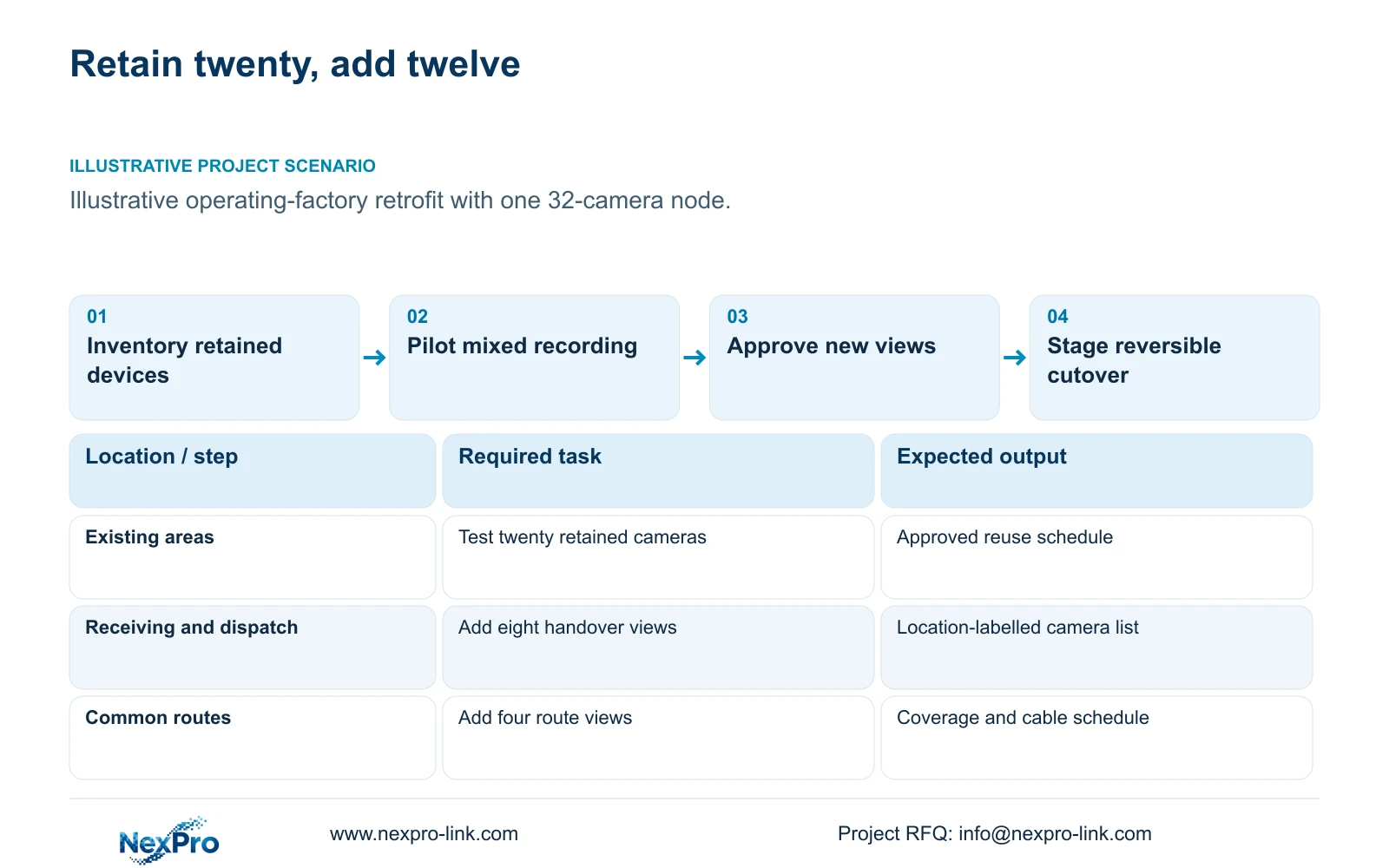
Illustrative project scenario: An operating factory wants twelve additional views while retaining twenty cameras with unknown model-specific compatibility limits. CASE09 assigns four new views to receiving, four to dispatch and four to common routes, creating one 32-camera recording node. All positions have ordinary security roles; no specialist locations are included. This is a procurement planning example, with no claimed customer installation or compatibility result.
Define the evidence required at each new point before selecting its housing or lens. NexPro-BL2812M55-5MP-DIC-AI and NexPro-DM2812M55-5MP-DIC-AI are ordinary-area candidates with a listed 2880×1620 output and 2.8–12mm motorized lenses. Preserve those source dimensions in the schedule. Check view width, lighting, mounting and maintenance access separately, and retain an existing camera only if its useful image still satisfies the assigned task.
Section 02
Prove mixed recording before committing the disk budget
Pilot representative retained models alongside a new camera on the proposed recorder and firmware. Exercise recording, playback, export, required events and recovery, including any essential audio workflow. ONVIF Profiles provides a device/client framework, but a profile label does not prove every feature across this combination. Keep the pilot configuration as the reference for procurement; a later firmware or stream change should reopen the affected checks.
The illustrative calculation assumes all 32 streams fit the selected recorder's supported 5MP-class modes, averaging 4 Mbps each for continuous recording over 30 days. Input is 32 × 4 = 128 Mbps. Using decimal TB, video_TB = cameras × average_Mbps × 10^6 × 86400 × days / 8 / 10^12 = 41.472 TB. Required usable capacity with 20% free space is 41.472 / 0.80 = 51.84 TB.
Four 16 TB drives provide 64 TB raw and, under the assumed 95% formatting factor, 60.8 TB usable. Their recording budget is 64 × 0.95 × 0.80 = 48.64 TB, above 41.472 TB; reserve is already included. NexPro-NVR4449-4K lists 320 Mbps input and four SATA bays up to 18 TB each. Its summary distinguishes 49×5MP from 9×4K. Confirm actual stream modes and playback demand without inferring RAID or decoding capacity from its channel count.
Section 03
Map retained power connections into four access groups
Allocate N1-SW1 through N1-SW4 as four eight-camera load groups at node N1. These groups describe demand, not a prescribed switch port count. Existing cameras may use local supplies or different PoE requirements, so map their real connections before assuming a replacement switch protects them. Include uplink ports, approved backbone equipment and any separate camera supplies in the final schedule.
CASE09 assumes 12 W at each ordinary camera, 90% cable delivery, 15 W switch self-consumption and 90% AC conversion efficiency. Each group therefore has 8 × 12 = 96 W device demand. Required PSE output is 96 / 0.90 = 106.6667 W; an 80% budget-utilization target requires 106.6667 / 0.80 = 133.3333 W. Complete switch AC demand is (106.6667 + 15) / 0.90 = 135.1852 W. These are design assumptions, not camera peak ratings.
Ask suppliers to match both total PSE budget and individual port requirements against actual devices. Route recording locally from access switches to the NVR, then identify the paths used for authorized viewing and export. The aggregate 128 Mbps recording input does not pass through every interface. Following the separation concerns described in NIST SP 800-82 Rev.3, agree network ownership and permitted access with the factory IT/OT team rather than treating a VLAN number as complete isolation. For retained devices that use PoE, include the negotiated allocation and the switch's class-reserving or other documented admission policy in the reuse test. Estimated draw with headroom alone does not establish that the mixed group can be admitted.
Section 04
Keep the display decision separate from recording continuity
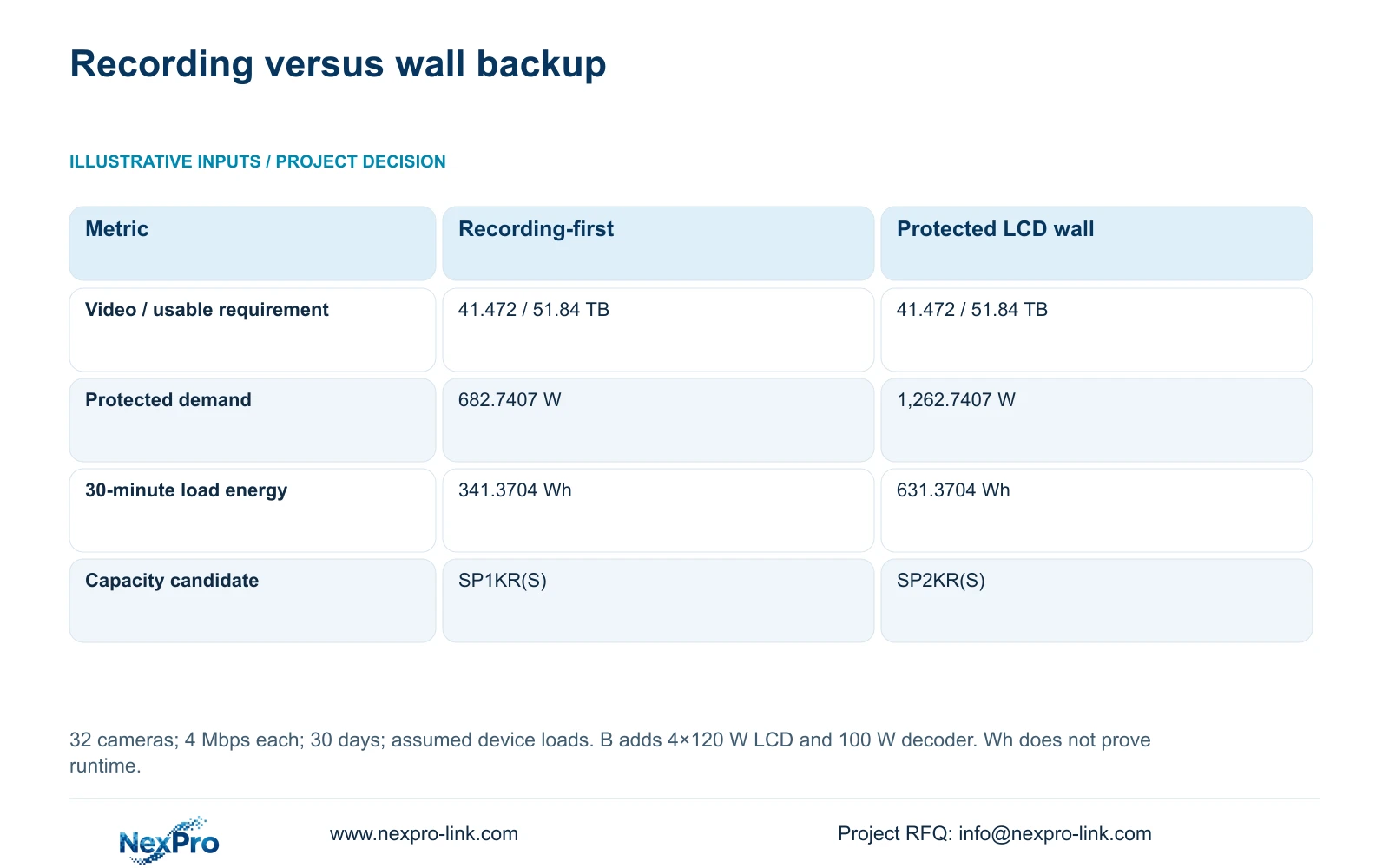
Option A protects four complete switch AC loads plus an assumed 30 W recorder, four drives at 8 W each, a 25 W core, a 15 W router and a 40 W retrieval screen. The total is 682.7407 W. Camera consumption is already inside switch AC demand and must not be added again. Option B retains that equipment and adds four assumed 120 W LCD panels plus a 100 W decoder, reaching 1,262.7407 W.
The table's decisive difference is the protected viewing scope: both options retain the same 32-camera recording task and storage demand. Choose A unless operators need concurrent wall viewing during an outage. NX-VP-5535 is an LCD reference, not direct-view LED; 120 W per panel and 100 W for decoding are illustrative inputs. Qualify the decoder's actual stream and window requirements independently.
With assumed PF 0.9 and 80% rated utilization, require rated_W ≥ load_W / 0.80 and rated_VA ≥ load_W / (0.90 × 0.80). SP1KR(S), rated 1kVA/900W, is A's capacity candidate; SP2KR(S), rated 2kVA/1800W, is B's. For 30 minutes, load_Wh = load_W × 30 / 60 gives 341.3704 Wh and 631.3704 Wh. Obtain the selected battery configuration and runtime curve; neither these energy figures nor UPS ratings prove duration.
| Metric | A: recording-first | B: protected LCD wall |
|---|---|---|
| Recording input | 128 Mbps | 128 Mbps |
| Required video | 41.472 TB | 41.472 TB |
| Required usable capacity | 51.84 TB | 51.84 TB |
| Protected AC demand | 682.7407 W | 1,262.7407 W |
| 30-minute load energy | 341.3704 Wh | 631.3704 Wh |
| UPS capacity candidate | SP1KR(S) | SP2KR(S) |
Section 05
Purchase new cable only after retained links pass
The complete 32-link inventory assumes continuous runs of 41–76 m, each including 6 m for service and termination. It totals 1,872 m. Dividing by 305 m and rounding upward gives a seven-reel lower bound; the supplied allocation also uses seven reels. That is a feasible full-replacement baseline, not the retrofit purchase quantity or a claim of globally optimal cutting.
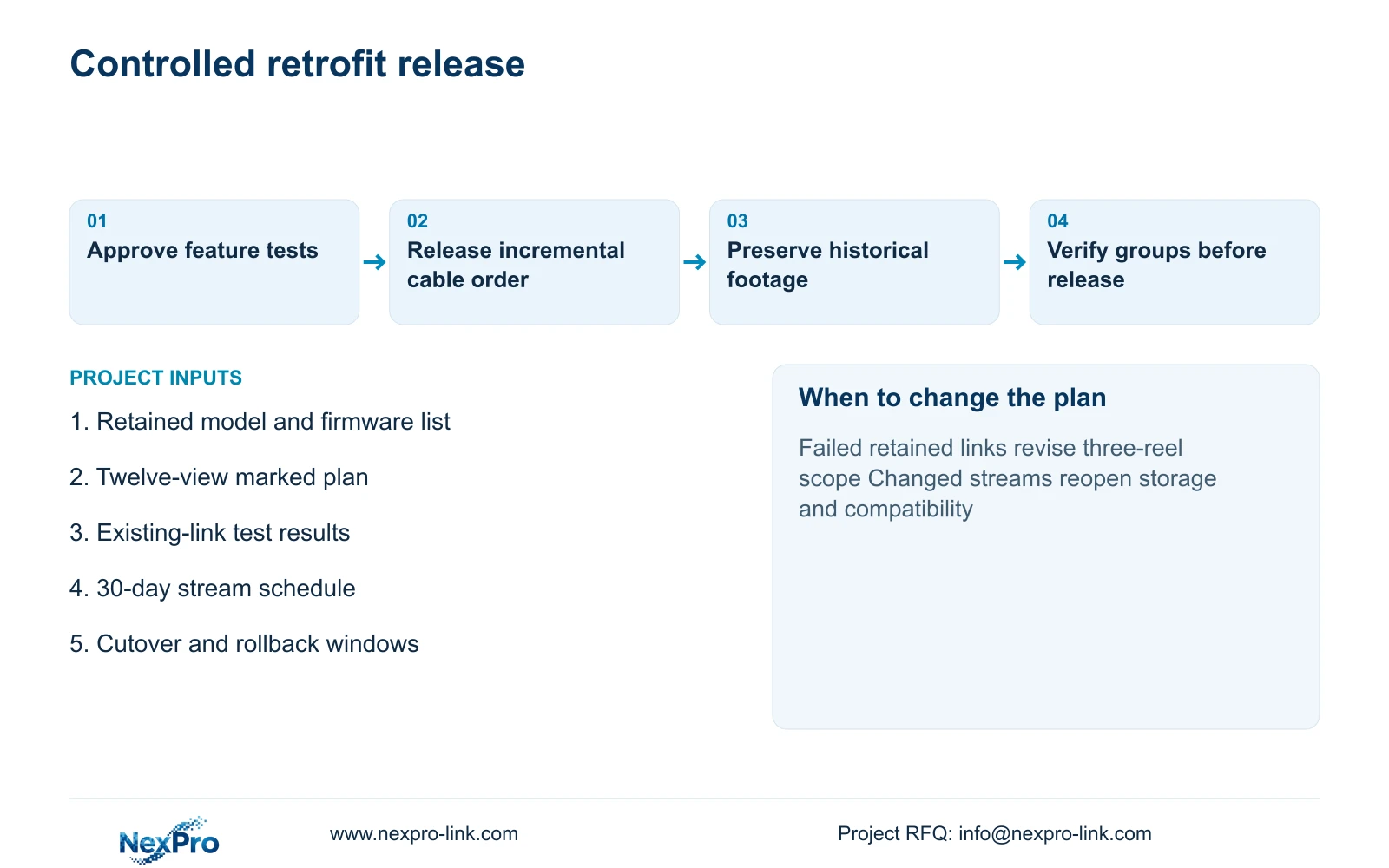
If all twenty existing links pass the applicable tests and receive retention approval, new procurement covers twelve runs totaling 742 m. Three 305 m reels have a feasible allocation of 294 m, 305 m and 143 m. Preserve camera IDs on the cut sheet, and treat remaining material as offcuts rather than an approved spare reel. Failed retained links require a revised allocation before the cable order is released.
Select permanent-link or direct-plug/MPTL termination deliberately and use the corresponding test method. Fluke Networks guidance distinguishes the typical 90 m permanent link from a 100 m complete channel. Patch cords remain separate here. The SP5648 48-port patch panel is a termination reference, not bulk cable. Survey outdoor routes and building crossings individually; fibre, containment, entry protection and local installation requirements need their own quantities and responsibilities.
Section 06
Release a reversible cutover package with clear quantities
The recommended base BOM contains twelve new cameras, twenty conditionally retained cameras, one recorder, four compatible 16 TB drives, four matched access switches, one configured UPS and one retrieval screen. Carry three cable reels only after existing-link approval. Show replacement terminations separately from retained ones: the case's 64-module count describes a full two-ended 32-link baseline, not automatically 64 new module purchases.
Before cutover, preserve required clips, back up supported configurations and record which old recorder holds historical footage. Prepare new equipment without overwriting the sole recording path. Migrate approved groups within agreed access windows, verify recording and export, then release the next group. Define rollback triggers such as a missing critical stream or unusable retrieval, with a documented return path. If zero interruption is required, qualify a temporary parallel arrangement before promising continuity.
NexPro-Link's BOQ and project-supply scope can support model matching, deviation records, configuration documentation and location-labelled packing. Compare alternative suppliers on the same accepted views, retention, cutover work and local service boundary. Unknown installation and recovery costs remain quotation items. Recalculate when retained-camera tests change stream settings, actual power differs, cables fail or the owner adds an essential wall-viewing task.
Section 07
Buyer questions
Can the old recorder remain available for historical searches? Yes, if its condition and access controls permit. Document the date ranges held on each recorder and keep a usable retrieval method until the owner approves retirement. New recording capacity does not transfer old footage automatically.
Must every retained model enter the pilot? Cover each distinct model, firmware and required feature combination. Several identical units can share an initial functional test, but individual cameras still need condition, image and connection checks.
What if one retained camera cannot provide the required events? Decide whether continuous recording with time-based retrieval satisfies that location's task. If the event workflow is essential, replace the affected camera or retain a qualified separate recording path and price the additional support.
Section 08
Request a retrofit scope review
Send your retained model and firmware inventory, marked plan for the twelve new views, retention and stream schedule, and permitted cutover windows to info@nexpro-link.com for a NexPro-Link retrofit equipment and interface review.
Engineering references
These sources support the general planning principles. Always use the selected product's current datasheet and applicable project standards for final design.
- User BL2812M series product specification
- User DM2812M series product specification
- NexPro-NVR4449-4K
- NexPro-Link rack online UPS
- NexPro-Link Structured Cabling
- NexPro-Link BOQ & Tender Support
- NexPro-Link Project Supply
- ONVIF Profiles
- Fluke Networks cable-testing guidance
- NIST SP 800-82 Rev.3 final
- NexPro-Link NX-VP-5535 LCD video wall panel
- NexPro-Link NX-VD-4K16 network video decoder
- Microchip: Next-Generation PoE IEEE 802.3bt White Paper