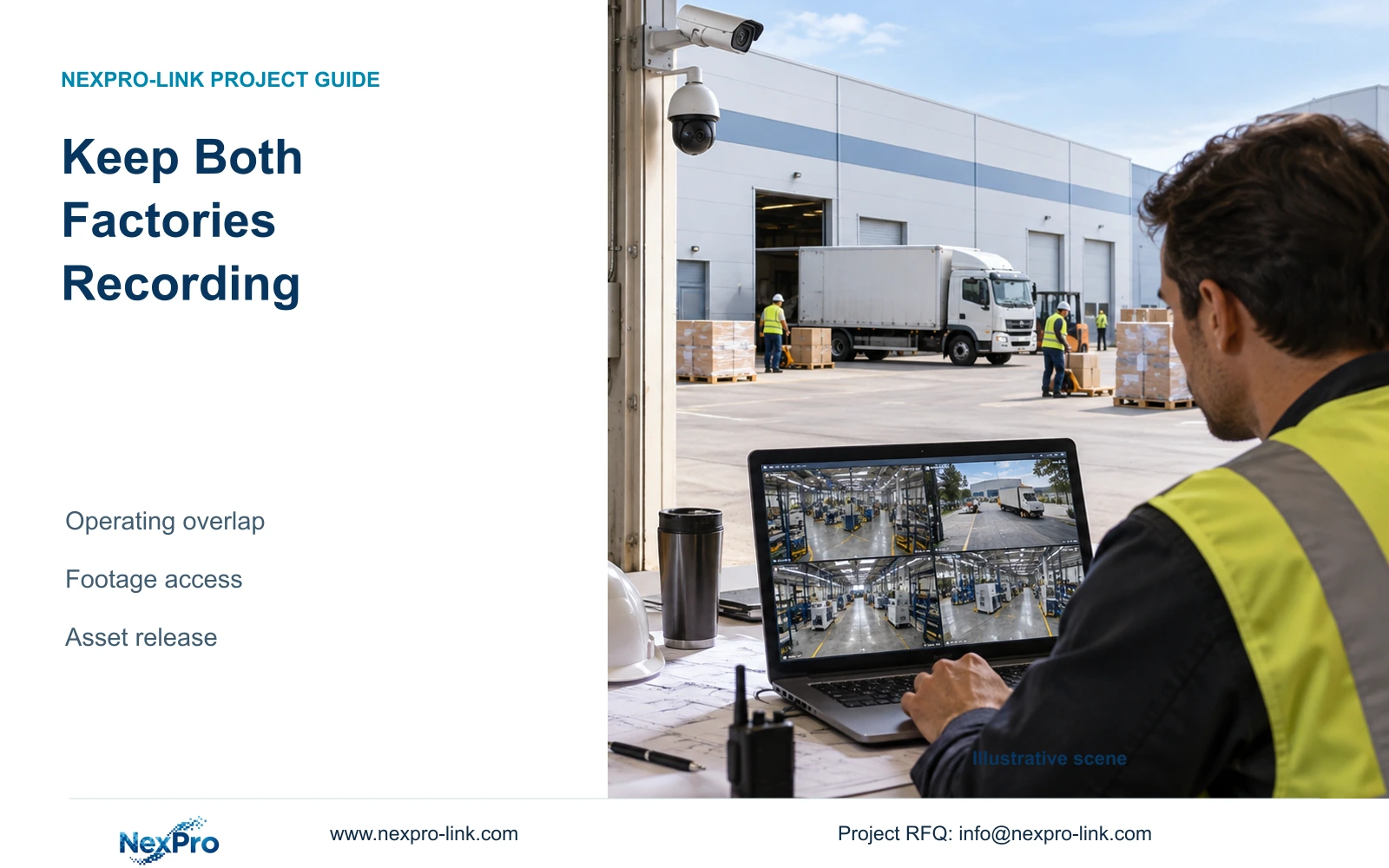
Assign each movable asset both an old-site duty-end milestone and a new-site required-by milestone. Where they conflict, quote a temporary dependency or defer movement instead of erasing the overlap.
Section 01
Define when each site can release its recording equipment
Assign each movable asset both an old-site duty-end milestone and a new-site required-by milestone. Where they conflict, quote a temporary dependency or defer movement instead of erasing the overlap. Keep historical-footage access separate from live-service closure. Obtain owner release against those duties before scheduling physical transfer.
Keep the old factory recording during relocation by budgeting two working security paths for the genuine operating overlap. Release cameras, switches or recorders only after their old-site tasks end and required historical footage remains accessible. The new factory's opening date alone is not permission to dismantle the old recording system.
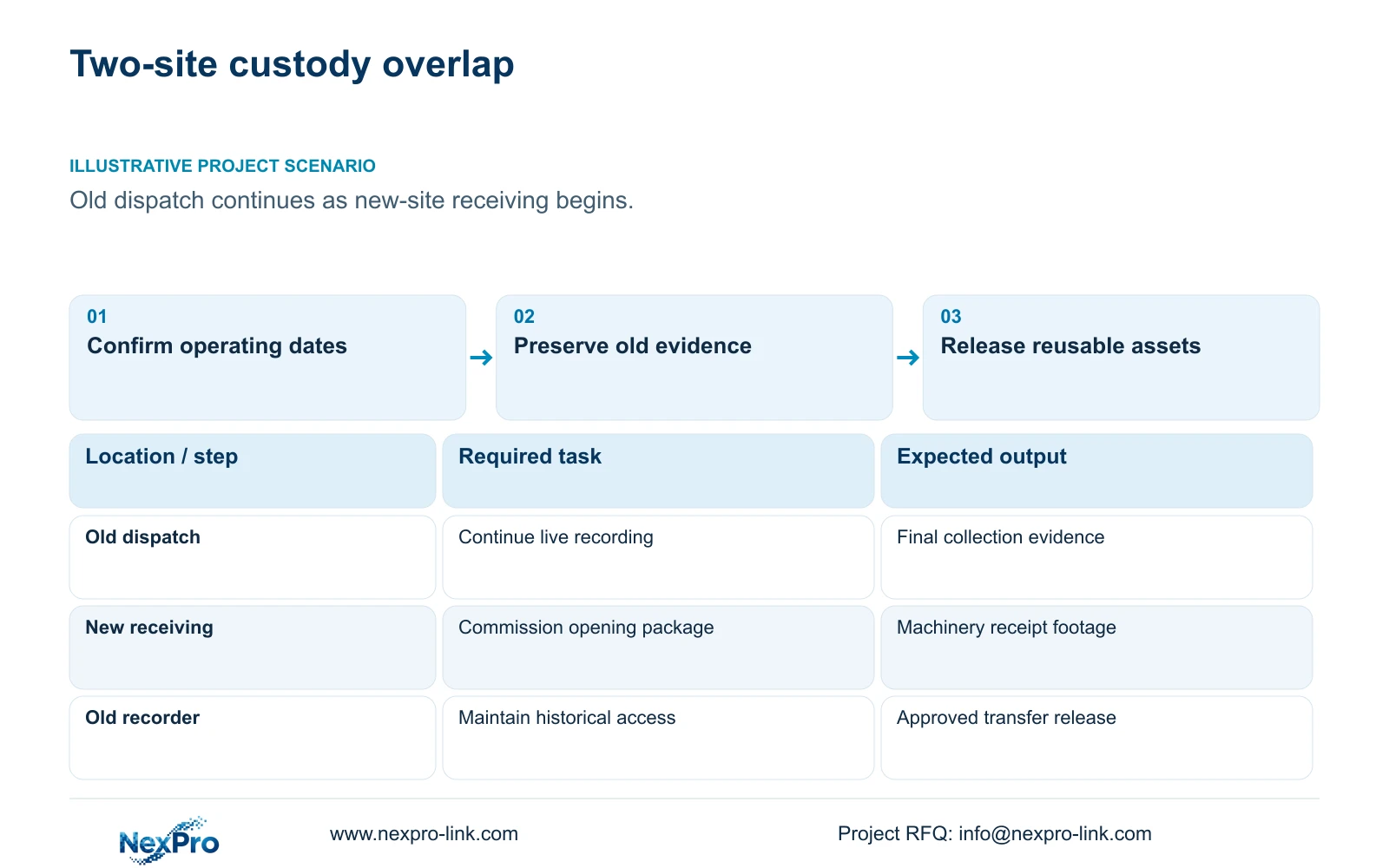
Illustrative project scenario: Production moves in stages and both sites need surveillance during the overlap. Assume the old factory continues dispatch and stock clearance while the new location receives machinery. The new-site teaching package starts with 16 cameras and grows to 32. No duration or customer outcome is assumed for the overlap.
Build a milestone register covering first new-site receipt, last old-site production, final stock collection and the end of required footage access. Assign each old asset its earliest release milestone. The project manager should confirm these dates with operations and the owner, because an equipment mover may otherwise schedule a recorder transfer while its cameras still protect active custody routes.
Section 02
Preserve the old site's footage before changing storage
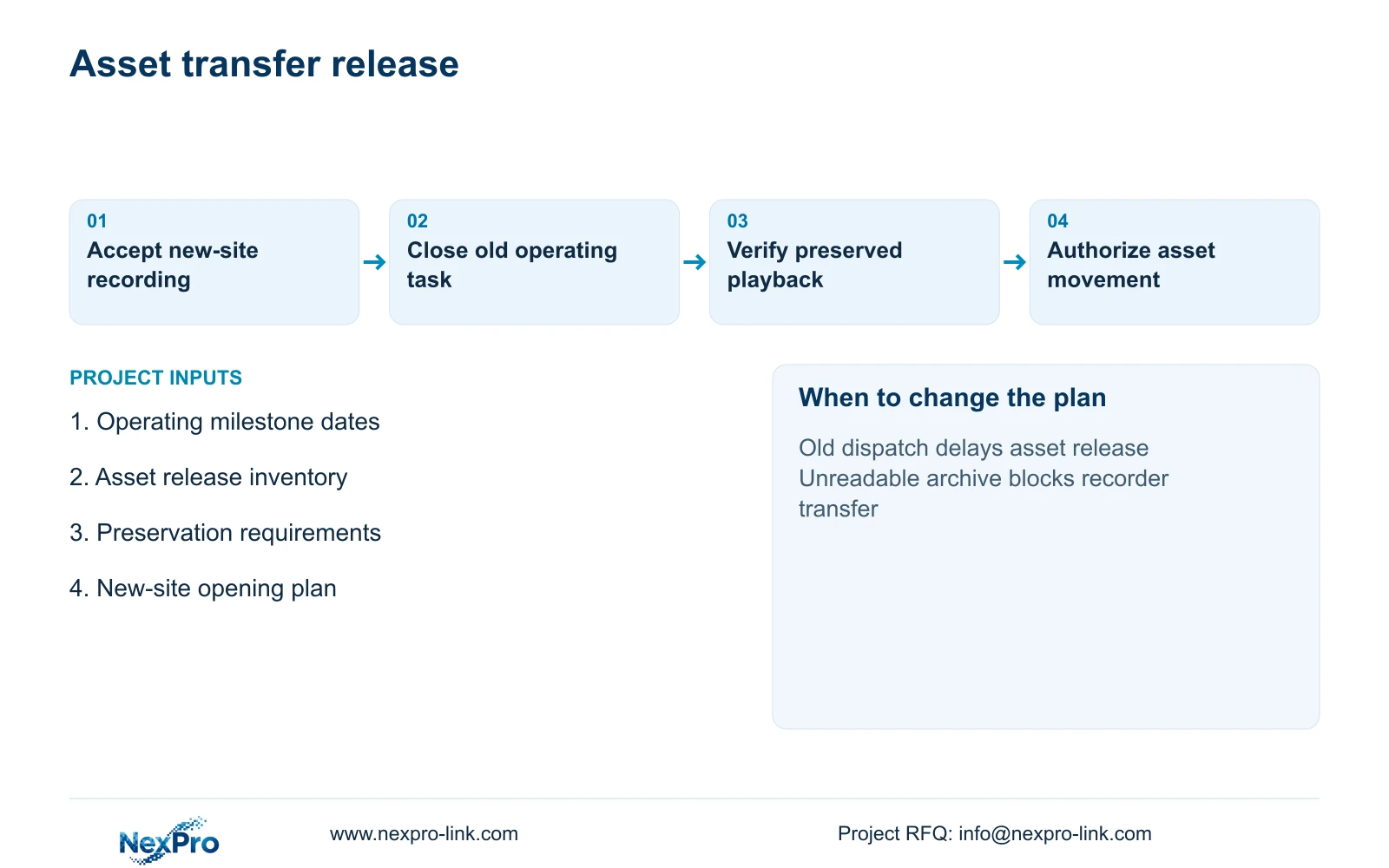
Separate current old-site recording from historical playback. The former needs the cameras and their recording path working until the relevant operations stop. The latter may continue after cameras are removed. Identify required recordings, authorized reviewers and the date or event that ends the preservation task before deciding whether the old recorder can move.
Keeping the old recorder available is one possible preservation arrangement. An approved archive is another, but its files, player requirements, indexing and access must be verified before relying on it. A disk containing data is not proof that another recorder can read it. Do not initialize or repurpose old disks as part of new-site setup without an approved preservation decision.
Record the site identity and time reference with exported material so similar camera names at both factories do not confuse event retrieval. Test a representative search and export with the intended review account. Where old and new platforms differ, define the viewing workflow explicitly rather than assuming one client can retrieve every retained function.
Section 03
Classify reusable assets by task and release date
Give each asset two decisions: whether it suits the new factory and when it becomes available. A serviceable camera might be technically reusable but still needed for old-site dispatch. A recorder could become available for live recording yet remain necessary for historical access. Separate those conditions in the movement schedule instead of treating the whole rack as one reusable item.
CASE09 illustrates the approval discipline through 20 retained cameras and 12 additions. Its retained devices still require condition, stream and compatibility checks. That single-site retrofit does not describe simultaneous operation at two factories. Apply its asset-by-asset method to relocation without assuming its quantities or infrastructure already cover the overlap.
New-site routes need their own takeoff and termination plan. An old cable may remain useful at its existing location without being practical to remove and reinstall. Count disconnection, transport, remounting and retesting separately from new supply. Record temporary new-site equipment's final destination so it does not become unplanned surplus after transferred assets arrive.
Section 04
Size the new site independently from the operating overlap
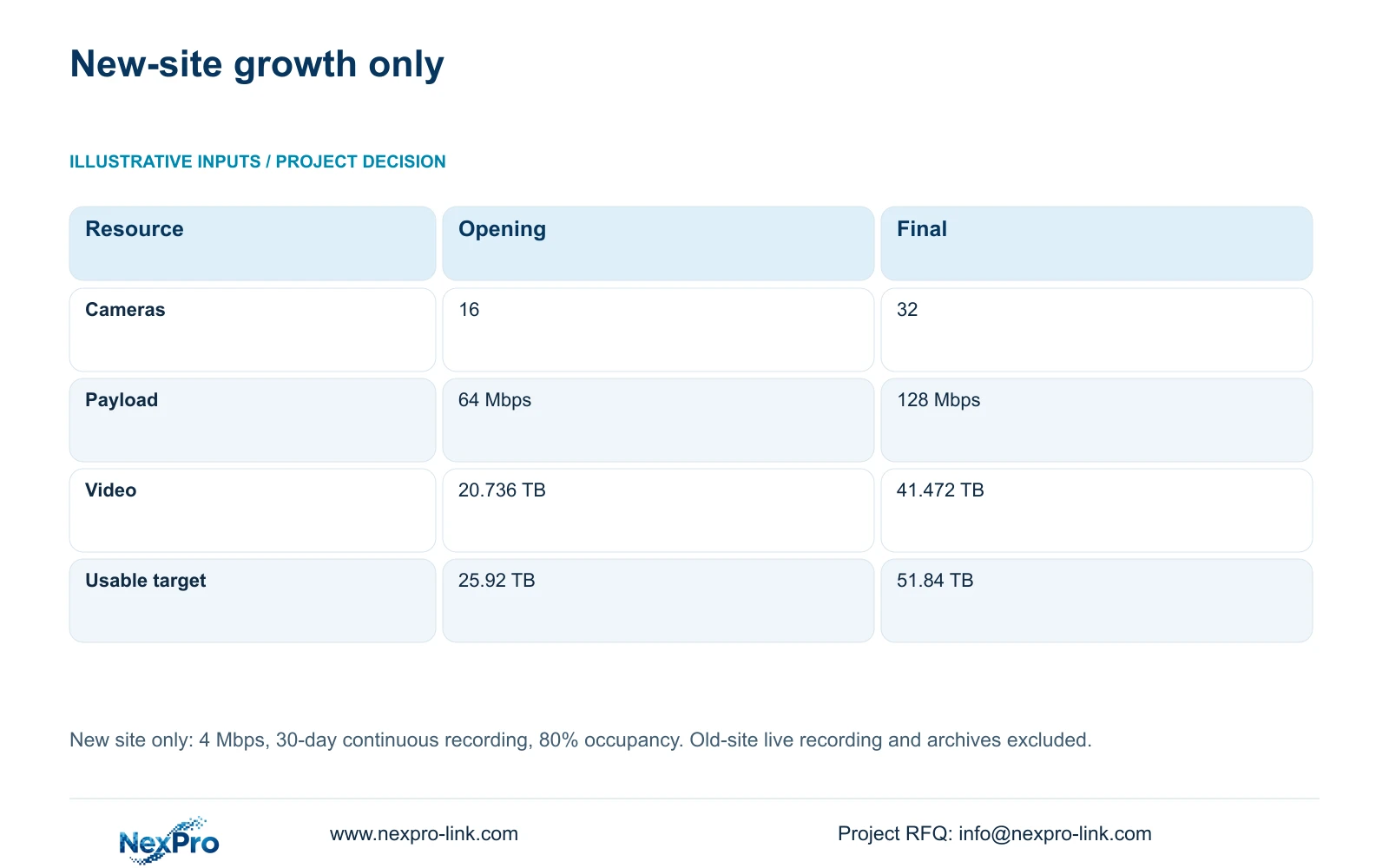
For the new site, assume 16 opening cameras and 32 final cameras, each averaging 4 Mbps with 30-day continuous recording. Payload Mbps = 4 × n. Video TB = 0.0108 × 4 × n × 30 in decimal units. Required usable capacity = video TB / 0.80, allowing 20% free space within usable storage.
The opening phase requires 64 Mbps, 20.736 TB of video and 25.92 TB of usable-capacity target. The final phase requires 128 Mbps, 41.472 TB and 51.84 TB. These values describe growth at the new site only. They exclude continuing old-site recording and preserved historical material, which need their own schedules and capacity boundaries.
CASE09's four 16 TB drives provide 48.64 TB of recording budget after its 95% formatting and 80% occupancy assumptions, enough for its 41.472 TB video calculation. This offers a final-site capacity reference, not spare space for an unspecified old archive. NexPro-NVR4449-4K lists four bays and 320 Mbps input, but actual stream modes and disk compatibility remain separate checks.
| Metric | New-site opening | New-site final |
|---|---|---|
| Cameras | 16 | 32 |
| Recorder payload | 64 Mbps | 128 Mbps |
| 30-day video | 20.736 TB | 41.472 TB |
| Required usable capacity | 25.92 TB | 51.84 TB |
Section 05
Budget duplicate dependencies for the period they are needed
Prefer keeping the old recording path intact while commissioning a complete new-site opening package. Reuse later assets when their release dates and suitability are confirmed. This arrangement avoids making the first new-site receiving event depend on an early recorder move. It also exposes the cost of overlap honestly instead of hiding it in a promised reuse allowance.
Quote new-site recording, network and protected power alongside the old site's continuing service requirements. Include any temporary equipment, transport and repeat installation visits. There is no matched price evidence here to establish whether temporary supply, rental or permanent new equipment is least expensive. Compare actual offers over the same overlap duties and final asset ownership.
Change the sequence if operations can authorize a shorter overlap, a verified archive releases the old recorder, or transferred equipment cannot meet the new views. Do not reduce old-site coverage merely to free hardware. Each location needs its own protected-power assessment; a UPS moving with the recorder cannot protect an old switch left behind or a new node on another circuit.
Section 06
Close each old-site duty before approving asset transfer
Use a transfer checklist tied to the milestone register. Operations confirms the old task has ended, the owner confirms footage access is preserved, and the installer records the equipment condition and configuration before removal. The new-site team then checks receipt, installation and task acceptance. Keep serial identity through both handoffs.
NexPro-Link's project supply and BOQ support scope can help distinguish permanent new supply, reusable equipment and conditional additions. A phase-labelled equipment list should show which new-site items must be operational before transferred assets become available. Packaging and overseas supply coordination can follow that sequence without claiming control over local dismantling or installation.
After the new-site phase is accepted, update the final asset schedule and remove temporary arrangements only against an approved replacement path. Preserve access-role and recording-setting records for both locations until their duties close. If relocation dates change, revise asset releases before changing shipment or installer bookings.
Section 07
Buyer questions
Can both sites use the same camera names? They can, but site-qualified identifiers make retrieval safer. Include the site in the channel name or index and retain a movement record when a camera changes location.
Should old disks be installed in the new recorder? Only after model-specific support and footage-preservation consequences are confirmed. Avoid any initialization step until the owner approves what must be retained and how it will remain readable.
Does the 16-camera opening budget cover both sites? No. It covers only the illustrative new-site opening phase. Old-site live recording, historical access and any simultaneous network or power requirements must be added in their own scope.
Section 08
Map the two-site operating overlap
Send your old/new operating milestones, asset release inventory, historical-footage requirements and new-site opening plan to info@nexpro-link.com to discuss staged supply and reusable-equipment boundaries.
Engineering references
These sources support the general planning principles. Always use the selected product's current datasheet and applicable project standards for final design.