A logistics company overlaps operations at an old warehouse and a new site during a staged inventory move. Identify the old-site tasks that continue during relocation.
Section 01
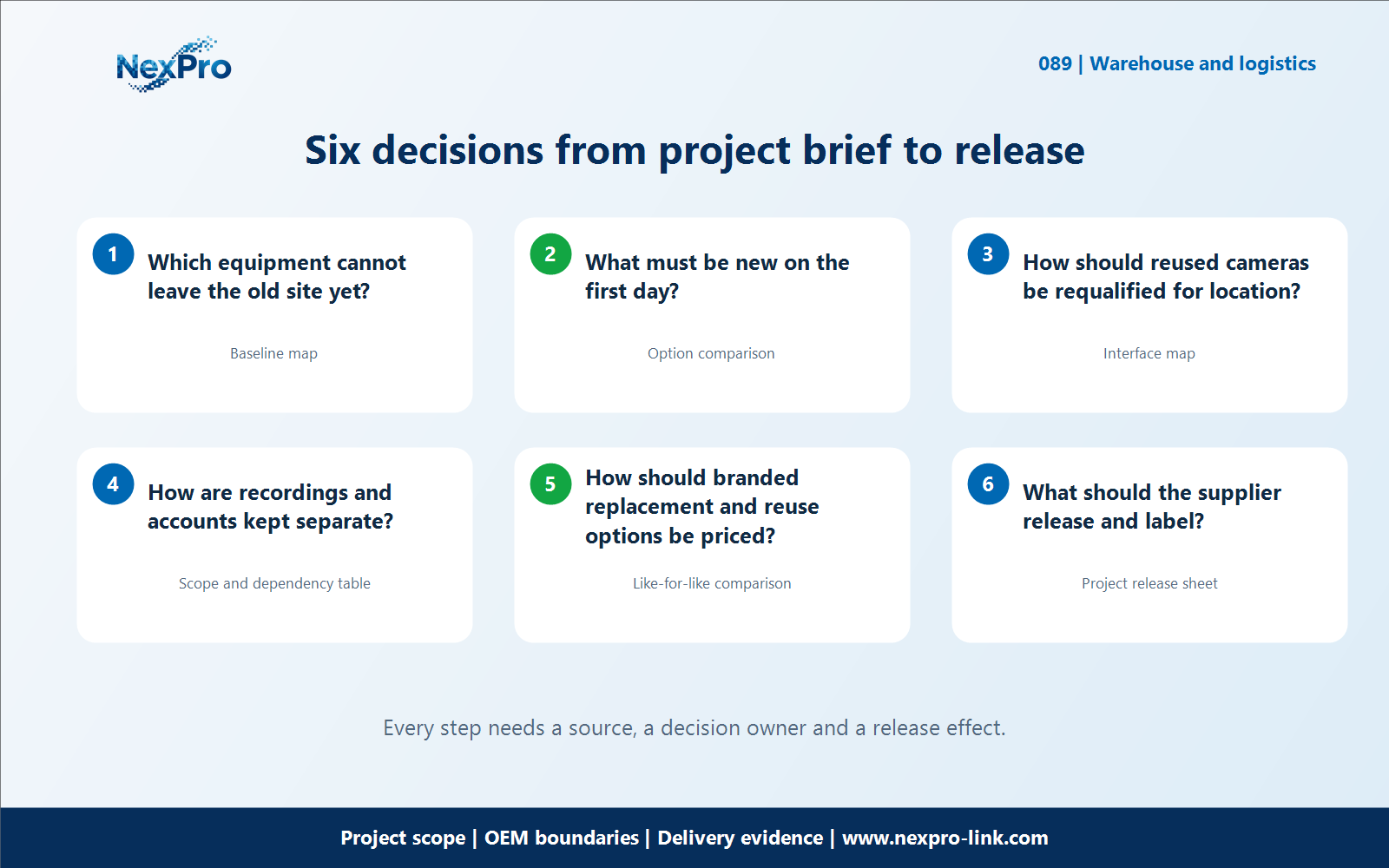
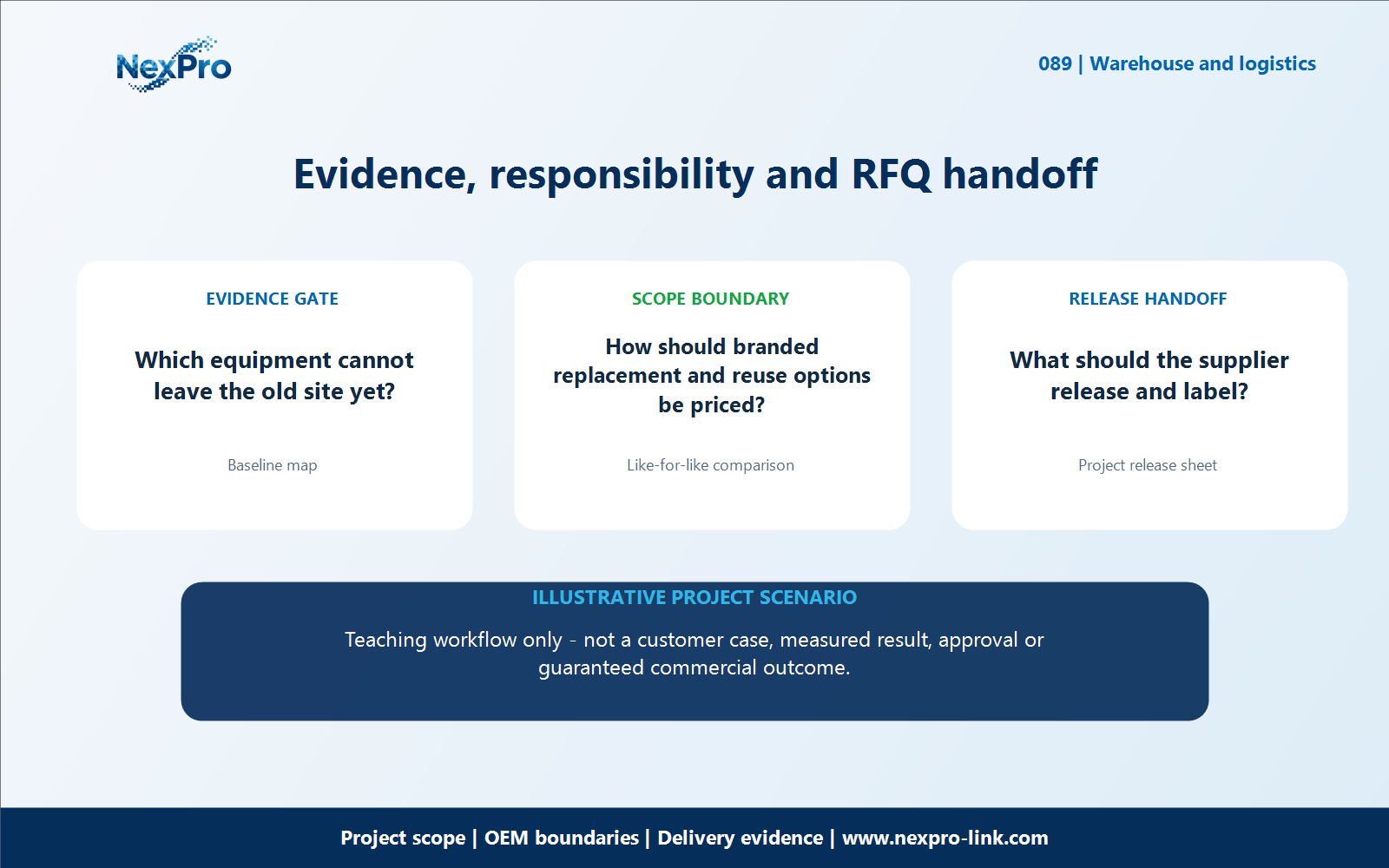
Which equipment cannot leave the old site yet?
A logistics company overlaps operations at an old warehouse and a new site during a staged inventory move. Identify the old-site tasks that continue during relocation. Equipment serving those tasks cannot be assumed available for the new building immediately. Plan the overlap period explicitly before counting existing cameras as free stock for reuse.
For the "Which equipment cannot leave the old site yet" decision, use the baseline map fields Area or item, Required task, Current assumption, Decision owner. Apply it to warehouse relocation CCTV staging so the buyer, supplier and local integrator can see which input is confirmed, who owns it and which evidence remains open.
Evaluate which equipment cannot leave the old site yet against the stated site task and the surrounding equipment, documentation, packing and handover dependencies for warehouse relocation CCTV staging. For which equipment cannot leave the old site yet in warehouse relocation CCTV staging, record the confirmed condition, chosen option and remaining evidence separately; an open value is not a price, test, approval or customer-result claim.
Carry the which equipment cannot leave the old site yet decision into the RFQ, BOQ, configuration or release record for warehouse relocation CCTV staging. For which equipment cannot leave the old site yet in warehouse relocation CCTV staging, name the equipment, artwork, network, installation and acceptance owner; site-specific work remains with the buyer or integrator unless the signed scope says otherwise.
Section 02
What must be new on the first day?
What must be new on the first day? Supply a complete operational first stage for the new site, including its recording and power path. Later reused equipment should be treated as a separate release. This avoids a first-day package that depends on cameras still needed elsewhere. For Warehouse Relocation CCTV: Keep the Old Site Running While the New Site Opens, keep this decision tied to the same project brief rather than opening a separate generic specification exercise.
For the "What must be new on the first day" decision, use the option comparison fields Position or option, Suitable condition, Trade-off, Next choice. Apply it to warehouse relocation CCTV staging so the buyer, supplier and local integrator can see which input is confirmed, who owns it and which evidence remains open.
Evaluate what must be new on the first day against the stated site task and the surrounding equipment, documentation, packing and handover dependencies for warehouse relocation CCTV staging. For what must be new on the first day in warehouse relocation CCTV staging, record the confirmed condition, chosen option and remaining evidence separately; an open value is not a price, test, approval or customer-result claim.
Carry the what must be new on the first day decision into the RFQ, BOQ, configuration or release record for warehouse relocation CCTV staging. For what must be new on the first day in warehouse relocation CCTV staging, name the equipment, artwork, network, installation and acceptance owner; site-specific work remains with the buyer or integrator unless the signed scope says otherwise.
Section 03
How should reused cameras be requalified for location?
How should reused cameras be requalified for location? Review the new position, lighting and required detail for each reused unit. Functioning equipment may still be wrong for a new view. Reuse should follow task suitability, not only the fact that the camera powers on. For Warehouse Relocation CCTV: Keep the Old Site Running While the New Site Opens, keep this decision tied to the same project brief rather than opening a separate generic specification exercise.
For the "How should reused cameras be requalified for location" decision, use the interface map fields Device or record, Input, Output, Responsible party. Apply it to warehouse relocation CCTV staging so the buyer, supplier and local integrator can see which input is confirmed, who owns it and which evidence remains open.
Evaluate how should reused cameras be requalified for location against the stated site task and the surrounding equipment, documentation, packing and handover dependencies for warehouse relocation CCTV staging. For how should reused cameras be requalified for location in warehouse relocation CCTV staging, record the confirmed condition, chosen option and remaining evidence separately; an open value is not a price, test, approval or customer-result claim.
Carry the how should reused cameras be requalified for location decision into the RFQ, BOQ, configuration or release record for warehouse relocation CCTV staging. For how should reused cameras be requalified for location in warehouse relocation CCTV staging, name the equipment, artwork, network, installation and acceptance owner; site-specific work remains with the buyer or integrator unless the signed scope says otherwise.
| Project question | Project-oriented treatment | Keep equal when comparing offers |
|---|---|---|
| Which equipment cannot leave the old site yet? | Identify the old-site tasks that continue during relocation. | Rack or handling-area geometry |
| What must be new on the first day? | Supply a complete operational first stage for the new site, including its recording and power path. | Recording and retrieval objective |
| How should reused cameras be requalified for location? | Review the new position, lighting and required detail for each reused unit. | Remote network and environmental scope |
| How are recordings and accounts kept separate? | Keep site names, access ownership and recording-handling instructions separate during the overlap. | Area-labelled equipment and support |
Section 04
How are recordings and accounts kept separate?
How are recordings and accounts kept separate? Keep site names, access ownership and recording-handling instructions separate during the overlap. Moving storage hardware is not a complete records-management plan. The buyer should define what recordings remain required and who may retrieve them. For Warehouse Relocation CCTV: Keep the Old Site Running While the New Site Opens, keep this decision tied to the same project brief rather than opening a separate generic specification exercise.
For the "How are recordings and accounts kept separate" decision, use the scope and dependency table fields Item, Included, Dependency, Separate option. Apply it to warehouse relocation CCTV staging so the buyer, supplier and local integrator can see which input is confirmed, who owns it and which evidence remains open.
Evaluate how are recordings and accounts kept separate against the stated site task and the surrounding equipment, documentation, packing and handover dependencies for warehouse relocation CCTV staging. For how are recordings and accounts kept separate in warehouse relocation CCTV staging, record the confirmed condition, chosen option and remaining evidence separately; an open value is not a price, test, approval or customer-result claim.
Carry the how are recordings and accounts kept separate decision into the RFQ, BOQ, configuration or release record for warehouse relocation CCTV staging. For how are recordings and accounts kept separate in warehouse relocation CCTV staging, name the equipment, artwork, network, installation and acceptance owner; site-specific work remains with the buyer or integrator unless the signed scope says otherwise.
Section 05
How should branded replacement and reuse options be priced?
How should branded replacement and reuse options be priced? Compare new, reused and mixed options on the full relocation scope. Include movement, reconfiguration and installation work where relevant. A reused camera is not cost-free if making it suitable consumes more work than a new position-specific unit. For Warehouse Relocation CCTV: Keep the Old Site Running While the New Site Opens, keep this decision tied to the same project brief rather than opening a separate generic specification exercise.
For the "How should branded replacement and reuse options be priced" decision, use the like-for-like comparison fields Requirement, Baseline, Proposed treatment, Remaining difference. Apply it to warehouse relocation CCTV staging so the buyer, supplier and local integrator can see which input is confirmed, who owns it and which evidence remains open.
Evaluate how should branded replacement and reuse options be priced against the stated site task and the surrounding equipment, documentation, packing and handover dependencies for warehouse relocation CCTV staging. For how should branded replacement and reuse options be priced in warehouse relocation CCTV staging, record the confirmed condition, chosen option and remaining evidence separately; an open value is not a price, test, approval or customer-result claim.
Carry the how should branded replacement and reuse options be priced decision into the RFQ, BOQ, configuration or release record for warehouse relocation CCTV staging. For how should branded replacement and reuse options be priced in warehouse relocation CCTV staging, name the equipment, artwork, network, installation and acceptance owner; site-specific work remains with the buyer or integrator unless the signed scope says otherwise.
Section 06
What should the supplier release and label?
What should the supplier release and label? Label new supply, later reused units and spares as different groups. Match each release to the new site's installation phase. Consistent buyer presentation is useful, but it should not obscure which items are new and which were transferred. For Warehouse Relocation CCTV: Keep the Old Site Running While the New Site Opens, keep this decision tied to the same project brief rather than opening a separate generic specification exercise.
For the "What should the supplier release and label" decision, use the project release sheet fields Configuration, Artwork, Quantity, Location, Release stage. Apply it to warehouse relocation CCTV staging so the buyer, supplier and local integrator can see which input is confirmed, who owns it and which evidence remains open.
Evaluate what should the supplier release and label against the stated site task and the surrounding equipment, documentation, packing and handover dependencies for warehouse relocation CCTV staging. For what should the supplier release and label in warehouse relocation CCTV staging, record the confirmed condition, chosen option and remaining evidence separately; an open value is not a price, test, approval or customer-result claim.
Carry the what should the supplier release and label decision into the RFQ, BOQ, configuration or release record for warehouse relocation CCTV staging. For what should the supplier release and label in warehouse relocation CCTV staging, name the equipment, artwork, network, installation and acceptance owner; site-specific work remains with the buyer or integrator unless the signed scope says otherwise.
Engineering references
These sources support the general planning principles. Always use the selected product's current datasheet and applicable project standards for final design.