A quiet camera test does not establish busy-shift traffic. Use representative averages for factory storage and map simultaneous recording, viewing and export demand onto the links that actually carry it.
Section 01
Use representative averages and separate peak checks
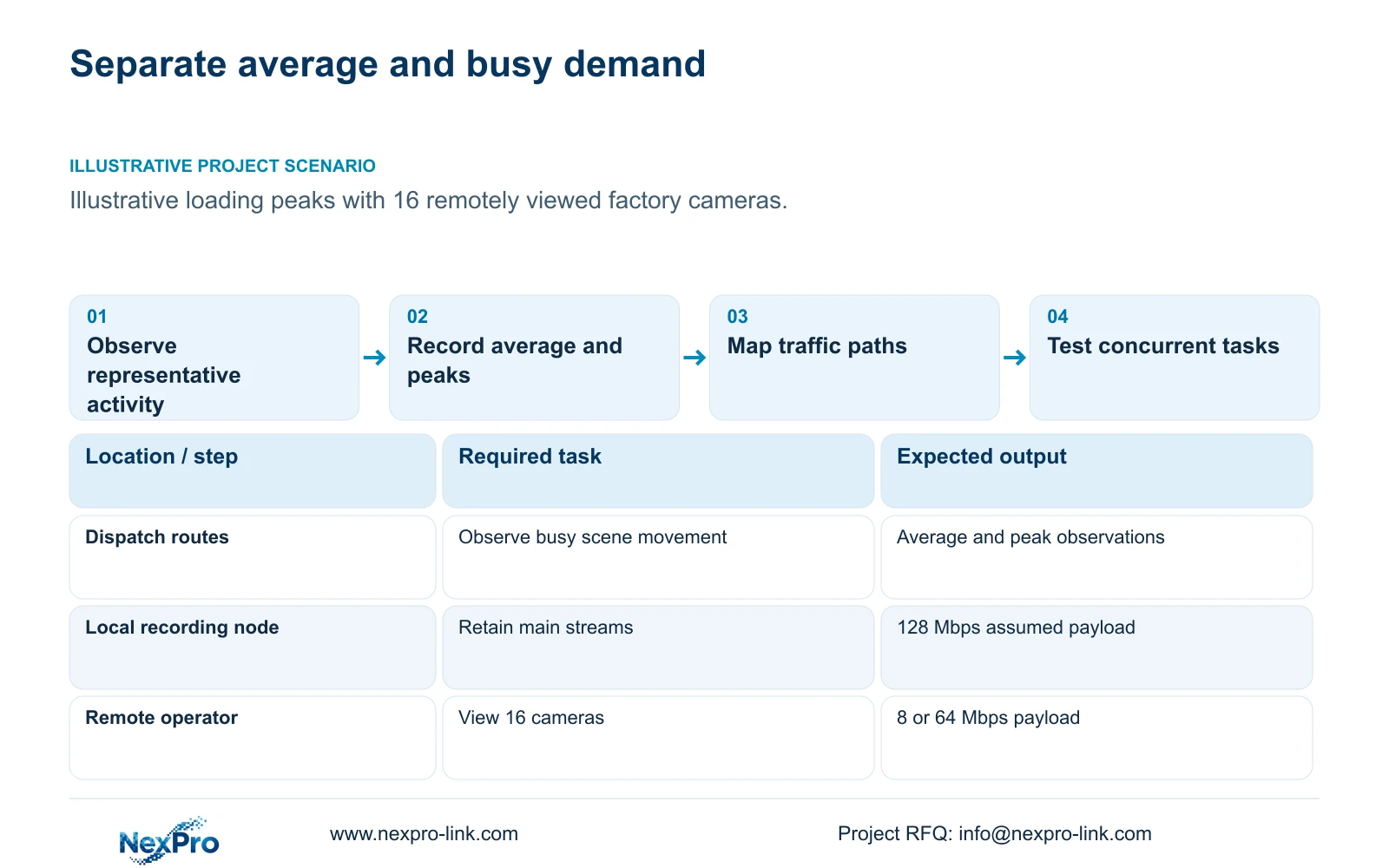
Use representative average bitrate to estimate factory storage, then check busy intervals separately for recorder and network capacity. A 30-day average cannot establish whether simultaneous camera peaks fit a link. The supplied example assumes 128 Mbps for local recording, with a separate remote-viewing payload of either 8 or 64 Mbps depending on the streams selected.
Illustrative project scenario: Loading peaks create more scene motion than a quiet commissioning test. In the supplied 32-camera CNC reference, assume dispatch activity and shared transfer routes become busy together while a remote supervisor views 16 cameras. The comparison retains local main-stream recording and changes only the viewing stream. No measured peak rate or WAN performance result is supplied.
Plan observations across loading, ordinary production, quiet periods and night operation. Keep recording settings fixed while collecting data. Mark provisional averages clearly where the factory has not opened. The engineer should retain both the storage estimate and the unresolved peak-capacity check rather than converting a quiet test into an unconditional system approval.
Section 02
Map traffic to each interface and direction
Draw the camera-to-recorder path and recorder-or-camera-to-operator path separately. CASE01 groups 32 cameras across four access-switch load groups, with local recording at one node. An eight-camera access group carries 8 × 4 = 32 Mbps of assumed main-stream payload toward the recorder. A shared aggregation path carrying all groups sees 128 Mbps before overhead.
Remote viewing belongs only on interfaces traversed by the selected streams. If the client receives video from the recorder, the individual camera access links may not carry another full copy to that client. If it pulls directly from cameras, some access paths do carry additional traffic. Confirm the actual connection method rather than adding remote payload to every cable.
Record ingress and egress separately where appropriate. Playback, export, another operator and unrelated shared-link traffic create additional demand on their actual routes. Dual Gigabit LAN ports on a recorder do not prove that traffic automatically splits as expected, so the proposed interface configuration needs its own check.
Section 03
Give storage reserve and network headroom different jobs
At the case's assumed 4 Mbps average per camera, video_TB = 0.0108 × 128 × 30 = 41.472 TB for continuous 30-day recording. The 20% free-space policy raises the usable-capacity target to 51.84 TB. Four 16 TB disks provide a 48.64 TB illustrative video allowance after the separate 95% usable-capacity assumption and free-space reserve.
That storage allowance does not absorb packets arriving faster than a link or recorder can process them. Network headroom must address traffic demand over the relevant busy interval, protocol overhead and other activity on the same interface. Do not apply the disk's 20% free-space factor as a substitute for a traffic analysis.
Conversely, a short busy interval should not be multiplied by 30 days and presented as expected storage unless it represents the full recording period. Keep the representative average, observed peaks, sampling interval and declared stream limits visible. The supplied figures are averages and viewing examples; actual simultaneous VBR peak demand remains a project input.
Section 04
Change remote viewing without changing local evidence
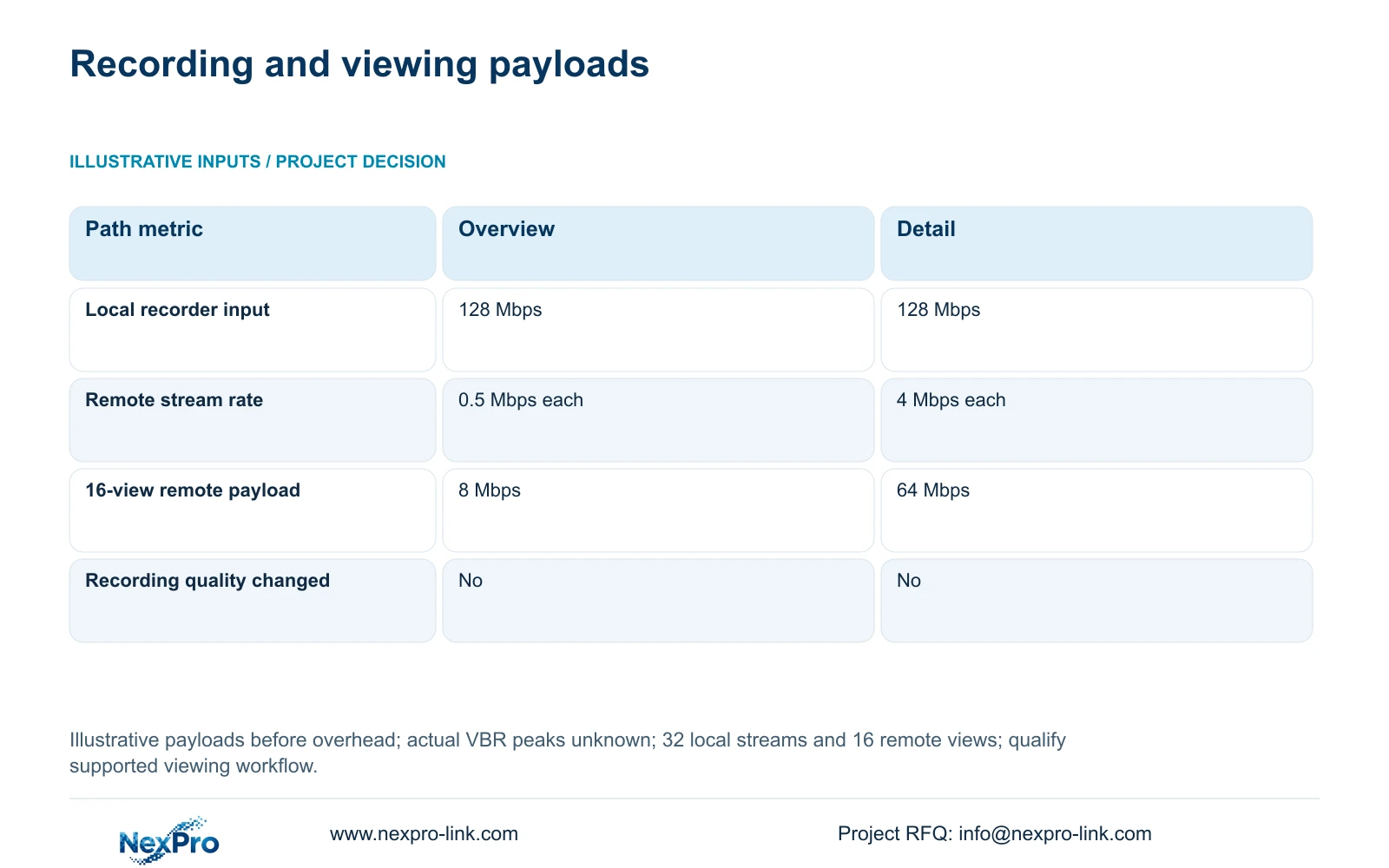
Use recorder_Mbps = 32 × 4 = 128 Mbps. For 16 simultaneous viewed streams, viewing_Mbps = 16 × stream_Mbps. At an assumed 0.5 Mbps each, the overview payload is 8 Mbps. At 4 Mbps each, the detail-viewing payload is 64 Mbps. Both options keep the same assumed local recording stream.
The decisive difference is the operator's viewing demand. A low-bandwidth overview can support scene awareness while the recorder retains its main streams, provided the actual camera, recorder and client support that workflow. It may be unsuitable for inspecting fine detail in every window. A viewing stream must be assessed against the operator task rather than accepted only because its rate is lower.
These figures precede protocol overhead and do not describe measured VBR peaks. If a shared direction genuinely carries both recording and viewing payloads, add only the flows present there. Otherwise keep them separate. Neither option guarantees remote performance, and simultaneous playback or export requires another path-specific calculation.
| Metric | Option A: overview | Option B: detail |
|---|---|---|
| Local recorder input | 128 Mbps | 128 Mbps |
| Concurrent viewed cameras | 16 | 16 |
| Remote stream rate | 0.5 Mbps each | 4 Mbps each |
| Remote viewing payload | 8 Mbps | 64 Mbps |
| Local recording changed | No | No |
Section 05
Approve a viewing policy and qualify the busy workflow
Prefer the overview option for an authorised remote grid when its picture meets the overview task. Request higher-detail streams for inspections that need them, and confirm how the client changes streams. If the workflow demands all 16 views at main-stream quality continuously, retain the 64 Mbps viewing comparison and qualify the route for that demand.
The NexPro-NVR4449-4K provides a published 320 Mbps input reference, while CASE01 assumes supported 5MP-class recording streams. The 128 Mbps average leaves a numerical difference below that input rating, but no supplied measurement establishes every simultaneous peak, playback combination or export load. Do not describe the remaining input capacity as verified peak headroom.
Run a commissioning exercise with busy scene activity, the agreed viewing grid and a representative playback or export task where required. Observe gaps, client response and interface traffic, then preserve the settings and topology used. If the configuration fails, revise the affected stream policy or resource rather than reducing recorded evidence without owner approval.
Section 06
Issue a traffic worksheet with measurable acceptance inputs
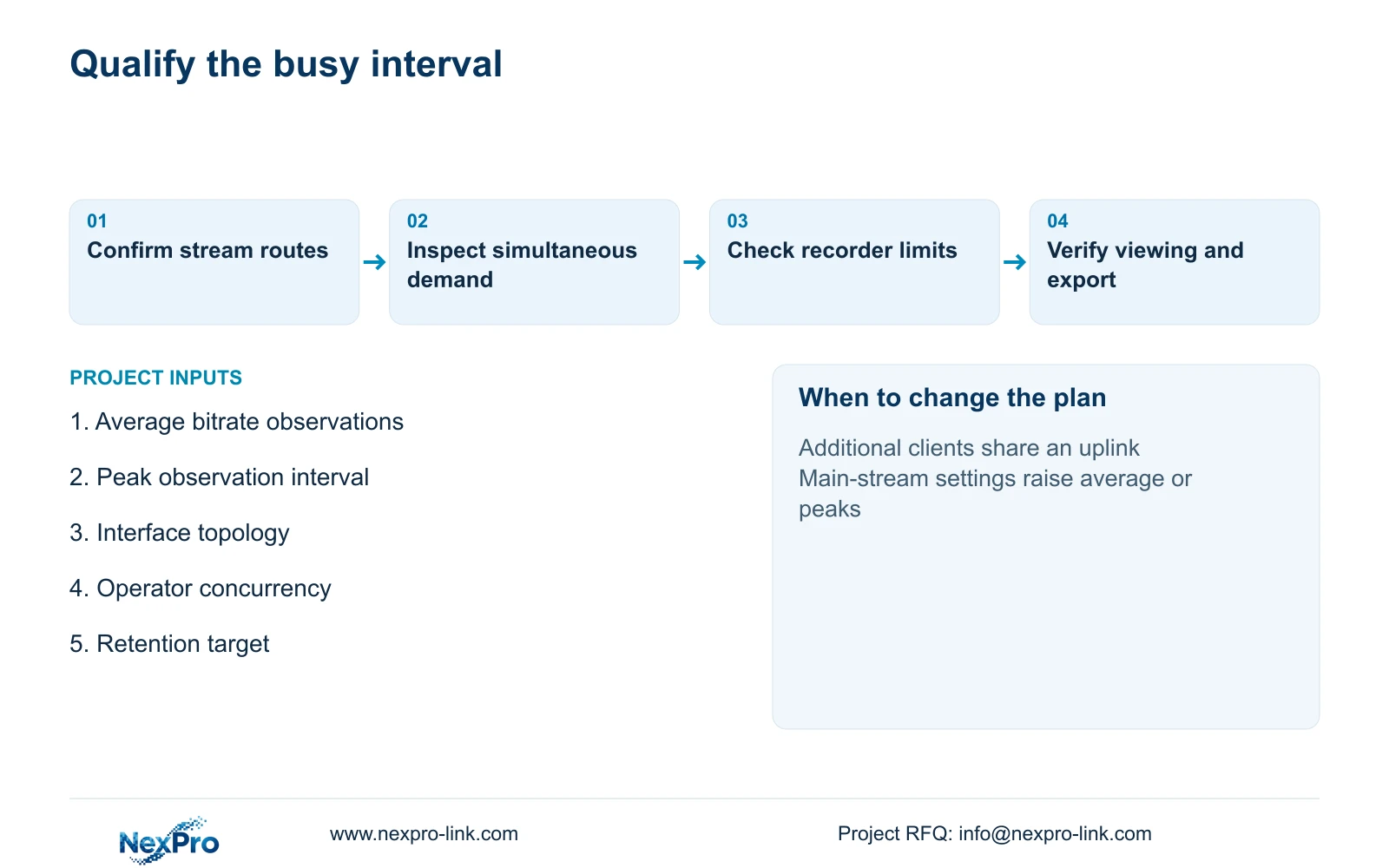
The engineer's worksheet should identify each interface, traffic direction, stream source, destination and concurrent task. Attach the average-bitrate observations used for storage and the busy-interval observations used for traffic checks. Keep provisional inputs visible until the site operates under representative conditions.
NexPro-Link's BOQ and Tender Support scope can help coordinate recorder matching and technical deviations. The local network team should confirm available routes, shared traffic and remote-access conditions. A quotation for hardware cannot establish a WAN service result, so any required connectivity provision and commissioning work need explicit responsibility.
Set change triggers for additional operators, revised remote grids, camera settings or export workflows. An increased remote-viewing load may leave local storage unchanged while affecting an uplink. A higher main-stream average affects both recording storage and the paths carrying that stream. Updating the appropriate calculation avoids unnecessary replacement of resources that the change never touches.
Section 07
Buyer questions
What if the factory is not operating during commissioning? Keep bitrate and peak demand provisional. Record the available test conditions and schedule a representative operating check after activity starts. Do not describe quiet-site observations as busy-shift verification.
Can a remote overview stream be used for incident evidence? The intended evidence source remains the accepted local recording stream in this example. If remote footage must serve a separate evidence task, define and verify its quality and preservation workflow independently.
Should the engineer sum individual camera peaks? A simultaneous-peak sum can be a declared conservative planning basis, but distinguish it from an observed aggregate peak. Record the time interval and concurrency assumptions so another reviewer can understand the capacity check.
Section 08
Review storage and traffic on the correct paths
Send your representative average and peak bitrate observations, network topology, concurrent viewing/export tasks and retention target to info@nexpro-link.com. NexPro-Link can discuss recorder selection and a traffic-aware recording proposal.
Engineering references
These sources support the general planning principles. Always use the selected product's current datasheet and applicable project standards for final design.