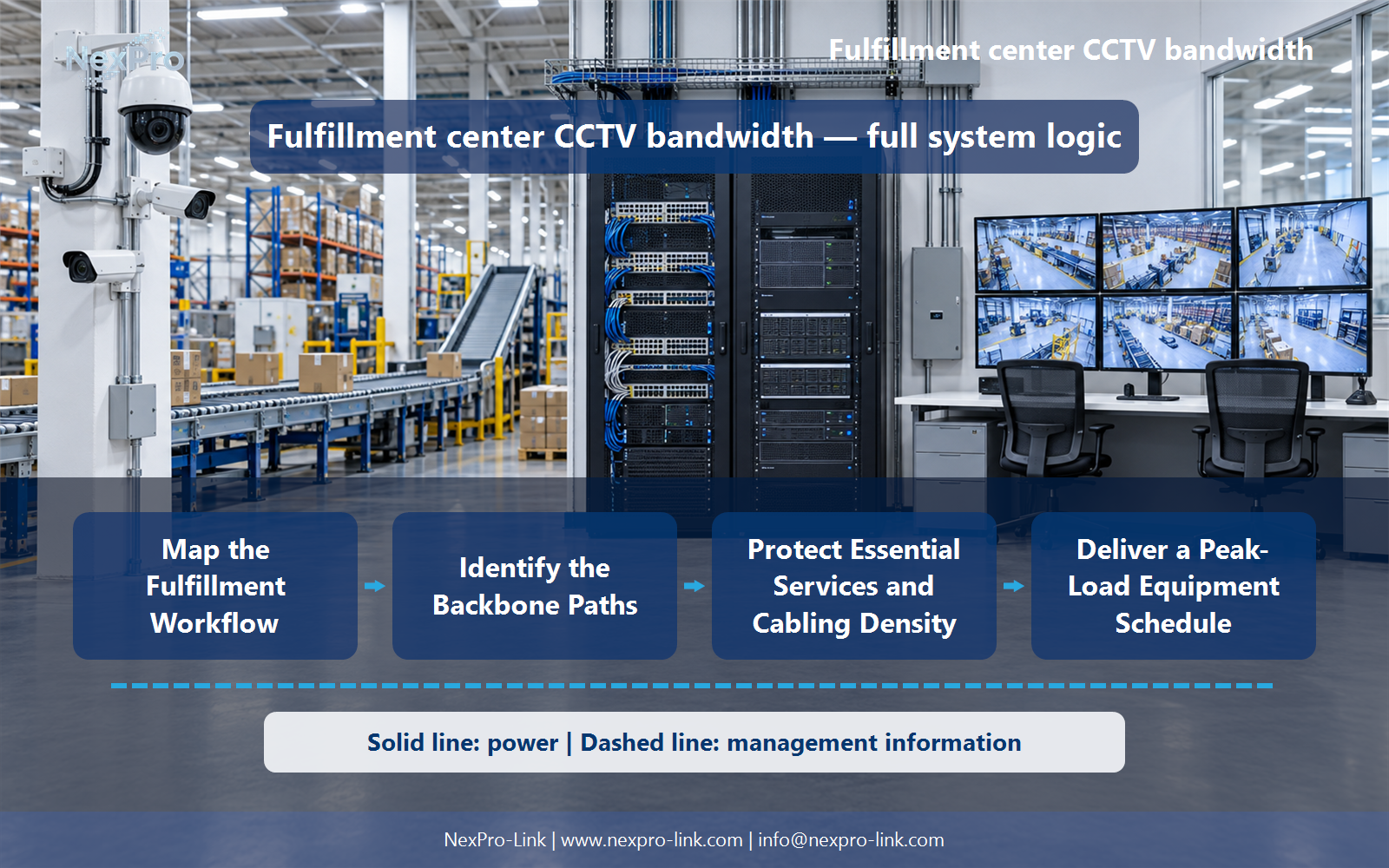
Plan fulfillment center CCTV bandwidth with practical guidance on map the fulfillment workflow and size recording and storage services. NexPro-Link project guide.
Section 01
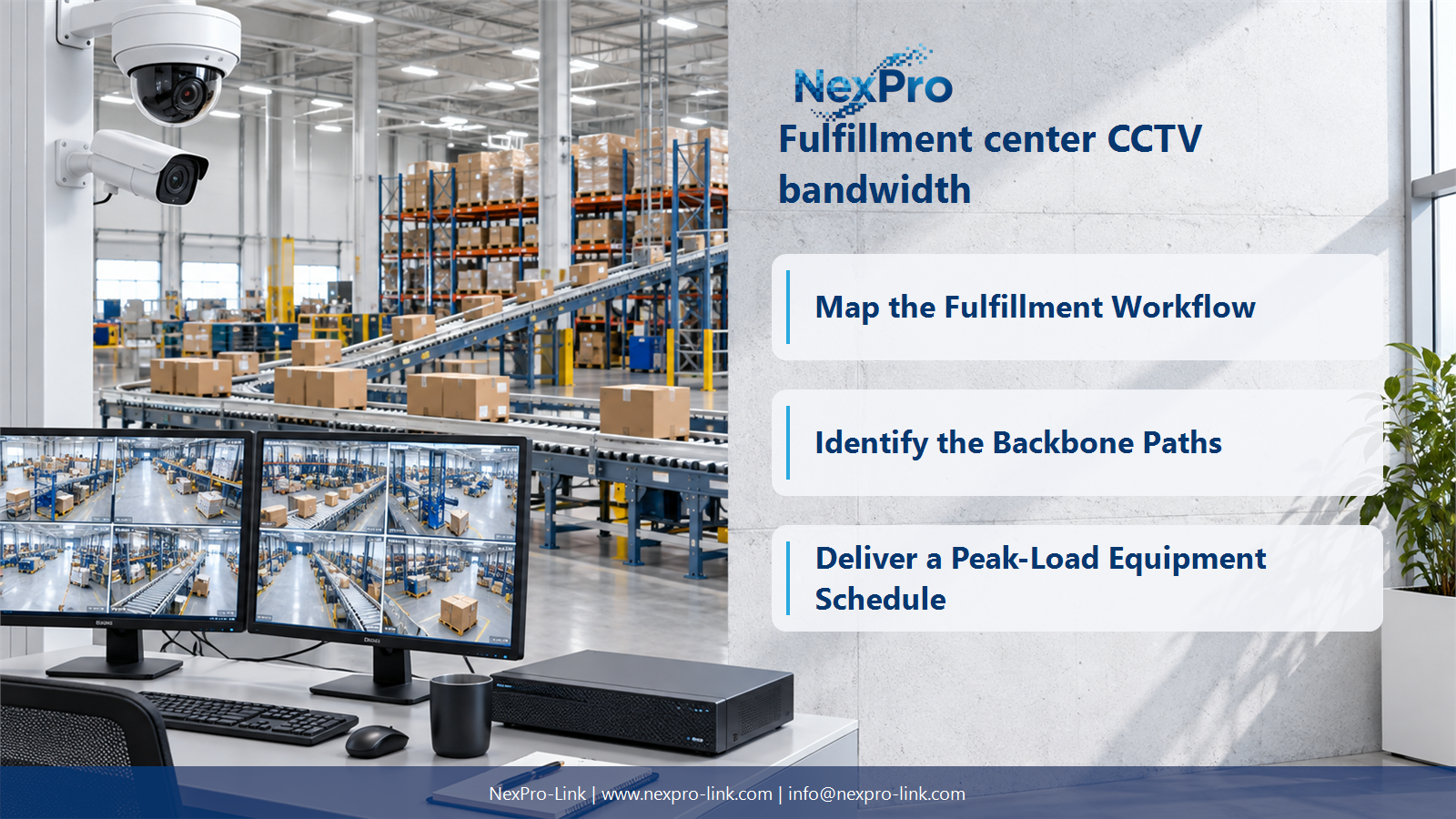
Map the Fulfillment Workflow
Separate packing detail, conveyor movement, storage access and loading context according to the questions the footage must answer. A large camera total does not mean every view has the same bitrate or evidence value. Identify the peak operating conditions for each group.
Turn the answer into a working record using Process, View task, Motion, Detail, Peak period.
| Decision area | Buyer question | Required output |
|---|---|---|
| Map the Fulfillment Workflow | Which fulfillment-center activities need distinct views? | Separate packing detail, conveyor movement, storage access and loading context according to the questions the footage must answer. |
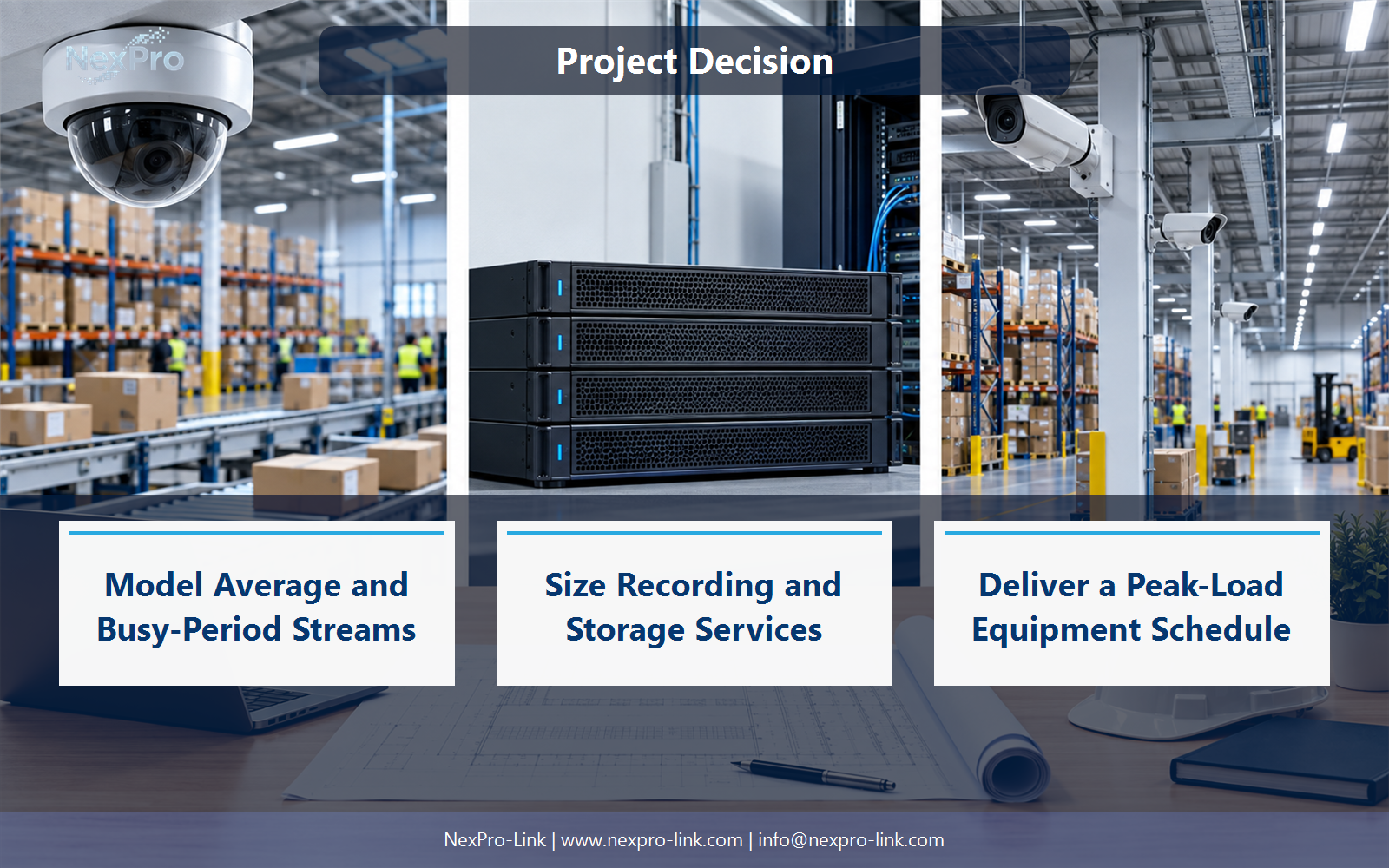
| Model Average and Busy-Period Streams | Why can peak operations change the network workload? | Scene activity and selected compression settings can change stream rates, while more investigations may add playback and export traffic. |
| Identify the Backbone Paths | Does a large fulfillment center automatically require every link at 10 Gbps? | No. |
Section 02
Model Average and Busy-Period Streams
Scene activity and selected compression settings can change stream rates, while more investigations may add playback and export traffic. Use explicit average and busy-period scenarios. Do not assume a fixed smart-codec saving or equate camera resolution with a guaranteed peak bitrate.
Use Group, Average Mbps, Busy Mbps, Concurrent investigations to compare options on the same basis. Keep product capability, project assumption and operating responsibility in separate columns.
Section 03
Identify the Backbone Paths
No. Calculate the flows crossing each access, aggregation and recording link. Concentrated traffic may justify faster backbone links, while individual camera connections have different needs. Display outputs and Ethernet backbone speed are also separate specifications.
The project output should make Link, Recording flow, Playback flow, Peak, Selected capacity traceable from input to acceptance.
- Confirm the answer to: Does a large fulfillment center automatically require every link at 10 Gbps?
- Record the project fields: Link / Recording flow / Playback flow / Peak / Selected capacity.
- Keep product capability, project assumptions and site responsibility in separate records.
Section 04
Size Recording and Storage Services
It can suit a workload requiring supported capacity, management and resilience beyond appliance configurations. Specify sustained recording, retention and concurrent read operations before selecting servers or storage. A CVR label does not itself establish sufficient performance or compatibility.
Record Recording service, Write load, Read load, Capacity, Recovery before selecting a product family. That makes later substitutions possible without silently changing the operational requirement.
Section 05
Protect Essential Services and Cabling Density
Include local PoE budgets, cabinet heat and power, backbone dependencies and manageable patching. Coordinate powered-cable bundles and pathways using the applicable guidance. Redundant power must be a supported design; merely placing two UPS units in the room does not protect every access zone.
Review Zone, Ports, Power, Heat, Pathway, Backup with the party that will operate or maintain the system.
Section 06
Deliver a Peak-Load Equipment Schedule
Show camera groups, network allocations, recording services, storage, operator displays and power dependencies under both normal and peak scenarios. Separate licences, specialist software and installation scope. This lets NexPro-Link discuss a coherent equipment package instead of assuming maximum-rated devices everywhere.
Use Group, Normal load, Peak load, Equipment role, Scope as the handoff between design and procurement.
Engineering references
These sources support the general planning principles. Always use the selected product's current datasheet and applicable project standards for final design.