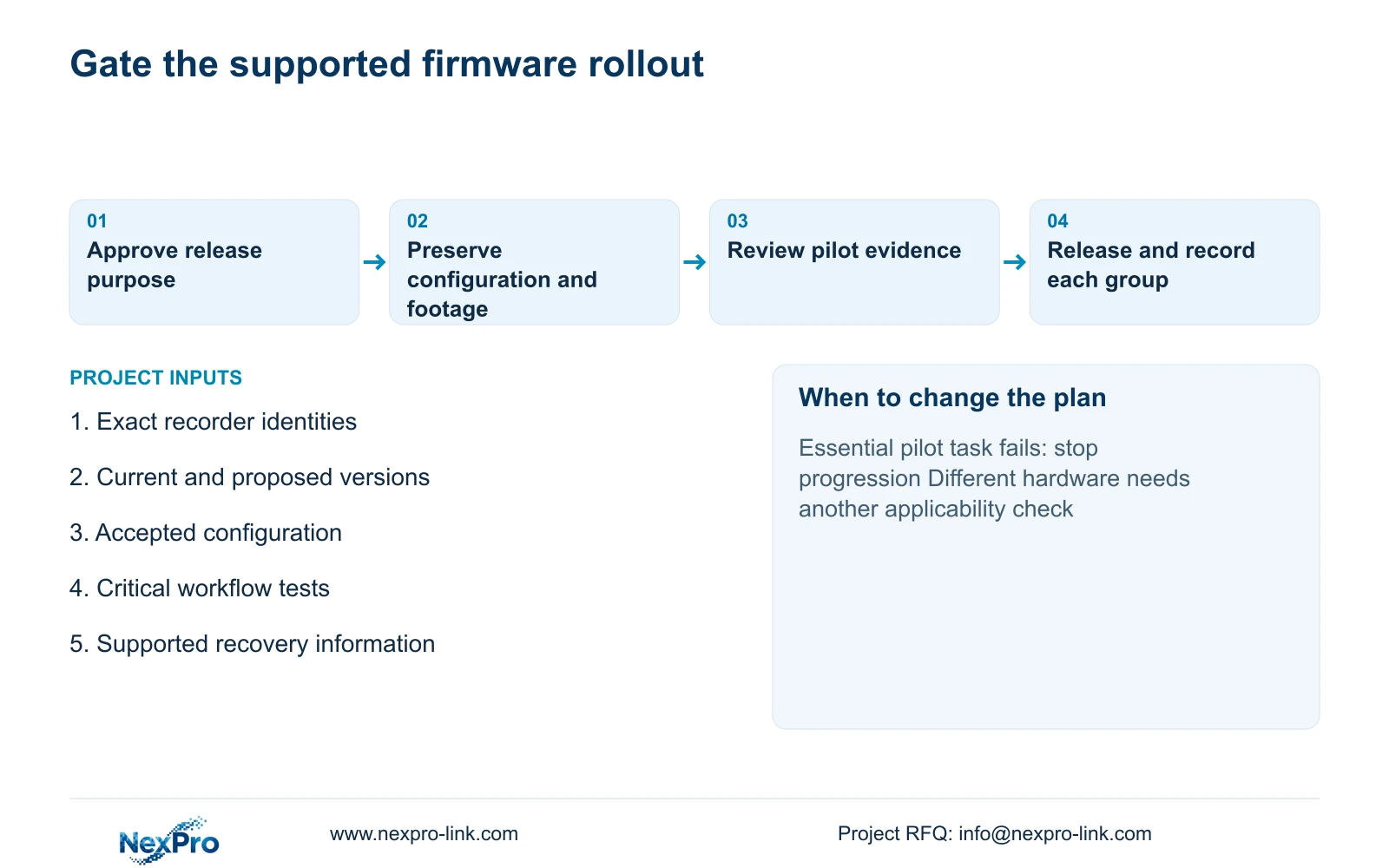
Before releasing the next fleet group, verify the pilot's required recording and retrieval tasks across the relevant operating shift, not merely immediately after restart. Record any untested scheduled function as open.
Section 01
Preserve the accepted configuration before approving the release
Before releasing the next fleet group, verify the pilot's required recording and retrieval tasks across the relevant operating shift, not merely immediately after restart. Record any untested scheduled function as open. Pause progression when the available observation period cannot cover the change's purpose; batch arithmetic does not provide that evidence.
Approve a factory NVR firmware rollout from the exact installed model, proposed release purpose and supported recovery route. Preserve the accepted configuration, test changed workflows on representative pilot devices and release later groups only after reviewing results. Newer firmware is not evidence of universal improvement, and reversibility cannot be assumed.
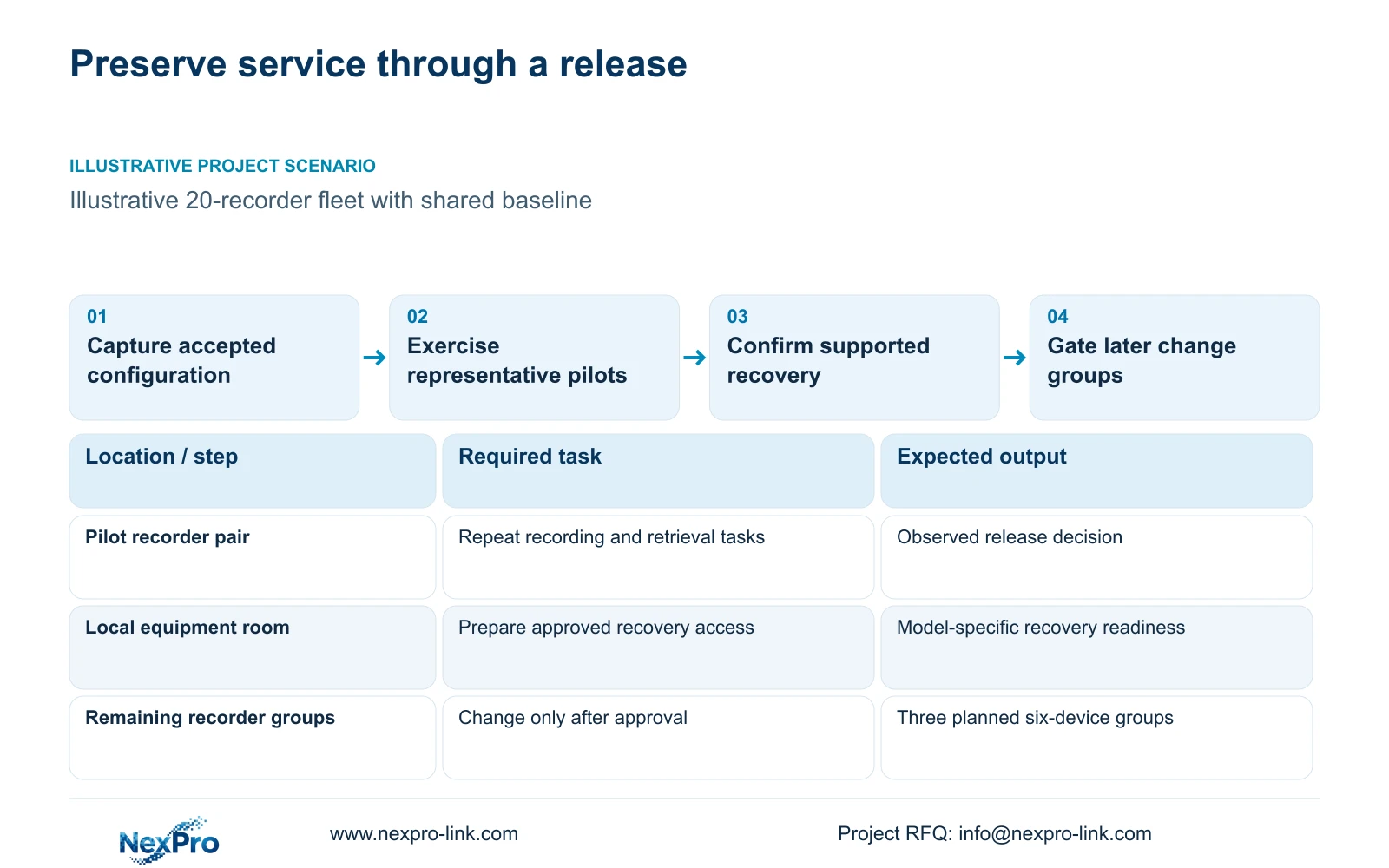
Illustrative project scenario: Several factory recorders share a firmware baseline and an update is proposed. The rollout comparison assumes a 20-device fleet, separate from CASE01's single 32-camera recording node. Use the CASE01 node as an example of the recording and retrieval tasks a pilot may need to preserve, not as proof of a 20-recorder installation.
Inventory recorder model, hardware identity where relevant, current version, camera modes, disk arrangement, network settings and client dependencies. Record the reason for the proposed change and the functions expected to change. This lets the owner distinguish a necessary corrective release from an update with no demonstrated project benefit.
Section 02
Choose pilot devices that represent the fleet's real dependencies
Select the two illustrative pilot devices by configuration coverage, not convenience alone. They should represent the relevant recorder models, camera families, storage arrangements and operator paths. If two devices cannot cover important differences, revise the pilot scope or maintain separate release decisions for those groups.
Capture pre-change evidence for continuous recording, time settings, disk status, required events and authorised retrieval. For a CASE01-like node, maintain the accepted 32-camera schedule and exercise live view, playback and export. The original 128 Mbps average demand is a planning input, not a firmware benchmark; verify the actual operating settings on the pilot.
After the supported update procedure, repeat the same tasks and compare observations. Include reconnecting the intended client and retrieving recordings from the relevant periods. A new menu or a successful boot is insufficient evidence for release. Keep pass criteria tied to operating tasks, with failed or untested items visible to the approving team.
Section 03
Confirm how service can be recovered before changing equipment
Obtain the model-specific supported recovery information before the maintenance window. Establish whether downgrade is supported, whether saved configuration can be imported into the intended release and what happens to existing recordings. A configuration export is useful only when its restoration method and version applicability are understood.
Preserve important footage through an authorised export process separately from configuration backup. Do not assume a settings file includes recordings or that a recovery action preserves every disk state. Have a local technician, support contact and any approved replacement equipment available according to the agreed recovery plan.
If the supported route requires replacement rather than rollback, describe that explicitly, including configuration work and expected recording gaps to be assessed. Keep the existing equipment record and owner-approved contingency together. Stable power and controlled access are maintenance prerequisites, but no general UPS reference establishes that an interrupted update can be recovered safely.
Section 04
Limit the changed group and hold each progression decision
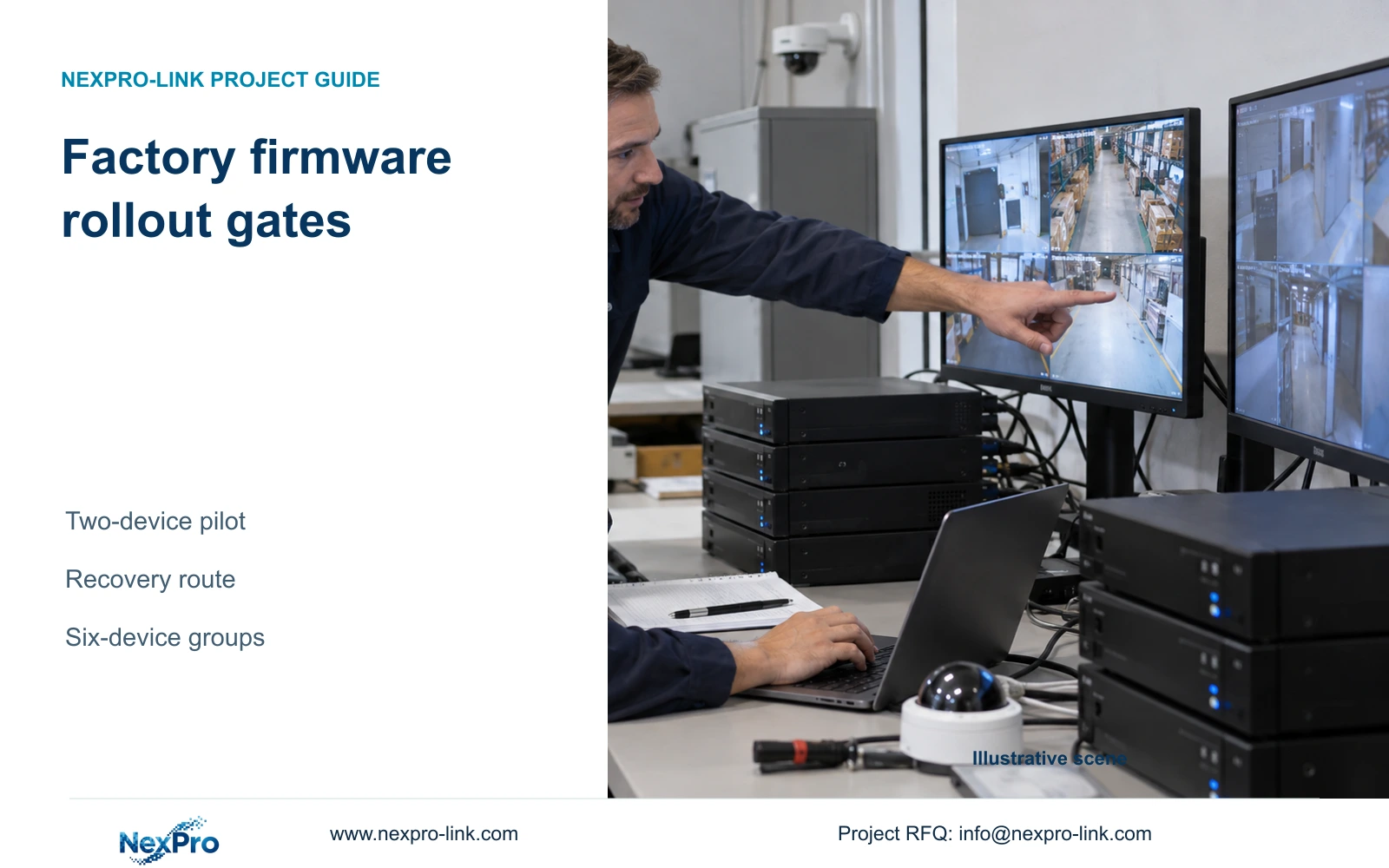
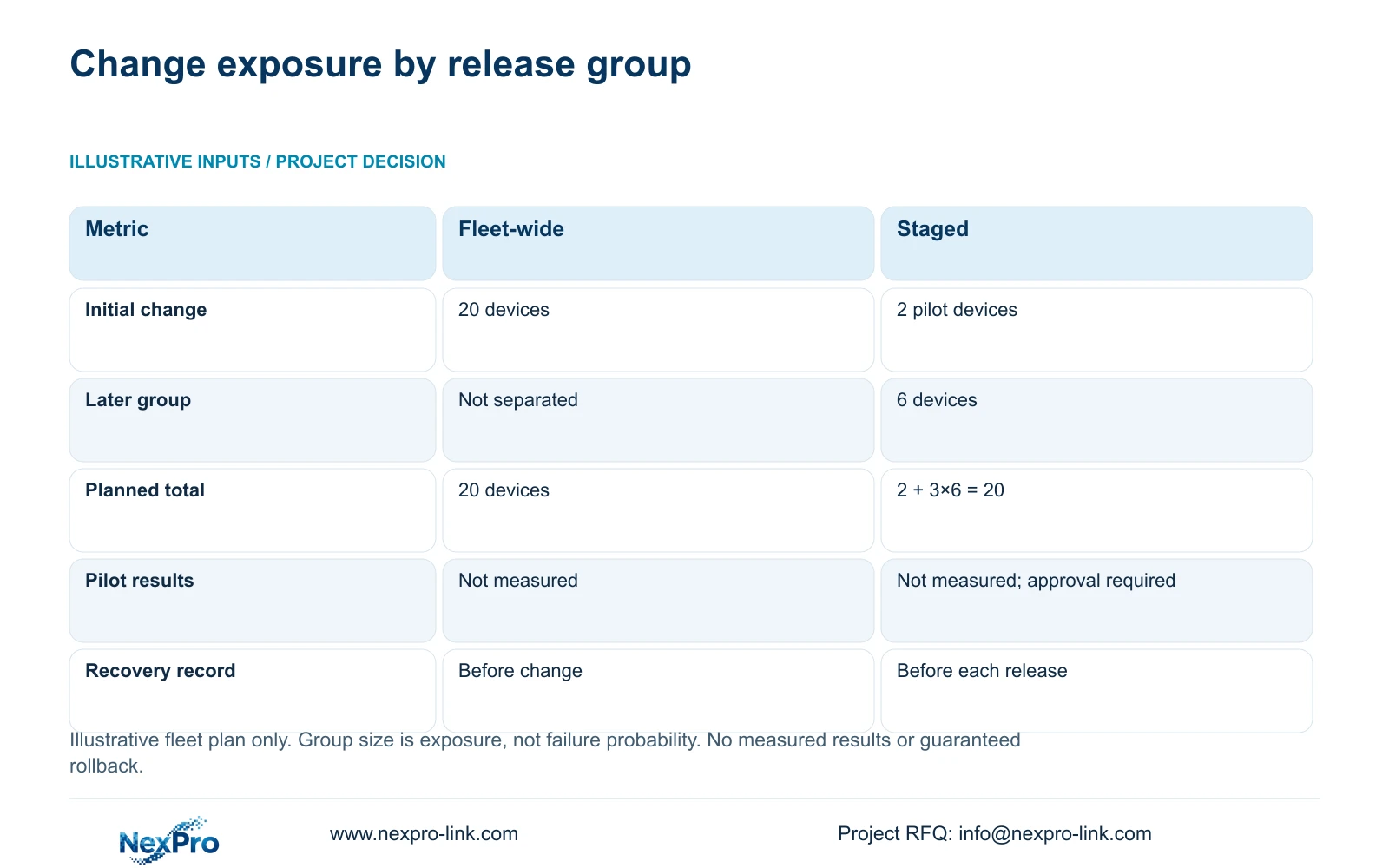
The illustrative fleet contains 20 recorders. Option A changes all 20 together. Option B plans two pilot devices followed by three groups of six, with progression conditional on accepted results. The arithmetic is 2 + 3×6 = 20 planned devices. Group size describes change exposure; it is not a calculated failure probability.
The decisive difference is the opportunity to observe and stop before exposing more operating nodes to the same release. The two-device pilot leaves the remainder unchanged until approval. Later six-device groups still need their own configuration records, access readiness and checks. An earlier pass does not pre-approve devices with a different hardware or camera combination.
No test outcomes are supplied. Use the table as a change plan, then populate actual evidence during execution. If a pilot loses an essential recording or retrieval function, stop progression and use the supported recovery decision. Do not increase group size to recover schedule time while the cause remains unresolved.
| Decision field | Fleet-wide change | Controlled staged change |
|---|---|---|
| Initial changed group | 20 devices | 2 pilot devices |
| Later group size | Not separated | 6 devices per group |
| Planned total | 20 devices | 2 + 3×6 = 20 devices |
| Configuration and recovery record | Required before change | Required before each release |
| Pilot evidence | Not measured | Not measured; progression gate |
| Automatic version acceptance | No | No |
Section 05
Proceed from observed service results and approved downtime
Prefer the staged approach for this shared-baseline scenario. It gives the owner an explicit hold point after the representative pilot and each later group. Define the observation period from the site's task cycles and release risks rather than inventing a universal number of hours. Include the relevant night, shift-change or remote retrieval workflow where it matters.
NIST SP 800-82 Rev.3 is a useful OT-security reference for respecting operational constraints during changes. Keep recorder maintenance on its approved network path and coordinate with production access restrictions. CCTV firmware work should not create an unapproved route into plant-control equipment or interfere with unrelated operating systems.
A time-sensitive release may require a different sequence, but it still needs exact applicability, acceptance tasks and recovery responsibility. Price the actual labour windows, local attendance and contingency scope when comparing support offers. No arbitrary risk score or invented downtime cost is necessary to explain the benefit of smaller, conditional release groups.
Section 06
Keep the rollout record usable for later supply and support
For every changed recorder, record the previous and accepted versions, configuration identity, maintenance approval and observed task results. Track devices that remain on the earlier baseline rather than treating the fleet as uniform after the pilot. The operator team needs to know which combinations are accepted and where an exception or temporary limitation remains.
NexPro-Link can discuss installed-model identification, technical documents and related equipment scope through its BOQ support route. The NVR4449 and NVR8864 references identify different chassis and recording mode summaries; they do not establish one shared firmware file or recovery procedure. Request release applicability for each actual model instead of applying a family-level assumption.
Carry the accepted baseline into repeat orders and replacement preparation. A replacement recorder should be matched to the approved operating combination, with any version difference reviewed before shipment or installation. Update the recorder and client capacity comparison with firmware scope so future support starts from the configuration in use, not the version originally proposed.
Section 07
Buyer questions
Is a newer release enough reason to update every recorder? No. Identify the release purpose, exact model applicability and expected benefit or corrective need. The decision should also account for maintenance access, required service continuity and the supported recovery route.
Does saving configuration guarantee rollback? No. Configuration restoration and firmware downgrade are separate capabilities. Confirm both where required, including version compatibility and treatment of recorded footage, before approving the change.
What if the two pilot devices do not represent every model? Add appropriate configuration coverage or use separate release gates for the unrepresented models. A successful pilot on one combination does not establish acceptance for another.
Should we update all devices in one building together? Base grouping on the permitted service interruption and recovery capacity. Avoid grouping solely by location if it removes all required observation for that building at once. The owner should approve the resulting recording gap.
Section 08
Scope a supported firmware release
Send the recorder model/version inventory, proposed release purpose, critical acceptance workflows, and approved maintenance/recovery constraints to info@nexpro-link.com to discuss NexPro-Link model-specific documentation and support scope.
Engineering references
These sources support the general planning principles. Always use the selected product's current datasheet and applicable project standards for final design.