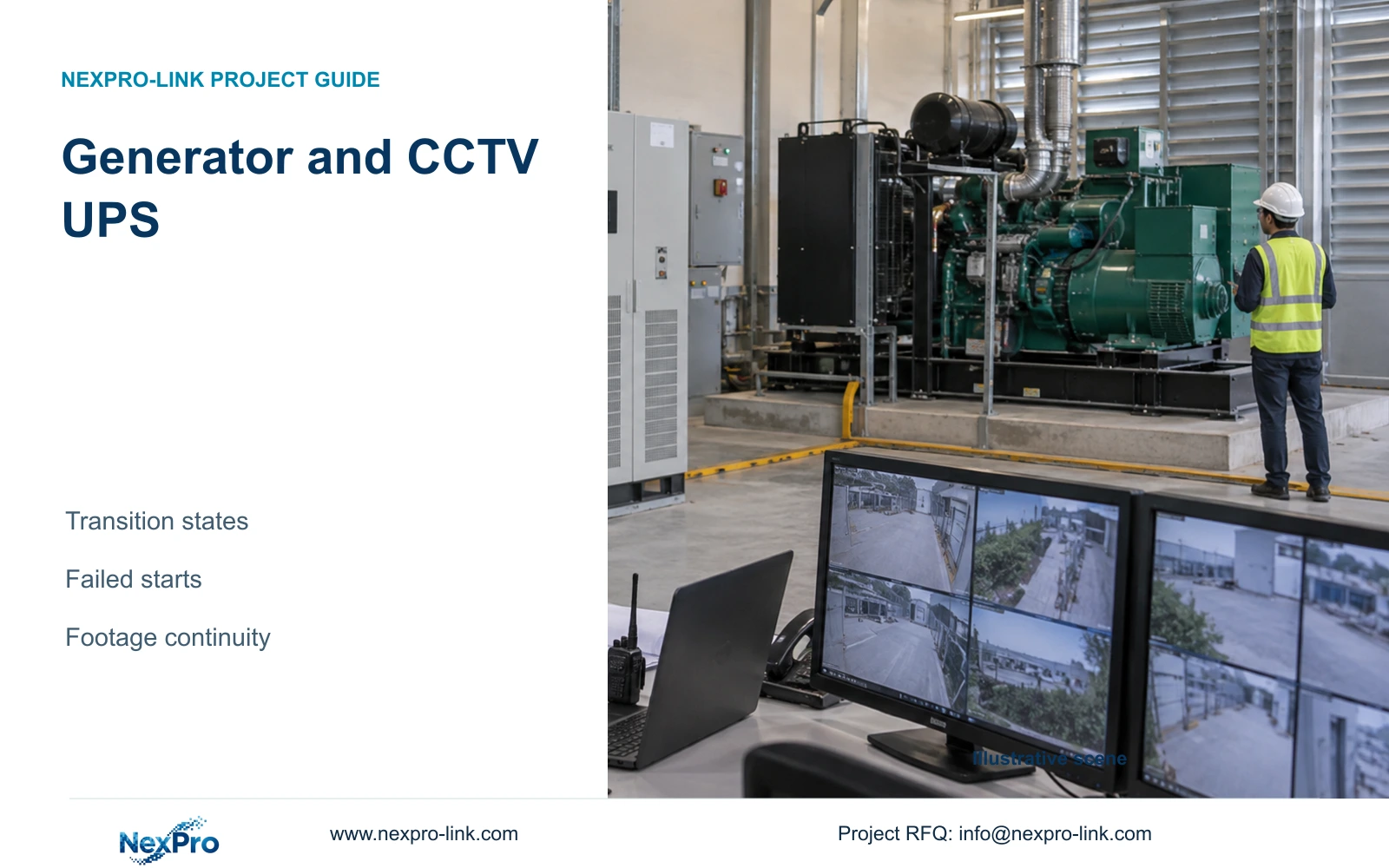
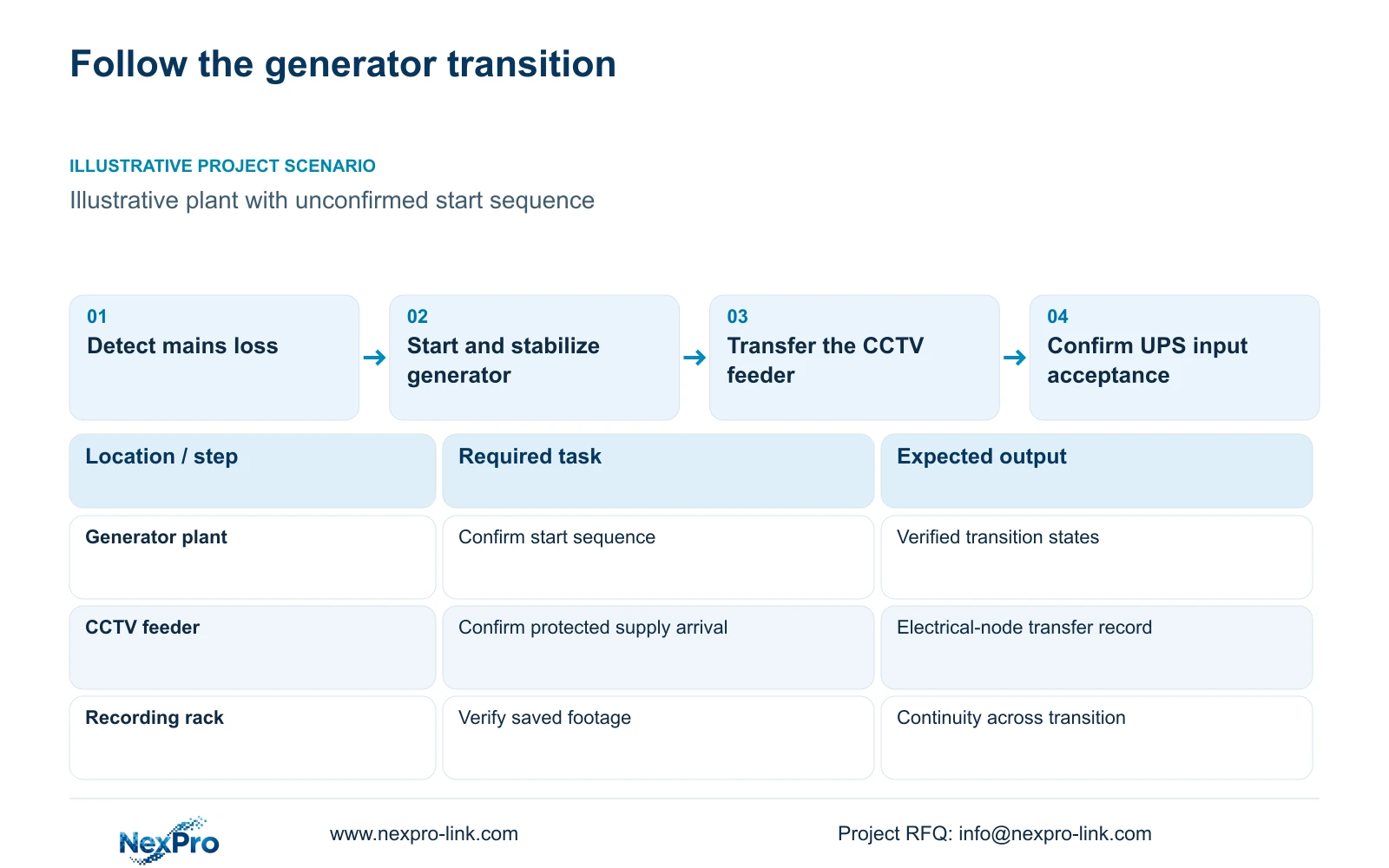
Use a joint witness record distinguishing generator running, accepted circuit supply, UPS input acceptance and continued footage. Record each transition from the responsible electrical team's approved test.
Section 01
Define when generator power becomes usable at the CCTV rack
Use a joint witness record distinguishing generator running, accepted circuit supply, UPS input acceptance and continued footage. Record each transition from the responsible electrical team's approved test. If one state is unobserved, leave it open rather than substituting the generator's start signal. CCTV staff do not prescribe generator-control settings.
Set the CCTV UPS bridge requirement from the agreed generator sequence and failure contingency. Follow mains loss, generator start, stable output, transfer to the relevant circuit and acceptance by the UPS. A universal 15-second assumption cannot establish that the recording rack has a usable alternative supply.
Illustrative project scenario: A standby generator serves the plant, but its start behavior and load sequence are not yet confirmed. The supplied 32-camera CNC factory reference defines the security service background. Assume the owner wants its required recording chain maintained while the electrical team resolves the generator transition; no generator timing has been measured.
Request a state sequence with responsible parties and evidence for each transition. The endpoint is acceptable input at the UPS supplying the essential CCTV loads. Generator operation elsewhere in the plant is insufficient if the security feeder is omitted, delayed or affected by later load steps. Keep estimated timings visibly provisional until the site's electrical team verifies them.
Section 02
Plan the failed-start response and battery recovery
Define what security service remains required if the generator fails to start or usable power is delayed. The owner may require continued observation, an approved shorter service window or controlled equipment shutdown. That contingency determines additional battery demand; the normal start sequence alone does not resolve it.
Ask the generator and electrical teams how retries, transfer decisions and load sequencing are handled. Do not invent a retry count or fixed stabilization period. Identify the person who decides that alternative supply has failed and the action required before battery depletion. Put that action into the operating procedure rather than relying on a generic low-battery alarm.
Once generator power is accepted, the UPS may need to serve its normal load and recharge depleted batteries. Review the supported charging demand and operating behavior with the relevant suppliers. Include repeated outages and retransfer to mains in the discussion. A successful first start does not establish that the battery is ready for another full bridge immediately afterward.
Section 03
Keep generator controls and CCTV power responsibilities explicit
The generator specialist and local electrical team should own generator control, transfer arrangements, approved distribution and protection design. The CCTV engineer defines essential devices, complete AC demand, electrical nodes and the required operating result. The UPS supplier supplies model-specific input, output and battery information for coordination.
Confirm the exact UPS input requirements against the proposed generator operation, including supported voltage and frequency conditions and behavior under the agreed loading sequence. No numerical acceptance window is supplied for this scenario. Obtain it for the actual variant rather than assuming every online UPS accepts every generator output.
The security load remains bounded. Loaded PoE switches, recorder, disks, necessary links and an essential viewing device may be included. Generator starting equipment, machine drives and life-safety systems are not automatically part of that schedule. The supplied UPS series ratings establish capacity references only and do not establish specialist generator-control capability.
Section 04
Use energy options to price contingencies, not generator start times
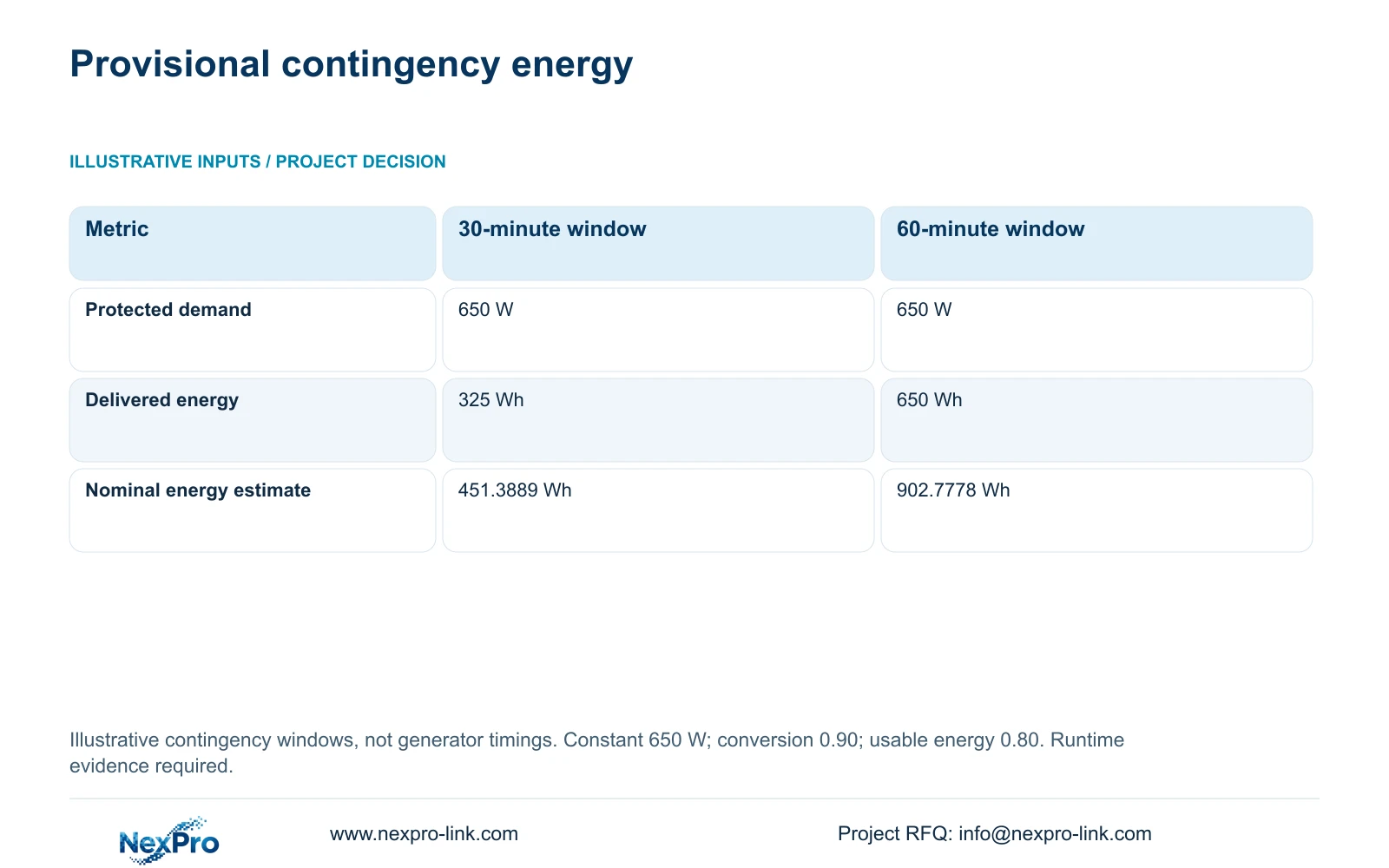
For a separate illustrative calculation, hold complete protected AC demand at 650 W and compare 30- and 60-minute contingency windows. These durations are planning alternatives, not claimed generator startup times. They also differ from CASE01's full recording-first load of 682.7407 W, which would require its own calculation.
Use load_Wh = P_W × minutes/60. The two output-energy requirements are 325 Wh and 650 Wh. With assumed battery-to-load conversion of 0.90 and usable stored-energy fraction of 0.80, nominal_battery_Wh = load_Wh/(0.90 × 0.80), producing theoretical nominal requirements of 451.3889 Wh and 902.7778 Wh.
The longer contingency doubles energy in this constant-load model without changing the continuous 650 W demand. It cannot correct a missing protected feeder or an incompatible input condition. Request supported battery configurations and actual runtime evidence; the table is useful for comparing scope while generator timing remains unresolved, not for declaring either duration adequate.
| Metric | 30-minute window | 60-minute window |
|---|---|---|
| Protected AC load | 650 W | 650 W |
| Target window | 30 minutes | 60 minutes |
| Load-side energy | 325 Wh | 650 Wh |
| Theoretical nominal battery energy | 451.3889 Wh | 902.7778 Wh |
Section 05
Approve the bridge after the transition and fallback are agreed
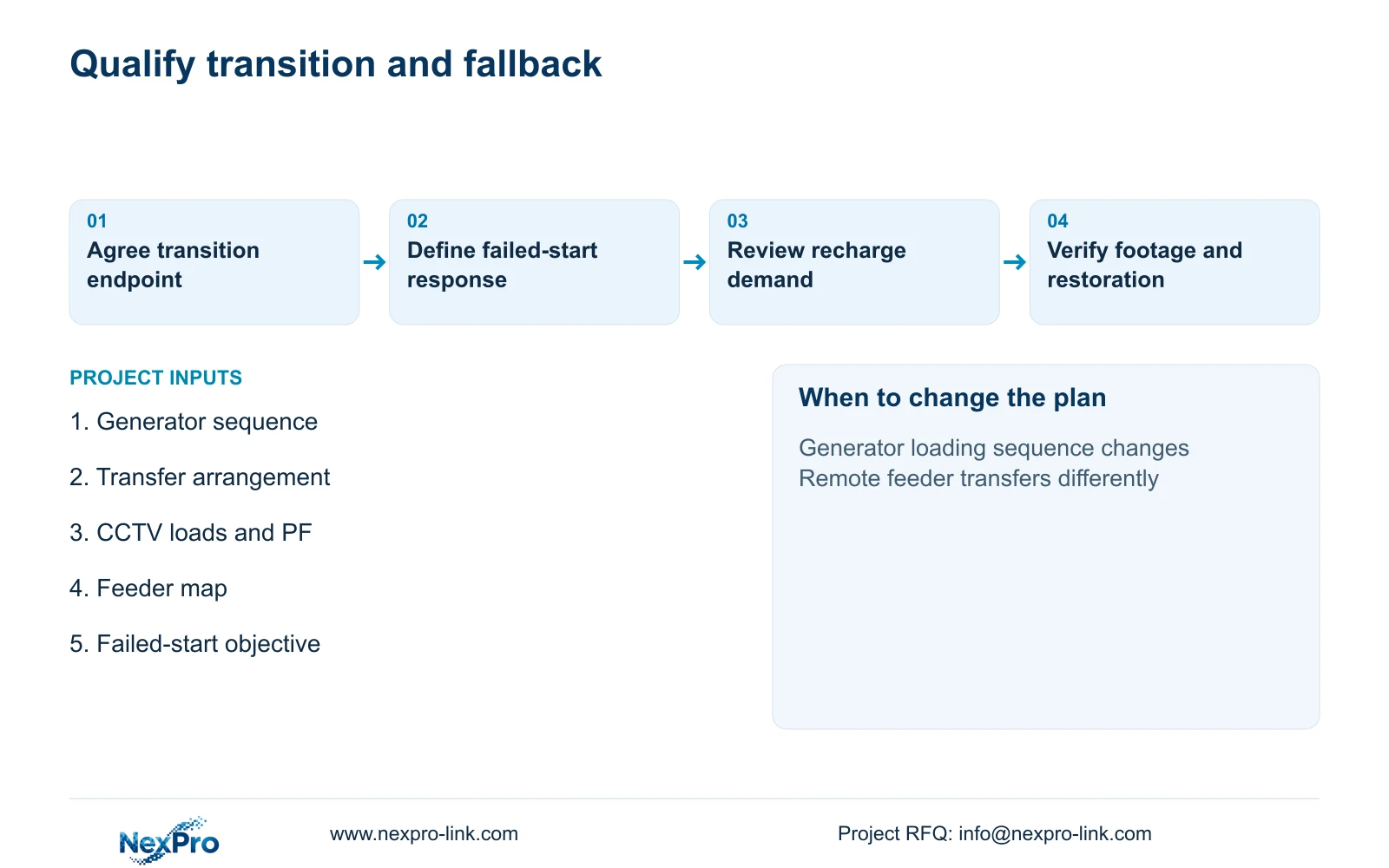
Recommend a bridge duration covering the verified transition plus the owner's approved failed-start response. Until that sequence is available, keep the duration provisional and quote clearly identified alternatives. Do not reduce the battery request to a short assumed start time merely because a standby generator appears on the site drawing.
The NexPro-Link rack series lists SP1KR(S) at 1 kVA/900 W, SP2KR(S) at 2 kVA/1800 W and SP3KR(S) at 3 kVA/2700 W. Use the chosen node's complete load and PF to check both output limits. Qualify the compatible battery system separately, including temperature, ageing basis, discharge rate, BMS limits and initial state of charge.
Recalculate when essential loads, generator sequencing, supported input conditions or recharge demand change. If remote cabinets have different generator feeders, review their transitions independently. The central recorder's successful transfer does not prove uninterrupted gate cameras. Compare supplier proposals against the same sequence and contingency rather than awarding a package for an unverified short-delay claim.
Section 06
Verify footage across transfer, recharge and mains return
Agree a coordinated test with the generator, electrical and CCTV teams. Record the transition states and verify required camera views, saved footage and operator access throughout the accepted process. Include the agreed loading sequence so a later plant load step is not absent from the assessment.
After transfer, check that the UPS accepts the supply and that recharge proceeds under supported conditions. During mains return, verify continued recording and normal recovery. Review failed-start contingency evidence through a site-approved method; do not create an unsafe interruption simply to complete a checklist. Any unresolved state should remain an acceptance exception.
NexPro-Link can help translate the CCTV load and duration request into equipment matching and technical documentation through its project supply scope. Generator controls and final electrical approval remain with the responsible specialists. Procurement should retain the agreed sequence, protected-node map and battery configuration together so future changes can be reviewed against the actual service.
Section 07
Buyer questions
Does a generator running signal prove the UPS has accepted its input? No. Confirm the relevant feeder, transfer state and UPS input acceptance. Use the agreed electrical sequence and recorded evidence rather than treating the running signal as the end of the bridge.
Can one bridge duration cover every factory cabinet? Only when the protected distribution and transition sequence support that assumption. Separately fed cabinets may need different checks and local battery configurations.
What if generator timing is unavailable at tender? State a provisional bridge and failed-start service objective, request alternatives, and identify timing verification as an approval dependency. Do not present an assumed delay as measured performance.
Section 08
Coordinate the CCTV bridge requirement
Send your generator/transfer sequence, protected CCTV loads with PF, feeder map and failed-start operating objective to info@nexpro-link.com for a UPS equipment-scope discussion.
Engineering references
These sources support the general planning principles. Always use the selected product's current datasheet and applicable project standards for final design.