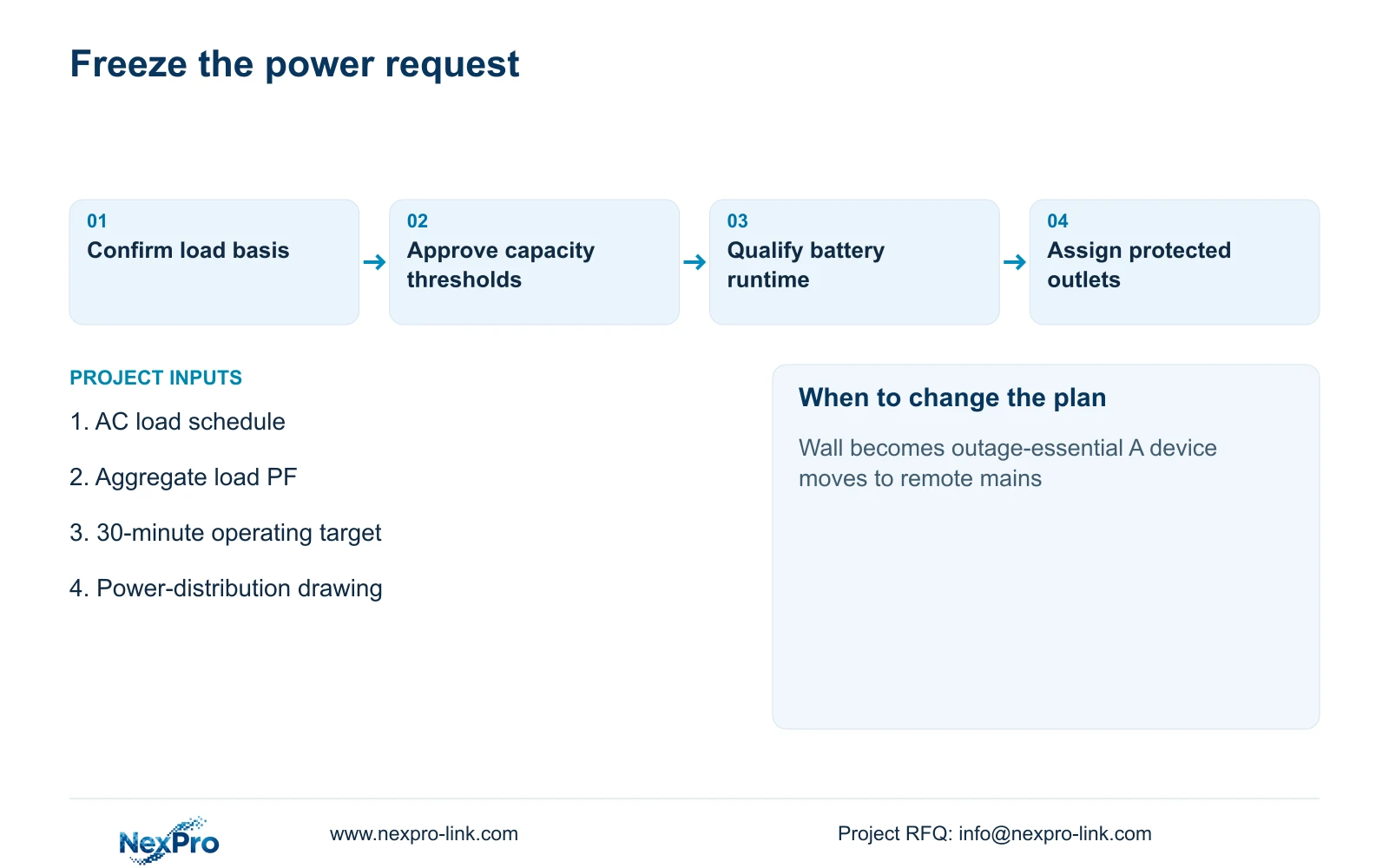
Assign each proposed addition to an existing protected circuit and identify whether its demand is already included in a loaded-switch figure. Revise W, VA and battery-request inputs together, preserving the original calculation.
Section 01
Decide which security functions must survive an outage
Assign each proposed addition to an existing protected circuit and identify whether its demand is already included in a loaded-switch figure. Revise W, VA and battery-request inputs together, preserving the original calculation. Hold unverified additions outside the released schedule; a spare UPS outlet does not establish electrical or duration headroom.
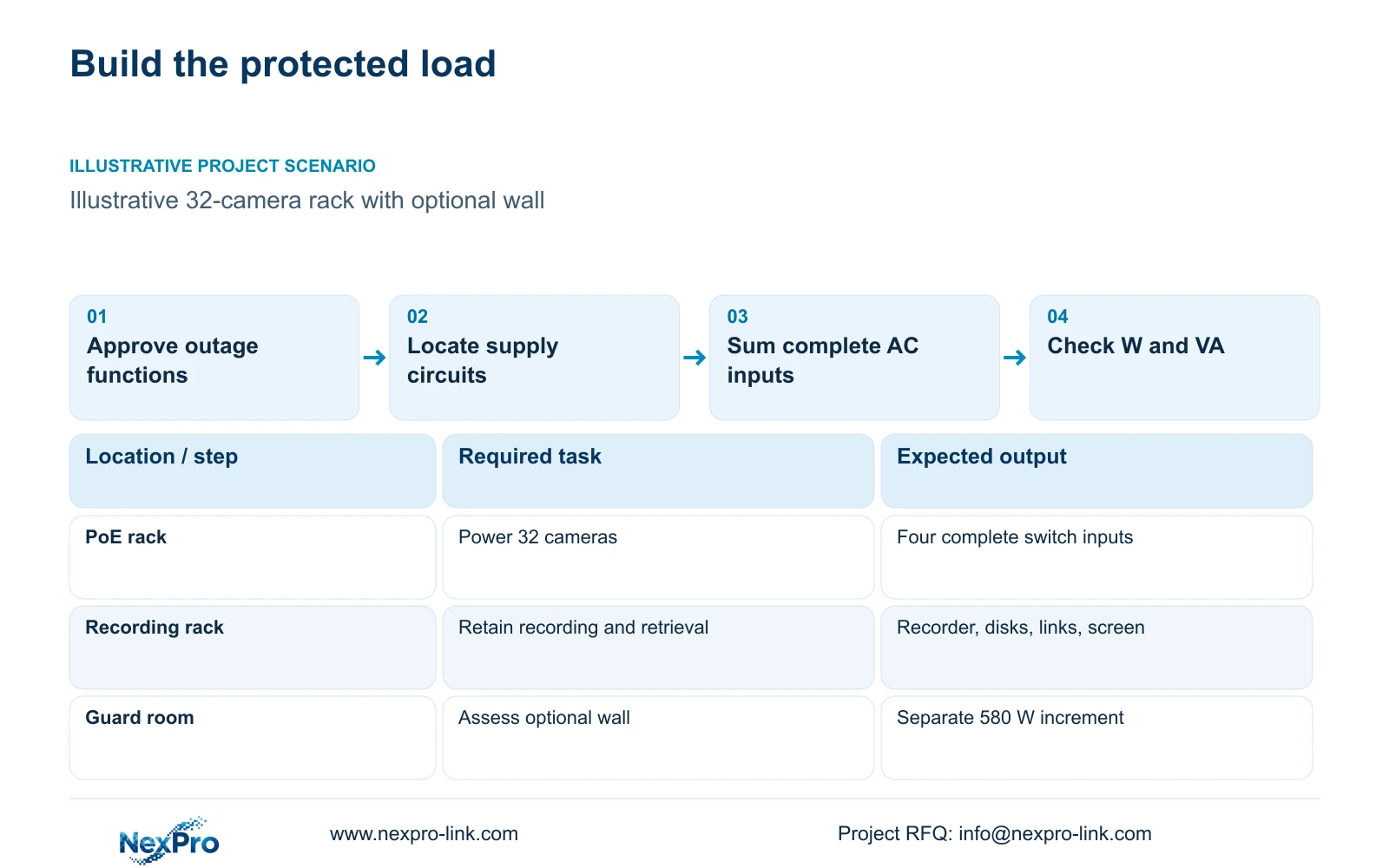
Start factory CCTV UPS sizing with the complete AC load list for the security functions that must keep working. Include loaded PoE switches, recording equipment and disks, necessary network links, and essential operator equipment. Record where each item receives power. Select the UPS output rating from watts and VA, then qualify its battery configuration against the required operating duration.
Illustrative project scenario: A buyer has a camera count and a requested backup duration but no consolidated load list. The supplied CNC factory reference has 32 ordinary security cameras covering gates, stores, permitted material transfers, common routes, dispatch and equipment-room approaches. Assume the owner wants recording and one retrieval screen available for 30 minutes; a four-panel display wall remains an option.
The engineer should turn that instruction into an outage operating schedule. For each device, record its electrical node, complete input demand, supplied or retained status, and whether it is essential throughout the outage. Machine drives, spindle power and life-safety supplies remain outside this CCTV calculation. Their presence in the same factory does not place them on the security UPS.
Section 02
Count the loaded switch once at its AC input
The reference uses four groups of eight cameras. Camera demand is assumed to be 12 W per powered device, giving 96 W per group. With assumed cable delivery of 90%, required PSE output is 96/0.90 = 106.6667 W. Adding 15 W for switch electronics and applying assumed PSU efficiency of 90% gives complete switch AC input: (106.6667 + 15)/0.90 = 135.1852 W.
Four such groups contribute approximately 540.7407 W, calculated from unrounded values. Those switch inputs already include the energy delivered to cameras. Adding another 32 × 12 W to the UPS schedule would count camera demand twice. Conversely, using only the switch electronics figure would omit most of the actual protected load.
Keep the PoE output budget separate from UPS demand. The illustrative 80% PSE utilization target requires 106.6667/0.80 = 133.3333 W of output budget per group, plus compatible individual ports. That budget is a switch-selection threshold, not another load to add. Replace the 12 W assumption with documented operating demand, including enabled illumination and startup conditions, before final selection.
Section 03
Apply the same loading target to watts and VA
Add the remaining illustrative inputs: recorder electronics at 30 W, four disks at 8 W each, core equipment at 25 W, router at 15 W, and the original operator screen at 40 W. The recording-first total is 540.7407 + 30 + 32 + 25 + 15 + 40 = 682.7407 W. These are planning inputs, not published power measurements for the named equipment.
With aggregate load power factor assumed to be 0.9 and an 80% loading target, required_UPS_W = P_AC/0.8 and required_UPS_VA = P_AC/(0.9 × 0.8). The resulting request must state both thresholds. A unit can satisfy its watt limit while failing the VA requirement when actual power factor differs from the assumption.
The APC/Schneider UPS buying guide supports treating W, VA and runtime as separate checks. For procurement, the engineer owns the load calculation, the supplier identifies an exact output and battery configuration, and the local electrical team confirms circuits and connections. The buyer approves the required service and duration rather than approving a kVA label alone.
Section 04
Show the capacity change before adding the wall
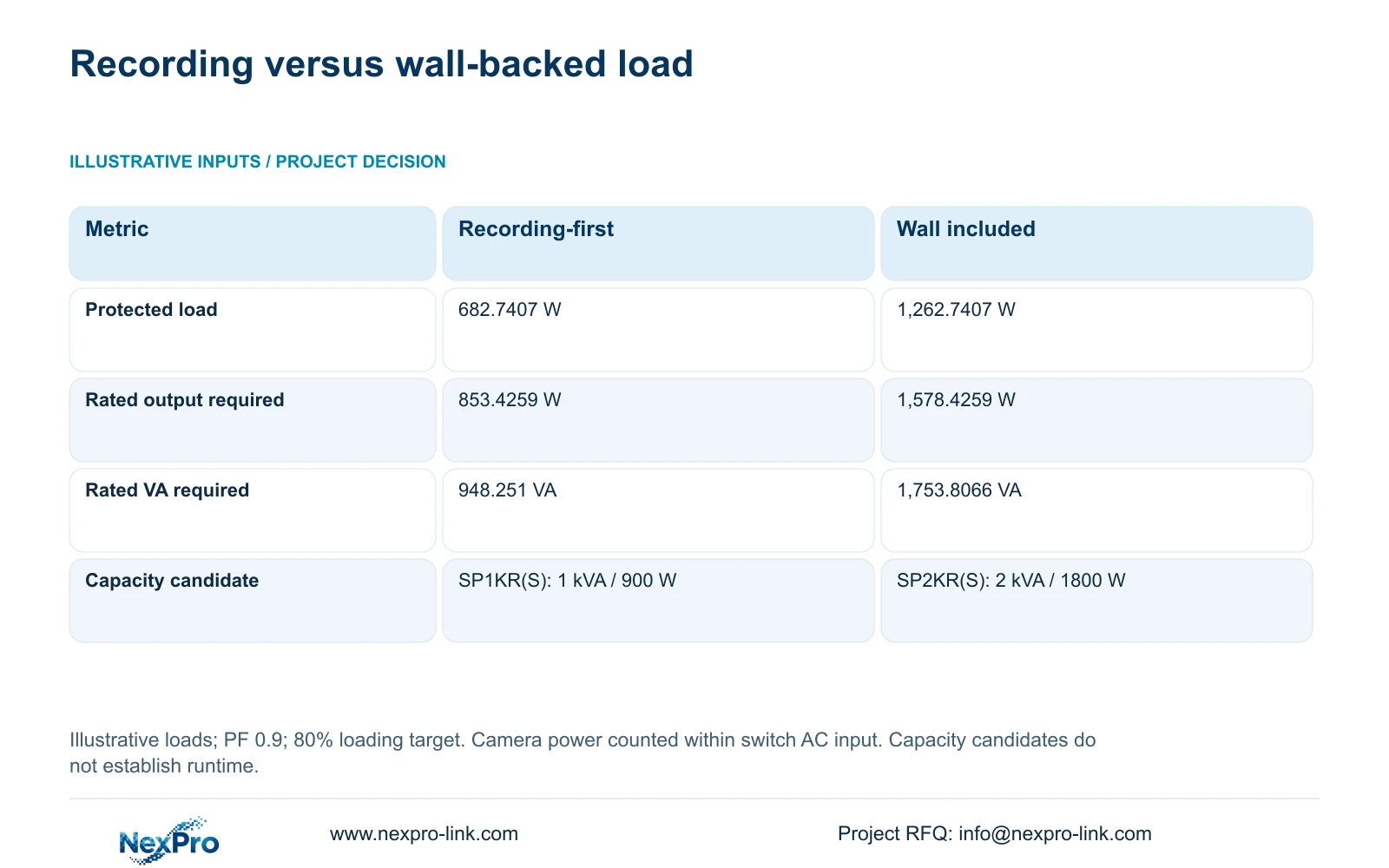
Option B retains every recording-first item and adds four panels at an assumed 120 W each plus a decoder at an assumed 100 W. The increment is 4 × 120 + 100 = 580 W, raising protected demand to 1,262.7407 W. The panel and decoder figures are illustrative; they are not published NX-VP-5535 or NX-VD-4K16 consumption values.
The decisive difference is the larger protected operating scope. Option A fits the stated capacity thresholds of SP1KR(S), while Option B requires a higher output class and fits those of SP2KR(S). The published series ratings are 1 kVA/900 W and 2 kVA/1800 W respectively. Neither selection establishes battery duration.
For the reference 30-minute objective, load-side energy equals watts × 0.5 hours: 341.3704 Wh for A and 631.3704 Wh for B. These energy requirements must accompany the capacity request. A battery configuration qualified for the smaller load cannot retain its old runtime claim after the wall is added.
| Metric | Option A: recording-first | Option B: wall included |
|---|---|---|
| Protected AC load | 682.7407 W | 1,262.7407 W |
| Required rated output | 853.4259 W | 1,578.4259 W |
| Required rated VA | 948.251 VA | 1,753.8066 VA |
| Capacity candidate only | SP1KR(S): 1 kVA / 900 W | SP2KR(S): 2 kVA / 1800 W |
Section 05
Keep recording-first protection unless wall operation is required
For this scenario, use Option A as the procurement basis unless the owner identifies an outage task requiring the complete wall. It preserves the camera power path, recorder, necessary networking and original screen while avoiding an unapproved 580 W addition. If simultaneous multi-view observation is essential, carry Option B through capacity, battery, distribution and room planning together.
Recalculate when camera demand, disk quantity, network equipment, aggregate PF or electrical location changes. A remotely powered switch needs protection at its actual supply point unless an approved central protected feeder reaches it. A data connection to the central rack provides no evidence that the remote cabinet has backup power.
Compare competing proposals using identical protected devices, duration, environmental conditions and installation boundaries. Include batteries, distribution accessories and commissioning in the comparison. A lower equipment subtotal cannot establish better value if it leaves an essential node unprotected or omits the required runtime evidence.
Section 06
Issue a load schedule that survives quotation and delivery
Give each schedule line a device identity, node, AC demand basis and outlet assignment. Mark assumed figures so the supplier can return replacements without changing the agreed task. Keep the recorder and installed disks together: the CASE01 storage arrangement uses four drives, so a later disk addition also belongs in the power change record.
The requested supplier response should identify the exact UPS variant, input/output arrangement, compatible battery system and runtime evidence at the declared load. Ask for the conditions behind that evidence, including temperature, battery state and ageing basis. Do not transfer a default webpage battery-energy field across all models.
NexPro-Link can discuss model matching, coordinated equipment lists and technical submittals through its project and BOQ support scope. Preparation, packing and overseas supply can be separated from local electrical installation and acceptance work. Keeping these responsibilities visible lets procurement compare a usable package without treating supplier coordination as approval of the site's electrical design.
Section 07
Buyer questions
Can a provisional load list support an early quotation? Yes. Identify every assumed demand and unresolved device, then request a conditional configuration. Before ordering, replace the assumptions that control capacity or runtime and retain the revised schedule with the quotation.
Should device nameplate maximums and measured operating loads be mixed? They can appear in one schedule if their basis is explicit. Do not present the total as measured demand when some entries are estimates. Review startup and feature-enabled conditions separately where they may affect selection.
Does spare UPS output capacity provide spare runtime? No. Output headroom concerns W and VA limits. Runtime depends on the selected battery system and actual load. Additional equipment may remain within output capacity while reducing available operating time.
Section 08
Request a protected-load UPS configuration
Send your node-by-node AC load list, load PF, required outage duration and power-distribution drawing to info@nexpro-link.com for a capacity and battery-configuration discussion.
Engineering references
These sources support the general planning principles. Always use the selected product's current datasheet and applicable project standards for final design.