Commission the estimate by recording the actual measurement interval, stream groups and usable disk reading. Compare observed data growth with the declared calculation without treating a quiet interval as a peak guarantee.
Section 01
Fix the recording inputs before counting disks
Commission the estimate by recording the actual measurement interval, stream groups and usable disk reading. Compare observed data growth with the declared calculation without treating a quiet interval as a peak guarantee. Investigate changed inputs before increasing disks or lowering quality; preserve both the estimate and the commissioning record.
For 32 cameras averaging 4 Mbps each, recording continuously for 30 days produces 41.472 TB of decimal video data. If recordings may occupy only 80% of usable storage, the usable-capacity requirement is 51.84 TB. These figures answer the initial sizing question, but procurement still needs a disk layout that provides this capacity within the selected recorder's limits.
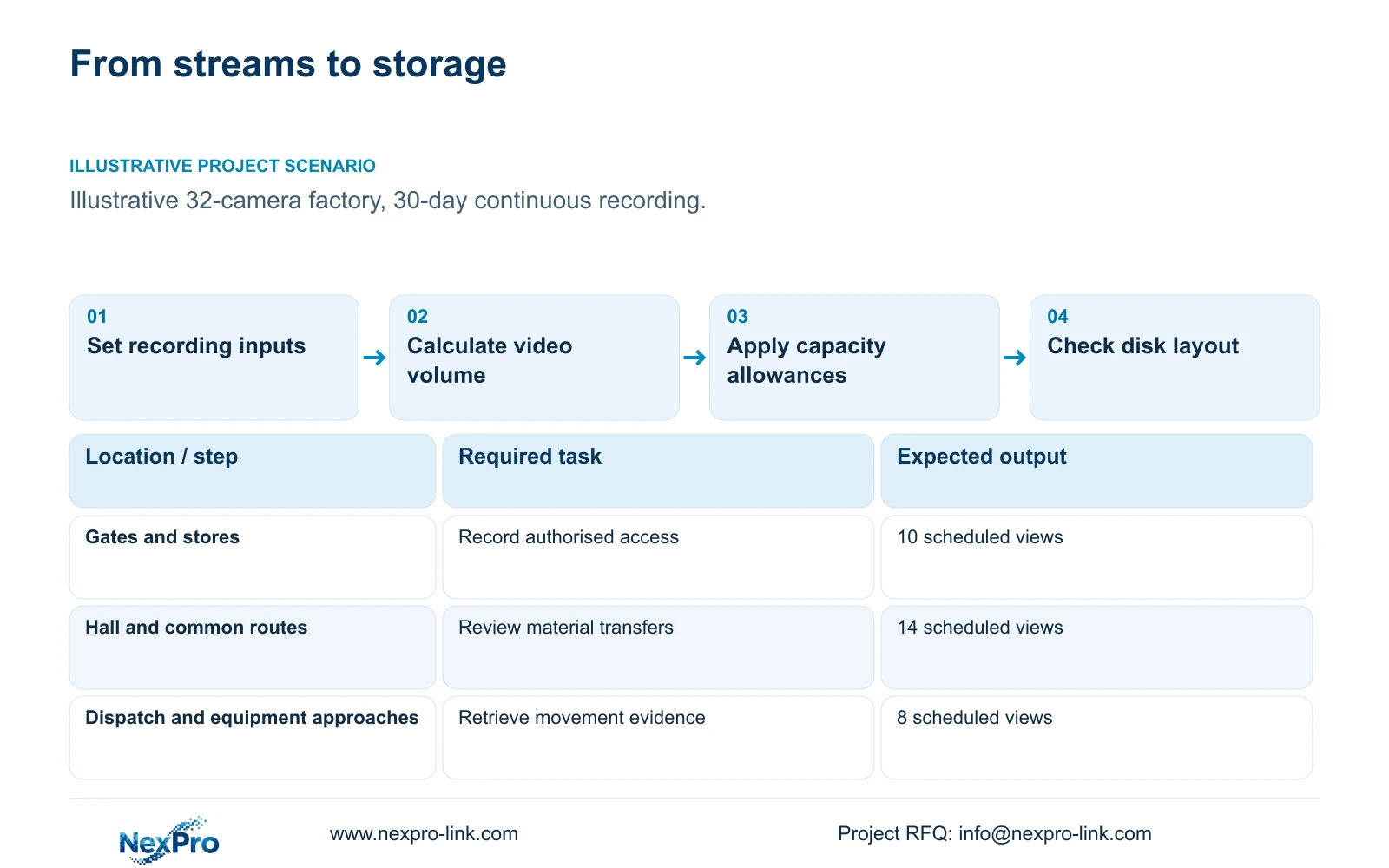
Illustrative project scenario: A contractor must price 30 days of continuous footage for a 32-camera factory. The supplied CNC reference assigns four views to gates, six to material and tool stores, ten to permitted machine-hall transfers, four to common routes, six to dispatch and two to equipment-room approaches. All are ordinary security tasks. The 4 Mbps input is a planning assumption, not a measured camera bitrate.
Create a stream schedule with camera quantity, average recording bitrate, recording hours and retention days for each group. Keep the recording stream separate from a lower-bandwidth viewing stream. Obtain representative recordings before freezing the order, especially where loading activity, lighting or scene movement differs from a quiet commissioning demonstration.
Section 02
Keep raw capacity and recording allowance separate
Raw capacity is the sum of disk-label capacities. Usable capacity is what remains available after the selected storage arrangement and its overhead. The recording allowance is the portion of that usable capacity assigned to footage after the project's free-space policy. Putting all three figures on the same calculation sheet prevents a supplier's raw TB headline from becoming an unsupported retention promise.
The reference case assumes 95% of raw capacity remains usable, then reserves 20% of that usable space. Its formula is recording_budget_TB = raw_TB × 0.95 × 0.80. Four 16 TB disks therefore provide 64 TB raw, 60.8 TB assumed usable and 48.64 TB for video. Compare 41.472 TB directly with 48.64 TB. The reserve is already included in that allowance.
Alternatively, compare the 51.84 TB usable requirement with 60.8 TB assumed usable capacity. Both routes reach the same decision. Multiplying the footage amount by 1.2 would produce 49.7664 TB, which does not leave 20% of the resulting capacity unused. Audio, extra metadata and any separately retained exports require their own allowance.
Section 03
Check whether the required disks fit the recorder
The NexPro-NVR4449-4K provides a four-bay reference with up to 18 TB per drive and a published 320 Mbps input rating. The case's 32 × 4 Mbps = 128 Mbps assumed input is below that rating. Its streams are assumed to fit supported 5MP-class recording modes; channel count does not establish every mixed-resolution or simultaneous playback configuration.
For 30 days, four compatible 16 TB disks are a workable capacity candidate under the stated assumptions. Even four 18 TB disks provide only 72 × 0.95 × 0.80 = 54.72 TB of recording allowance, so filling the same four bays cannot meet the 82.944 TB video requirement for 60 days. That is a physical capacity constraint, not a quotation detail.
The eight-bay NexPro-NVR8864-4K is a candidate when longer retention requires more disks. Eight compatible 16 TB disks would provide 128 TB raw and 97.28 TB of illustrative recording allowance. Confirm actual drive support and recording modes before approval. Neither recorder's bay count establishes RAID support, and this calculation includes no parity or dedicated spare.
Section 04
Compare retention periods without changing image quality
Use video_TB = cameras × average_Mbps × 10^6 × 86400 × days ÷ 8 ÷ 10^12. The factors convert megabits per second into decimal terabytes over the selected period. With 32 cameras, 4 Mbps each and 24 hours per day, the daily video amount is 1.3824 TB. Multiply by the number of days, then divide by 0.8 for the usable-capacity target.
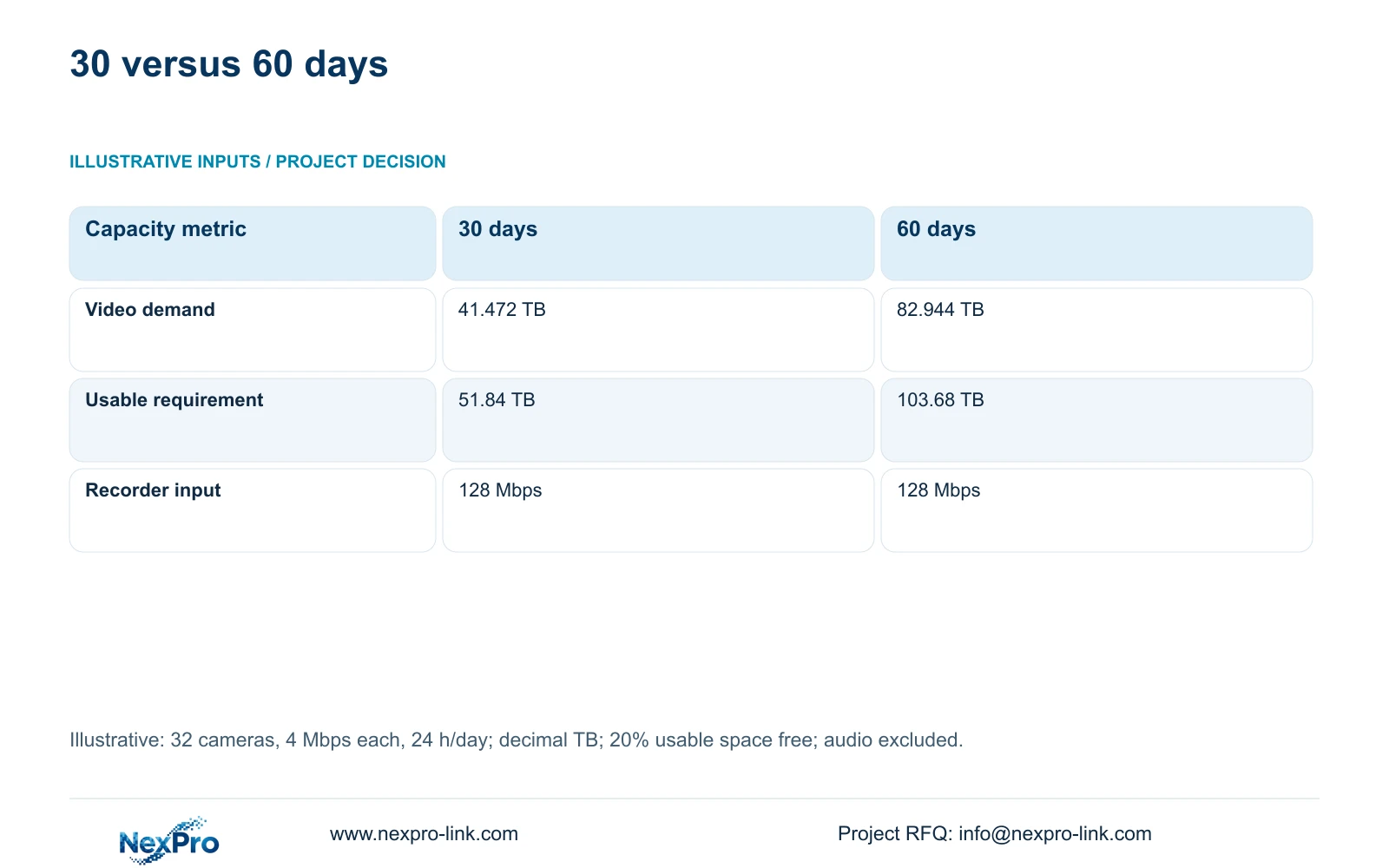
The decisive difference is duration: moving from 30 to 60 days doubles video volume while leaving the assumed 128 Mbps recorder input unchanged. A supplier should not lower bitrate in the longer-retention offer unless the owner separately accepts the changed evidence quality. The table contains illustrative demand, not compression test results.
| Metric | 30 days | 60 days |
|---|---|---|
| Cameras | 32 | 32 |
| Average bitrate per camera | 4 Mbps | 4 Mbps |
| Recording schedule | 24 h/day | 24 h/day |
| Video demand | 41.472 TB | 82.944 TB |
| Required usable capacity | 51.84 TB | 103.68 TB |
| Assumed recorder input | 128 Mbps | 128 Mbps |
Section 05
Approve the baseline and define recalculation triggers
For the contractor's stated 30-day task, retain the four-bay, four-disk baseline as a capacity candidate. It provides 48.64 TB of illustrative video allowance against 41.472 TB required. The difference is available within the calculation's chosen boundary; it should not be described as unlimited expansion or a guarantee against every bitrate variation.
Change the layout when measured average bitrate, retention, camera quantity or a required storage-protection mode exceeds that allowance. A request for fault tolerance can reduce data capacity even when installed raw TB stays constant. Adding cameras also affects input bandwidth and supported recording modes, so the engineer should update those checks alongside storage.
Compare alternative brands using the same accepted image task, hours, retention and usable-space policy. The cost team should identify recorder replacement, disk quantities, configuration work and independent archive provision separately. Without matching quotations, this example establishes feasible capacity choices but provides no basis for claiming a cheaper brand or a compression advantage.
Section 06
Turn the calculation into an orderable storage schedule
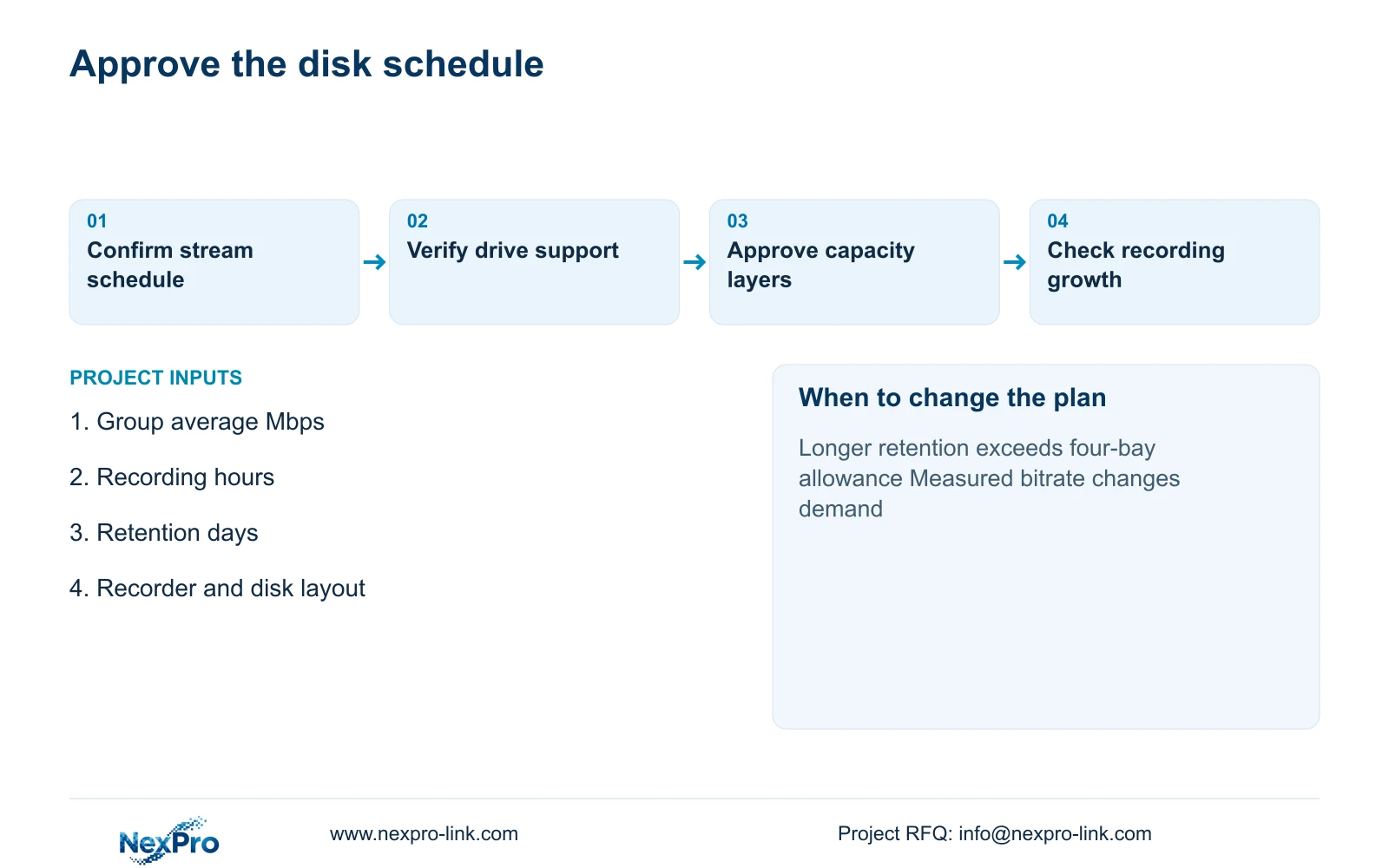
Issue a storage schedule showing the recorder model, firmware basis, drive quantity, exact proposed drive model and each capacity layer. Include the stream schedule that generated the demand. The design engineer owns the arithmetic and technical acceptance criteria; the supplier confirms the offered configuration; the local integrator checks installation and commissioned operation.
Define an acceptance check that inspects disk recognition, actual available capacity, recording continuity and playback from the intended camera groups. Once representative operation is available, compare observed daily growth with the design input. Record any correction before treating the retention estimate as the operating baseline.
NexPro-Link's BOQ and Tender Support scope can help translate the accepted calculation into model matching, technical documents and a quotation with visible deviations. Keep independent incident exports outside the rolling-video allowance unless they are explicitly included. The handover should leave the owner with a calculation that can be revised when operations change, rather than a fixed TB figure with no traceable assumptions.
Section 07
Buyer questions
Can spare recording space be used for a permanent incident archive? Only if the recorder supports the intended retention workflow and the capacity is allocated explicitly. A rolling-footage allowance should not silently absorb indefinite exports. Specify the archive location, expected volume and deletion authority separately.
Should we order the largest supported disks immediately? Compare the complete layout first. Larger disks may solve a capacity shortage, but they do not establish lower failure risk. Check exact drive compatibility, expansion needs and replacement arrangements before choosing capacity.
What if only estimated bitrates are available before tender? Issue a provisional calculation with the assumptions visible and require a representative recording check before final configuration approval. Preserve the accepted image task when replacing estimates with measured averages.
Section 08
Request a traceable storage configuration
Send your camera-group bitrates, recording hours, retention target and proposed or existing disk layout to info@nexpro-link.com. NexPro-Link can discuss the recorder and drive schedule needed for a recalculable factory storage proposal.
Engineering references
These sources support the general planning principles. Always use the selected product's current datasheet and applicable project standards for final design.