
For each agreed clock, record the trigger, actual milestone and any contractually permitted pause with its reason. Keep waiting for site access, supplier response and restored recording distinguishable.
Section 01
Define what a response commitment actually delivers
For each agreed clock, record the trigger, actual milestone and any contractually permitted pause with its reason. Keep waiting for site access, supplier response and restored recording distinguishable. Do not apply an assumed pause rule or label replacement dispatch as restoration. The written agreement determines timing obligations, not this illustrative record method.
Separate a factory CCTV warranty from a service-level agreement by writing the deliverable for each service stage. A hardware remedy concerns applicable equipment coverage. A response commitment may concern acknowledgement or technical review. Neither automatically includes parts arrival, local labour or verified restoration of the owner's recording task.
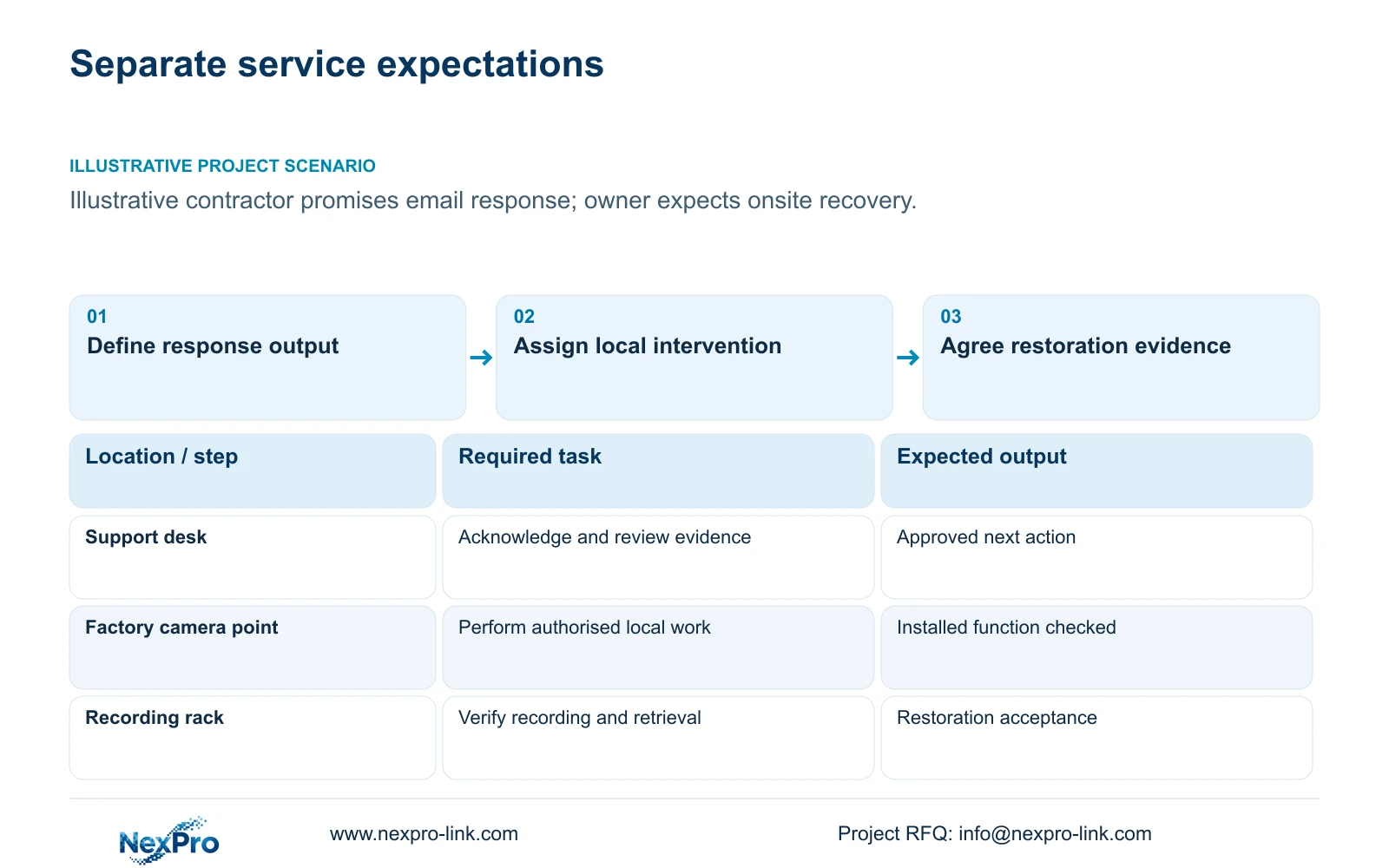
Illustrative project scenario: A contractor offers fast email response while the owner expects immediate onsite restoration. Use the supplied 32-camera CNC reference to make the disagreement concrete: one camera loss affects a view, while a recorder or shared access dependency can affect a wider task. No response hours, fulfilment rate or recovery guarantee has been supplied for either party.
Ask the contractor to distinguish message receipt from a useful diagnostic response. Define the evidence needed to begin technical review and the output expected from that review, such as an approved next check or return decision. Give the owner these definitions before approving the service offer so 'support available' does not become an informal promise of uninterrupted onsite coverage.
Section 02
Assign the onsite work and access dependencies
List the local tasks that remote support cannot perform: gaining approved access, examining the installed link, checking relevant power observations, removing equipment and verifying the restored scene. Assign these tasks to the appointed integrator or another accepted local party. Identify who authorises work near production and who supplies the required access equipment.
The CNC reference's four access groups and single recording node help map service impact, but their design does not establish local service availability. If several cameras lose recording together, the local team may need to investigate a shared dependency before replacing individual cameras. The supplier's diagnostic contribution and the installer's onsite contribution should have distinct deliverables.
Specify labour, travel, consumables and freight separately from the hardware remedy. NexPro-Link's published project supply scope covers equipment coordination and preparation; it is not an automatic promise of local construction or attendance in every destination. If the owner needs an onsite commitment, obtain it from a party that accepts the location and access conditions.
Section 03
Agree spares and the meaning of restored service
Define restoration in terms of the required function. For a transfer camera, it may require the accepted view to be recorded and retrievable. For a recorder failure, restoration of new recording does not mean historical footage has been recovered. Keep those outcomes separate in the service agreement and final verification record.
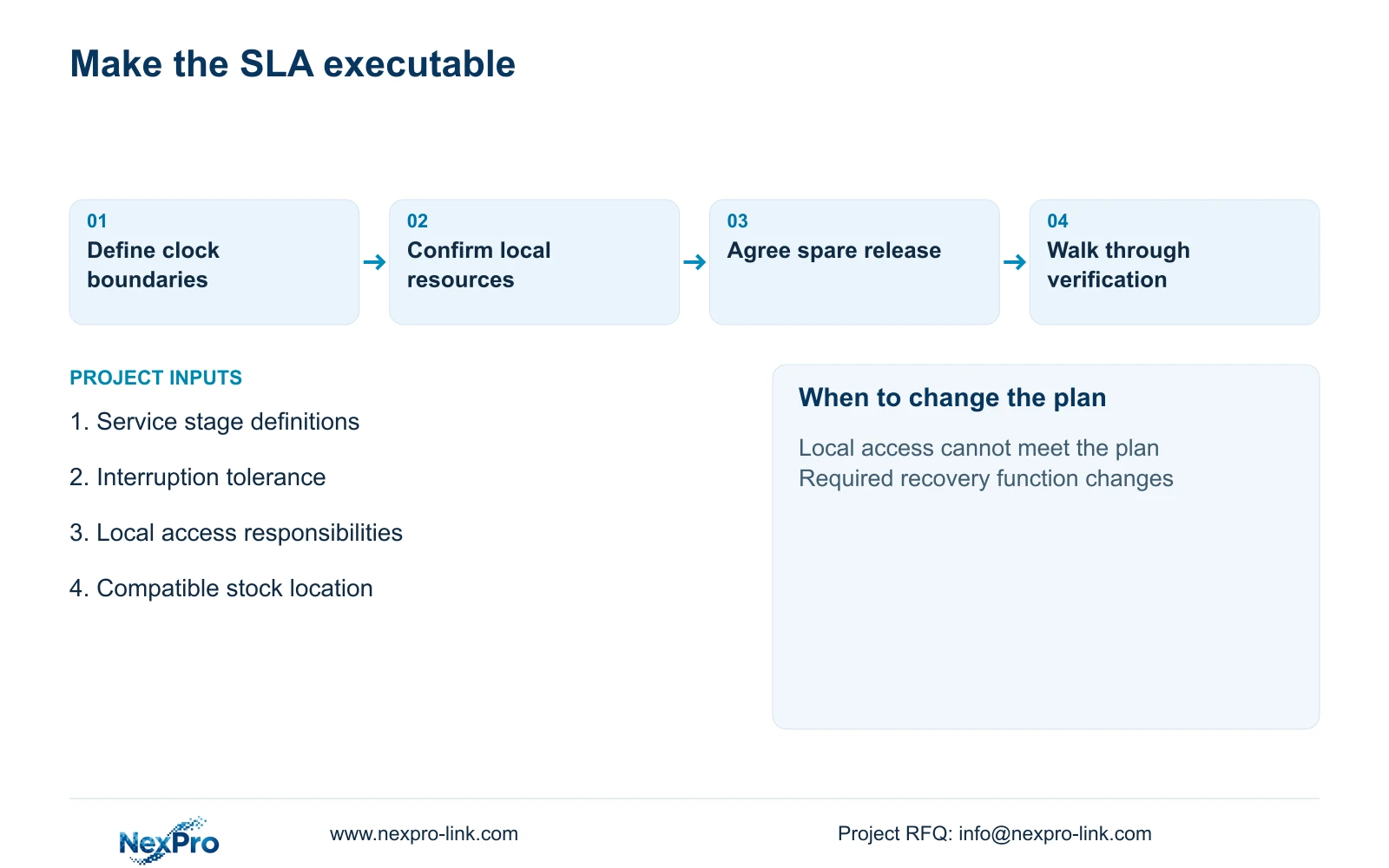
Identify the spare assumptions behind any proposed recovery target. Confirm compatible models, stock location, release authority, configuration availability and the local party able to install them. An advance replacement arrangement or service-held spare must be explicitly included. A dispatch commitment alone leaves arrival, access and reinstatement unresolved.
Document temporary service options and their limitations. Another overview may help retain event context while a close-detail view is unavailable, but the owner must accept that reduced outcome. If no temporary measure satisfies the task, the service plan needs a different resource or architecture. Do not describe degraded coverage as full restoration to close a ticket.
Section 04
Give each service clock a start and stop
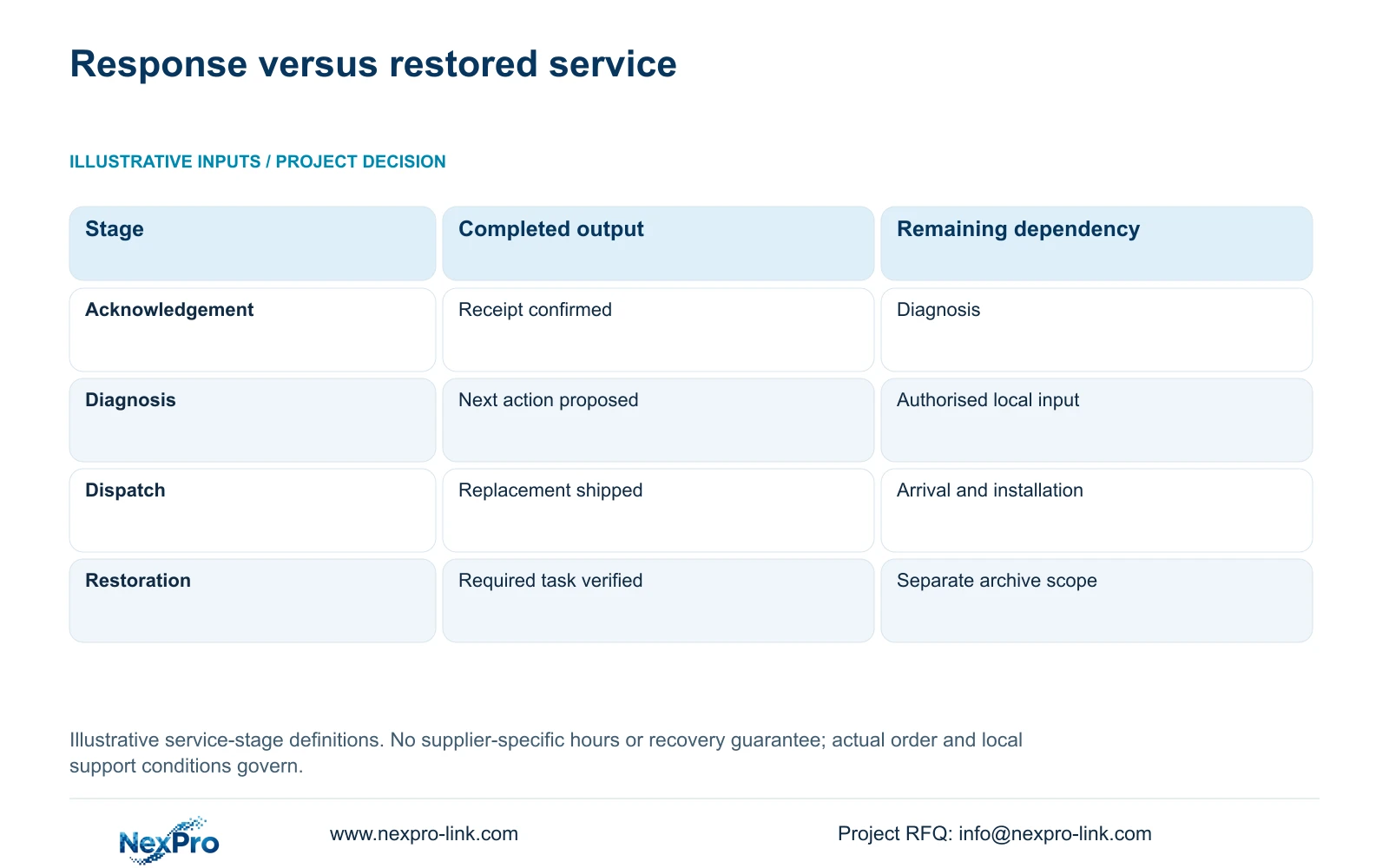
Use the service-stage matrix as a negotiation tool. For every stage, define the clock start, clock stop, responsible party, exclusions and dependencies. State service hours, time zone, reporting route and escalation ownership in the actual agreement. No supplier-specific timing should be filled in without a written commitment.
The decisive difference is between completing a stage and completing the service. Acknowledgement ends when receipt is confirmed; dispatch ends when the approved part is shipped. Restoration ends only when the agreed function is recovered and checked. These events can be separated by evidence collection, transport, local access or configuration work.
Make pauses and dependencies visible rather than hiding them inside a broad exclusion. If diagnosis awaits authorised site observations, record what is missing and who provides it. If a part has shipped, track arrival and installation separately. This allows procurement to compare obligations and helps the owner see which resource could shorten an actual service interruption.
| Stage | Completion evidence | Still not established |
|---|---|---|
| Acknowledgement | Report receipt confirmed | System restored |
| Remote diagnosis | Evidence reviewed; next action proposed | Onsite check completed |
| Part dispatch | Approved replacement shipped | Arrival and installation |
| Restoration | Required function recovered and verified | Historical footage recovery unless scoped |
| Warranty coverage | Applicable hardware remedy identified | Continuous onsite SLA |
Section 05
Select the service package the site can execute
Prefer a service arrangement with workable responsibilities over an attractive but undefined response phrase. Where the owner accepts remote diagnosis and a practical replenishment route, equipment warranty plus separately assigned local service may be sufficient. Where a critical role needs rapid local intervention, obtain compatible stock and an explicit onsite arrangement.
Compare NexPro-Link and other supplier proposals on identical stages and geography. Separate equipment warranty, remote support, replacement supply and local service prices. A long warranty period cannot be treated as a substitute for an onsite agreement, and an email response cannot be priced as if it includes every repair task. Use matched quotations before making cost conclusions.
The supplied NexPro-Link policy describes eligible main equipment with a 24-month receipt-based baseline. That period does not define response or restoration timing, while product and order terms can differ. Change the service recommendation when interruption tolerance, access restrictions or the equipment's specialist scope cannot be supported by the proposed resources.
Section 06
Test the service route before relying on it
Walk through a hypothetical camera fault with the owner, integrator and supplier before handover. Confirm who raises the report, which evidence is available, who approves checks, how a spare is released and what proves restoration. This exercise tests the clarity of the agreement without inventing an outage or claiming a measured recovery result.
Release a service contact and equipment-identity record linked to the approved BOM. Include applicable order terms and separate entries for disks, batteries, labour and freight. Maintain the replacement configuration so repeat supply does not introduce an untested model while the team is under pressure to restore service.
NexPro-Link's BOQ support can help organise model matching and documented deviations for the equipment part of this route. The buyer approves service expectations, and the local party accepts onsite responsibilities. Close each service case with a verification record and retain any incomplete function; a ticket status alone should not erase an outstanding operating limitation.
Section 07
Buyer questions
Can one agreement include both warranty and an onsite SLA? Yes, provided each scope, responsible party and timing condition is explicit. The presence of both in one document does not remove the need to distinguish hardware remedy from service delivery.
Should a shipped replacement close the restoration ticket? It can complete the dispatch stage. Keep the restoration stage open until the agreed function is installed, recovered and checked.
What should a service report show when access is delayed? Record the required access, responsible approver, missing input and next action. Apply only the pause or exclusion terms actually agreed, rather than inventing a new timing rule during the incident.
Section 08
Define an executable CCTV service agreement
Send your required service stages, interruption tolerance, local intervention responsibilities and spare-stock assumptions to info@nexpro-link.com to discuss the equipment and remote-support boundary.
Engineering references
These sources support the general planning principles. Always use the selected product's current datasheet and applicable project standards for final design.