End the sample trial with a state-coverage record: demonstrated, failed and not observed. Tie each result to the relevant view and configuration.
Section 01
Choose production conditions that can challenge the sample
End the sample trial with a state-coverage record: demonstrated, failed and not observed. Tie each result to the relevant view and configuration. Schedule an absent busy or night condition as further work rather than assigning it a pass from another scene. Approval can cover demonstrated roles without becoming a universal product-performance claim.
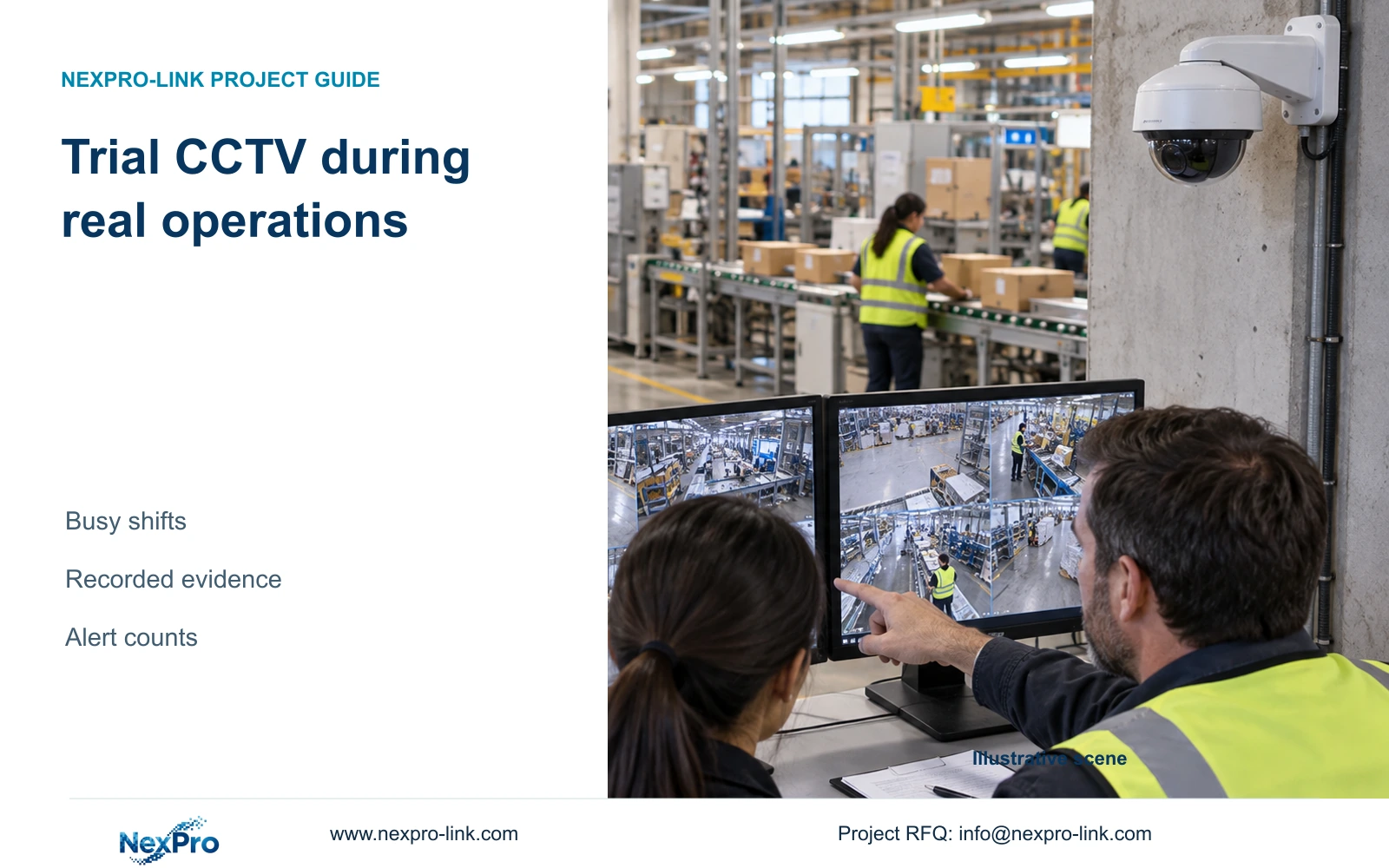
Run a factory CCTV sample trial under authorised, representative operating conditions with defined task outcomes and recorded settings. Judge the retained footage and required operator workflow. A clear screenshot from an empty hall provides little evidence about transfers obscured by moving loads, changing lighting or normal production activity.
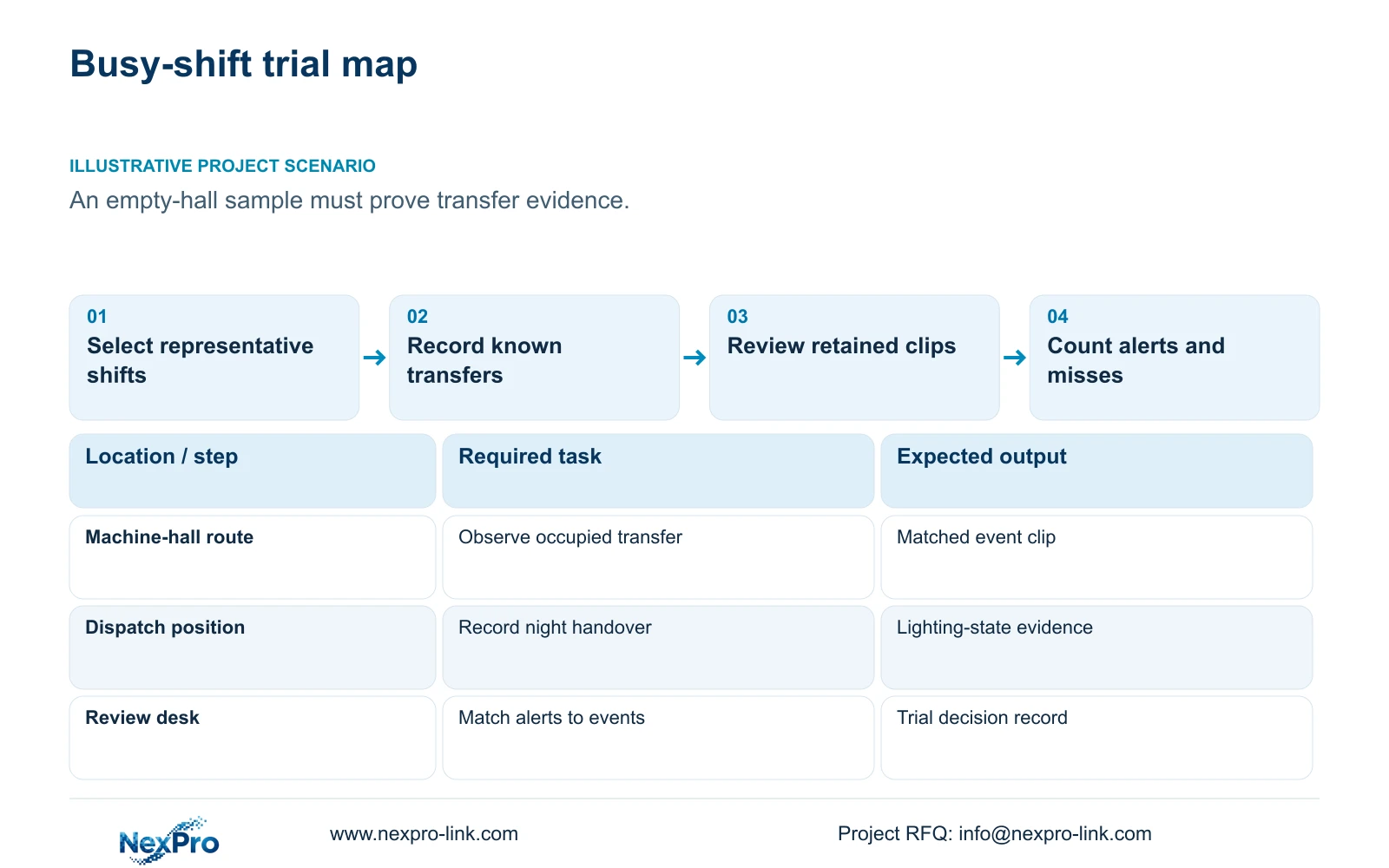
Illustrative project scenario: A sample camera looks good in an empty CNC hall, but the owner needs transfer evidence during actual operations. CASE01 provides a hypothetical 32-view security background, including ten permitted machine-hall transfer views and six dispatch views. Assume the trial focuses on representative transfer and dispatch positions before any volume order is approved.
Ask the production representative which normal conditions challenge those positions: occupied aisles, loaded handling equipment, open loading doors or a shift change. Select permitted activities that reproduce the observation task without staging unsafe movements. Record conditions that could not be tested. The result should identify suitable roles and unresolved scenes, rather than approve every location from one successful sample.
Section 02
Record comparable tasks during day and night operation
Create a trial schedule around operations rather than convenient demonstration hours. Identify the day and night states that matter, who authorises access and who witnesses each transfer. Keep a normal lighting state as the baseline. If additional lighting is proposed, record it as a separate configuration with its own installation scope.
Preserve camera model, firmware, position, lens setting, resolution, frame rate, exposure controls and recording parameters for each run. The supplied BL2812M 5MP specification lists 2880×1620 output, 25fps and a 2.8–12mm motorized lens. These fields describe a candidate's listed configuration; they do not establish useful detail at the selected transfer distance.
Retrieve each trial sequence from the intended recorder and review it using the intended operator route. Compare entry, handover and departure, including any obstruction between them. When a configuration changes, repeat the relevant task under comparable conditions. Otherwise an apparent improvement may come from a brighter scene or slower movement rather than the proposed equipment change.
Section 03
Establish known events before counting alerts
The trial needs an independent event log. Record the time, location and type of each relevant event observed by the authorised witness. Agree how an alert is matched to that event, including the permitted time window and handling of duplicate notifications. Without this reference, missed events remain invisible and alert totals have no useful denominator.
Count true positives as relevant events correctly detected, false negatives as relevant events missed and false positives as alerts without a matching relevant event. Keep duplicate alerts visible as operator workload even if the scoring rule consolidates them. Do not use these counts to score individual workers or represent certified machine protection.
Separate detection from useful evidence. An alert may correctly indicate a vehicle while the load handover is hidden. Conversely, continuous recording may preserve a useful event without generating an alert. Assign the engineer the configuration record, the witness the event log and the owner the decision on whether alerts are required for the operating task.
Section 04
Compare missed events and alert usefulness together
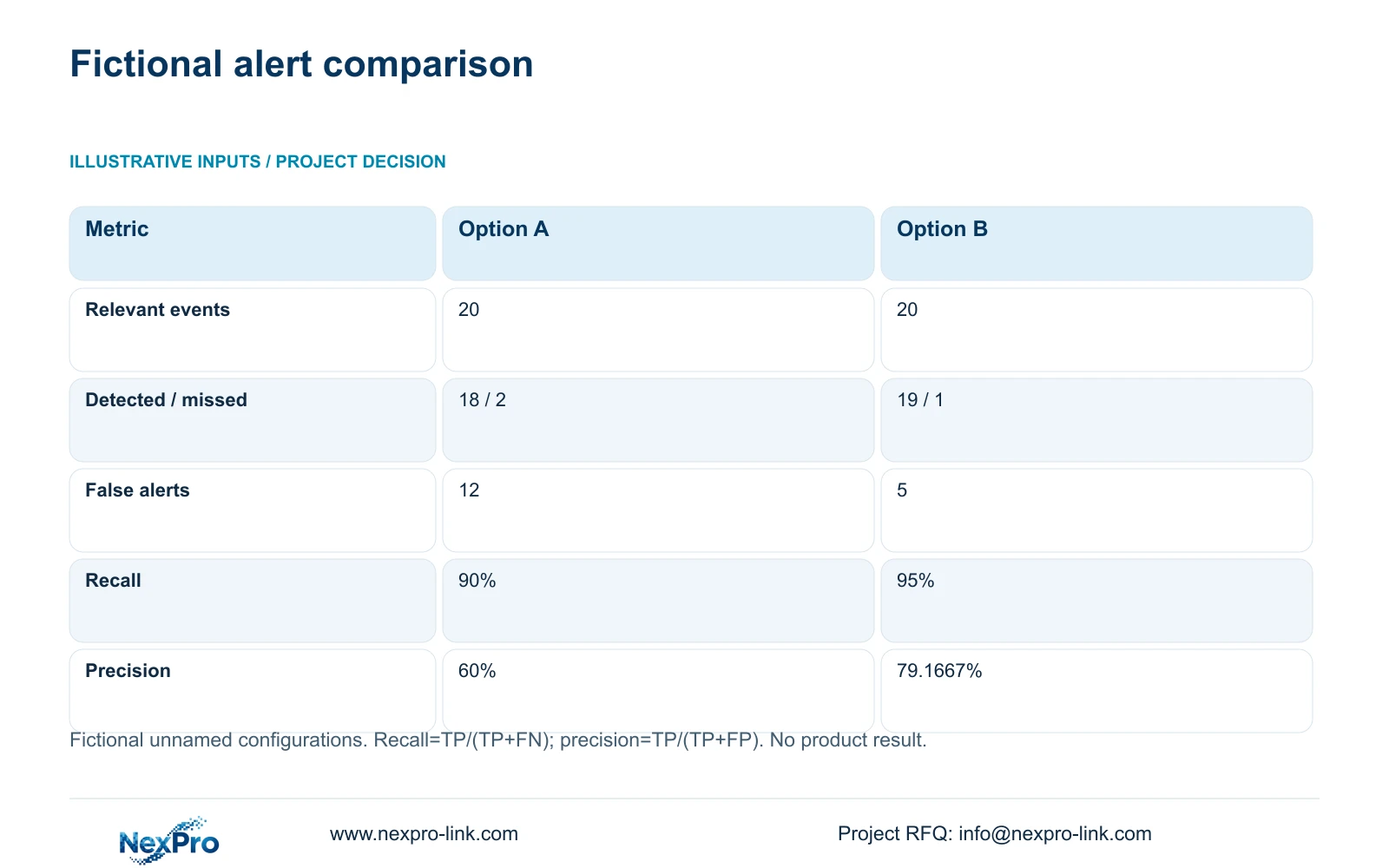
The supplied fictional dataset contains 20 relevant events for each unnamed configuration. Option A detects 18 events and adds 12 false alerts. Option B detects 19 events and adds five false alerts. These are teaching inputs, not NexPro-Link or competitor measurements, and cannot support a product performance claim.
Recall = TP / (TP + FN), so A gives 18 / 20 = 90% and B gives 19 / 20 = 95%. Precision = TP / (TP + FP), so A gives 18 / 30 = 60% and B gives 19 / 24 = 79.1667%, approximately 79.17%. The table keeps both the missed-event count and the false-alert count visible.
B is preferable within this fictional dataset because it misses fewer relevant events while producing fewer false alerts. That conclusion does not establish reliability across every shift. Review which event was missed and whether the owner can tolerate that failure. Repeat difficult conditions before treating a small sample difference as a purchasing basis.
| Metric | Option A | Option B |
|---|---|---|
| Relevant events | 20 | 20 |
| True positives / false negatives | 18 / 2 | 19 / 1 |
| False positives | 12 | 5 |
| Recall | 90% | 95% |
| Precision | 60% | 79.1667% |
Section 05
Approve a role-specific result rather than a universal winner
Recommend the configuration that supplies the required recorded evidence and, where needed, an acceptable alert workflow at the tested position. A sample can qualify a role without qualifying the entire factory. A successful dispatch view does not resolve a store counter with different distances, obstructions and permissions.
If alerts are optional, a clear continuous-recording workflow may remain appropriate while analytics tuning continues. If immediate notification is essential, unresolved misses should block that specific function's approval. Record the decision as approved, conditional or requiring another trial, with the condition written in operational terms. Avoid an arbitrary overall score that hides a critical failure.
Compare supplier samples using the same view width, task, movement and lighting conditions, then list any supporting equipment and local services separately. CASE01 assumes 4Mbps average recording streams; actual trial settings may change that input. Before repeating the accepted configuration across 32 views, revisit the storage and network assumptions instead of copying the sample settings without review.
Section 06
Carry the accepted trial into batch preparation and handover
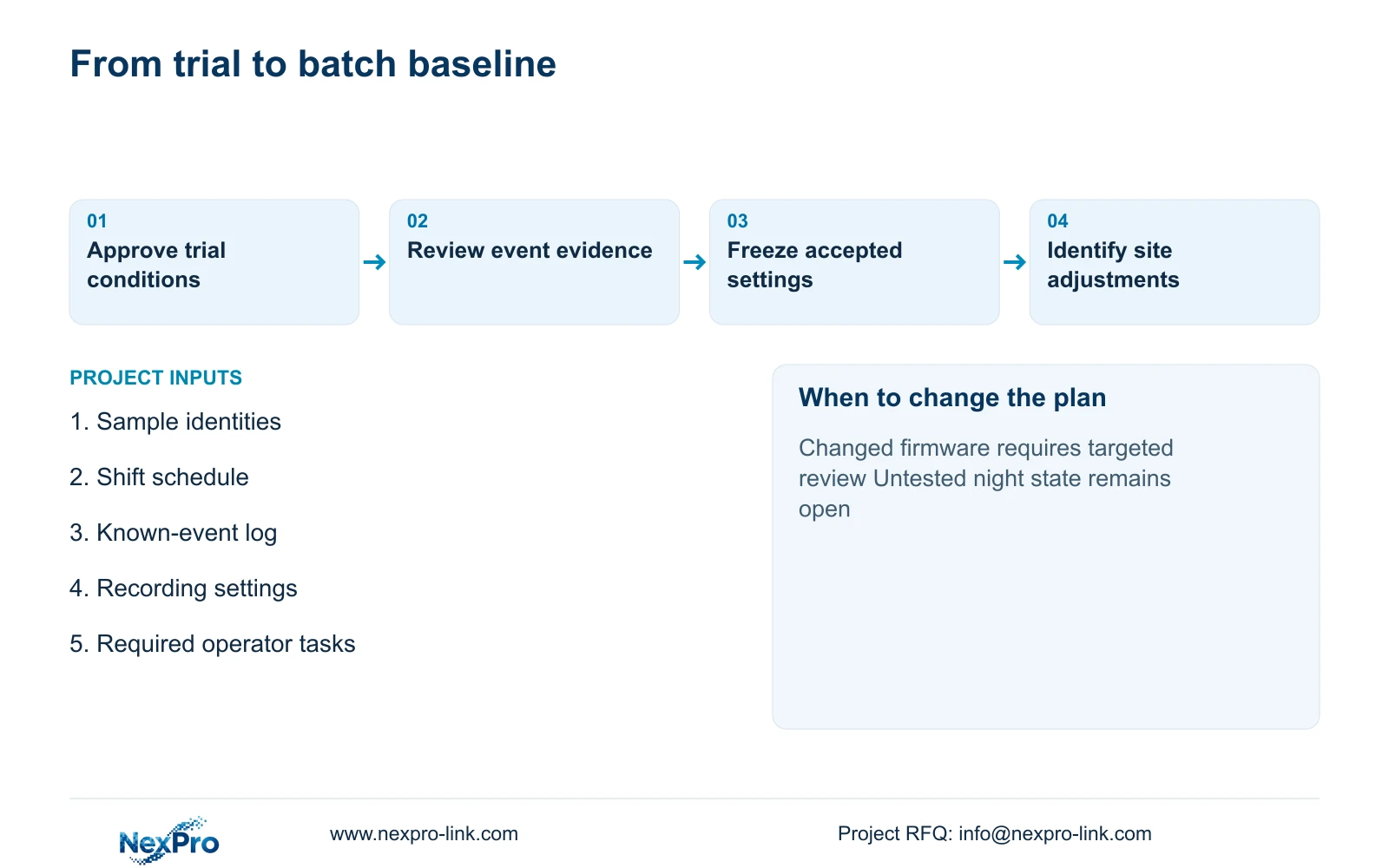
Issue a trial decision record containing the sample identities, accepted settings, representative clips, event counts and unresolved observations. State which settings are suitable as factory baselines and which require local adjustment. Final focus, privacy boundaries and scene-specific alert regions should remain site tasks where installation conditions determine them.
The volume schedule should identify any approved model or firmware differences from the sample. A substitution needs a targeted review of the functions that could change, followed by the appropriate retest. Keep the original trial record so the project team can explain why a later unit or configuration differs.
NexPro-Link's project supply and BOQ support can be used to discuss the equipment schedule, technical deviations and preparation boundary emerging from the trial. Quote sample provision, batch configuration and local commissioning separately where their responsibilities differ. The operator handover should include accepted retrieval tasks and a clear route for reporting missed events or unusable recordings.
Section 07
Buyer questions
How long should the sample trial run? Use enough authorised operating windows to cover the required scene states and repeat difficult tasks. A fixed duration alone does not establish representative coverage; document missing shifts or conditions before approval.
Can sensitivity changes alone solve poor alert results? They may change the balance between misses and false alerts, but placement, obstructions and lighting also need review. Retest against the same event definitions after any adjustment.
Does a good sample qualify a different firmware batch? Do not assume it does. Identify the changed firmware and affected functions, obtain the supplier's explanation and repeat the relevant checks before extending the trial conclusion.
Section 08
Prepare a representative sample trial
Send your proposed sample schedule, authorised busy-shift and night conditions, and required transfer or alert outcomes to info@nexpro-link.com. NexPro-Link can discuss suitable sample roles and the evidence needed before batch preparation.
Engineering references
These sources support the general planning principles. Always use the selected product's current datasheet and applicable project standards for final design.