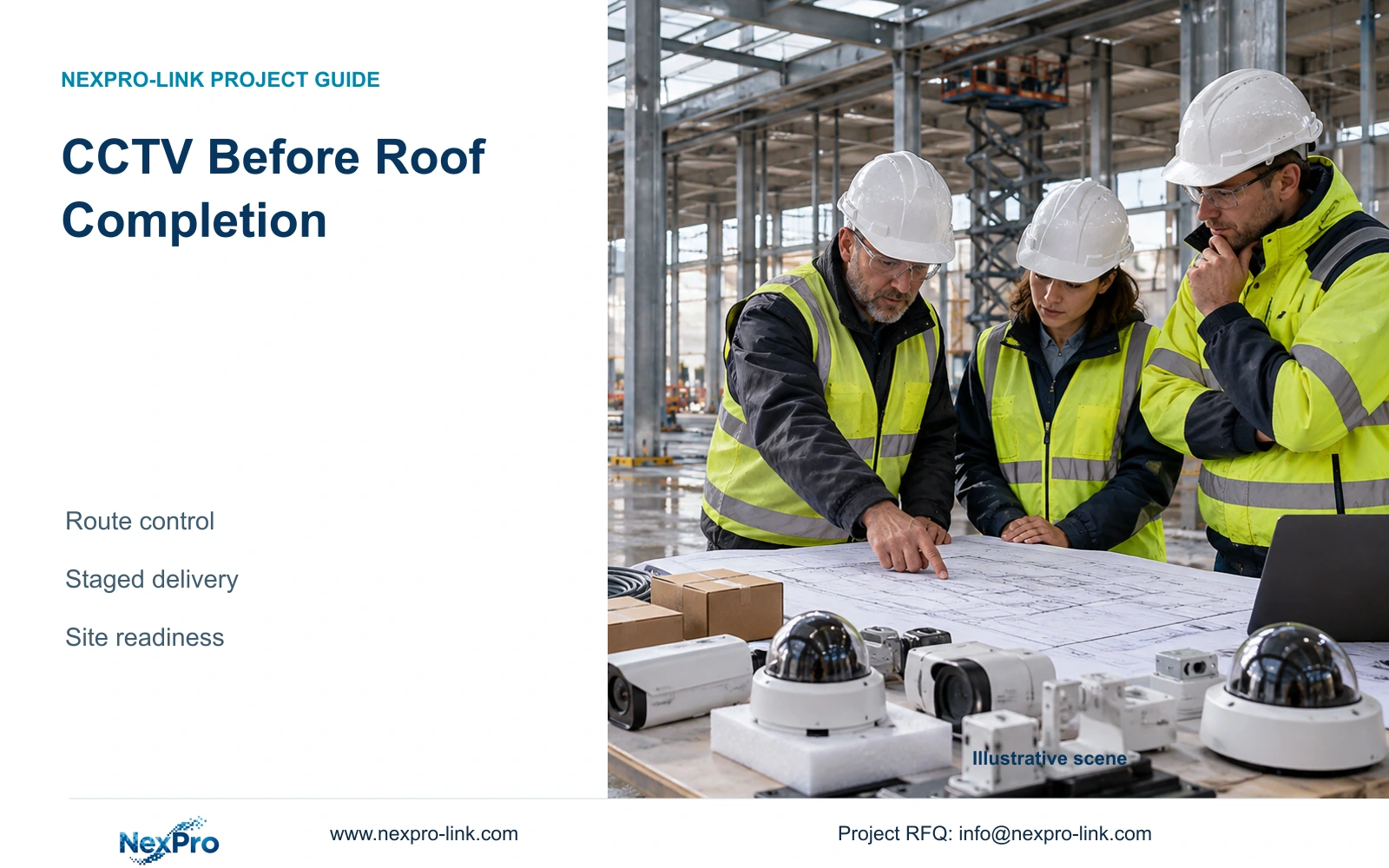
Unfinished roofs and cable trays need not stop every CCTV purchasing decision. Release stable equipment against documented dependencies while holding route-sensitive quantities and installation dates.
Section 01
Freeze the route boundaries before releasing equipment
Procure factory CCTV before roof and cable-tray completion by separating stable equipment requirements from decisions that still depend on construction. Approve recording tasks, cabinet locations and interface responsibilities first. Hold final cable quantities, mounting accessories and view-specific releases wherever unfinished overhead work could change them. Each purchase release should identify the drawing revision and the conditions that would reopen its scope.
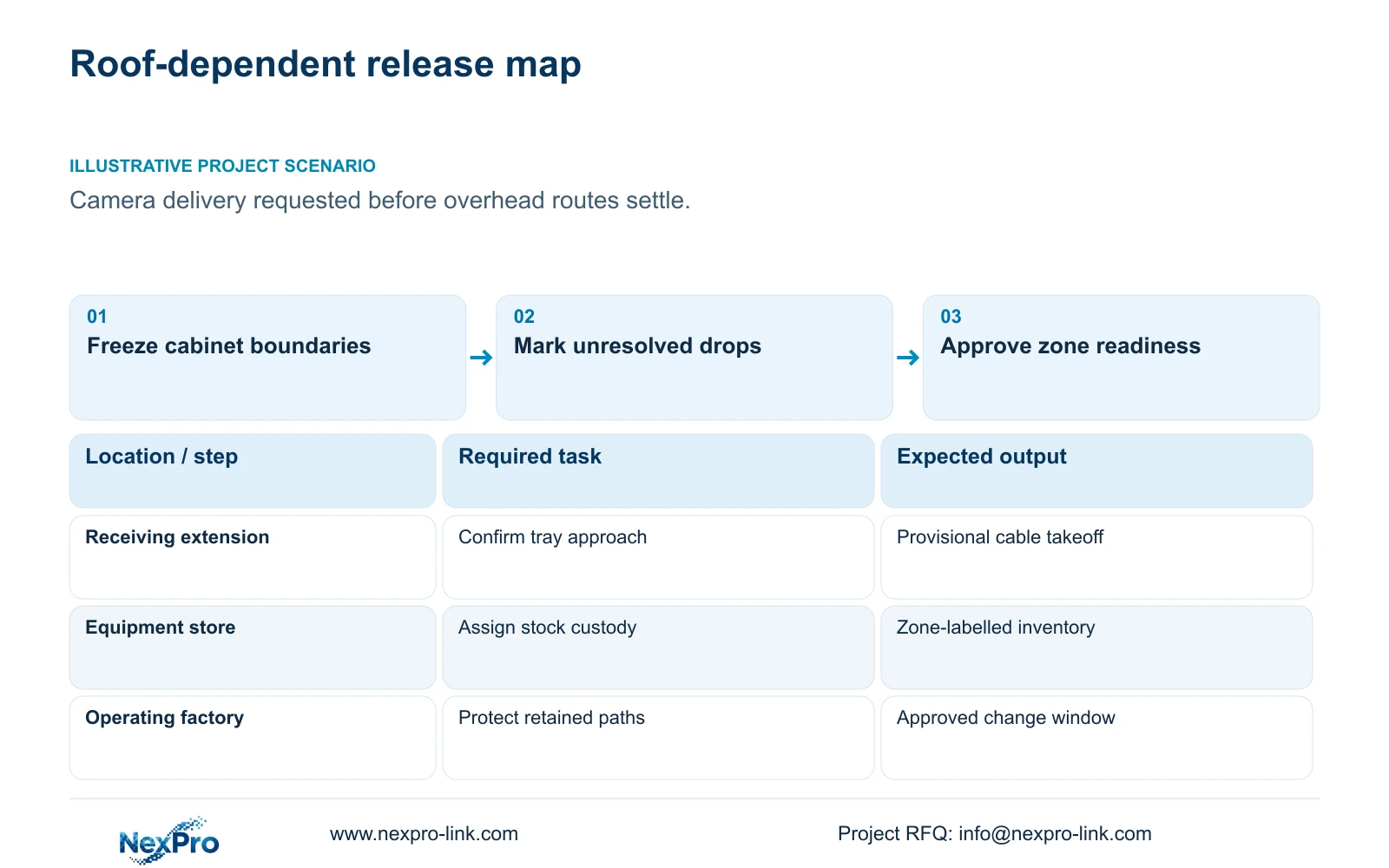
Illustrative project scenario: A contractor wants camera delivery while overhead installation conditions are still changing. Assume an operating factory is adding receiving, dispatch and common-route coverage while the new roof section remains unfinished. CASE09 provides a planning baseline of 20 retained cameras and 12 additions. Those quantities describe a hypothetical retrofit, not a surveyed installation or completed customer project.
Mark approved cabinet zones, proposed tray corridors, vertical drops and unresolved crossings on one route drawing. Record who can approve changes to each boundary. A cabinet position may be stable enough for equipment selection even when its final cable approach remains provisional. Conversely, a roof-mounted camera cannot be released solely because its observation task is agreed if the mounting surface or maintenance access is still uncertain.
Section 02
Give delivery and installation separate release conditions
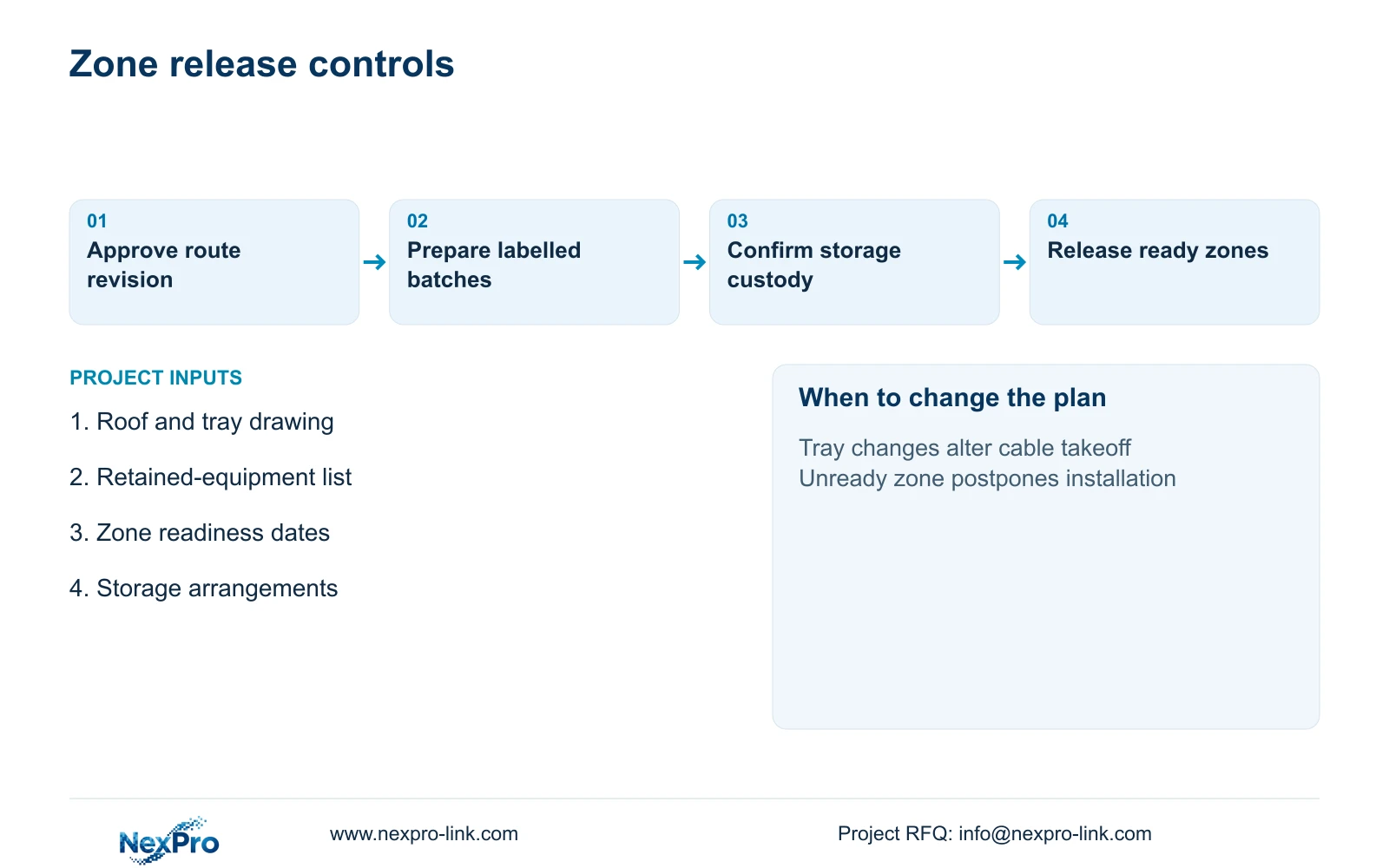
Use two approvals for each zone: an equipment delivery release and an installation readiness release. Delivery requires an accepted equipment schedule, receiving arrangements and suitable storage. Installation additionally requires the local contractor to confirm access, completed supports, an acceptable environment and the relevant electrical and network interfaces. A carton arriving on schedule satisfies neither the camera view nor the recording acceptance task.
For retained operating areas, identify the existing recorder, switch and power path before introducing new equipment. The project manager should record permitted change windows and the dates when old and new zones must remain available. If a proposed tray crossing requires work near an active production route, treat that access dependency separately from supplier preparation.
Compare an all-at-once delivery with zone-labelled releases. A single shipment can simplify receiving but may leave view-specific devices stored while construction changes. Staged delivery can reduce premature handling, although it introduces additional packing and transport coordination. Choose between them using actual site readiness and quoted logistics, rather than assuming either arrangement is inherently cheaper.
Section 03
Assign custody before accepting early deliveries
Early delivery needs a named custodian and a storage location suitable for the exact equipment. The receiving team should check model identities, quantities, carton condition and serial records against the release list. Separate unopened stock from units used for bench preparation, and keep accessories with their assigned zone package. This avoids discovering missing brackets or power leads only after overhead access has been booked.
The local contractor should maintain a release register showing whether each item is stored, prepared, installed or accepted. Batteries require their own manufacturer-specific storage and maintenance instructions; no universal charging interval follows from the CCTV procurement schedule. Record any movement between stores and installation areas so custody remains clear during construction.
In CASE09, retaining 20 existing links would leave 12 new links totalling 742 m, with a feasible three-reel cutting plan using 305 m reels. That procurement basis applies only after the old links are tested and approved for retention. If they fail or routes change, the full 32-link baseline is 1,872 m and seven reels. Neither figure substitutes for the unfinished-tray takeoff.
Section 04
Overlap preparation only where approval dependencies allow it
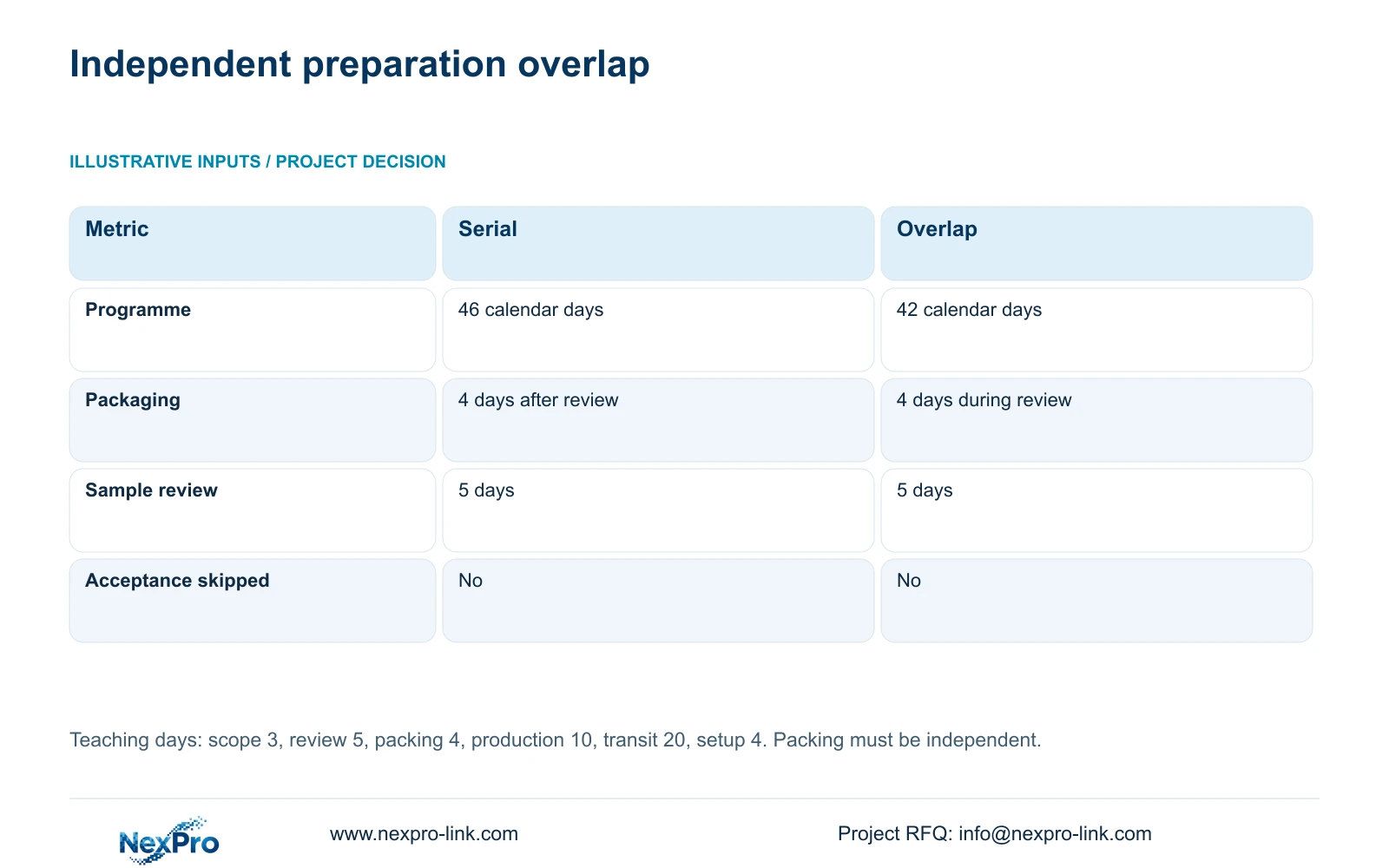
Consider an illustrative calendar-day programme: technical scope takes 3 days, sample review 5 days, packaging preparation 4 days, production 10 days, transit 20 days and site setup 4 days. Serial preparation gives 3 + 5 + 4 + 10 + 20 + 4 = 46 days. If packaging preparation is genuinely independent after technical scope is defined, the path becomes 3 + max(5, 4) + 10 + 20 + 4 = 42 days.
The decisive difference is the four-day packaging activity running alongside sample review. Technical acceptance remains in both options, and production still follows it. Generic carton planning or an approved project-label layout might qualify for overlap. Final inserts, model-specific labels or artwork dependent on the sample decision would remain on the approval path.
These figures are teaching inputs, not NexPro-Link lead times. Replace them with confirmed approval durations, working calendars and transport arrangements. The four-day site setup assumption also starts only when the relevant zone is ready. A roof delay can therefore postpone installation even when supplier preparation follows the shorter path.
| Decision | Serial preparation | Independent overlap |
|---|---|---|
| Total programme | 46 calendar days | 42 calendar days |
| Packaging preparation | 4 days after review | 4 days alongside review |
| Sample acceptance | Required before production | Required before production |
| Site setup | 4 days after readiness | 4 days after readiness |
Section 05
Release stable capacity and hold view-sensitive details
Prefer dependency-controlled releases when cabinet functions and recording objectives are stable but overhead routes remain open. Reserve the infrastructure needed for the accepted operating task, then release camera positions and cable quantities by ready zone. The owner retains the required coverage outcome; the engineer retains control of unresolved interfaces; the cost manager can distinguish approved equipment from provisional site quantities.
CASE09 assumes 32 streams at 4 Mbps, giving 128 Mbps of recording payload and 41.472 TB of video over 30 days. Its NexPro-NVR4449-4K reference has a published 320 Mbps input and four SATA bays supporting up to 18 TB per drive. Its summary distinguishes 49×5MP from 9×4K. This supports a capacity discussion, subject to actual streams and firmware, without establishing RAID or simultaneous decoding performance.
Where an ordinary-area camera is appropriate, NexPro-BL2812M55-5MP-DIC-AI offers a listed 2880×1620 output and a 2.8–12mm motorized lens. Lens adjustment cannot compensate for an unsuitable final mounting position. Hold that release if structural access, required scene detail or environmental conditions remain unresolved. Retain mandatory platform or specialist requirements rather than substituting ordinary equipment to preserve the schedule.
Section 06
Make each supply release traceable to a ready zone
Build the procurement schedule around zone packages with explicit supplied, retained and installer-provided items. For the illustrative receiving addition, new cameras and their approved accessories belong to the supplier release; retained links require contractor test evidence; completed supports and local electrical work remain installation dependencies. Each interface should have one responsible party and an agreed acceptance output.
NexPro-Link's factory project and BOQ support scope can help translate these decisions into model matching, technical documents and coordinated equipment lists. Project packing should identify zone, model and release revision so postponed equipment does not become mixed with the first installation batch. Overseas supply arrangements should state shipment boundaries and destination handling separately from local construction.
Before releasing a changed batch, reconcile the route drawing, equipment list and installation dates. If a tray moves, check affected link lengths and camera drops before altering only the cable order. If the ready-zone date slips, decide whether stock stays with the supplier or enters approved site storage. Record the commercial consequences through the quotation or order variation.
Section 07
Buyer questions
Can final camera focusing wait until roof work is complete? Yes, if the equipment choice and mounting arrangement are already justified. Keep final alignment and recorded-image acceptance as site tasks after lighting, obstructions and mounting positions are stable.
Should all cable be ordered with the first equipment shipment? Only quantities supported by an approved routed takeoff should be treated as final. Separate confirmed runs from provisional routes and any explicitly approved spare reels.
What should a quotation say about construction delays? Request clear shipment releases, storage responsibility and the treatment of postponed batches. Installation dates and warranty terms should be documented separately; an equipment delivery promise does not establish zone readiness.
Section 08
Define your first equipment release
Send your current roof and tray drawing, retained-equipment list, zone readiness dates and available storage arrangements to info@nexpro-link.com to discuss a dependency-controlled CCTV supply release.
Engineering references
These sources support the general planning principles. Always use the selected product's current datasheet and applicable project standards for final design.